 Add to Chrome
 Add to Firefox
 Add to Edge
Steering LLMs for Culturally Localized Generation
Mar 24, 2026
LLMs are deployed globally, yet produce responses biased towards cultures with abundant training data. Existing cultural localization approaches such as prompting or post-training alignment are black-box, hard to control, and do not reveal whether failures reflect missing knowledge or poor elicitation. In this paper, we address these gaps using mechanistic interpretability to uncover and manipulate cultural representations in LLMs. Leveraging sparse autoencoders, we identify interpretable features that encode culturally salient information and aggregate them into Cultural Embeddings (CuE). We use CuE both to analyze implicit cultural biases under underspecified prompts and to construct white-box steering interventions. Across multiple models, we show that CuE-based steering increases cultural faithfulness and elicits significantly rarer, long-tail cultural concepts than prompting alone. Notably, CuE-based steering is complementary to black-box localization methods, offering gains when applied on top of prompt-augmented inputs. This also suggests that models do benefit from better elicitation strategies, and don't necessarily lack long-tail knowledge representation, though this varies across cultures. Our results provide both diagnostic insight into cultural representations in LLMs and a controllable method to steer towards desired cultures.

MUSIC: MUlti-Step Instruction Contrast for Multi-Turn Reward Models
Dec 31, 2025Evaluating the quality of multi-turn conversations is crucial for developing capable Large Language Models (LLMs), yet remains a significant challenge, often requiring costly human evaluation. Multi-turn reward models (RMs) offer a scalable alternative and can provide valuable signals for guiding LLM training. While recent work has advanced multi-turn \textit{training} techniques, effective automated \textit{evaluation} specifically for multi-turn interactions lags behind. We observe that standard preference datasets, typically contrasting responses based only on the final conversational turn, provide insufficient signal to capture the nuances of multi-turn interactions. Instead, we find that incorporating contrasts spanning \textit{multiple} turns is critical for building robust multi-turn RMs. Motivated by this finding, we propose \textbf{MU}lti-\textbf{S}tep \textbf{I}nstruction \textbf{C}ontrast (MUSIC), an unsupervised data augmentation strategy that synthesizes contrastive conversation pairs exhibiting differences across multiple turns. Leveraging MUSIC on the Skywork preference dataset, we train a multi-turn RM based on the Gemma-2-9B-Instruct model. Empirical results demonstrate that our MUSIC-augmented RM outperforms baseline methods, achieving higher alignment with judgments from advanced proprietary LLM judges on multi-turn conversations, crucially, without compromising performance on standard single-turn RM benchmarks.
Fantastic Reasoning Behaviors and Where to Find Them: Unsupervised Discovery of the Reasoning Process
Dec 30, 2025Despite the growing reasoning capabilities of recent large language models (LLMs), their internal mechanisms during the reasoning process remain underexplored. Prior approaches often rely on human-defined concepts (e.g., overthinking, reflection) at the word level to analyze reasoning in a supervised manner. However, such methods are limited, as it is infeasible to capture the full spectrum of potential reasoning behaviors, many of which are difficult to define in token space. In this work, we propose an unsupervised framework (namely, RISE: Reasoning behavior Interpretability via Sparse auto-Encoder) for discovering reasoning vectors, which we define as directions in the activation space that encode distinct reasoning behaviors. By segmenting chain-of-thought traces into sentence-level 'steps' and training sparse auto-encoders (SAEs) on step-level activations, we uncover disentangled features corresponding to interpretable behaviors such as reflection and backtracking. Visualization and clustering analyses show that these behaviors occupy separable regions in the decoder column space. Moreover, targeted interventions on SAE-derived vectors can controllably amplify or suppress specific reasoning behaviors, altering inference trajectories without retraining. Beyond behavior-specific disentanglement, SAEs capture structural properties such as response length, revealing clusters of long versus short reasoning traces. More interestingly, SAEs enable the discovery of novel behaviors beyond human supervision. We demonstrate the ability to control response confidence by identifying confidence-related vectors in the SAE decoder space. These findings underscore the potential of unsupervised latent discovery for both interpreting and controllably steering reasoning in LLMs.
Eliciting Behaviors in Multi-Turn Conversations
Dec 29, 2025Identifying specific and often complex behaviors from large language models (LLMs) in conversational settings is crucial for their evaluation. Recent work proposes novel techniques to find natural language prompts that induce specific behaviors from a target model, yet they are mainly studied in single-turn settings. In this work, we study behavior elicitation in the context of multi-turn conversations. We first offer an analytical framework that categorizes existing methods into three families based on their interactions with the target model: those that use only prior knowledge, those that use offline interactions, and those that learn from online interactions. We then introduce a generalized multi-turn formulation of the online method, unifying single-turn and multi-turn elicitation. We evaluate all three families of methods on automatically generating multi-turn test cases. We investigate the efficiency of these approaches by analyzing the trade-off between the query budget, i.e., the number of interactions with the target model, and the success rate, i.e., the discovery rate of behavior-eliciting inputs. We find that online methods can achieve an average success rate of 45/19/77% with just a few thousand queries over three tasks where static methods from existing multi-turn conversation benchmarks find few or even no failure cases. Our work highlights a novel application of behavior elicitation methods in multi-turn conversation evaluation and the need for the community to move towards dynamic benchmarks.
Principled Foundations for Preference Optimization
Jul 10, 2025In this paper, we show that direct preference optimization (DPO) is a very specific form of a connection between two major theories in the ML context of learning from preferences: loss functions (Savage) and stochastic choice (Doignon-Falmagne and Machina). The connection is established for all of Savage's losses and at this level of generality, (i) it includes support for abstention on the choice theory side, (ii) it includes support for non-convex objectives on the ML side, and (iii) it allows to frame for free some notable extensions of the DPO setting, including margins and corrections for length. Getting to understand how DPO operates from a general principled perspective is crucial because of the huge and diverse application landscape of models, because of the current momentum around DPO, but also -- and importantly -- because many state of the art variations on DPO definitely occupy a small region of the map that we cover. It also helps to understand the pitfalls of departing from this map, and figure out workarounds.
SALVe: Semantic Alignment Verification for Floorplan Reconstruction from Sparse Panoramas
Jun 27, 2024We propose a new system for automatic 2D floorplan reconstruction that is enabled by SALVe, our novel pairwise learned alignment verifier. The inputs to our system are sparsely located 360$^\circ$ panoramas, whose semantic features (windows, doors, and openings) are inferred and used to hypothesize pairwise room adjacency or overlap. SALVe initializes a pose graph, which is subsequently optimized using GTSAM. Once the room poses are computed, room layouts are inferred using HorizonNet, and the floorplan is constructed by stitching the most confident layout boundaries. We validate our system qualitatively and quantitatively as well as through ablation studies, showing that it outperforms state-of-the-art SfM systems in completeness by over 200%, without sacrificing accuracy. Our results point to the significance of our work: poses of 81% of panoramas are localized in the first 2 connected components (CCs), and 89% in the first 3 CCs. Code and models are publicly available at https://github.com/zillow/salve.
Distributed Global Structure-from-Motion with a Deep Front-End
Nov 30, 2023While initial approaches to Structure-from-Motion (SfM) revolved around both global and incremental methods, most recent applications rely on incremental systems to estimate camera poses due to their superior robustness. Though there has been tremendous progress in SfM `front-ends' powered by deep models learned from data, the state-of-the-art (incremental) SfM pipelines still rely on classical SIFT features, developed in 2004. In this work, we investigate whether leveraging the developments in feature extraction and matching helps global SfM perform on par with the SOTA incremental SfM approach (COLMAP). To do so, we design a modular SfM framework that allows us to easily combine developments in different stages of the SfM pipeline. Our experiments show that while developments in deep-learning based two-view correspondence estimation do translate to improvements in point density for scenes reconstructed with global SfM, none of them outperform SIFT when comparing with incremental SfM results on a range of datasets. Our SfM system is designed from the ground up to leverage distributed computation, enabling us to parallelize computation on multiple machines and scale to large scenes.
The Waymo Open Sim Agents Challenge
May 19, 2023In this work, we define the Waymo Open Sim Agents Challenge (WOSAC). Simulation with realistic, interactive agents represents a key task for autonomous vehicle software development. WOSAC is the first public challenge to tackle this task and propose corresponding metrics. The goal of the challenge is to stimulate the design of realistic simulators that can be used to evaluate and train a behavior model for autonomous driving. We outline our evaluation methodology and present preliminary results for a number of different baseline simulation agent methods.
Argoverse 2: Next Generation Datasets for Self-Driving Perception and Forecasting
Jan 02, 2023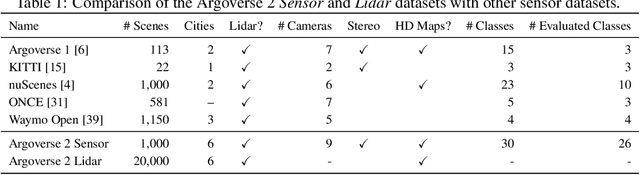
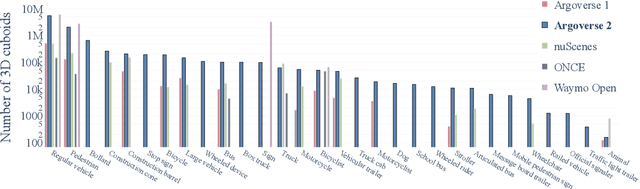
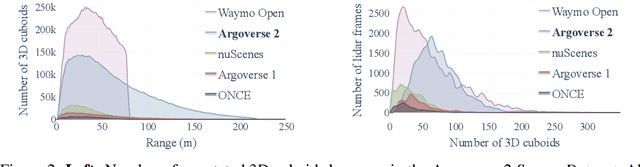

We introduce Argoverse 2 (AV2) - a collection of three datasets for perception and forecasting research in the self-driving domain. The annotated Sensor Dataset contains 1,000 sequences of multimodal data, encompassing high-resolution imagery from seven ring cameras, and two stereo cameras in addition to lidar point clouds, and 6-DOF map-aligned pose. Sequences contain 3D cuboid annotations for 26 object categories, all of which are sufficiently-sampled to support training and evaluation of 3D perception models. The Lidar Dataset contains 20,000 sequences of unlabeled lidar point clouds and map-aligned pose. This dataset is the largest ever collection of lidar sensor data and supports self-supervised learning and the emerging task of point cloud forecasting. Finally, the Motion Forecasting Dataset contains 250,000 scenarios mined for interesting and challenging interactions between the autonomous vehicle and other actors in each local scene. Models are tasked with the prediction of future motion for "scored actors" in each scenario and are provided with track histories that capture object location, heading, velocity, and category. In all three datasets, each scenario contains its own HD Map with 3D lane and crosswalk geometry - sourced from data captured in six distinct cities. We believe these datasets will support new and existing machine learning research problems in ways that existing datasets do not. All datasets are released under the CC BY-NC-SA 4.0 license.
Trust, but Verify: Cross-Modality Fusion for HD Map Change Detection
Dec 14, 2022High-definition (HD) map change detection is the task of determining when sensor data and map data are no longer in agreement with one another due to real-world changes. We collect the first dataset for the task, which we entitle the Trust, but Verify (TbV) dataset, by mining thousands of hours of data from over 9 months of autonomous vehicle fleet operations. We present learning-based formulations for solving the problem in the bird's eye view and ego-view. Because real map changes are infrequent and vector maps are easy to synthetically manipulate, we lean on simulated data to train our model. Perhaps surprisingly, we show that such models can generalize to real world distributions. The dataset, consisting of maps and logs collected in six North American cities, is one of the largest AV datasets to date with more than 7.8 million images. We make the data available to the public at https://www.argoverse.org/av2.html#mapchange-link, along with code and models at https://github.com/johnwlambert/tbv under the the CC BY-NC-SA 4.0 license.