 Add to Chrome
 Add to Firefox
 Add to Edge
Image To Image Translation
Image-to-image translation is the process of converting an image from one domain to another using deep learning techniques.
Papers and Code
UniCorn: Towards Self-Improving Unified Multimodal Models through Self-Generated Supervision
Jan 08, 2026
While Unified Multimodal Models (UMMs) have achieved remarkable success in cross-modal comprehension, a significant gap persists in their ability to leverage such internal knowledge for high-quality generation. We formalize this discrepancy as Conduction Aphasia, a phenomenon where models accurately interpret multimodal inputs but struggle to translate that understanding into faithful and controllable synthesis. To address this, we propose UniCorn, a simple yet elegant self-improvement framework that eliminates the need for external data or teacher supervision. By partitioning a single UMM into three collaborative roles: Proposer, Solver, and Judge, UniCorn generates high-quality interactions via self-play and employs cognitive pattern reconstruction to distill latent understanding into explicit generative signals. To validate the restoration of multimodal coherence, we introduce UniCycle, a cycle-consistency benchmark based on a Text to Image to Text reconstruction loop. Extensive experiments demonstrate that UniCorn achieves comprehensive and substantial improvements over the base model across six general image generation benchmarks. Notably, it achieves SOTA performance on TIIF(73.8), DPG(86.8), CompBench(88.5), and UniCycle while further delivering substantial gains of +5.0 on WISE and +6.5 on OneIG. These results highlight that our method significantly enhances T2I generation while maintaining robust comprehension, demonstrating the scalability of fully self-supervised refinement for unified multimodal intelligence.

Aligning Findings with Diagnosis: A Self-Consistent Reinforcement Learning Framework for Trustworthy Radiology Reporting
Jan 06, 2026Multimodal Large Language Models (MLLMs) have shown strong potential for radiology report generation, yet their clinical translation is hindered by architectural heterogeneity and the prevalence of factual hallucinations. Standard supervised fine-tuning often fails to strictly align linguistic outputs with visual evidence, while existing reinforcement learning approaches struggle with either prohibitive computational costs or limited exploration. To address these challenges, we propose a comprehensive framework for self-consistent radiology report generation. First, we conduct a systematic evaluation to identify optimal vision encoder and LLM backbone configurations for medical imaging. Building on this foundation, we introduce a novel "Reason-then-Summarize" architecture optimized via Group Relative Policy Optimization (GRPO). This framework restructures generation into two distinct components: a think block for detailed findings and an answer block for structured disease labels. By utilizing a multi-dimensional composite reward function, we explicitly penalize logical discrepancies between the generated narrative and the final diagnosis. Extensive experiments on the MIMIC-CXR benchmark demonstrate that our method achieves state-of-the-art performance in clinical efficacy metrics and significantly reduces hallucinations compared to strong supervised baselines.
Dream2Flow: Bridging Video Generation and Open-World Manipulation with 3D Object Flow
Dec 31, 2025Generative video modeling has emerged as a compelling tool to zero-shot reason about plausible physical interactions for open-world manipulation. Yet, it remains a challenge to translate such human-led motions into the low-level actions demanded by robotic systems. We observe that given an initial image and task instruction, these models excel at synthesizing sensible object motions. Thus, we introduce Dream2Flow, a framework that bridges video generation and robotic control through 3D object flow as an intermediate representation. Our method reconstructs 3D object motions from generated videos and formulates manipulation as object trajectory tracking. By separating the state changes from the actuators that realize those changes, Dream2Flow overcomes the embodiment gap and enables zero-shot guidance from pre-trained video models to manipulate objects of diverse categories-including rigid, articulated, deformable, and granular. Through trajectory optimization or reinforcement learning, Dream2Flow converts reconstructed 3D object flow into executable low-level commands without task-specific demonstrations. Simulation and real-world experiments highlight 3D object flow as a general and scalable interface for adapting video generation models to open-world robotic manipulation. Videos and visualizations are available at https://dream2flow.github.io/.
The Color-Clinical Decoupling: Why Perceptual Calibration Fails Clinical Biomarkers in Smartphone Dermatology
Dec 26, 2025Smartphone-based tele-dermatology assumes that colorimetric calibration ensures clinical reliability, yet this remains untested for underrepresented skin phototypes. We investigated whether standard calibration translates to reliable clinical biomarkers using 43,425 images from 965 Korean subjects (Fitzpatrick III-IV) across DSLR, tablet, and smartphone devices. While Linear Color Correction Matrix (CCM) normalization reduced color error by 67-77% -- achieving near-clinical accuracy (Delta E < 2.3) -- this success did not translate to biomarker reliability. We identify a phenomenon termed "color-clinical decoupling": despite perceptual accuracy, the Individual Typology Angle (ITA) showed poor inter-device agreement (ICC = 0.40), while the Melanin Index achieved good agreement (ICC = 0.77). This decoupling is driven by the ITA formula's sensitivity to b* channel noise and is further compounded by anatomical variance. Facial region accounts for 25.2% of color variance -- 3.6x greater than device effects (7.0%) -- challenging the efficacy of single-patch calibration. Our results demonstrate that current colorimetric standards are insufficient for clinical-grade biomarker extraction, necessitating region-aware protocols for mobile dermatology.
Seeing Justice Clearly: Handwritten Legal Document Translation with OCR and Vision-Language Models
Dec 19, 2025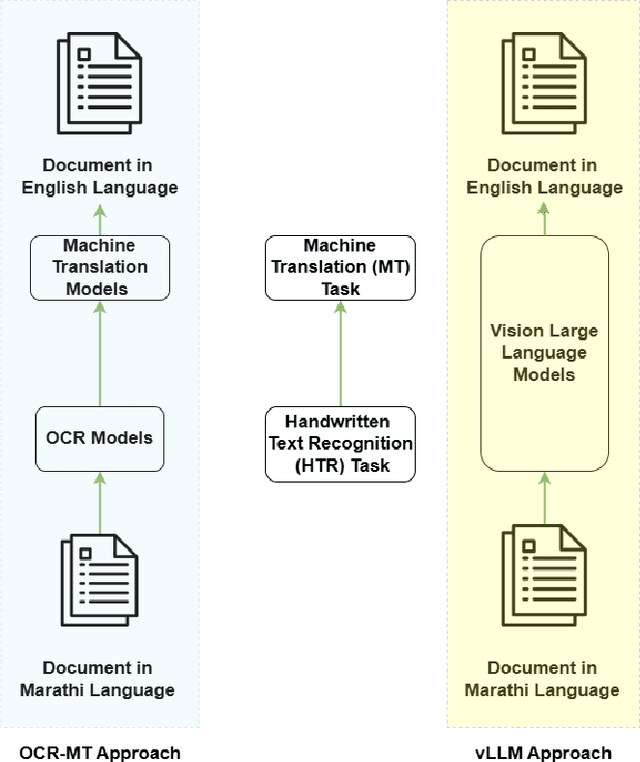
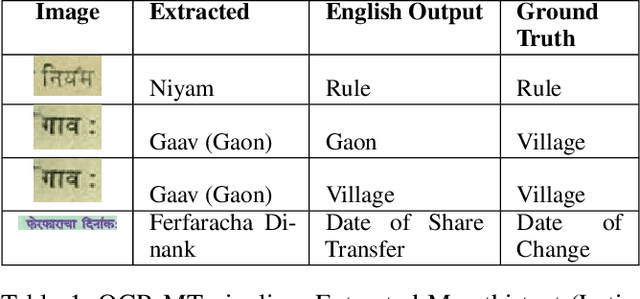
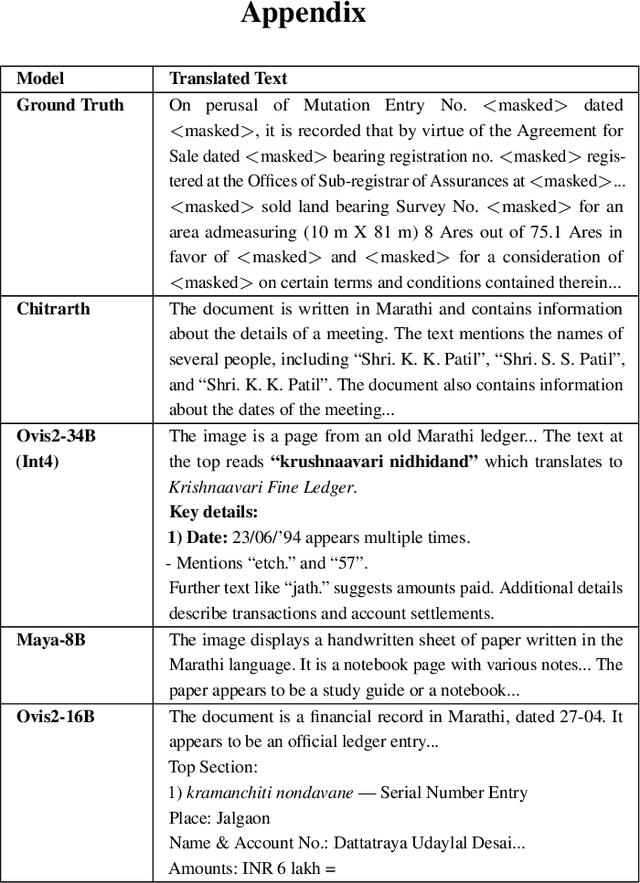
Handwritten text recognition (HTR) and machine translation continue to pose significant challenges, particularly for low-resource languages like Marathi, which lack large digitized corpora and exhibit high variability in handwriting styles. The conventional approach to address this involves a two-stage pipeline: an OCR system extracts text from handwritten images, which is then translated into the target language using a machine translation model. In this work, we explore and compare the performance of traditional OCR-MT pipelines with Vision Large Language Models that aim to unify these stages and directly translate handwritten text images in a single, end-to-end step. Our motivation is grounded in the urgent need for scalable, accurate translation systems to digitize legal records such as FIRs, charge sheets, and witness statements in India's district and high courts. We evaluate both approaches on a curated dataset of handwritten Marathi legal documents, with the goal of enabling efficient legal document processing, even in low-resource environments. Our findings offer actionable insights toward building robust, edge-deployable solutions that enhance access to legal information for non-native speakers and legal professionals alike.
LVLM-Aided Alignment of Task-Specific Vision Models
Dec 26, 2025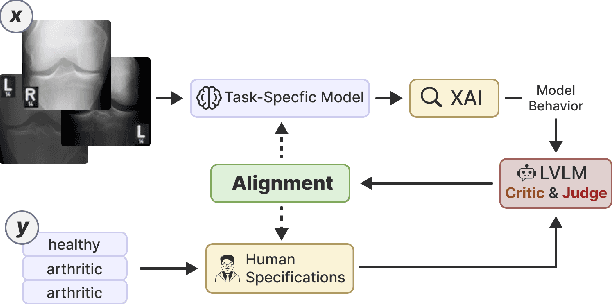
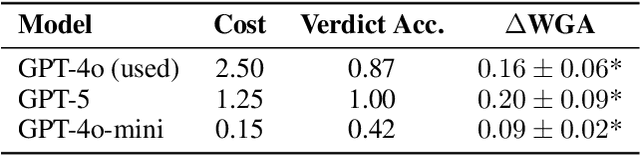
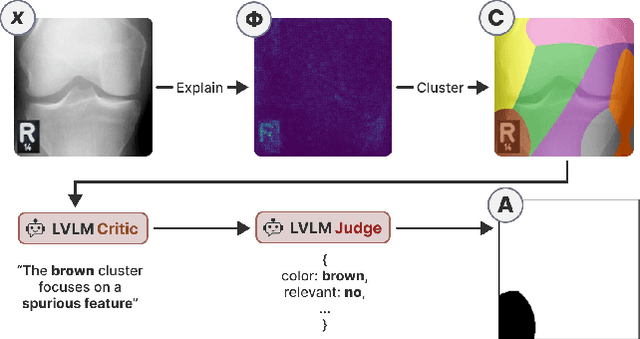
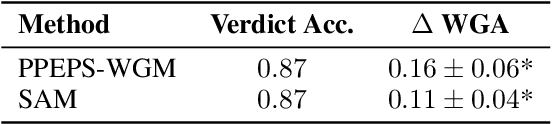
In high-stakes domains, small task-specific vision models are crucial due to their low computational requirements and the availability of numerous methods to explain their results. However, these explanations often reveal that the models do not align well with human domain knowledge, relying instead on spurious correlations. This might result in brittle behavior once deployed in the real-world. To address this issue, we introduce a novel and efficient method for aligning small task-specific vision models with human domain knowledge by leveraging the generalization capabilities of a Large Vision Language Model (LVLM). Our LVLM-Aided Visual Alignment (LVLM-VA) method provides a bidirectional interface that translates model behavior into natural language and maps human class-level specifications to image-level critiques, enabling effective interaction between domain experts and the model. Our method demonstrates substantial improvement in aligning model behavior with human specifications, as validated on both synthetic and real-world datasets. We show that it effectively reduces the model's dependence on spurious features and on group-specific biases, without requiring fine-grained feedback.
Two-Step Data Augmentation for Masked Face Detection and Recognition: Turning Fake Masks to Real
Dec 13, 2025Data scarcity and distribution shift pose major challenges for masked face detection and recognition. We propose a two-step generative data augmentation framework that combines rule-based mask warping with unpaired image-to-image translation using GANs, enabling the generation of realistic masked-face samples beyond purely synthetic transformations. Compared to rule-based warping alone, the proposed approach yields consistent qualitative improvements and complements existing GAN-based masked face generation methods such as IAMGAN. We introduce a non-mask preservation loss and stochastic noise injection to stabilize training and enhance sample diversity. Experimental observations highlight the effectiveness of the proposed components and suggest directions for future improvements in data-centric augmentation for face recognition tasks.
* 9 pages, 9 figures. Conference version
The OCR-PT-CT Project: Semi-Automatic Recognition of Ancient Egyptian Hieroglyphs Based on Metric Learning
Dec 30, 2025Digital humanities are significantly transforming how Egyptologists study ancient Egyptian texts. The OCR-PT-CT project proposes a recognition method for hieroglyphs based on images of Coffin Texts (CT) from Adriaan de Buck (1935-1961) and Pyramid Texts (PT) from Middle Kingdom coffins (James Allen, 2006). The system identifies hieroglyphs and transcribes them into Gardiner's codes. A web tool organizes them by spells and witnesses, storing the data in CSV format for integration with the MORTEXVAR dataset, which collects Coffin Texts with metadata, transliterations, and translations for research. Recognition has been addressed in two ways: a Mobilenet neural network trained on 140 hieroglyph classes achieved 93.87 \% accuracy but struggled with underrepresented classes. A novel Deep Metric Learning approach improves flexibility for new or data-limited signs, achieving 97.70 \% accuracy and recognizing more hieroglyphs. Due to its superior performance under class imbalance and adaptability, the final system adopts Deep Metric Learning as the default classifier.
Rotterdam artery-vein segmentation (RAV) dataset
Dec 19, 2025Purpose: To provide a diverse, high-quality dataset of color fundus images (CFIs) with detailed artery-vein (A/V) segmentation annotations, supporting the development and evaluation of machine learning algorithms for vascular analysis in ophthalmology. Methods: CFIs were sampled from the longitudinal Rotterdam Study (RS), encompassing a wide range of ages, devices, and capture conditions. Images were annotated using a custom interface that allowed graders to label arteries, veins, and unknown vessels on separate layers, starting from an initial vessel segmentation mask. Connectivity was explicitly verified and corrected using connected component visualization tools. Results: The dataset includes 1024x1024-pixel PNG images in three modalities: original RGB fundus images, contrast-enhanced versions, and RGB-encoded A/V masks. Image quality varied widely, including challenging samples typically excluded by automated quality assessment systems, but judged to contain valuable vascular information. Conclusion: This dataset offers a rich and heterogeneous source of CFIs with high-quality segmentations. It supports robust benchmarking and training of machine learning models under real-world variability in image quality and acquisition settings. Translational Relevance: By including connectivity-validated A/V masks and diverse image conditions, this dataset enables the development of clinically applicable, generalizable machine learning tools for retinal vascular analysis, potentially improving automated screening and diagnosis of systemic and ocular diseases.
IF-Bench: Benchmarking and Enhancing MLLMs for Infrared Images with Generative Visual Prompting
Dec 10, 2025Recent advances in multimodal large language models (MLLMs) have led to impressive progress across various benchmarks. However, their capability in understanding infrared images remains unexplored. To address this gap, we introduce IF-Bench, the first high-quality benchmark designed for evaluating multimodal understanding of infrared images. IF-Bench consists of 499 images sourced from 23 infrared datasets and 680 carefully curated visual question-answer pairs, covering 10 essential dimensions of image understanding. Based on this benchmark, we systematically evaluate over 40 open-source and closed-source MLLMs, employing cyclic evaluation, bilingual assessment, and hybrid judgment strategies to enhance the reliability of the results. Our analysis reveals how model scale, architecture, and inference paradigms affect infrared image comprehension, providing valuable insights for this area. Furthermore, we propose a training-free generative visual prompting (GenViP) method, which leverages advanced image editing models to translate infrared images into semantically and spatially aligned RGB counterparts, thereby mitigating domain distribution shifts. Extensive experiments demonstrate that our method consistently yields significant performance improvements across a wide range of MLLMs. The benchmark and code are available at https://github.com/casiatao/IF-Bench.