 Add to Chrome
 Add to Firefox
 Add to Edge
Rotterdam artery-vein segmentation (RAV) dataset
Dec 19, 2025
Purpose: To provide a diverse, high-quality dataset of color fundus images (CFIs) with detailed artery-vein (A/V) segmentation annotations, supporting the development and evaluation of machine learning algorithms for vascular analysis in ophthalmology. Methods: CFIs were sampled from the longitudinal Rotterdam Study (RS), encompassing a wide range of ages, devices, and capture conditions. Images were annotated using a custom interface that allowed graders to label arteries, veins, and unknown vessels on separate layers, starting from an initial vessel segmentation mask. Connectivity was explicitly verified and corrected using connected component visualization tools. Results: The dataset includes 1024x1024-pixel PNG images in three modalities: original RGB fundus images, contrast-enhanced versions, and RGB-encoded A/V masks. Image quality varied widely, including challenging samples typically excluded by automated quality assessment systems, but judged to contain valuable vascular information. Conclusion: This dataset offers a rich and heterogeneous source of CFIs with high-quality segmentations. It supports robust benchmarking and training of machine learning models under real-world variability in image quality and acquisition settings. Translational Relevance: By including connectivity-validated A/V masks and diverse image conditions, this dataset enables the development of clinically applicable, generalizable machine learning tools for retinal vascular analysis, potentially improving automated screening and diagnosis of systemic and ocular diseases.

VascX Models: Model Ensembles for Retinal Vascular Analysis from Color Fundus Images
Sep 24, 2024We introduce VascX models, a comprehensive set of model ensembles for analyzing retinal vasculature from color fundus images (CFIs). Annotated CFIs were aggregated from public datasets for vessel, artery-vein, and disc segmentation; and fovea localization. Additional CFIs from the population-based Rotterdam Study were, with arteries and veins annotated by graders at pixel level. Our models achieved robust performance across devices from different vendors, varying levels of image quality levels, and diverse pathologies. Our models demonstrated superior segmentation performance compared to existing systems under a variety of conditions. Significant enhancements were observed in artery-vein and disc segmentation performance, particularly in segmentations of these structures on CFIs of intermediate quality, a common characteristic of large cohorts and clinical datasets. Our model outperformed human graders in segmenting vessels with greater precision. With VascX models we provide a robust, ready-to-use set of model ensembles and inference code aimed at simplifying the implementation and enhancing the quality of automated retinal vasculature analyses. The precise vessel parameters generated by the model can serve as starting points for the identification of disease patterns in and outside of the eye.
How Private is Low-Frequency Speech Audio in the Wild? An Analysis of Verbal Intelligibility by Humans and Machines
Jul 18, 2024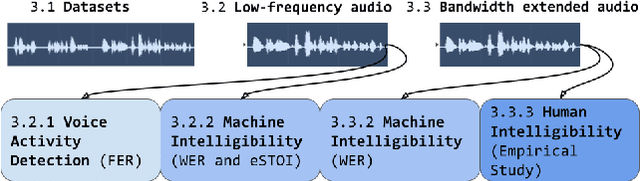
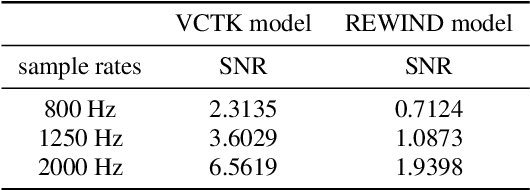
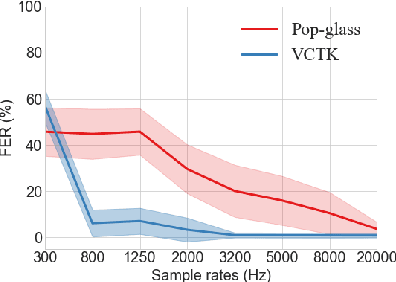
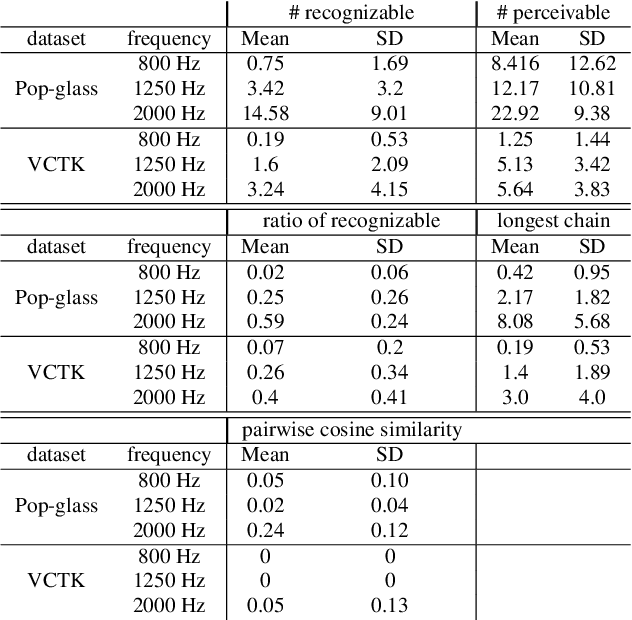
Low-frequency audio has been proposed as a promising privacy-preserving modality to study social dynamics in real-world settings. To this end, researchers have developed wearable devices that can record audio at frequencies as low as 1250 Hz to mitigate the automatic extraction of the verbal content of speech that may contain private details. This paper investigates the validity of this hypothesis, examining the degree to which low-frequency speech ensures verbal privacy. It includes simulating a potential privacy attack in various noise environments. Further, it explores the trade-off between the performance of voice activity detection, which is fundamental for understanding social behavior, and privacy-preservation. The evaluation incorporates subjective human intelligibility and automatic speech recognition performance, comprehensively analyzing the delicate balance between effective social behavior analysis and preserving verbal privacy.
REWIND Dataset: Privacy-preserving Speaking Status Segmentation from Multimodal Body Movement Signals in the Wild
Mar 02, 2024

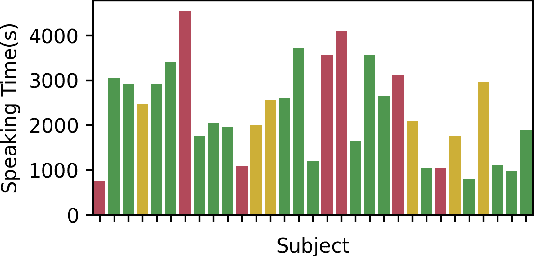
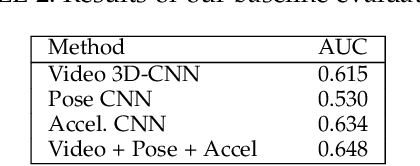
Recognizing speaking in humans is a central task towards understanding social interactions. Ideally, speaking would be detected from individual voice recordings, as done previously for meeting scenarios. However, individual voice recordings are hard to obtain in the wild, especially in crowded mingling scenarios due to cost, logistics, and privacy concerns. As an alternative, machine learning models trained on video and wearable sensor data make it possible to recognize speech by detecting its related gestures in an unobtrusive, privacy-preserving way. These models themselves should ideally be trained using labels obtained from the speech signal. However, existing mingling datasets do not contain high quality audio recordings. Instead, speaking status annotations have often been inferred by human annotators from video, without validation of this approach against audio-based ground truth. In this paper we revisit no-audio speaking status estimation by presenting the first publicly available multimodal dataset with high-quality individual speech recordings of 33 subjects in a professional networking event. We present three baselines for no-audio speaking status segmentation: a) from video, b) from body acceleration (chest-worn accelerometer), c) from body pose tracks. In all cases we predict a 20Hz binary speaking status signal extracted from the audio, a time resolution not available in previous datasets. In addition to providing the signals and ground truth necessary to evaluate a wide range of speaking status detection methods, the availability of audio in REWIND makes it suitable for cross-modality studies not feasible with previous mingling datasets. Finally, our flexible data consent setup creates new challenges for multimodal systems under missing modalities.