 Add to Chrome
 Add to Firefox
 Add to Edge
NyayaMind- A Framework for Transparent Legal Reasoning and Judgment Prediction in the Indian Legal System
Apr 10, 2026
Court Judgment Prediction and Explanation (CJPE) aims to predict a judicial decision and provide a legally grounded explanation for a given case based on the facts, legal issues, arguments, cited statutes, and relevant precedents. For such systems to be practically useful in judicial or legal research settings, they must not only achieve high predictive performance but also generate transparent and structured legal reasoning that aligns with established judicial practices. In this work, we present NyayaMind, an open-source framework designed to enable transparent and scalable legal reasoning for the Indian judiciary. The proposed framework integrates retrieval, reasoning, and verification mechanisms to emulate the structured decision-making process typically followed in courts. Specifically, NyayaMind consists of two main components: a Retrieval Module and a Prediction Module. The Retrieval Module employs a RAG pipeline to identify legally relevant statutes and precedent cases from large-scale legal corpora, while the Prediction Module utilizes reasoning-oriented LLMs fine-tuned for the Indian legal domain to generate structured outputs including issues, arguments, rationale, and the final decision. Our extensive results and expert evaluation demonstrate that NyayaMind significantly improves the quality of explanation and evidence alignment compared to existing CJPE approaches, providing a promising step toward trustworthy AI-assisted legal decision support systems.

Seeing Justice Clearly: Handwritten Legal Document Translation with OCR and Vision-Language Models
Dec 19, 2025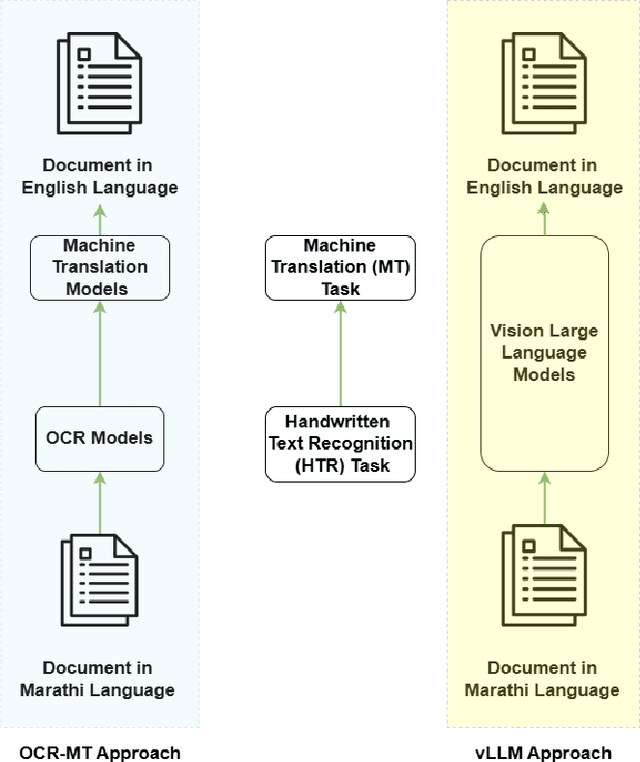
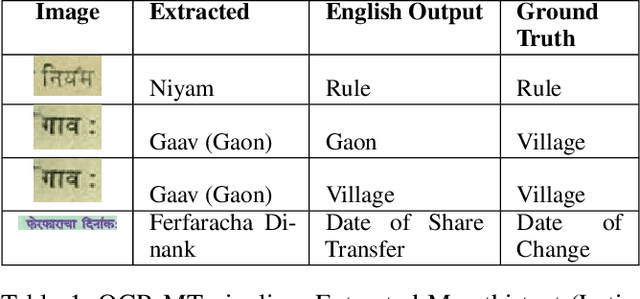
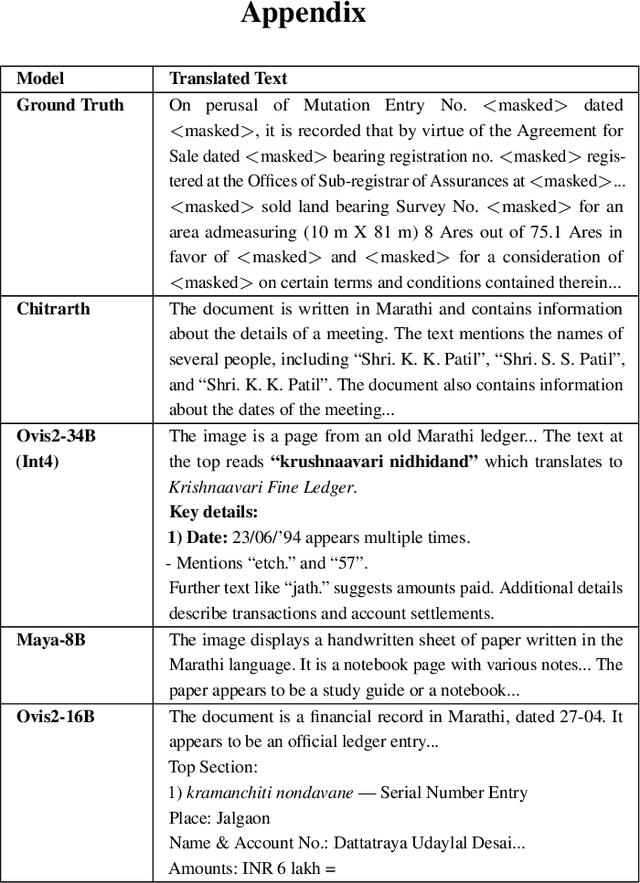
Handwritten text recognition (HTR) and machine translation continue to pose significant challenges, particularly for low-resource languages like Marathi, which lack large digitized corpora and exhibit high variability in handwriting styles. The conventional approach to address this involves a two-stage pipeline: an OCR system extracts text from handwritten images, which is then translated into the target language using a machine translation model. In this work, we explore and compare the performance of traditional OCR-MT pipelines with Vision Large Language Models that aim to unify these stages and directly translate handwritten text images in a single, end-to-end step. Our motivation is grounded in the urgent need for scalable, accurate translation systems to digitize legal records such as FIRs, charge sheets, and witness statements in India's district and high courts. We evaluate both approaches on a curated dataset of handwritten Marathi legal documents, with the goal of enabling efficient legal document processing, even in low-resource environments. Our findings offer actionable insights toward building robust, edge-deployable solutions that enhance access to legal information for non-native speakers and legal professionals alike.