 Add to Chrome
 Add to Firefox
 Add to Edge
Two-Step Data Augmentation for Masked Face Detection and Recognition: Turning Fake Masks to Real
Dec 13, 2025
Data scarcity and distribution shift pose major challenges for masked face detection and recognition. We propose a two-step generative data augmentation framework that combines rule-based mask warping with unpaired image-to-image translation using GANs, enabling the generation of realistic masked-face samples beyond purely synthetic transformations. Compared to rule-based warping alone, the proposed approach yields consistent qualitative improvements and complements existing GAN-based masked face generation methods such as IAMGAN. We introduce a non-mask preservation loss and stochastic noise injection to stabilize training and enhance sample diversity. Experimental observations highlight the effectiveness of the proposed components and suggest directions for future improvements in data-centric augmentation for face recognition tasks.
* 9 pages, 9 figures. Conference version

Performance Analysis of Keypoint Detectors and Binary Descriptors Under Varying Degrees of Photometric and Geometric Transformations
Dec 08, 2020

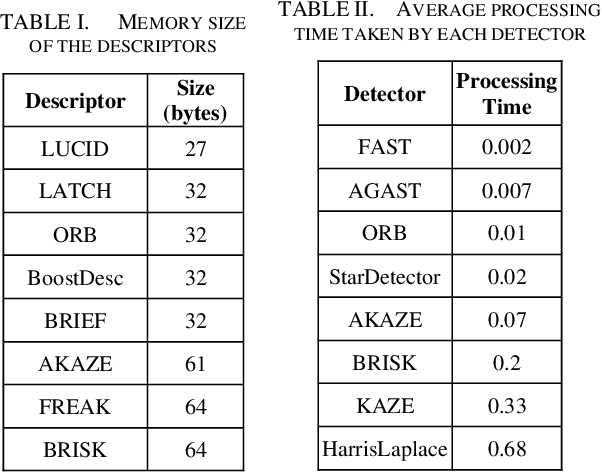
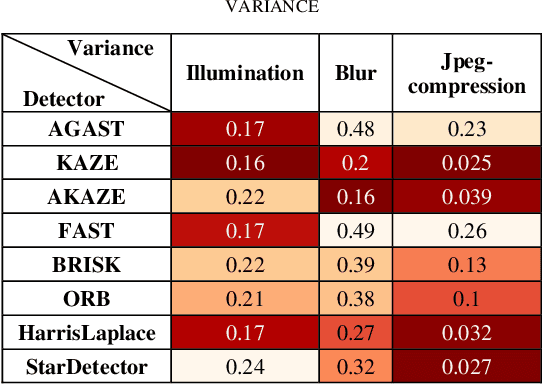
Detecting image correspondences by feature matching forms the basis of numerous computer vision applications. Several detectors and descriptors have been presented in the past, addressing the efficient generation of features from interest points (keypoints) in an image. In this paper, we investigate eight binary descriptors (AKAZE, BoostDesc, BRIEF, BRISK, FREAK, LATCH, LUCID, and ORB) and eight interest point detector (AGAST, AKAZE, BRISK, FAST, HarrisLapalce, KAZE, ORB, and StarDetector). We have decoupled the detection and description phase to analyze the interest point detectors and then evaluate the performance of the pairwise combination of different detectors and descriptors. We conducted experiments on a standard dataset and analyzed the comparative performance of each method under different image transformations. We observed that: (1) the FAST, AGAST, ORB detectors were faster and detected more keypoints, (2) the AKAZE and KAZE detectors performed better under photometric changes while ORB was more robust against geometric changes, (3) in general, descriptors performed better when paired with the KAZE and AKAZE detectors, (4) the BRIEF, LUCID, ORB descriptors were relatively faster, and (5) none of the descriptors did particularly well under geometric transformations, only BRISK, FREAK, and AKAZE showed reasonable resiliency.