 Add to Chrome
 Add to Firefox
 Add to Edge
Zero Shot Segmentation medical imaging
Papers and Code
SegMate: Asymmetric Attention-Based Lightweight Architecture for Efficient Multi-Organ Segmentation
Feb 27, 2026
State-of-the-art models for medical image segmentation achieve excellent accuracy but require substantial computational resources, limiting deployment in resource-constrained clinical settings. We present SegMate, an efficient 2.5D framework that achieves state-of-the-art accuracy, while considerably reducing computational requirements. Our efficient design is the result of meticulously integrating asymmetric architectures, attention mechanisms, multi-scale feature fusion, slice-based positional conditioning, and multi-task optimization. We demonstrate the efficiency-accuracy trade-off of our framework across three modern backbones (EfficientNetV2-M, MambaOut-Tiny, FastViT-T12). We perform experiments on three datasets: TotalSegmentator, SegTHOR and AMOS22. Compared with the vanilla models, SegMate reduces computation (GFLOPs) by up to 2.5x and memory footprint (VRAM) by up to 2.1x, while generally registering performance gains of around 1%. On TotalSegmentator, we achieve a Dice score of 93.51% with only 295MB peak GPU memory. Zero-shot cross-dataset evaluations on SegTHOR and AMOS22 demonstrate strong generalization, with Dice scores of up to 86.85% and 89.35%, respectively. We release our open-source code at https://github.com/andreibunea99/SegMate.

A data- and compute-efficient chest X-ray foundation model beyond aggressive scaling
Feb 26, 2026Foundation models for medical imaging are typically pretrained on increasingly large datasets, following a "scale-at-all-costs" paradigm. However, this strategy faces two critical challenges: large-scale medical datasets often contain substantial redundancy and severe class imbalance that bias representation learning toward over-represented patterns, and indiscriminate training regardless of heterogeneity in data quality incurs considerable computational inefficiency. Here we demonstrate that active, principled data curation during pretraining can serve as a viable, cost-effective alternative to brute-force dataset enlargement. We introduce CheXficient, a chest X-ray (CXR) foundation model that selectively prioritizes informative training samples. CheXficient is pretrained on only 22.7% of 1,235,004 paired CXR images and reports while consuming under 27.3% of the total compute budget, yet achieving comparable or superior performance to its full-data counterpart and other large-scale pretrained models. We assess CheXficient across 20 individual benchmarks spanning 5 task types, including non-adapted off-the-shelf evaluations (zero-shot findings classification and crossmodal retrieval) and adapted downstream tasks (disease prediction, semantic segmentation, and radiology report generation). Further analyses show that CheXficient systematically prioritizes under-represented training samples, improving generalizability on long-tailed or rare conditions. Overall, our work offers practical insights into the data and computation demands for efficient pretraining and downstream adaptation of medical vision-language foundation models.
SegMoTE: Token-Level Mixture of Experts for Medical Image Segmentation
Feb 22, 2026Medical image segmentation is vital for clinical diagnosis and quantitative analysis, yet remains challenging due to the heterogeneity of imaging modalities and the high cost of pixel-level annotations. Although general interactive segmentation models like SAM have achieved remarkable progress, their transfer to medical imaging still faces two key bottlenecks: (i) the lack of adaptive mechanisms for modality- and anatomy-specific tasks, which limits generalization in out-of-distribution medical scenarios; and (ii) current medical adaptation methods fine-tune on large, heterogeneous datasets without selection, leading to noisy supervision, higher cost, and negative transfer. To address these issues, we propose SegMoTE, an efficient and adaptive framework for medical image segmentation. SegMoTE preserves SAM's original prompt interface, efficient inference, and zero-shot generalization while introducing only a small number of learnable parameters to dynamically adapt across modalities and tasks. In addition, we design a progressive prompt tokenization mechanism that enables fully automatic segmentation, significantly reducing annotation dependence. Trained on MedSeg-HQ, a curated dataset less than 1% of existing large-scale datasets, SegMoTE achieves SOTA performance across diverse imaging modalities and anatomical tasks. It represents the first efficient, robust, and scalable adaptation of general segmentation models to the medical domain under extremely low annotation cost, advancing the practical deployment of foundation vision models in clinical applications.
SigVLP: Sigmoid Volume-Language Pre-Training for Self-Supervised CT-Volume Adaptive Representation Learning
Feb 25, 2026Large-scale, volumetric medical imaging datasets typically aggregate scans from different vendors and devices, resulting in highly variable resolution, slice thicknesses, and numbers of slices per study. Consequently, training representation models usually requires cropping or interpolating along the z-axis to obtain fixed-size blocks, which inevitably causes information loss. We propose a new training approach to overcome this limitation. Instead of absolute position embeddings, we interpret volumes as sequences of 3D chunks and adopt Rotary Position Embeddings, allowing us to treat the z-axis as an unconstrained temporal dimensions. Building on this idea, we introduce a new vision-language model: SigVLP. In SigVLP, we implement Rotary Position Embedding as the positional encoding method, which is applied directly within the attention operation, generating input-conditioned sine and cosine weights on the fly. This design ensures consistent alignment between query and key projections and adapts to any input sizes. To allow for variable input size during training, we sample Computed Tomography volumes in chunks and pair them with localized organ-wise textual observations. Compared to using entire reports for conditioning, chunkwise alignment provides finer-grained supervision, enabling the model to establish stronger correlations between the text and volume representations, thereby improving the precision of text-to-volume alignment. Our models are trained with the Muon optimizer and evaluated on a diverse set of downstream tasks, including zero-shot abnormality and organ classification, segmentation, and retrieval tasks.
Zero-shot System for Automatic Body Region Detection for Volumetric CT and MR Images
Feb 09, 2026Reliable identification of anatomical body regions is a prerequisite for many automated medical imaging workflows, yet existing solutions remain heavily dependent on unreliable DICOM metadata. Current solutions mainly use supervised learning, which limits their applicability in many real-world scenarios. In this work, we investigate whether body region detection in volumetric CT and MR images can be achieved in a fully zero-shot manner by using knowledge embedded in large pre-trained foundation models. We propose and systematically evaluate three training-free pipelines: (1) a segmentation-driven rule-based system leveraging pre-trained multi-organ segmentation models, (2) a Multimodal Large Language Model (MLLM) guided by radiologist-defined rules, and (3) a segmentation-aware MLLM that combines visual input with explicit anatomical evidence. All methods are evaluated on 887 heterogeneous CT and MR scans with manually verified anatomical region labels. The segmentation-driven rule-based approach achieves the strongest and most consistent performance, with weighted F1-scores of 0.947 (CT) and 0.914 (MR), demonstrating robustness across modalities and atypical scan coverage. The MLLM performs competitively in visually distinctive regions, while the segmentation-aware MLLM reveals fundamental limitations.
Synthetic Volumetric Data Generation Enables Zero-Shot Generalization of Foundation Models in 3D Medical Image Segmentation
Jan 18, 2026Foundation models such as Segment Anything Model 2 (SAM 2) exhibit strong generalization on natural images and videos but perform poorly on medical data due to differences in appearance statistics, imaging physics, and three-dimensional structure. To address this gap, we introduce SynthFM-3D, an analytical framework that mathematically models 3D variability in anatomy, contrast, boundary definition, and noise to generate synthetic data for training promptable segmentation models without real annotations. We fine-tuned SAM 2 on 10,000 SynthFM-3D volumes and evaluated it on eleven anatomical structures across three medical imaging modalities (CT, MR, ultrasound) from five public datasets. SynthFM-3D training led to consistent and statistically significant Dice score improvements over the pretrained SAM 2 baseline, demonstrating stronger zero-shot generalization across modalities. When compared with the supervised SAM-Med3D model on unseen cardiac ultrasound data, SynthFM-3D achieved 2-3x higher Dice scores, establishing analytical 3D data modeling as an effective pathway to modality-agnostic medical segmentation.
MRAD: Zero-Shot Anomaly Detection with Memory-Driven Retrieval
Jan 31, 2026Zero-shot anomaly detection (ZSAD) often leverages pretrained vision or vision-language models, but many existing methods use prompt learning or complex modeling to fit the data distribution, resulting in high training or inference cost and limited cross-domain stability. To address these limitations, we propose Memory-Retrieval Anomaly Detection method (MRAD), a unified framework that replaces parametric fitting with a direct memory retrieval. The train-free base model, MRAD-TF, freezes the CLIP image encoder and constructs a two-level memory bank (image-level and pixel-level) from auxiliary data, where feature-label pairs are explicitly stored as keys and values. During inference, anomaly scores are obtained directly by similarity retrieval over the memory bank. Based on the MRAD-TF, we further propose two lightweight variants as enhancements: (i) MRAD-FT fine-tunes the retrieval metric with two linear layers to enhance the discriminability between normal and anomaly; (ii) MRAD-CLIP injects the normal and anomalous region priors from the MRAD-FT as dynamic biases into CLIP's learnable text prompts, strengthening generalization to unseen categories. Across 16 industrial and medical datasets, the MRAD framework consistently demonstrates superior performance in anomaly classification and segmentation, under both train-free and training-based settings. Our work shows that fully leveraging the empirical distribution of raw data, rather than relying only on model fitting, can achieve stronger anomaly detection performance. The code will be publicly released at https://github.com/CROVO1026/MRAD.
Opportunistic Promptable Segmentation: Leveraging Routine Radiological Annotations to Guide 3D CT Lesion Segmentation
Jan 30, 2026The development of machine learning models for CT imaging depends on the availability of large, high-quality, and diverse annotated datasets. Although large volumes of CT images and reports are readily available in clinical picture archiving and communication systems (PACS), 3D segmentations of critical findings are costly to obtain, typically requiring extensive manual annotation by radiologists. On the other hand, it is common for radiologists to provide limited annotations of findings during routine reads, such as line measurements and arrows, that are often stored in PACS as GSPS objects. We posit that these sparse annotations can be extracted along with CT volumes and converted into 3D segmentations using promptable segmentation models, a paradigm we term Opportunistic Promptable Segmentation. To enable this paradigm, we propose SAM2CT, the first promptable segmentation model designed to convert radiologist annotations into 3D segmentations in CT volumes. SAM2CT builds upon SAM2 by extending the prompt encoder to support arrow and line inputs and by introducing Memory-Conditioned Memories (MCM), a memory encoding strategy tailored to 3D medical volumes. On public lesion segmentation benchmarks, SAM2CT outperforms existing promptable segmentation models and similarly trained baselines, achieving Dice similarity coefficients of 0.649 for arrow prompts and 0.757 for line prompts. Applying the model to pre-existing GSPS annotations from a clinical PACS (N = 60), SAM2CT generates 3D segmentations that are clinically acceptable or require only minor adjustments in 87% of cases, as scored by radiologists. Additionally, SAM2CT demonstrates strong zero-shot performance on select Emergency Department findings. These results suggest that large-scale mining of historical GSPS annotations represents a promising and scalable approach for generating 3D CT segmentation datasets.
EchoVLM: Measurement-Grounded Multimodal Learning for Echocardiography
Dec 13, 2025Echocardiography is the most widely used imaging modality in cardiology, yet its interpretation remains labor-intensive and inherently multimodal, requiring view recognition, quantitative measurements, qualitative assessments, and guideline-based reasoning. While recent vision-language models (VLMs) have achieved broad success in natural images and certain medical domains, their potential in echocardiography has been limited by the lack of large-scale, clinically grounded image-text datasets and the absence of measurement-based reasoning central to echo interpretation. We introduce EchoGround-MIMIC, the first measurement-grounded multimodal echocardiography dataset, comprising 19,065 image-text pairs from 1,572 patients with standardized views, structured measurements, measurement-grounded captions, and guideline-derived disease labels. Building on this resource, we propose EchoVLM, a vision-language model that incorporates two novel pretraining objectives: (i) a view-informed contrastive loss that encodes the view-dependent structure of echocardiographic imaging, and (ii) a negation-aware contrastive loss that distinguishes clinically critical negative from positive findings. Across five types of clinical applications with 36 tasks spanning multimodal disease classification, image-text retrieval, view classification, chamber segmentation, and landmark detection, EchoVLM achieves state-of-the-art performance (86.5% AUC in zero-shot disease classification and 95.1% accuracy in view classification). We demonstrate that clinically grounded multimodal pretraining yields transferable visual representations and establish EchoVLM as a foundation model for end-to-end echocardiography interpretation. We will release EchoGround-MIMIC and the data curation code, enabling reproducibility and further research in multimodal echocardiography interpretation.
Towards Better Ultrasound Video Segmentation Foundation Model: An Empirical study on SAM2 Finetuning from Data Perspective
Nov 07, 2025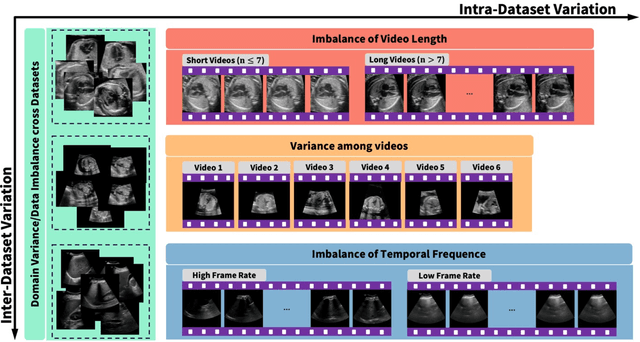

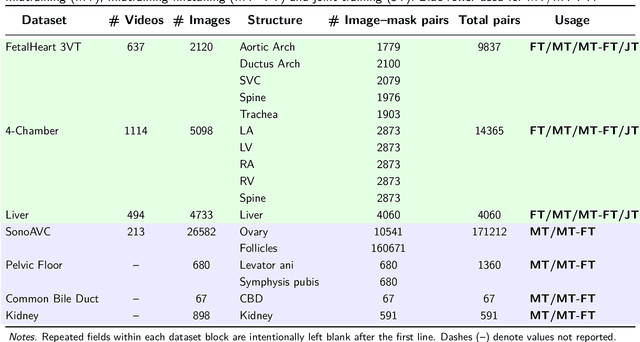
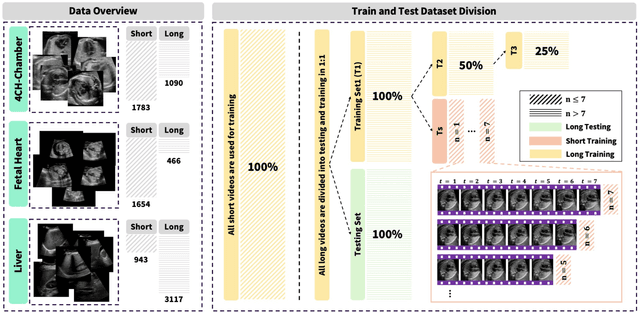
Ultrasound (US) video segmentation remains a challenging problem due to strong inter- and intra-dataset variability, motion artifacts, and limited annotated data. Although foundation models such as Segment Anything Model 2 (SAM2) demonstrate strong zero-shot and prompt-guided segmentation capabilities, their performance deteriorates substantially when transferred to medical imaging domains. Current adaptation studies mainly emphasize architectural modifications, while the influence of data characteristics and training regimes has not been systematically examined. In this study, we present a comprehensive, data-centric investigation of SAM2 adaptation for ultrasound video segmentation. We analyze how training-set size, video duration, and augmentation schemes affect adaptation performance under three paradigms: task-specific fine-tuning, intermediate adaptation, and multi-task joint training, across five SAM2 variants and multiple prompting modes. We further design six ultrasound-specific augmentations, assessing their effect relative to generic strategies. Experiments on three representative ultrasound datasets reveal that data scale and temporal context play a more decisive role than model architecture or initialization. Moreover, joint training offers an efficient compromise between modality alignment and task specialization. This work aims to provide empirical insights for developing efficient, data-aware adaptation pipelines for SAM2 in ultrasound video analysis.