 Add to Chrome
 Add to Firefox
 Add to Edge
Zero-shot System for Automatic Body Region Detection for Volumetric CT and MR Images
Feb 09, 2026
Reliable identification of anatomical body regions is a prerequisite for many automated medical imaging workflows, yet existing solutions remain heavily dependent on unreliable DICOM metadata. Current solutions mainly use supervised learning, which limits their applicability in many real-world scenarios. In this work, we investigate whether body region detection in volumetric CT and MR images can be achieved in a fully zero-shot manner by using knowledge embedded in large pre-trained foundation models. We propose and systematically evaluate three training-free pipelines: (1) a segmentation-driven rule-based system leveraging pre-trained multi-organ segmentation models, (2) a Multimodal Large Language Model (MLLM) guided by radiologist-defined rules, and (3) a segmentation-aware MLLM that combines visual input with explicit anatomical evidence. All methods are evaluated on 887 heterogeneous CT and MR scans with manually verified anatomical region labels. The segmentation-driven rule-based approach achieves the strongest and most consistent performance, with weighted F1-scores of 0.947 (CT) and 0.914 (MR), demonstrating robustness across modalities and atypical scan coverage. The MLLM performs competitively in visually distinctive regions, while the segmentation-aware MLLM reveals fundamental limitations.

Exploring AI-based System Design for Pixel-level Protected Health Information Detection in Medical Images
Jan 16, 2025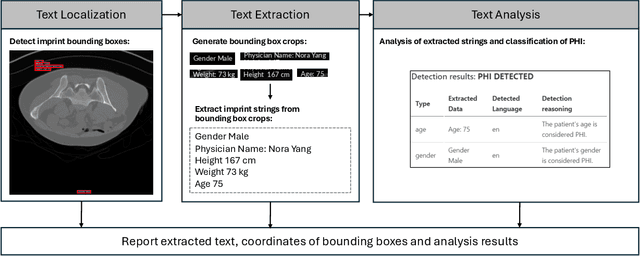
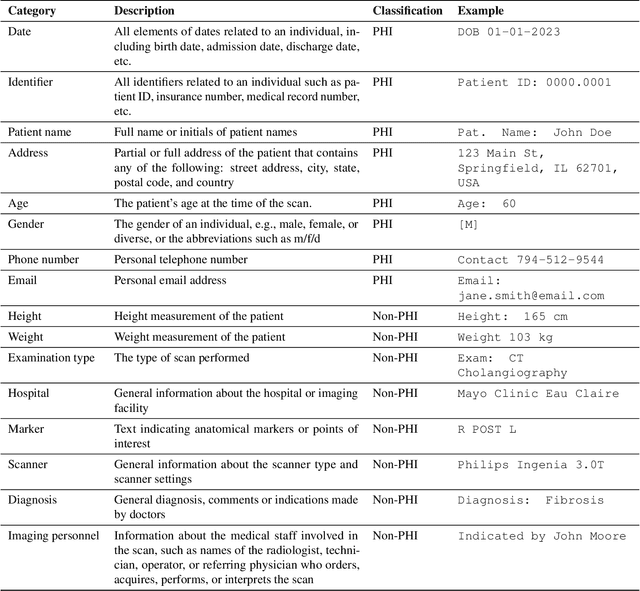
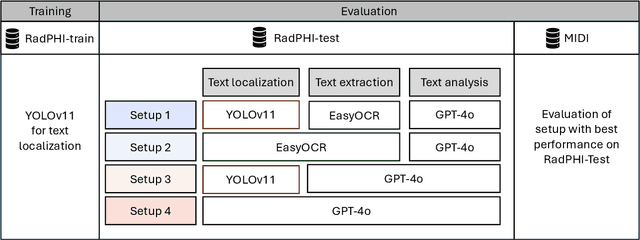
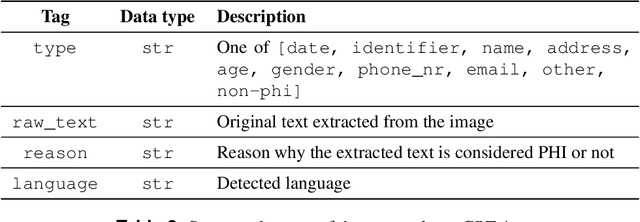
De-identification of medical images is a critical step to ensure privacy during data sharing in research and clinical settings. The initial step in this process involves detecting Protected Health Information (PHI), which can be found in image metadata or imprinted within image pixels. Despite the importance of such systems, there has been limited evaluation of existing AI-based solutions, creating barriers to the development of reliable and robust tools. In this study, we present an AI-based pipeline for PHI detection, comprising three key components: text detection, text extraction, and analysis of PHI content in medical images. By experimenting with exchanging roles of vision and language models within the pipeline, we evaluate the performance and recommend the best setup for the PHI detection task.