 Add to Chrome
 Add to Firefox
 Add to Edge
Hypergraph Contrastive Learning
Papers and Code
From Representation to Clusters: A Contrastive Learning Approach for Attributed Hypergraph Clustering
Mar 10, 2026
Contrastive learning has demonstrated strong performance in attributed hypergraph clustering. Typically, existing methods based on contrastive learning first learn node embeddings and then apply clustering algorithms, such as k-means, to these embeddings to obtain the clustering results.However, these methods lack direct clustering supervision, risking the inclusion of clustering-irrelevant information in the learned graph.To this end, we propose a Contrastive learning approach for Attributed Hypergraph Clustering (CAHC), an end-to-end method that simultaneously learns node embeddings and obtains clustering results. CAHC consists of two main steps: representation learning and cluster assignment learning. The former employs a novel contrastive learning approach that incorporates both node-level and hyperedge-level objectives to generate node embeddings.The latter joint embedding and clustering optimization to refine these embeddings by clustering-oriented guidance and obtains clustering results simultaneously.Extensive experimental results demonstrate that CAHC outperforms baselines on eight datasets.

HypeMed: Enhancing Medication Recommendations with Hypergraph-Based Patient Relationships
Mar 19, 2026Medication recommendations aim to generate safe and effective medication sets from health records. However, accurately recommending medications hinges on inferring a patient's latent clinical condition from sparse and noisy observations, which requires both (i) preserving the visit-level combinatorial semantics of co-occurring entities and (ii) leveraging informative historical references through effective, visit-conditioned retrieval. Most existing methods fall short in one of both aspects: graph-based modeling often fragments higher-order intra-visit patterns into pairwise relations, while inter-visit augmentation methods commonly exhibit an imbalance between learning a globally stable representation space and performing dynamic retrieval within it. To address these limitations, this paper proposes HypeMed, a two-stage hypergraph-based framework unifying intra-visit coherence modeling and inter-visit augmentation. HypeMed consists of two core modules: MedRep for representation pre-training, and SimMR for similarity-enhanced recommendation. In the first stage, MedRep encodes clinical visits as hyperedges via knowledge-aware contrastive pre-training, creating a globally consistent, retrieval-friendly embedding space. In the second stage, SimMR performs dynamic retrieval within this space, fusing retrieved references with the patient's longitudinal data to refine medication prediction. Evaluation on real-world benchmarks shows that HypeMed outperforms state-of-the-art baselines in both recommendation precision and DDI reduction, simultaneously enhancing the effectiveness and safety of clinical decision support.
BHyGNN+: Unsupervised Representation Learning for Heterophilic Hypergraphs
Feb 16, 2026Hypergraph Neural Networks (HyGNNs) have demonstrated remarkable success in modeling higher-order relationships among entities. However, their performance often degrades on heterophilic hypergraphs, where nodes connected by the same hyperedge tend to have dissimilar semantic representations or belong to different classes. While several HyGNNs, including our prior work BHyGNN, have been proposed to address heterophily, their reliance on labeled data significantly limits their applicability in real-world scenarios where annotations are scarce or costly. To overcome this limitation, we introduce BHyGNN+, a self-supervised learning framework that extends BHyGNN for representation learning on heterophilic hypergraphs without requiring ground-truth labels. The core idea of BHyGNN+ is hypergraph duality, a structural transformation where the roles of nodes and hyperedges are interchanged. By contrasting augmented views of a hypergraph against its dual using cosine similarity, our framework captures essential structural patterns in a fully unsupervised manner. Notably, this duality-based formulation eliminates the need for negative samples, a common requirement in existing hypergraph contrastive learning methods that is often difficult to satisfy in practice. Extensive experiments on eleven benchmark datasets demonstrate that BHyGNN+ consistently outperforms state-of-the-art supervised and self-supervised baselines on both heterophilic and homophilic hypergraphs. Our results validate the effectiveness of leveraging hypergraph duality for self-supervised learning and establish a new paradigm for representation learning on challenging, unlabeled hypergraphs.
Emotion Collider: Dual Hyperbolic Mirror Manifolds for Sentiment Recovery via Anti Emotion Reflection
Feb 18, 2026Emotional expression underpins natural communication and effective human-computer interaction. We present Emotion Collider (EC-Net), a hyperbolic hypergraph framework for multimodal emotion and sentiment modeling. EC-Net represents modality hierarchies using Poincare-ball embeddings and performs fusion through a hypergraph mechanism that passes messages bidirectionally between nodes and hyperedges. To sharpen class separation, contrastive learning is formulated in hyperbolic space with decoupled radial and angular objectives. High-order semantic relations across time steps and modalities are preserved via adaptive hyperedge construction. Empirical results on standard multimodal emotion benchmarks show that EC-Net produces robust, semantically coherent representations and consistently improves accuracy, particularly when modalities are partially available or contaminated by noise. These findings indicate that explicit hierarchical geometry combined with hypergraph fusion is effective for resilient multimodal affect understanding.
HyperRAG: Reasoning N-ary Facts over Hypergraphs for Retrieval Augmented Generation
Feb 16, 2026Graph-based retrieval-augmented generation (RAG) methods, typically built on knowledge graphs (KGs) with binary relational facts, have shown promise in multi-hop open-domain QA. However, their rigid retrieval schemes and dense similarity search often introduce irrelevant context, increase computational overhead, and limit relational expressiveness. In contrast, n-ary hypergraphs encode higher-order relational facts that capture richer inter-entity dependencies and enable shallower, more efficient reasoning paths. To address this limitation, we propose HyperRAG, a RAG framework tailored for n-ary hypergraphs with two complementary retrieval variants: (i) HyperRetriever learns structural-semantic reasoning over n-ary facts to construct query-conditioned relational chains. It enables accurate factual tracking, adaptive high-order traversal, and interpretable multi-hop reasoning under context constraints. (ii) HyperMemory leverages the LLM's parametric memory to guide beam search, dynamically scoring n-ary facts and entities for query-aware path expansion. Extensive evaluations on WikiTopics (11 closed-domain datasets) and three open-domain QA benchmarks (HotpotQA, MuSiQue, and 2WikiMultiHopQA) validate HyperRAG's effectiveness. HyperRetriever achieves the highest answer accuracy overall, with average gains of 2.95% in MRR and 1.23% in Hits@10 over the strongest baseline. Qualitative analysis further shows that HyperRetriever bridges reasoning gaps through adaptive and interpretable n-ary chain construction, benefiting both open and closed-domain QA.
Diffusion-Guided Pretraining for Brain Graph Foundation Models
Feb 10, 2026With the growing interest in foundation models for brain signals, graph-based pretraining has emerged as a promising paradigm for learning transferable representations from connectome data. However, existing contrastive and masked autoencoder methods typically rely on naive random dropping or masking for augmentation, which is ill-suited for brain graphs and hypergraphs as it disrupts semantically meaningful connectivity patterns. Moreover, commonly used graph-level readout and reconstruction schemes fail to capture global structural information, limiting the robustness of learned representations. In this work, we propose a unified diffusion-based pretraining framework that addresses both limitations. First, diffusion is designed to guide structure-aware dropping and masking strategies, preserving brain graph semantics while maintaining effective pretraining diversity. Second, diffusion enables topology-aware graph-level readout and node-level global reconstruction by allowing graph embeddings and masked nodes to aggregate information from globally related regions. Extensive experiments across multiple neuroimaging datasets with over 25,000 subjects and 60,000 scans involving various mental disorders and brain atlases demonstrate consistent performance improvements.
MetaHGNIE: Meta-Path Induced Hypergraph Contrastive Learning in Heterogeneous Knowledge Graphs
Dec 13, 2025Node importance estimation (NIE) in heterogeneous knowledge graphs is a critical yet challenging task, essential for applications such as recommendation, knowledge reasoning, and question answering. Existing methods often rely on pairwise connections, neglecting high-order dependencies among multiple entities and relations, and they treat structural and semantic signals independently, hindering effective cross-modal integration. To address these challenges, we propose MetaHGNIE, a meta-path induced hypergraph contrastive learning framework for disentangling and aligning structural and semantic information. MetaHGNIE constructs a higher-order knowledge graph via meta-path sequences, where typed hyperedges capture multi-entity relational contexts. Structural dependencies are aggregated with local attention, while semantic representations are encoded through a hypergraph transformer equipped with sparse chunking to reduce redundancy. Finally, a multimodal fusion module integrates structural and semantic embeddings under contrastive learning with auxiliary supervision, ensuring robust cross-modal alignment. Extensive experiments on benchmark NIE datasets demonstrate that MetaHGNIE consistently outperforms state-of-the-art baselines. These results highlight the effectiveness of explicitly modeling higher-order interactions and cross-modal alignment in heterogeneous knowledge graphs. Our code is available at https://github.com/SEU-WENJIA/DualHNIE
Personality-guided Public-Private Domain Disentangled Hypergraph-Former Network for Multimodal Depression Detection
Nov 16, 2025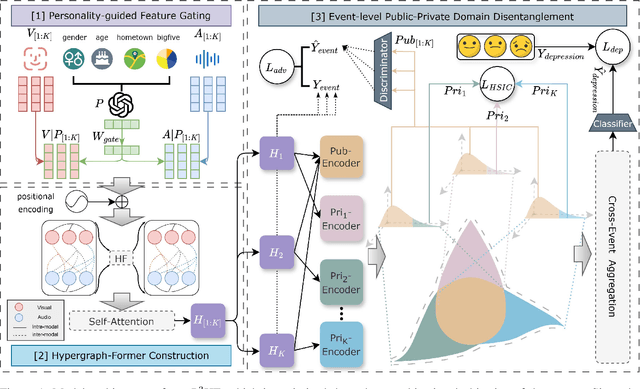
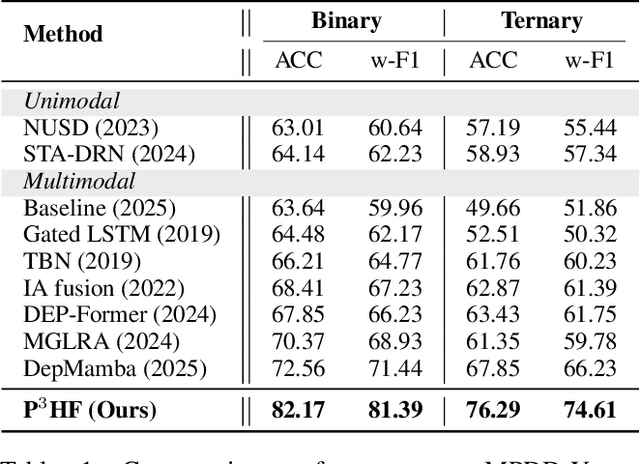
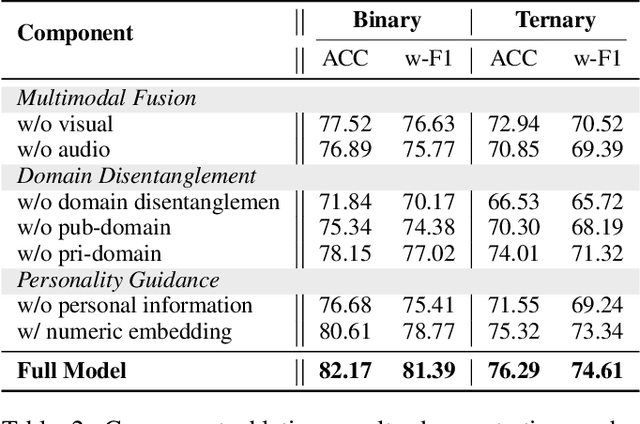
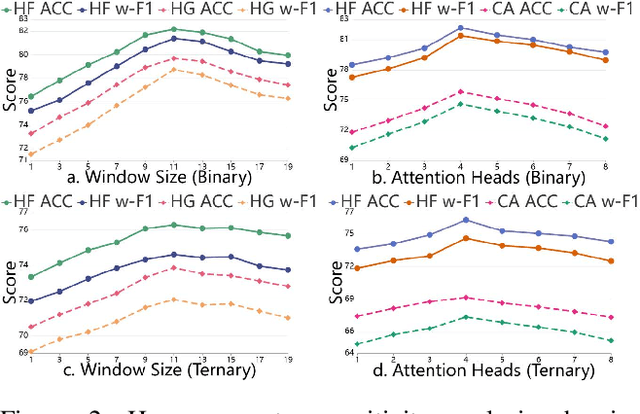
Depression represents a global mental health challenge requiring efficient and reliable automated detection methods. Current Transformer- or Graph Neural Networks (GNNs)-based multimodal depression detection methods face significant challenges in modeling individual differences and cross-modal temporal dependencies across diverse behavioral contexts. Therefore, we propose P$^3$HF (Personality-guided Public-Private Domain Disentangled Hypergraph-Former Network) with three key innovations: (1) personality-guided representation learning using LLMs to transform discrete individual features into contextual descriptions for personalized encoding; (2) Hypergraph-Former architecture modeling high-order cross-modal temporal relationships; (3) event-level domain disentanglement with contrastive learning for improved generalization across behavioral contexts. Experiments on MPDD-Young dataset show P$^3$HF achieves around 10\% improvement on accuracy and weighted F1 for binary and ternary depression classification task over existing methods. Extensive ablation studies validate the independent contribution of each architectural component, confirming that personality-guided representation learning and high-order hypergraph reasoning are both essential for generating robust, individual-aware depression-related representations. The code is released at https://github.com/hacilab/P3HF.
Dual-branch Spatial-Temporal Self-supervised Representation for Enhanced Road Network Learning
Nov 10, 2025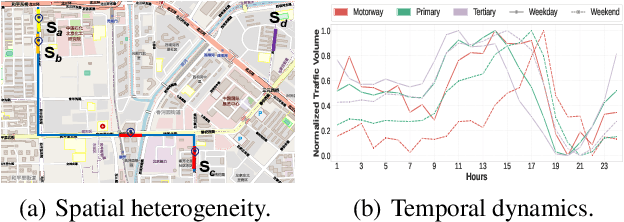
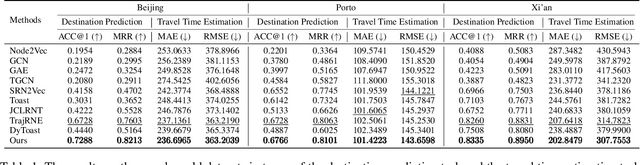
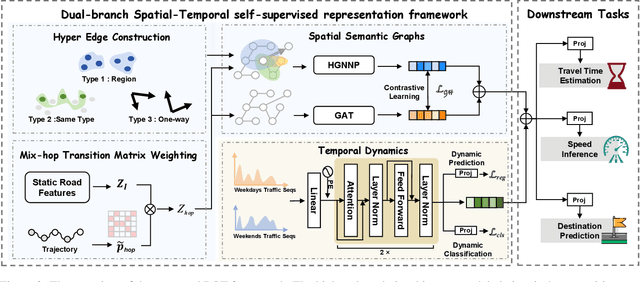
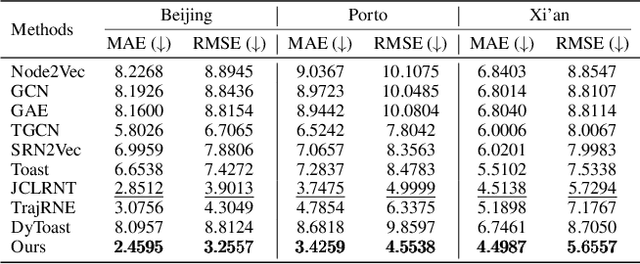
Road network representation learning (RNRL) has attracted increasing attention from both researchers and practitioners as various spatiotemporal tasks are emerging. Recent advanced methods leverage Graph Neural Networks (GNNs) and contrastive learning to characterize the spatial structure of road segments in a self-supervised paradigm. However, spatial heterogeneity and temporal dynamics of road networks raise severe challenges to the neighborhood smoothing mechanism of self-supervised GNNs. To address these issues, we propose a $\textbf{D}$ual-branch $\textbf{S}$patial-$\textbf{T}$emporal self-supervised representation framework for enhanced road representations, termed as DST. On one hand, DST designs a mix-hop transition matrix for graph convolution to incorporate dynamic relations of roads from trajectories. Besides, DST contrasts road representations of the vanilla road network against that of the hypergraph in a spatial self-supervised way. The hypergraph is newly built based on three types of hyperedges to capture long-range relations. On the other hand, DST performs next token prediction as the temporal self-supervised task on the sequences of traffic dynamics based on a causal Transformer, which is further regularized by differentiating traffic modes of weekdays from those of weekends. Extensive experiments against state-of-the-art methods verify the superiority of our proposed framework. Moreover, the comprehensive spatiotemporal modeling facilitates DST to excel in zero-shot learning scenarios.
MMHCL: Multi-Modal Hypergraph Contrastive Learning for Recommendation
Apr 23, 2025The burgeoning presence of multimodal content-sharing platforms propels the development of personalized recommender systems. Previous works usually suffer from data sparsity and cold-start problems, and may fail to adequately explore semantic user-product associations from multimodal data. To address these issues, we propose a novel Multi-Modal Hypergraph Contrastive Learning (MMHCL) framework for user recommendation. For a comprehensive information exploration from user-product relations, we construct two hypergraphs, i.e. a user-to-user (u2u) hypergraph and an item-to-item (i2i) hypergraph, to mine shared preferences among users and intricate multimodal semantic resemblance among items, respectively. This process yields denser second-order semantics that are fused with first-order user-item interaction as complementary to alleviate the data sparsity issue. Then, we design a contrastive feature enhancement paradigm by applying synergistic contrastive learning. By maximizing/minimizing the mutual information between second-order (e.g. shared preference pattern for users) and first-order (information of selected items for users) embeddings of the same/different users and items, the feature distinguishability can be effectively enhanced. Compared with using sparse primary user-item interaction only, our MMHCL obtains denser second-order hypergraphs and excavates more abundant shared attributes to explore the user-product associations, which to a certain extent alleviates the problems of data sparsity and cold-start. Extensive experiments have comprehensively demonstrated the effectiveness of our method. Our code is publicly available at: https://github.com/Xu107/MMHCL.