 Add to Chrome
 Add to Firefox
 Add to Edge
Learning Multi-Modal Mobility Dynamics for Generalized Next Location Recommendation
Dec 27, 2025
The precise prediction of human mobility has produced significant socioeconomic impacts, such as location recommendations and evacuation suggestions. However, existing methods suffer from limited generalization capability: unimodal approaches are constrained by data sparsity and inherent biases, while multi-modal methods struggle to effectively capture mobility dynamics caused by the semantic gap between static multi-modal representation and spatial-temporal dynamics. Therefore, we leverage multi-modal spatial-temporal knowledge to characterize mobility dynamics for the location recommendation task, dubbed as \textbf{M}ulti-\textbf{M}odal \textbf{Mob}ility (\textbf{M}$^3$\textbf{ob}). First, we construct a unified spatial-temporal relational graph (STRG) for multi-modal representation, by leveraging the functional semantics and spatial-temporal knowledge captured by the large language models (LLMs)-enhanced spatial-temporal knowledge graph (STKG). Second, we design a gating mechanism to fuse spatial-temporal graph representations of different modalities, and propose an STKG-guided cross-modal alignment to inject spatial-temporal dynamic knowledge into the static image modality. Extensive experiments on six public datasets show that our proposed method not only achieves consistent improvements in normal scenarios but also exhibits significant generalization ability in abnormal scenarios.

Dual-branch Spatial-Temporal Self-supervised Representation for Enhanced Road Network Learning
Nov 10, 2025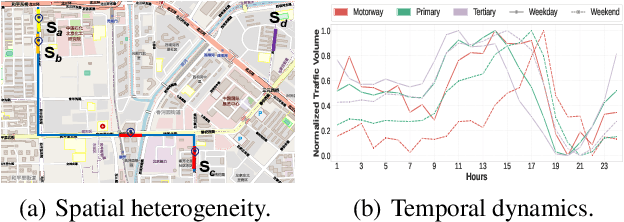
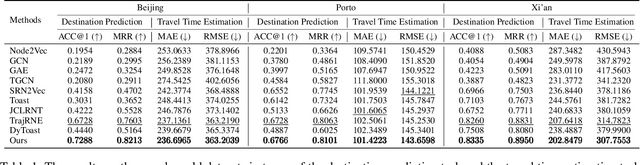
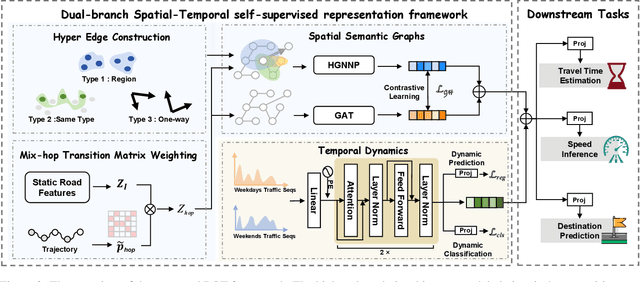
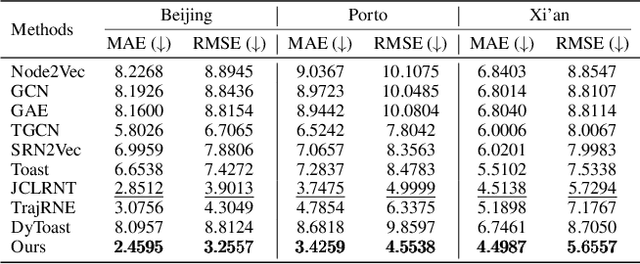
Road network representation learning (RNRL) has attracted increasing attention from both researchers and practitioners as various spatiotemporal tasks are emerging. Recent advanced methods leverage Graph Neural Networks (GNNs) and contrastive learning to characterize the spatial structure of road segments in a self-supervised paradigm. However, spatial heterogeneity and temporal dynamics of road networks raise severe challenges to the neighborhood smoothing mechanism of self-supervised GNNs. To address these issues, we propose a $\textbf{D}$ual-branch $\textbf{S}$patial-$\textbf{T}$emporal self-supervised representation framework for enhanced road representations, termed as DST. On one hand, DST designs a mix-hop transition matrix for graph convolution to incorporate dynamic relations of roads from trajectories. Besides, DST contrasts road representations of the vanilla road network against that of the hypergraph in a spatial self-supervised way. The hypergraph is newly built based on three types of hyperedges to capture long-range relations. On the other hand, DST performs next token prediction as the temporal self-supervised task on the sequences of traffic dynamics based on a causal Transformer, which is further regularized by differentiating traffic modes of weekdays from those of weekends. Extensive experiments against state-of-the-art methods verify the superiority of our proposed framework. Moreover, the comprehensive spatiotemporal modeling facilitates DST to excel in zero-shot learning scenarios.
LLM$^3$-DTI: A Large Language Model and Multi-modal data co-powered framework for Drug-Target Interaction prediction
Nov 09, 2025Drug-target interaction (DTI) prediction is of great significance for drug discovery and drug repurposing. With the accumulation of a large volume of valuable data, data-driven methods have been increasingly harnessed to predict DTIs, reducing costs across various dimensions. Therefore, this paper proposes a $\textbf{L}$arge $\textbf{L}$anguage $\textbf{M}$odel and $\textbf{M}$ulti-$\textbf{M}$odel data co-powered $\textbf{D}$rug $\textbf{T}$arget $\textbf{I}$nteraction prediction framework, named LLM$^3$-DTI. LLM$^3$-DTI constructs multi-modal data embedding to enhance DTI prediction performance. In this framework, the text semantic embeddings of drugs and targets are encoded by a domain-specific LLM. To effectively align and fuse multi-modal embedding. We propose the dual cross-attention mechanism and the TSFusion module. Finally, these multi-modal data are utilized for the DTI task through an output network. The experimental results indicate that LLM$^3$-DTI can proficiently identify validated DTIs, surpassing the performance of the models employed for comparison across diverse scenarios. Consequently, LLM$^3$-DTI is adept at fulfilling the task of DTI prediction with excellence. The data and code are available at https://github.com/chaser-gua/LLM3DTI.
Holistic Semantic Representation for Navigational Trajectory Generation
Jan 06, 2025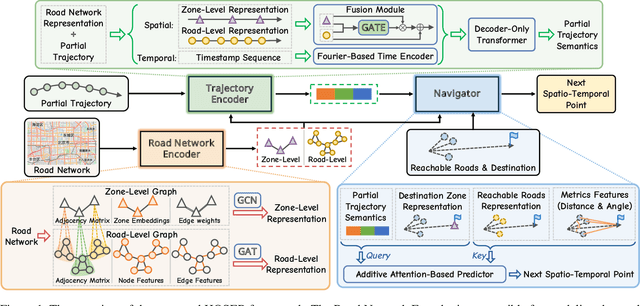
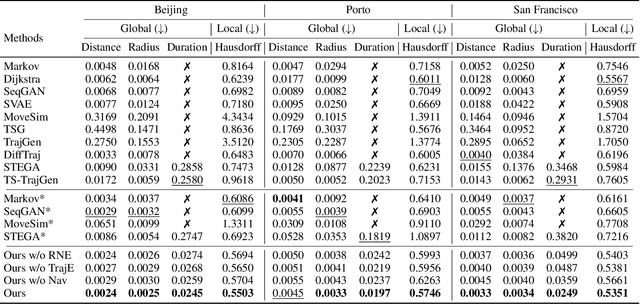
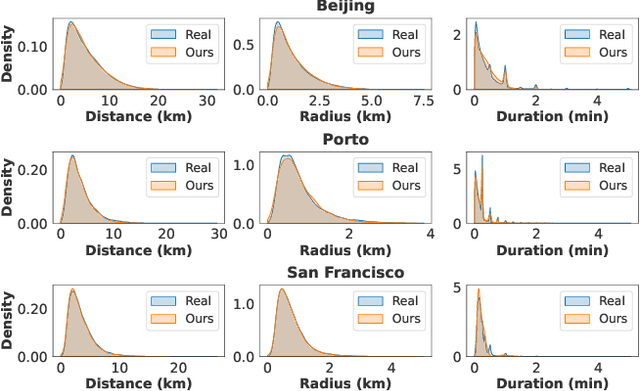
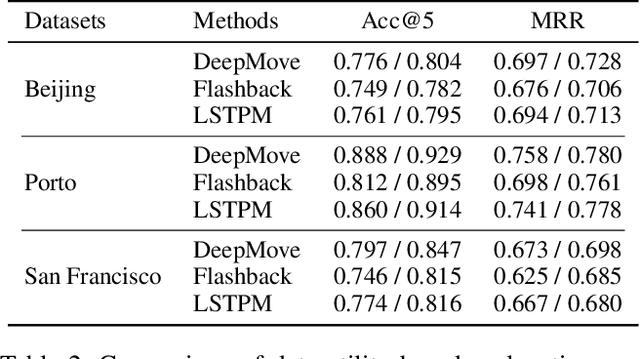
Trajectory generation has garnered significant attention from researchers in the field of spatio-temporal analysis, as it can generate substantial synthesized human mobility trajectories that enhance user privacy and alleviate data scarcity. However, existing trajectory generation methods often focus on improving trajectory generation quality from a singular perspective, lacking a comprehensive semantic understanding across various scales. Consequently, we are inspired to develop a HOlistic SEmantic Representation (HOSER) framework for navigational trajectory generation. Given an origin-and-destination (OD) pair and the starting time point of a latent trajectory, we first propose a Road Network Encoder to expand the receptive field of road- and zone-level semantics. Second, we design a Multi-Granularity Trajectory Encoder to integrate the spatio-temporal semantics of the generated trajectory at both the point and trajectory levels. Finally, we employ a Destination-Oriented Navigator to seamlessly integrate destination-oriented guidance. Extensive experiments on three real-world datasets demonstrate that HOSER outperforms state-of-the-art baselines by a significant margin. Moreover, the model's performance in few-shot learning and zero-shot learning scenarios further verifies the effectiveness of our holistic semantic representation.