 Add to Chrome
 Add to Firefox
 Add to Edge
DART-SD: Diamond-topology Aware Retrieval and Tuning for Self-Distillation of Multi-Turn Tool-Calling Agents
Aug 19, 2026
Equipping Large Language Models (LLMs) with multi-turn tool-calling capabilities is essential for building autonomous agents. However, progress is fundamentally limited by the reliance on full-length trajectory imitation. For tasks involving multiple order-independent sub-goals, the optimal solution space forms a vast combinatorial diamond lattice. Forcing this rich topology into monolithic trajectories causes a severe topological collapse, indiscriminately penalizing valid alternative explorations and severely degrading policy diversity. To address this, we propose DART-SD (Diamond-topology Aware Retrieval and Tuning for Self-Distillation), a novel framework that shifts the paradigm from global forcing to topology-guided localized correction. DART-SD first models the execution process as a converging Interaction-State Transition Graph (ISTG), faithfully capturing the inherent diamond topology of successful and failed exploratory paths. During autonomous rollouts, the framework identifies the Critical Topological Breakpoint (CTB) and retrieves success-supported recovery references. Finally, we introduce a progressive self-distillation paradigm through CTB-guided localized supervision, ensuring that the training loss is calculated exclusively on the generated recovery steps while strictly protecting the valid reasoning prefix from destructive gradient updates. Experiments on complex multi-turn tool-calling benchmarks demonstrate that DART-SD significantly outperforms traditional full-trajectory baselines.

ProMSA:Progressive Multimodal Search Agents for Knowledge-Based Visual Question Answering
Jun 26, 2026Knowledge-based Visual Question Answering (KB-VQA) requires models to combine image understanding with external knowledge. Most prior methods use a fixed retrieve-then-generate pipeline with a pre-selected retriever and a static top-k setting, which is not adaptive during reasoning. We propose ProMSA, a progressive multimodal search agent for KB-VQA. Given an image-question pair, the agent iteratively chooses image search, text search, or stop, under explicit tool-call budgets and with deduplication to avoid redundant retrieval. For training, we first use rejection-sampling SFT to learn valid tool-use formats, then optimize the agent with TN-GSPO, a sequence-level RL objective that normalizes updates by both generation length and tool-interaction depth. Experiments on E-VQA and InfoSeek show consistent gains over strong RAG and agent baselines, and improved retrieval and end-to-end accuracy. The code is available at https://github.com/DingWu1021/Promsa.
Learning to Search: A Decision-Based Agent for Knowledge-Based Visual Question Answering
Apr 09, 2026Knowledge-based visual question answering (KB-VQA) requires vision-language models to understand images and use external knowledge, especially for rare entities and long-tail facts. Most existing retrieval-augmented generation (RAG) methods adopt a fixed pipeline that sequentially retrieves information, filters it, and then produces an answer. Such a design makes it difficult to adapt to diverse question types. Moreover, it separates retrieval from reasoning, making it hard for the model to decide when to search, how to refine queries, or when to stop. As a result, the retrieved evidence is often poorly aligned with the question. To address these limitations, we reformulate KB-VQA as a search-agent problem and model the solving process as a multi-step decision-making procedure. At each step, the agent selects one of four actions-Answer, Image Retrieval, Text Retrieval, and Caption-based on its current information state. We further design an automated pipeline to collect multi-step trajectories that record the agent's reasoning process, tool usage, and intermediate decisions. These trajectories are then used as supervision for fine-tuning. Experiments on InfoSeek and E-VQA demonstrate that our method achieves state-of-the-art performance, consistently outperforming prior baselines and confirming the effectiveness of our framework.
Stabilizing Unsupervised Self-Evolution of MLLMs via Continuous Softened Retracing reSampling
Apr 04, 2026In the unsupervised self-evolution of Multimodal Large Language Models, the quality of feedback signals during post-training is pivotal for stable and effective learning. However, existing self-evolution methods predominantly rely on majority voting to select the most frequent output as the pseudo-golden answer, which may stem from the model's intrinsic biases rather than guaranteeing the objective correctness of the reasoning paths. To counteract the degradation, we propose \textbf{C}ontinuous \textbf{S}oftened \textbf{R}etracing re\textbf{S}ampling (\textbf{CSRS}) in MLLM self-evolution. Specifically, we introduce a Retracing Re-inference Mechanism (\textbf{RRM}) that the model re-inferences from anchor points to expand the exploration of long-tail reasoning paths. Simultaneously, we propose Softened Frequency Reward (\textbf{SFR}), which replaces binary rewards with continuous signals, calibrating reward based on the answers' frequency across sampled reasoning sets. Furthermore, incorporated with Visual Semantic Perturbation (\textbf{VSP}), CSRS ensures the model prioritizes mathematical logic over visual superficiality. Experimental results demonstrate that CSRS significantly enhances the reasoning performance of Qwen2.5-VL-7B on benchmarks such as MathVision. We achieve state-of-the-art (SOTA) results in unsupervised self-evolution on geometric tasks. Our code is avaible at https://github.com/yyy195/CSRS.
When Models Judge Themselves: Unsupervised Self-Evolution for Multimodal Reasoning
Mar 22, 2026Recent progress in multimodal large language models has led to strong performance on reasoning tasks, but these improvements largely rely on high-quality annotated data or teacher-model distillation, both of which are costly and difficult to scale.To address this, we propose an unsupervised self-evolution training framework for multimodal reasoning that achieves stable performance improvements without using human-annotated answers or external reward models. For each input, we sample multiple reasoning trajectories and jointly model their within group structure.We use the Actor's self-consistency signal as a training prior, and introduce a bounded Judge based modulation to continuously reweight trajectories of different quality.We further model the modulated scores as a group level distribution and convert absolute scores into relative advantages within each group, enabling more robust policy updates. Trained with Group Relative Policy Optimization (GRPO) on unlabeled data, our method consistently improves reasoning performance and generalization on five mathematical reasoning benchmarks, offering a scalable path toward self-evolving multimodal models.The code are available at https://dingwu1021.github.io/SelfJudge/.
R3G: A Reasoning--Retrieval--Reranking Framework for Vision-Centric Answer Generation
Jan 25, 2026Vision-centric retrieval for VQA requires retrieving images to supply missing visual cues and integrating them into the reasoning process. However, selecting the right images and integrating them effectively into the model's reasoning remains challenging.To address this challenge, we propose R3G, a modular Reasoning-Retrieval-Reranking framework.It first produces a brief reasoning plan that specifies the required visual cues, then adopts a two-stage strategy, with coarse retrieval followed by fine-grained reranking, to select evidence images.On MRAG-Bench, R3G improves accuracy across six MLLM backbones and nine sub-scenarios, achieving state-of-the-art overall performance. Ablations show that sufficiency-aware reranking and reasoning steps are complementary, helping the model both choose the right images and use them well. We release code and data at https://github.com/czh24/R3G.
Language-Guided and Motion-Aware Gait Representation for Generalizable Recognition
Jan 17, 2026Gait recognition is emerging as a promising technology and an innovative field within computer vision. However, existing methods typically rely on complex architectures to directly extract features from images and apply pooling operations to obtain sequence-level representations. Such designs often lead to overfitting on static noise (e.g., clothing), while failing to effectively capture dynamic motion regions.To address the above challenges, we present a Language guided and Motion-aware gait recognition framework, named LMGait.In particular, we utilize designed gait-related language cues to capture key motion features in gait sequences.
DAGait: Generalized Skeleton-Guided Data Alignment for Gait Recognition
Mar 24, 2025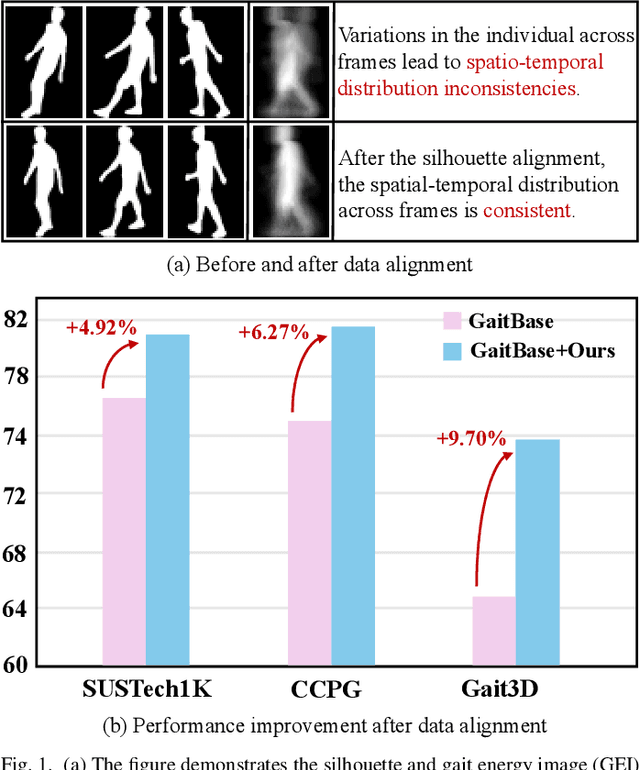
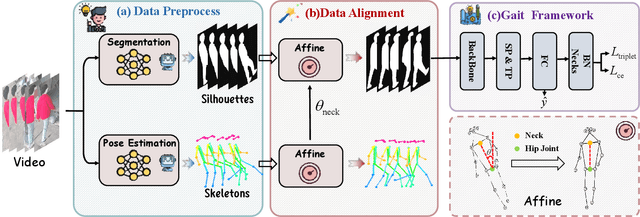
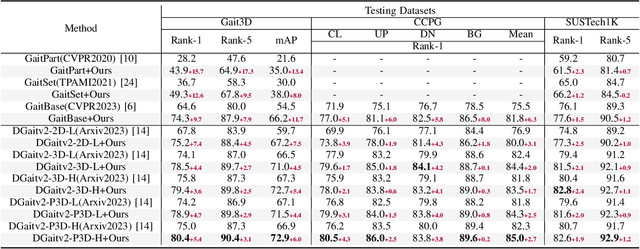
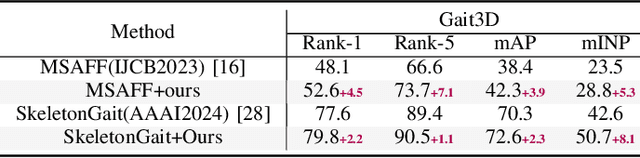
Gait recognition is emerging as a promising and innovative area within the field of computer vision, widely applied to remote person identification. Although existing gait recognition methods have achieved substantial success in controlled laboratory datasets, their performance often declines significantly when transitioning to wild datasets.We argue that the performance gap can be primarily attributed to the spatio-temporal distribution inconsistencies present in wild datasets, where subjects appear at varying angles, positions, and distances across the frames. To achieve accurate gait recognition in the wild, we propose a skeleton-guided silhouette alignment strategy, which uses prior knowledge of the skeletons to perform affine transformations on the corresponding silhouettes.To the best of our knowledge, this is the first study to explore the impact of data alignment on gait recognition. We conducted extensive experiments across multiple datasets and network architectures, and the results demonstrate the significant advantages of our proposed alignment strategy.Specifically, on the challenging Gait3D dataset, our method achieved an average performance improvement of 7.9% across all evaluated networks. Furthermore, our method achieves substantial improvements on cross-domain datasets, with accuracy improvements of up to 24.0%.
PSGait: Multimodal Gait Recognition using Parsing Skeleton
Mar 15, 2025Gait recognition has emerged as a robust biometric modality due to its non-intrusive nature and resilience to occlusion. Conventional gait recognition methods typically rely on silhouettes or skeletons. Despite their success in gait recognition for controlled laboratory environments, they usually fail in real-world scenarios due to their limited information entropy for gait representations. To achieve accurate gait recognition in the wild, we propose a novel gait representation, named Parsing Skeleton. This representation innovatively introduces the skeleton-guided human parsing method to capture fine-grained body dynamics, so they have much higher information entropy to encode the shapes and dynamics of fine-grained human parts during walking. Moreover, to effectively explore the capability of the parsing skeleton representation, we propose a novel parsing skeleton-based gait recognition framework, named PSGait, which takes parsing skeletons and silhouettes as input. By fusing these two modalities, the resulting image sequences are fed into gait recognition models for enhanced individual differentiation. We conduct comprehensive benchmarks on various datasets to evaluate our model. PSGait outperforms existing state-of-the-art multimodal methods. Furthermore, as a plug-and-play method, PSGait leads to a maximum improvement of 10.9% in Rank-1 accuracy across various gait recognition models. These results demonstrate the effectiveness and versatility of parsing skeletons for gait recognition in the wild, establishing PSGait as a new state-of-the-art approach for multimodal gait recognition.
Patch-Wise Hypergraph Contrastive Learning with Dual Normal Distribution Weighting for Multi-Domain Stain Transfer
Mar 12, 2025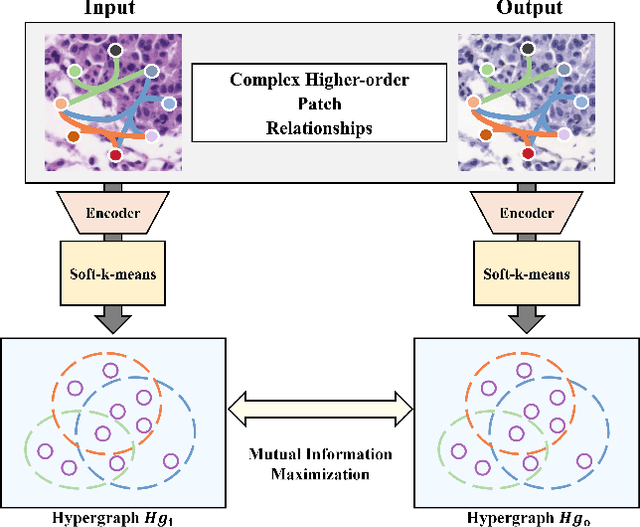
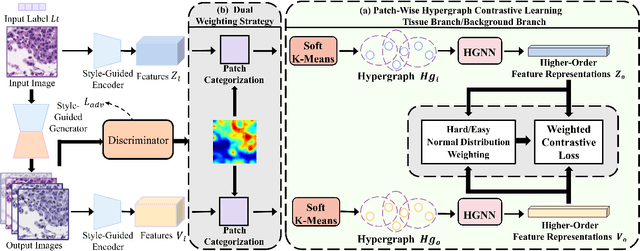
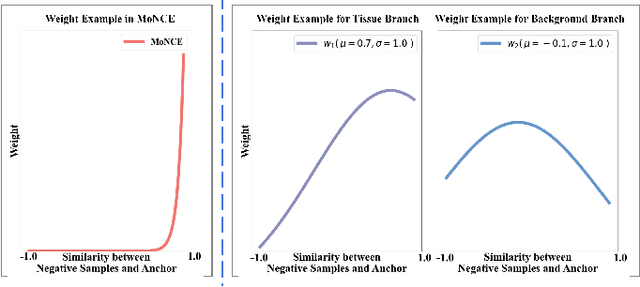
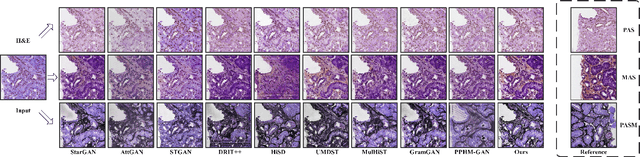
Virtual stain transfer leverages computer-assisted technology to transform the histochemical staining patterns of tissue samples into other staining types. However, existing methods often lose detailed pathological information due to the limitations of the cycle consistency assumption. To address this challenge, we propose STNHCL, a hypergraph-based patch-wise contrastive learning method. STNHCL captures higher-order relationships among patches through hypergraph modeling, ensuring consistent higher-order topology between input and output images. Additionally, we introduce a novel negative sample weighting strategy that leverages discriminator heatmaps to apply different weights based on the Gaussian distribution for tissue and background, thereby enhancing traditional weighting methods. Experiments demonstrate that STNHCL achieves state-of-the-art performance in the two main categories of stain transfer tasks. Furthermore, our model also performs excellently in downstream tasks. Code will be made available.