 Add to Chrome
 Add to Firefox
 Add to Edge
Before Reasoning Can Fail: Pre-Evidence Procedural Failures in Agentic RAG
Aug 04, 2026
Agentic retrieval-augmented generation (RAG) systems can fail before evidence-conditioned reasoning is tested: an agent may retrieve candidate snippets but finalize without inspecting them. We study this failure mode as a procedural property of the agent trajectory, decomposing wrong answers into pre-evidence discipline failures and post-gold-read failures using saved tool-call traces, retrieved evidence, read passages, and final answers. Across 12,000 paired trajectories on HotpotQA, 2WikiMultiHopQA, and MuSiQue, the two failure types are largely non-redundant: the both-trigger rate is in [11.2%, 13.1%] across regex and spaCy entity extractors. We then evaluate Read-Gate, a minimal runtime invariant requiring an agent to read after search and before finalization. Forced reading improves LLM-Acc by 14.9-19.9 points on trajectories that would otherwise skip reading and by 3.2-9.4 points on full minimal-reasoning cells. Additional diagnostics show that larger hidden thinking budgets do not necessarily increase evidence inspection. Together, these results indicate that evidence-gathering should be evaluated as a trajectory-level control problem, separately from answer-side reasoning.

Before Reasoning Fails: Pre-Evidence Procedural Failures in Agentic RAG
Aug 03, 2026Agentic retrieval-augmented generation (RAG) systems can fail before evidence-conditioned reasoning is tested: an agent may retrieve candidate snippets but finalize without inspecting them. We study this failure mode as a procedural property of the agent trajectory, decomposing wrong answers into pre-evidence discipline failures and post-gold-read failures using saved tool-call traces, retrieved evidence, read passages, and final answers. Across 12,000 paired trajectories on HotpotQA, 2WikiMultiHopQA, and MuSiQue, the two failure types are largely non-redundant: the both-trigger rate is in [11.2%, 13.1%] across regex and spaCy entity extractors. We then evaluate Read-Gate, a minimal runtime invariant requiring an agent to read after search and before finalization. Forced reading improves LLM-Acc by 14.9-19.9 points on trajectories that would otherwise skip reading and by 3.2-9.4 points on full minimal-reasoning cells. Additional diagnostics show that larger hidden thinking budgets do not necessarily increase evidence inspection. Together, these results indicate that evidence-gathering should be evaluated as a trajectory-level control problem, separately from answer-side reasoning.
HALT: Verification-Aware Stopping for Retrieval-Augmented Search Agents
Aug 03, 2026Retrieval-augmented search agents answer multi-hop questions by repeatedly issuing search queries and accumulating evidence. This creates a stopping problem: after the necessary evidence has appeared, further retrieval often adds cost, latency, and distracting context rather than useful information. We frame stopping as evidence coverage rather than generator confidence, and introduce HALT, a lightweight verification-aware policy that leaves the search agent unchanged. Given expected hop claims, HALT stops only when cumulative evidence supports each required claim. Across three multi-hop QA benchmarks, HALT reduces redundant search while largely preserving exact match. We separate a deployable setting, where hop claims are generated from the question, from a diagnostic upper bound that uses gold supporting-fact annotations: generated claims give smaller but still exact-match-preserving savings, while gold claims show the larger savings available when hop targets are clean. Baseline comparisons and ablations show that this behavior is driven by claim-evidence alignment rather than generic sufficiency, fixed stop positions, or lexical overlap. Open-corpus pilots further suggest that HALT abstains when coverage cannot be reliably verified. Overall, evidence coverage provides a practical runtime control signal for improving retrieval-augmented agents without retraining or modifying the host agent.
RaLMPH: Reliability-aware Learning for Multi-Pathologist Harmonization in Whole-Slide Image Classification
Jun 17, 2026Multiple Instance Learning (MIL) is a standard paradigm for Whole-Slide Image (WSI) analysis and has achieved strong results in computational pathology. However, most MIL pipelines assume a single "gold" label per slide, which conflicts with clinical practice where substantial inter-pathologist variability is common. Existing multi-annotator learning and label-refinement methods typically estimate global annotator reliability or rely on single-instance assumptions, making them poorly suited to MIL and to localized diagnostic contexts where experts disagree. We propose RaLMPH (Reliability-aware Learning for Multi-Pathologist Harmonization), a MIL-based label reconciliation framework for WSIs annotated by multiple pathologists. RaLMPH introduces a reliability field that jointly models (i) local neighborhood structure in WSI feature space and (ii) expert uncertainty (entropy), enabling per-sample identification of trustworthy reference neighborhoods. Leveraging this field, RaLMPH performs sample-wise local annotator ranking to select reliable opinions per slide and applies an adaptive gating mechanism to fuse labels conditioned on local reliability. Experiments on a clinical WSI dataset with labels from six pathologists, as well as controlled simulated benchmarks, show that RaLMPH consistently outperforms existing approaches. Further analyses clarify how our reliability-aware mechanism improves label reconciliation and downstream MIL performance.
Every Preference Has Its Strength: Injecting Ordinal Semantics into LLM-Based Recommenders
May 11, 2026Recent work has shown that large language models (LLMs) can enhance recommender systems by integrating collaborative filtering (CF) signals through hybrid prompting. However, most existing CF-LLM frameworks collapse explicit ratings into implicit or positive-only feedback, discarding the ordinal structure that conveys fine-grained preference strength. As a result, these models struggle to exploit graded semantics and nuanced preference distinctions. We propose Ordinal Semantic Anchoring (OSA), a hybrid CF-LLM framework that explicitly incorporates preference strength by modeling interaction-level user feedback. OSA represents ordinal preference levels as numeric textual tokens and uses their token embeddings as semantic anchors to align user-item interaction representations in the LLM latent space. Through strength-aware alignment across ordinal levels, OSA preserves preference semantics when integrating collaborative signals with LLMs. Experiments on multiple real-world datasets demonstrate that OSA consistently outperforms existing baselines, particularly in pairwise preference evaluation, highlighting its effectiveness in modeling fine-grained user preferences over prior CF-LLM methods.
Every Error has Its Magnitude: Asymmetric Mistake Severity Training for Multiclass Multiple Instance Learning
Mar 14, 2026Multiple Instance Learning (MIL) has emerged as a promising paradigm for Whole Slide Image (WSI) diagnosis, offering effective learning with limited annotations. However, existing MIL frameworks overlook diagnostic priorities and fail to differentiate the severity of misclassifications in multiclass, leaving clinically critical errors unaddressed. We propose a mistake-severity-aware training strategy that organizes diagnostic classes into a hierarchical structure, with each level optimized using a severity-weighted cross-entropy loss that penalizes high-severity misclassifications more strongly. Additionally, hierarchical consistency is enforced through probabilistic alignment, a semantic feature remix applied to the instance bag to robustly train class priority and accommodate clinical cases involving multiple symptoms. An asymmetric Mikel's Wheel-based metric is also introduced to quantify the severity of errors specific to medical fields. Experiments on challenging public and real-world in-house datasets demonstrate that our approach significantly mitigates critical errors in MIL diagnosis compared to existing methods. We present additional experimental results on natural domain data to demonstrate the generalizability of our proposed method beyond medical contexts.
Rethinking LLM-Based Recommendations: A Query Generation-Based, Training-Free Approach
Apr 16, 2025Existing large language model LLM-based recommendation methods face several challenges, including inefficiency in handling large candidate pools, sensitivity to item order within prompts ("lost in the middle" phenomenon) poor scalability, and unrealistic evaluation due to random negative sampling. To address these issues, we propose a Query-to-Recommendation approach that leverages LLMs to generate personalized queries for retrieving relevant items from the entire candidate pool, eliminating the need for candidate pre-selection. This method can be integrated into an ID-based recommendation system without additional training, enhances recommendation performance and diversity through LLMs' world knowledge, and performs well even for less popular item groups. Experiments on three datasets show up to 57 percent improvement, with an average gain of 31 percent, demonstrating strong zero-shot performance and further gains when ensembled with existing models.
Closer through commonality: Enhancing hypergraph contrastive learning with shared groups
Feb 12, 2025Hypergraphs provide a superior modeling framework for representing complex multidimensional relationships in the context of real-world interactions that often occur in groups, overcoming the limitations of traditional homogeneous graphs. However, there have been few studies on hypergraphbased contrastive learning, and existing graph-based contrastive learning methods have not been able to fully exploit the highorder correlation information in hypergraphs. Here, we propose a Hypergraph Fine-grained contrastive learning (HyFi) method designed to exploit the complex high-dimensional information inherent in hypergraphs. While avoiding traditional graph augmentation methods that corrupt the hypergraph topology, the proposed method provides a simple and efficient learning augmentation function by adding noise to node features. Furthermore, we expands beyond the traditional dichotomous relationship between positive and negative samples in contrastive learning by introducing a new relationship of weak positives. It demonstrates the importance of fine-graining positive samples in contrastive learning. Therefore, HyFi is able to produce highquality embeddings, and outperforms both supervised and unsupervised baselines in average rank on node classification across 10 datasets. Our approach effectively exploits high-dimensional hypergraph information, shows significant improvement over existing graph-based contrastive learning methods, and is efficient in terms of training speed and GPU memory cost. The source code is available at https://github.com/Noverse0/HyFi.git.
ProbGate at EHRSQL 2024: Enhancing SQL Query Generation Accuracy through Probabilistic Threshold Filtering and Error Handling
Apr 25, 2024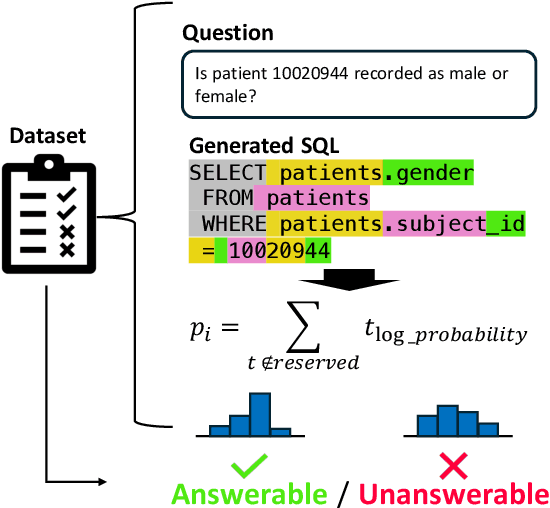
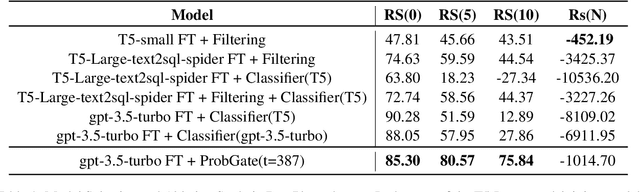
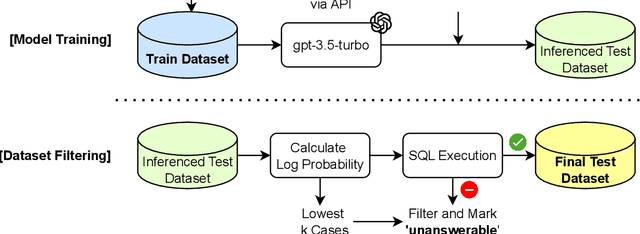
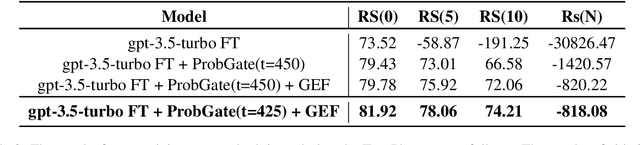
Recently, deep learning-based language models have significantly enhanced text-to-SQL tasks, with promising applications in retrieving patient records within the medical domain. One notable challenge in such applications is discerning unanswerable queries. Through fine-tuning model, we demonstrate the feasibility of converting medical record inquiries into SQL queries. Additionally, we introduce an entropy-based method to identify and filter out unanswerable results. We further enhance result quality by filtering low-confidence SQL through log probability-based distribution, while grammatical and schema errors are mitigated by executing queries on the actual database. We experimentally verified that our method can filter unanswerable questions, which can be widely utilized even when the parameters of the model are not accessible, and that it can be effectively utilized in practice.