 Add to Chrome
 Add to Firefox
 Add to Edge
3D Assembly
Papers and Code
Towards Autonomous Instrument Tray Assembly for Sterile Processing Applications
Feb 02, 2026
The Sterile Processing and Distribution (SPD) department is responsible for cleaning, disinfecting, inspecting, and assembling surgical instruments between surgeries. Manual inspection and preparation of instrument trays is a time-consuming, error-prone task, often prone to contamination and instrument breakage. In this work, we present a fully automated robotic system that sorts and structurally packs surgical instruments into sterile trays, focusing on automation of the SPD assembly stage. A custom dataset comprising 31 surgical instruments and 6,975 annotated images was collected to train a hybrid perception pipeline using YOLO12 for detection and a cascaded ResNet-based model for fine-grained classification. The system integrates a calibrated vision module, a 6-DOF Staubli TX2-60L robotic arm with a custom dual electromagnetic gripper, and a rule-based packing algorithm that reduces instrument collisions during transport. The packing framework uses 3D printed dividers and holders to physically isolate instruments, reducing collision and friction during transport. Experimental evaluations show high perception accuracy and statistically significant reduction in tool-to-tool collisions compared to human-assembled trays. This work serves as the scalable first step toward automating SPD workflows, improving safety, and consistency of surgical preparation while reducing SPD processing times.

Learning to Build Shapes by Extrusion
Jan 30, 2026We introduce Text Encoded Extrusion (TEE), a text-based representation that expresses mesh construction as sequences of face extrusions rather than polygon lists, and a method for generating 3D meshes from TEE using a large language model (LLM). By learning extrusion sequences that assemble a mesh, similar to the way artists create meshes, our approach naturally supports arbitrary output face counts and produces manifold meshes by design, in contrast to recent transformer-based models. The learnt extrusion sequences can also be applied to existing meshes - enabling editing in addition to generation. To train our model, we decompose a library of quadrilateral meshes with non-self-intersecting face loops into constituent loops, which can be viewed as their building blocks, and finetune an LLM on the steps for reassembling the meshes by performing a sequence of extrusions. We demonstrate that our representation enables reconstruction, novel shape synthesis, and the addition of new features to existing meshes.
Quartet of Diffusions: Structure-Aware Point Cloud Generation through Part and Symmetry Guidance
Jan 28, 2026We introduce the Quartet of Diffusions, a structure-aware point cloud generation framework that explicitly models part composition and symmetry. Unlike prior methods that treat shape generation as a holistic process or only support part composition, our approach leverages four coordinated diffusion models to learn distributions of global shape latents, symmetries, semantic parts, and their spatial assembly. This structured pipeline ensures guaranteed symmetry, coherent part placement, and diverse, high-quality outputs. By disentangling the generative process into interpretable components, our method supports fine-grained control over shape attributes, enabling targeted manipulation of individual parts while preserving global consistency. A central global latent further reinforces structural coherence across assembled parts. Our experiments show that the Quartet achieves state-of-the-art performance. To our best knowledge, this is the first 3D point cloud generation framework that fully integrates and enforces both symmetry and part priors throughout the generative process.
ME-WARD: A multimodal ergonomic analysis tool for musculoskeletal risk assessment from inertial and video data in working plac
Jan 24, 2026This study presents ME-WARD (Multimodal Ergonomic Workplace Assessment and Risk from Data), a novel system for ergonomic assessment and musculoskeletal risk evaluation that implements the Rapid Upper Limb Assessment (RULA) method. ME-WARD is designed to process joint angle data from motion capture systems, including inertial measurement unit (IMU)-based setups, and deep learning human body pose tracking models. The tool's flexibility enables ergonomic risk assessment using any system capable of reliably measuring joint angles, extending the applicability of RULA beyond proprietary setups. To validate its performance, the tool was tested in an industrial setting during the assembly of conveyor belts, which involved high-risk tasks such as inserting rods and pushing conveyor belt components. The experiments leveraged gold standard IMU systems alongside a state-of-the-art monocular 3D pose estimation system. The results confirmed that ME-WARD produces reliable RULA scores that closely align with IMU-derived metrics for flexion-dominated movements and comparable performance with the monocular system, despite limitations in tracking lateral and rotational motions. This work highlights the potential of integrating multiple motion capture technologies into a unified and accessible ergonomic assessment pipeline. By supporting diverse input sources, including low-cost video-based systems, the proposed multimodal approach offers a scalable, cost-effective solution for ergonomic assessments, paving the way for broader adoption in resource-constrained industrial environments.
* 19 pages
Copy-Trasform-Paste: Zero-Shot Object-Object Alignment Guided by Vision-Language and Geometric Constraints
Jan 20, 2026We study zero-shot 3D alignment of two given meshes, using a text prompt describing their spatial relation -- an essential capability for content creation and scene assembly. Earlier approaches primarily rely on geometric alignment procedures, while recent work leverages pretrained 2D diffusion models to model language-conditioned object-object spatial relationships. In contrast, we directly optimize the relative pose at test time, updating translation, rotation, and isotropic scale with CLIP-driven gradients via a differentiable renderer, without training a new model. Our framework augments language supervision with geometry-aware objectives: a variant of soft-Iterative Closest Point (ICP) term to encourage surface attachment and a penetration loss to discourage interpenetration. A phased schedule strengthens contact constraints over time, and camera control concentrates the optimization on the interaction region. To enable evaluation, we curate a benchmark containing diverse categories and relations, and compare against baselines. Our method outperforms all alternatives, yielding semantically faithful and physically plausible alignments.
Enhancing Spatial Reasoning in Large Language Models for Metal-Organic Frameworks Structure Prediction
Jan 14, 2026Metal-organic frameworks (MOFs) are porous crystalline materials with broad applications such as carbon capture and drug delivery, yet accurately predicting their 3D structures remains a significant challenge. While Large Language Models (LLMs) have shown promise in generating crystals, their application to MOFs is hindered by MOFs' high atomic complexity. Inspired by the success of block-wise paradigms in deep generative models, we pioneer the use of LLMs in this domain by introducing MOF-LLM, the first LLM framework specifically adapted for block-level MOF structure prediction. To effectively harness LLMs for this modular assembly task, our training paradigm integrates spatial-aware continual pre-training (CPT), structural supervised fine-tuning (SFT), and matching-driven reinforcement learning (RL). By incorporating explicit spatial priors and optimizing structural stability via Soft Adaptive Policy Optimization (SAPO), our approach substantially enhances the spatial reasoning capability of a Qwen-3 8B model for accurate MOF structure prediction. Comprehensive experiments demonstrate that MOF-LLM outperforms state-of-the-art denoising-based and LLM-based methods while exhibiting superior sampling efficiency.
Muses: Designing, Composing, Generating Nonexistent Fantasy 3D Creatures without Training
Jan 06, 2026We present Muses, the first training-free method for fantastic 3D creature generation in a feed-forward paradigm. Previous methods, which rely on part-aware optimization, manual assembly, or 2D image generation, often produce unrealistic or incoherent 3D assets due to the challenges of intricate part-level manipulation and limited out-of-domain generation. In contrast, Muses leverages the 3D skeleton, a fundamental representation of biological forms, to explicitly and rationally compose diverse elements. This skeletal foundation formalizes 3D content creation as a structure-aware pipeline of design, composition, and generation. Muses begins by constructing a creatively composed 3D skeleton with coherent layout and scale through graph-constrained reasoning. This skeleton then guides a voxel-based assembly process within a structured latent space, integrating regions from different objects. Finally, image-guided appearance modeling under skeletal conditions is applied to generate a style-consistent and harmonious texture for the assembled shape. Extensive experiments establish Muses' state-of-the-art performance in terms of visual fidelity and alignment with textual descriptions, and potential on flexible 3D object editing. Project page: https://luhexiao.github.io/Muses.github.io/.
Unified Primitive Proxies for Structured Shape Completion
Jan 02, 2026Structured shape completion recovers missing geometry as primitives rather than as unstructured points, which enables primitive-based surface reconstruction. Instead of following the prevailing cascade, we rethink how primitives and points should interact, and find it more effective to decode primitives in a dedicated pathway that attends to shared shape features. Following this principle, we present UniCo, which in a single feed-forward pass predicts a set of primitives with complete geometry, semantics, and inlier membership. To drive this unified representation, we introduce primitive proxies, learnable queries that are contextualized to produce assembly-ready outputs. To ensure consistent optimization, our training strategy couples primitives and points with online target updates. Across synthetic and real-world benchmarks with four independent assembly solvers, UniCo consistently outperforms recent baselines, lowering Chamfer distance by up to 50% and improving normal consistency by up to 7%. These results establish an attractive recipe for structured 3D understanding from incomplete data. Project page: https://unico-completion.github.io.
PalpAid: Multimodal Pneumatic Tactile Sensor for Tissue Palpation
Dec 22, 2025The tactile properties of tissue, such as elasticity and stiffness, often play an important role in surgical oncology when identifying tumors and pathological tissue boundaries. Though extremely valuable, robot-assisted surgery comes at the cost of reduced sensory information to the surgeon; typically, only vision is available. Sensors proposed to overcome this sensory desert are often bulky, complex, and incompatible with the surgical workflow. We present PalpAid, a multimodal pneumatic tactile sensor equipped with a microphone and pressure sensor, converting contact force into an internal pressure differential. The pressure sensor acts as an event detector, while the auditory signature captured by the microphone assists in tissue delineation. We show the design, fabrication, and assembly of sensory units with characterization tests to show robustness to use, inflation-deflation cycles, and integration with a robotic system. Finally, we show the sensor's ability to classify 3D-printed hard objects with varying infills and soft ex vivo tissues. Overall, PalpAid aims to fill the sensory gap intelligently and allow improved clinical decision-making.
LitePT: Lighter Yet Stronger Point Transformer
Dec 15, 2025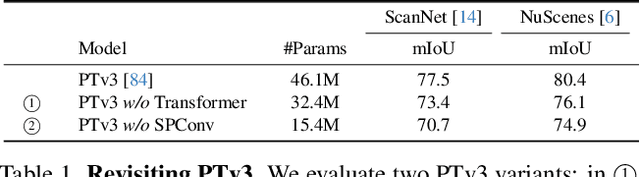
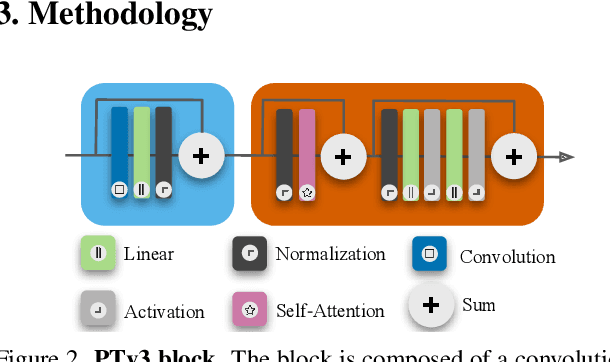

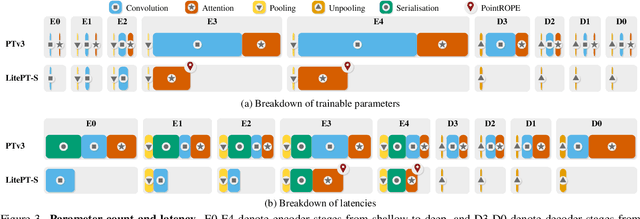
Modern neural architectures for 3D point cloud processing contain both convolutional layers and attention blocks, but the best way to assemble them remains unclear. We analyse the role of different computational blocks in 3D point cloud networks and find an intuitive behaviour: convolution is adequate to extract low-level geometry at high-resolution in early layers, where attention is expensive without bringing any benefits; attention captures high-level semantics and context in low-resolution, deep layers more efficiently. Guided by this design principle, we propose a new, improved 3D point cloud backbone that employs convolutions in early stages and switches to attention for deeper layers. To avoid the loss of spatial layout information when discarding redundant convolution layers, we introduce a novel, training-free 3D positional encoding, PointROPE. The resulting LitePT model has $3.6\times$ fewer parameters, runs $2\times$ faster, and uses $2\times$ less memory than the state-of-the-art Point Transformer V3, but nonetheless matches or even outperforms it on a range of tasks and datasets. Code and models are available at: https://github.com/prs-eth/LitePT.