 Add to Chrome
 Add to Firefox
 Add to Edge
ViPS: Video-informed Pose Spaces for Auto-Rigged Meshes
Apr 19, 2026
Kinematic rigs provide a structured interface for articulating 3D meshes, but they lack an inherent representation of the plausible manifold of joint configurations for a given asset. Without such a pose space, stochastic sampling or manual manipulation of raw rig parameters often leads to semantic or geometric violations, such as anatomical hyperextension and non-physical self-intersections. We propose Video-informed Pose Spaces (ViPS), a feed-forward framework that discovers the latent distribution of valid articulations for auto-rigged meshes by distilling motion priors from a pretrained video diffusion model. Unlike existing methods that rely on scarce artist-authored 4D datasets, ViPS transfers generative video priors into a universal distribution over a given rig parameterization. Differentiable geometric validators applied to the skinned mesh enforce asset-specific validity without requiring manual regularizers. Our model learns a smooth, compact, and controllable pose space that supports diverse sampling, manifold projection for inverse kinematics, and temporally coherent trajectories for keyframing. Furthermore, the distilled 3D pose samples serve as precise semantic proxies for guiding video diffusion, effectively closing the loop between generative 2D priors and structured 3D kinematic control. Our evaluations show that ViPS, trained solely on video priors, matches the performance of state-of-the-art methods trained on synthetic artist-created 4D data in both plausibility and diversity. Most importantly, as a universal model, ViPS demonstrates robust zero-shot generalization to out-of-distribution species and unseen skeletal topologies.

Learning to Build Shapes by Extrusion
Jan 30, 2026We introduce Text Encoded Extrusion (TEE), a text-based representation that expresses mesh construction as sequences of face extrusions rather than polygon lists, and a method for generating 3D meshes from TEE using a large language model (LLM). By learning extrusion sequences that assemble a mesh, similar to the way artists create meshes, our approach naturally supports arbitrary output face counts and produces manifold meshes by design, in contrast to recent transformer-based models. The learnt extrusion sequences can also be applied to existing meshes - enabling editing in addition to generation. To train our model, we decompose a library of quadrilateral meshes with non-self-intersecting face loops into constituent loops, which can be viewed as their building blocks, and finetune an LLM on the steps for reassembling the meshes by performing a sequence of extrusions. We demonstrate that our representation enables reconstruction, novel shape synthesis, and the addition of new features to existing meshes.
Motion Modes: What Could Happen Next?
Nov 29, 2024
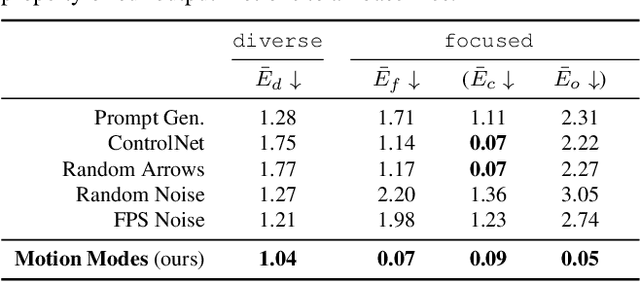
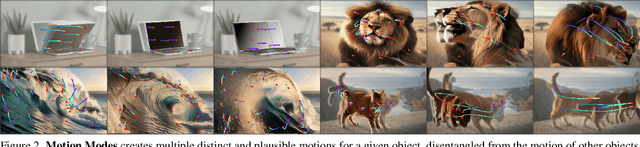
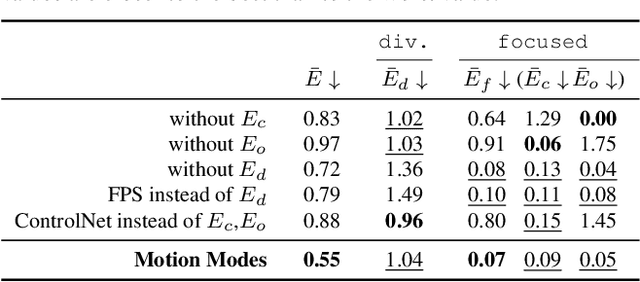
Predicting diverse object motions from a single static image remains challenging, as current video generation models often entangle object movement with camera motion and other scene changes. While recent methods can predict specific motions from motion arrow input, they rely on synthetic data and predefined motions, limiting their application to complex scenes. We introduce Motion Modes, a training-free approach that explores a pre-trained image-to-video generator's latent distribution to discover various distinct and plausible motions focused on selected objects in static images. We achieve this by employing a flow generator guided by energy functions designed to disentangle object and camera motion. Additionally, we use an energy inspired by particle guidance to diversify the generated motions, without requiring explicit training data. Experimental results demonstrate that Motion Modes generates realistic and varied object animations, surpassing previous methods and even human predictions regarding plausibility and diversity. Project Webpage: https://motionmodes.github.io/
Diffusion Handles: Enabling 3D Edits for Diffusion Models by Lifting Activations to 3D
Dec 06, 2023


Diffusion Handles is a novel approach to enabling 3D object edits on diffusion images. We accomplish these edits using existing pre-trained diffusion models, and 2D image depth estimation, without any fine-tuning or 3D object retrieval. The edited results remain plausible, photo-real, and preserve object identity. Diffusion Handles address a critically missing facet of generative image based creative design, and significantly advance the state-of-the-art in generative image editing. Our key insight is to lift diffusion activations for an object to 3D using a proxy depth, 3D-transform the depth and associated activations, and project them back to image space. The diffusion process applied to the manipulated activations with identity control, produces plausible edited images showing complex 3D occlusion and lighting effects. We evaluate Diffusion Handles: quantitatively, on a large synthetic data benchmark; and qualitatively by a user study, showing our output to be more plausible, and better than prior art at both, 3D editing and identity control. Project Webpage: https://diffusionhandles.github.io/