 Add to Chrome
 Add to Firefox
 Add to Edge
Learning to Build Shapes by Extrusion
Jan 30, 2026
We introduce Text Encoded Extrusion (TEE), a text-based representation that expresses mesh construction as sequences of face extrusions rather than polygon lists, and a method for generating 3D meshes from TEE using a large language model (LLM). By learning extrusion sequences that assemble a mesh, similar to the way artists create meshes, our approach naturally supports arbitrary output face counts and produces manifold meshes by design, in contrast to recent transformer-based models. The learnt extrusion sequences can also be applied to existing meshes - enabling editing in addition to generation. To train our model, we decompose a library of quadrilateral meshes with non-self-intersecting face loops into constituent loops, which can be viewed as their building blocks, and finetune an LLM on the steps for reassembling the meshes by performing a sequence of extrusions. We demonstrate that our representation enables reconstruction, novel shape synthesis, and the addition of new features to existing meshes.

De-homogenization using Convolutional Neural Networks
May 10, 2021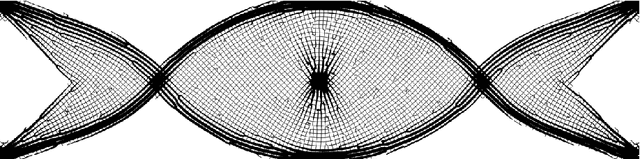
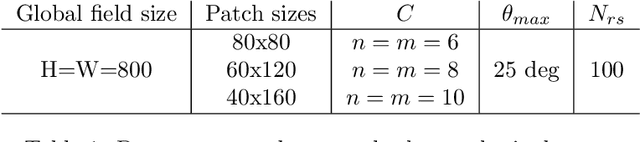
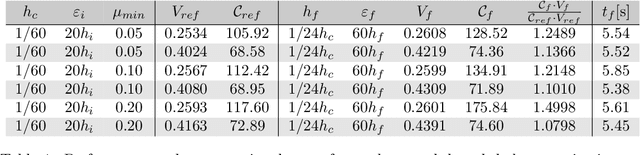
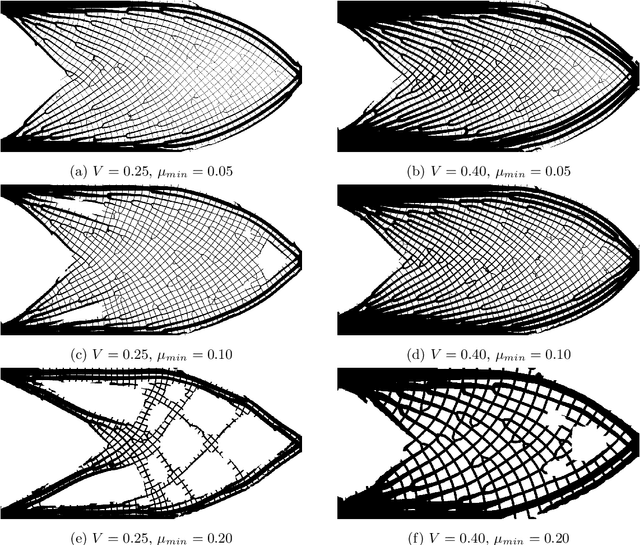
This paper presents a deep learning-based de-homogenization method for structural compliance minimization. By using a convolutional neural network to parameterize the mapping from a set of lamination parameters on a coarse mesh to a one-scale design on a fine mesh, we avoid solving the least square problems associated with traditional de-homogenization approaches and save time correspondingly. To train the neural network, a two-step custom loss function has been developed which ensures a periodic output field that follows the local lamination orientations. A key feature of the proposed method is that the training is carried out without any use of or reference to the underlying structural optimization problem, which renders the proposed method robust and insensitive wrt. domain size, boundary conditions, and loading. A post-processing procedure utilizing a distance transform on the output field skeleton is used to project the desired lamination widths onto the output field while ensuring a predefined minimum length-scale and volume fraction. To demonstrate that the deep learning approach has excellent generalization properties, numerical examples are shown for several different load and boundary conditions. For an appropriate choice of parameters, the de-homogenized designs perform within $7-25\%$ of the homogenization-based solution at a fraction of the computational cost. With several options for further improvements, the scheme may provide the basis for future interactive high-resolution topology optimization.
Shape from Projections via Differentiable Forward Projector
Jun 29, 2020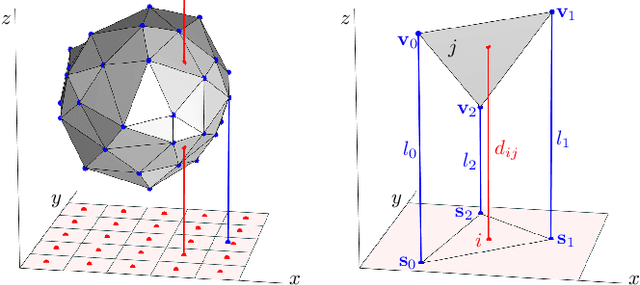
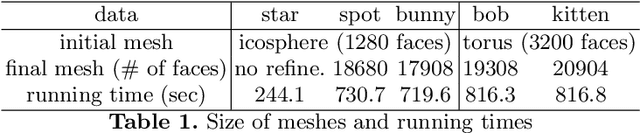
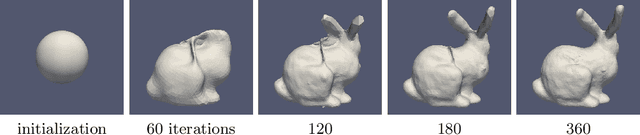
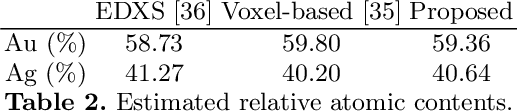
In tomography, forward projection of 3D meshes has been mostly studied to simulate data acquisition. However, such works did not consider an inverse process of estimating shapes from projections. In this paper, we propose a differentiable forward projector for 3D meshes, to bridge the gap between the forward model for 3D surfaces and optimization. We view the forward projection as a rendering process, and make it differentiable by extending a recent work in differentiable rasterization. We use the proposed forward projector to reconstruct 3D shapes directly from projections. Experimental results for single-object problems show that our method outperforms the traditional voxel-based methods on noisy simulated data. We also apply our method on real data from electron tomography to estimate the shapes of some nanoparticles.