 Add to Chrome
 Add to Firefox
 Add to Edge
Geometric Action Model for Robot Policy Learning
Jun 15, 2026
Generalist robot policies must follow user instructions while reasoning about how objects, cameras, and robot actions interact in the 3D physical world. Recent vision-language-action models (VLAs) and video world-action models (WAMs) inherit strong semantic or temporal priors from large-scale foundation models, but they still operate primarily on 2D image frames or 2D-derived latent spaces, leaving implicit the 3D geometry required for contact-rich manipulation. We propose the Geometric Action Model (GAM), a language-conditioned manipulation policy that directly repurposes a pretrained geometric foundation model (GFM) as a shared substrate for perception, temporal prediction, and action decoding. GAM splits the GFM at an intermediate layer: the shallow layers serve as an observation encoder, and a causal future predictor inserted at the split layer forecasts future latent tokens conditioned on language, proprioception, and action history. The predicted future tokens are then routed through the remaining GFM blocks for feature propagation and decoding, allowing a single backbone to produce both future geometry and actions. This design equips the GFM with language-conditioned temporal world modeling through minimal architectural modification while preserving its rich geometric priors. Across a broad suite of simulation and real-robot manipulation benchmarks, GAM is more accurate, more robust, faster, and lighter than current foundation-model-scale baselines.

PROSE: Training-Free Egocentric Scene Registration with Vision-Language Models
Jun 15, 2026Registering two captures of the same indoor space taken at different times underpins persistent spatial memory for robots and AR systems, yet the realistic version of this task is egocentric and its most scalable form is RGB-only. Head-mounted cameras yield blurry, fast-moving, partially overlapping views from which dense geometry is hard to recover. Classical registration leans on exactly the clean point clouds this setting lacks, while learned scene-graph methods require a pre-built or annotated graph and a trained matcher that we find brittle under egocentric data. We take a different route, using a pretrained vision-language model as the source of both scene understanding and cross-scan matching. Our method, PROSE (Prompted Scene rEgistration), lifts each RGB sequence into an object-level 3D scene graph using off-the-shelf foundation models for geometry, segmentation, and language, then prompts the same VLM to match object instances across the two RGB sequences. To make this matching tractable and reliable, we leverage object heights as a prior and verify each proposed match with a paired same/different query, then solve for the rigid transform by hypothesizing a candidate per matched object and selecting the one with the strongest geometric consensus. PROSE adds no learned parameters and requires no depth sensor, training, or annotated graph. On the egocentric Aria Digital Twin and Aria Everyday Activities benchmarks, it outperforms both geometric and learned scene-graph baselines in registration accuracy, on ground-truth and RGB-reconstructed point clouds alike, and the scene graph it produces transfers directly to downstream tasks.
ZipSplat: Fewer Gaussians, Better Splats
Jun 03, 2026Feed-forward 3D Gaussian Splatting methods reconstruct a scene from posed or pose-free images in a single forward pass, yet current approaches predict one Gaussian per input pixel, tying the representation budget to camera resolution rather than scene complexity. A flat wall and a richly textured object thus produce equally many Gaussians despite very different geometric needs. We propose ZipSplat, a token-based feed-forward model that decouples Gaussian placement from the pixel grid. A multi-view backbone extracts dense visual tokens, and k-means clustering compresses them into a compact set of scene tokens. Cross- and self-attention refine these tokens, and a lightweight MLP decodes each into a group of Gaussians with unconstrained 3D positions. Because clustering is applied at inference, a single trained model spans the quality-efficiency curve without retraining. ZipSplat operates without ground-truth poses or intrinsics, yet sets a new state of the art on DL3DV and RealEstate10K with ${\sim}6{\times}$ fewer Gaussians than pixel-aligned methods, surpassing the best pose-free baseline by 2.1dB and 1.2dB PSNR, respectively. It further generalizes zero-shot to Mip-NeRF360 and ScanNet++, outperforming all comparable baselines. Our project page is at ${\href{https://veichta.com/zipsplat}{https://veichta.com/zipsplat}}$.
Learning Global Motion with Compact Gaussians for Feed-Forward 4D Reconstruction
May 29, 2026Dynamic scene reconstruction from monocular video remains a fundamental challenge in computer vision. Existing feed-forward methods predict 3D Gaussians pixel-wise for each frame, suffering from duplicated Gaussians and view-dependent biases that hinder effective learning of scene motion. We present C4G, a feed-forward 4D reconstruction framework built upon a compact set of timestamp-conditioned learnable Gaussian query tokens. Each token aggregates corresponding features across the full temporal context and decodes a 3D Gaussian whose position is modulated by the target timestamp, enabling globally coherent motion modeling without per-scene optimization. To capture fine-grained details, we further introduce a video diffusion model-based rendering enhancement module. Since our framework effectively aggregates features into Gaussians, we extend this capability to feature lifting, producing a 4D feature field that supports point tracking and dynamic scene understanding. C4G achieves strong novel-view synthesis performance using significantly fewer Gaussians and without requiring camera poses, while exhibiting stronger motion modeling and robustness to large temporal gaps.
Entropy-Gradient Grounding: Training-Free Evidence Retrieval in Vision-Language Models
Apr 09, 2026Despite rapid progress, pretrained vision-language models still struggle when answers depend on tiny visual details or on combining clues spread across multiple regions, as in documents and compositional queries. We address this by framing grounding as test-time evidence retrieval: given a query, the model should actively identify where to look next to resolve ambiguity. To this end, we propose a training-free, model-intrinsic grounding method that uses uncertainty as supervision. Specifically, we compute the entropy of the model's next-token distribution and backpropagate it to the visual token embeddings to obtain an entropy-gradient relevance map, without auxiliary detectors or attention-map heuristics. We then extract and rank multiple coherent regions to support multi-evidence queries, and introduce an iterative zoom-and-reground procedure with a spatial-entropy stopping rule to avoid over-refinement. Experiments on seven benchmarks across four VLM architectures demonstrate consistent improvements over existing methods, with the largest gains on detail-critical and high-resolution settings, while also producing more interpretable evidence localizations.
TORA: Topological Representation Alignment for 3D Shape Assembly
Apr 05, 2026Flow-matching methods for 3D shape assembly learn point-wise velocity fields that transport parts toward assembled configurations, yet they receive no explicit guidance about which cross-part interactions should drive the motion. We introduce TORA, a topology-first representation alignment framework that distills relational structure from a frozen pretrained 3D encoder into the flow-matching backbone during training. We first realize this via simple instantiation, token-wise cosine matching, which injects the learned geometric descriptors from the teacher representation. We then extend to employ a Centered Kernel Alignment (CKA) loss to match the similarity structure between student and teacher representations for enhanced topological alignment. Through systematic probing of diverse 3D encoders, we show that geometry- and contact-centric teacher properties, not semantic classification ability, govern alignment effectiveness, and that alignment is most beneficial at later transformer layers where spatial structure naturally emerges. TORA introduces zero inference overhead while yielding two consistent benefits: faster convergence (up to 6.9$\times$) and improved accuracy in-distribution, along with greater robustness under domain shift. Experiments on five benchmarks spanning geometric, semantic, and inter-object assembly demonstrate state-of-the-art performance, with particularly pronounced gains in zero-shot transfer to unseen real-world and synthetic datasets. Project page: https://nahyuklee.github.io/tora.
TETO: Tracking Events with Teacher Observation for Motion Estimation and Frame Interpolation
Mar 24, 2026Event cameras capture per-pixel brightness changes with microsecond resolution, offering continuous motion information lost between RGB frames. However, existing event-based motion estimators depend on large-scale synthetic data that often suffers from a significant sim-to-real gap. We propose TETO (Tracking Events with Teacher Observation), a teacher-student framework that learns event motion estimation from only $\sim$25 minutes of unannotated real-world recordings through knowledge distillation from a pretrained RGB tracker. Our motion-aware data curation and query sampling strategy maximizes learning from limited data by disentangling object motion from dominant ego-motion. The resulting estimator jointly predicts point trajectories and dense optical flow, which we leverage as explicit motion priors to condition a pretrained video diffusion transformer for frame interpolation. We achieve state-of-the-art point tracking on EVIMO2 and optical flow on DSEC using orders of magnitude less training data, and demonstrate that accurate motion estimation translates directly to superior frame interpolation quality on BS-ERGB and HQ-EVFI.
Moving Beyond Sparse Grounding with Complete Screen Parsing Supervision
Feb 15, 2026Modern computer-use agents (CUA) must perceive a screen as a structured state, what elements are visible, where they are, and what text they contain, before they can reliably ground instructions and act. Yet, most available grounding datasets provide sparse supervision, with insufficient and low-diversity labels that annotate only a small subset of task-relevant elements per screen, which limits both coverage and generalization; moreover, practical deployment requires efficiency to enable low-latency, on-device use. We introduce ScreenParse, a large-scale dataset for complete screen parsing, with dense annotations of all visible UI elements (boxes, 55-class types, and text) across 771K web screenshots (21M elements). ScreenParse is generated by Webshot, an automated, scalable pipeline that renders diverse urls, extracts annotations and applies VLM-based relabeling and quality filtering. Using ScreenParse, we train ScreenVLM, a compact, 316M-parameter vision language model (VLM) that decodes a compact ScreenTag markup representation with a structure-aware loss that upweights structure-critical tokens. ScreenVLM substantially outperforms much larger foundation VLMs on dense parsing (e.g., 0.592 vs. 0.294 PageIoU on ScreenParse) and shows strong transfer to public benchmarks. Moreover, finetuning foundation VLMs on ScreenParse consistently improves their grounding performance, suggesting that dense screen supervision provides transferable structural priors for UI understanding. Project page: https://saidgurbuz.github.io/screenparse/.
LitePT: Lighter Yet Stronger Point Transformer
Dec 15, 2025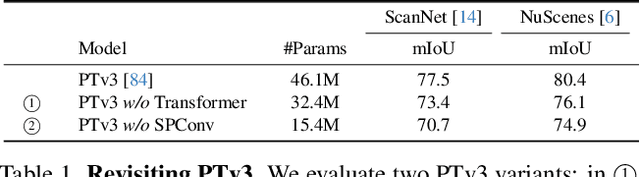
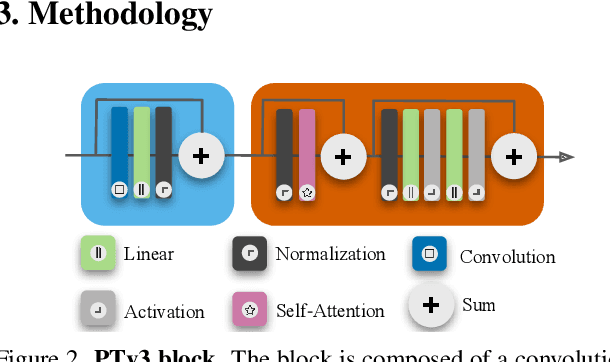

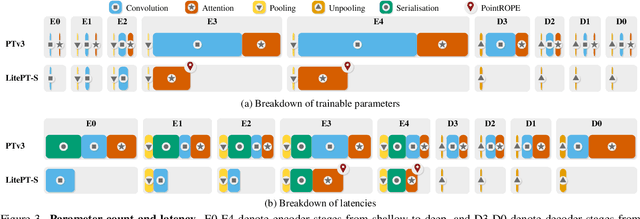
Modern neural architectures for 3D point cloud processing contain both convolutional layers and attention blocks, but the best way to assemble them remains unclear. We analyse the role of different computational blocks in 3D point cloud networks and find an intuitive behaviour: convolution is adequate to extract low-level geometry at high-resolution in early layers, where attention is expensive without bringing any benefits; attention captures high-level semantics and context in low-resolution, deep layers more efficiently. Guided by this design principle, we propose a new, improved 3D point cloud backbone that employs convolutions in early stages and switches to attention for deeper layers. To avoid the loss of spatial layout information when discarding redundant convolution layers, we introduce a novel, training-free 3D positional encoding, PointROPE. The resulting LitePT model has $3.6\times$ fewer parameters, runs $2\times$ faster, and uses $2\times$ less memory than the state-of-the-art Point Transformer V3, but nonetheless matches or even outperforms it on a range of tasks and datasets. Code and models are available at: https://github.com/prs-eth/LitePT.
Visual Representation Alignment for Multimodal Large Language Models
Sep 09, 2025Multimodal large language models (MLLMs) trained with visual instruction tuning have achieved strong performance across diverse tasks, yet they remain limited in vision-centric tasks such as object counting or spatial reasoning. We attribute this gap to the prevailing text-only supervision paradigm, which provides only indirect guidance for the visual pathway and often leads MLLMs to discard fine-grained visual details during training. In this paper, we present VIsual Representation ALignment (VIRAL), a simple yet effective regularization strategy that aligns the internal visual representations of MLLMs with those of pre-trained vision foundation models (VFMs). By explicitly enforcing this alignment, VIRAL enables the model not only to retain critical visual details from the input vision encoder but also to complement additional visual knowledge from VFMs, thereby enhancing its ability to reason over complex visual inputs. Our experiments demonstrate consistent improvements across all tasks on widely adopted multimodal benchmarks. Furthermore, we conduct comprehensive ablation studies to validate the key design choices underlying our framework. We believe this simple finding opens up an important direction for the effective integration of visual information in training MLLMs.