 Add to Chrome
 Add to Firefox
 Add to Edge
Deformable Radial Kernel Splatting
Dec 16, 2024
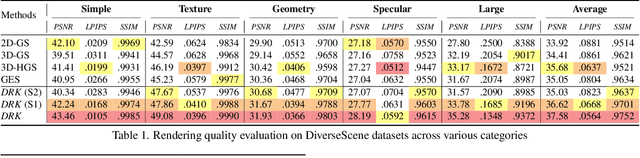
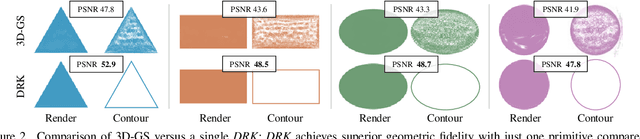
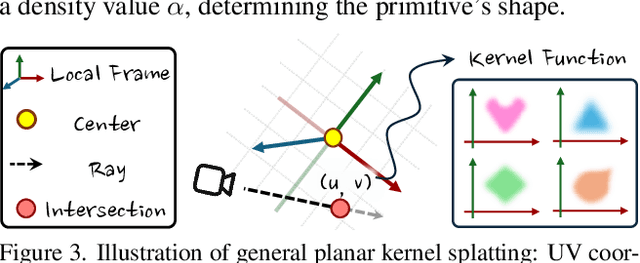
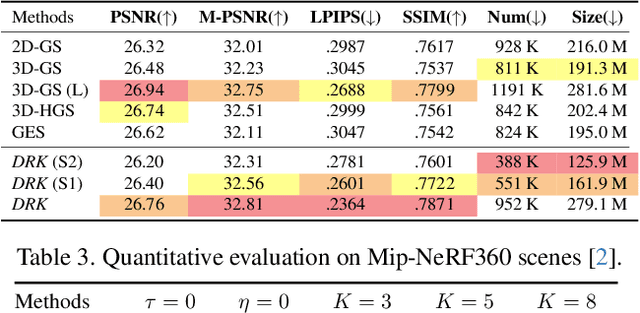
Recently, Gaussian splatting has emerged as a robust technique for representing 3D scenes, enabling real-time rasterization and high-fidelity rendering. However, Gaussians' inherent radial symmetry and smoothness constraints limit their ability to represent complex shapes, often requiring thousands of primitives to approximate detailed geometry. We introduce Deformable Radial Kernel (DRK), which extends Gaussian splatting into a more general and flexible framework. Through learnable radial bases with adjustable angles and scales, DRK efficiently models diverse shape primitives while enabling precise control over edge sharpness and boundary curvature. iven DRK's planar nature, we further develop accurate ray-primitive intersection computation for depth sorting and introduce efficient kernel culling strategies for improved rasterization efficiency. Extensive experiments demonstrate that DRK outperforms existing methods in both representation efficiency and rendering quality, achieving state-of-the-art performance while dramatically reducing primitive count.

Weighted-Reward Preference Optimization for Implicit Model Fusion
Dec 04, 2024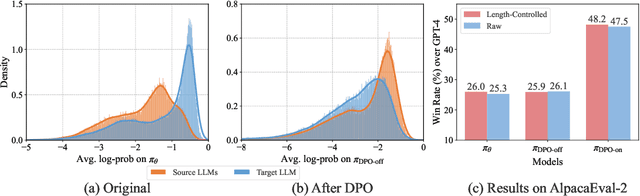
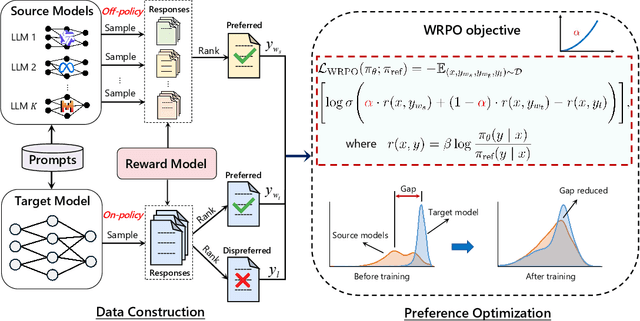
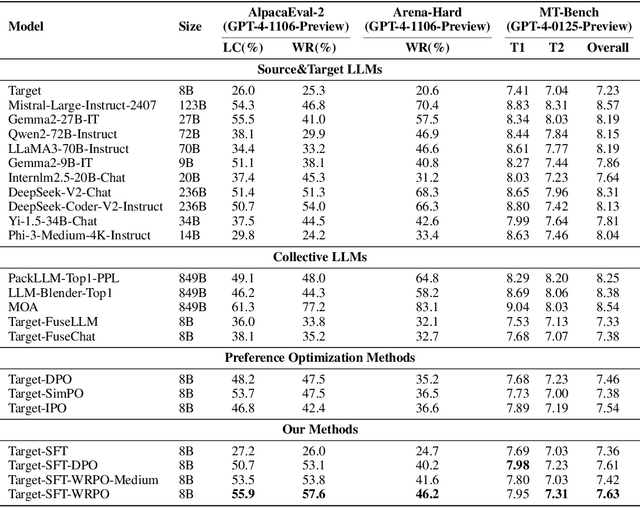
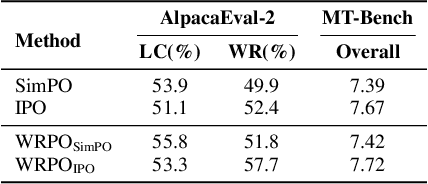
While fusing heterogeneous open-source LLMs with varying architectures and sizes can potentially integrate the strengths of different models, existing fusion methods face significant challenges, such as vocabulary alignment and merging distribution matrices. These procedures are not only complex but also prone to introducing noise and errors. In this paper, we propose an implicit fusion method, Weighted-Reward Preference Optimization (WRPO), which leverages preference optimization between the source LLMs and the target LLM to transfer their capabilities effectively. WRPO eliminates the need for vocabulary alignment and matrix fusion and can be efficiently scaled to accommodate various LLMs. To address distributional deviations between the source and target LLMs, WRPO introduces a progressive adaptation strategy that gradually shifts reliance on preferred examples from the target LLM to the source LLMs. Extensive experiments on the MT-Bench, AlpacaEval-2, and Arena-Hard benchmarks demonstrate that WRPO consistently outperforms existing knowledge fusion methods and various fine-tuning baselines. When applied to LLaMA3-8B-Instruct as the target model, WRPO achieves a length-controlled win rate of 55.9% against GPT-4-Preview-1106 on AlpacaEval-2 and a win rate of 46.2% against GPT-4-0314 on Arena-Hard. Our code is available at \url{https://github.com/SLIT-AI/WRPO}.
OASIS: Open Agent Social Interaction Simulations with One Million Agents
Nov 26, 2024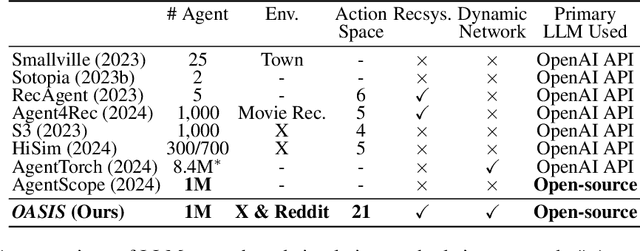

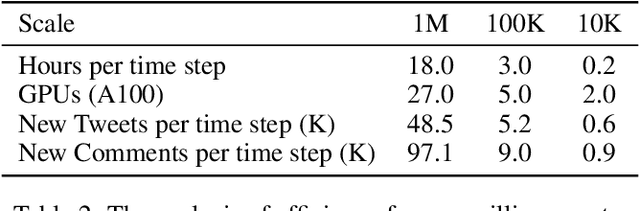
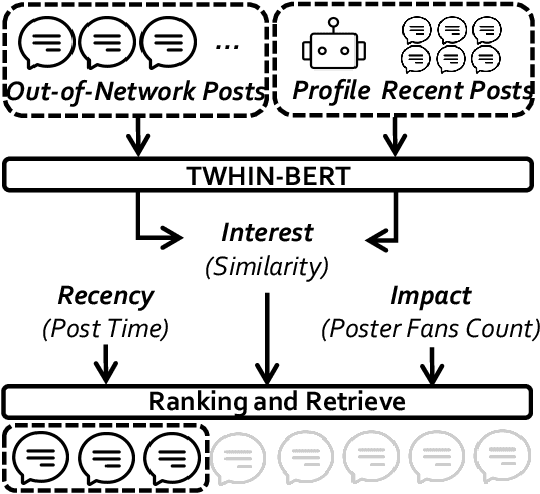
There has been a growing interest in enhancing rule-based agent-based models (ABMs) for social media platforms (i.e., X, Reddit) with more realistic large language model (LLM) agents, thereby allowing for a more nuanced study of complex systems. As a result, several LLM-based ABMs have been proposed in the past year. While they hold promise, each simulator is specifically designed to study a particular scenario, making it time-consuming and resource-intensive to explore other phenomena using the same ABM. Additionally, these models simulate only a limited number of agents, whereas real-world social media platforms involve millions of users. To this end, we propose OASIS, a generalizable and scalable social media simulator. OASIS is designed based on real-world social media platforms, incorporating dynamically updated environments (i.e., dynamic social networks and post information), diverse action spaces (i.e., following, commenting), and recommendation systems (i.e., interest-based and hot-score-based). Additionally, OASIS supports large-scale user simulations, capable of modeling up to one million users. With these features, OASIS can be easily extended to different social media platforms to study large-scale group phenomena and behaviors. We replicate various social phenomena, including information spreading, group polarization, and herd effects across X and Reddit platforms. Moreover, we provide observations of social phenomena at different agent group scales. We observe that the larger agent group scale leads to more enhanced group dynamics and more diverse and helpful agents' opinions. These findings demonstrate OASIS's potential as a powerful tool for studying complex systems in digital environments.
OASIS: Open Agents Social Interaction Simulations on One Million Agents
Nov 21, 2024There has been a growing interest in enhancing rule-based agent-based models (ABMs) for social media platforms (i.e., X, Reddit) with more realistic large language model (LLM) agents, thereby allowing for a more nuanced study of complex systems. As a result, several LLM-based ABMs have been proposed in the past year. While they hold promise, each simulator is specifically designed to study a particular scenario, making it time-consuming and resource-intensive to explore other phenomena using the same ABM. Additionally, these models simulate only a limited number of agents, whereas real-world social media platforms involve millions of users. To this end, we propose OASIS, a generalizable and scalable social media simulator. OASIS is designed based on real-world social media platforms, incorporating dynamically updated environments (i.e., dynamic social networks and post information), diverse action spaces (i.e., following, commenting), and recommendation systems (i.e., interest-based and hot-score-based). Additionally, OASIS supports large-scale user simulations, capable of modeling up to one million users. With these features, OASIS can be easily extended to different social media platforms to study large-scale group phenomena and behaviors. We replicate various social phenomena, including information spreading, group polarization, and herd effects across X and Reddit platforms. Moreover, we provide observations of social phenomena at different agent group scales. We observe that the larger agent group scale leads to more enhanced group dynamics and more diverse and helpful agents' opinions. These findings demonstrate OASIS's potential as a powerful tool for studying complex systems in digital environments.
Towards Realistic Example-based Modeling via 3D Gaussian Stitching
Aug 28, 2024Using parts of existing models to rebuild new models, commonly termed as example-based modeling, is a classical methodology in the realm of computer graphics. Previous works mostly focus on shape composition, making them very hard to use for realistic composition of 3D objects captured from real-world scenes. This leads to combining multiple NeRFs into a single 3D scene to achieve seamless appearance blending. However, the current SeamlessNeRF method struggles to achieve interactive editing and harmonious stitching for real-world scenes due to its gradient-based strategy and grid-based representation. To this end, we present an example-based modeling method that combines multiple Gaussian fields in a point-based representation using sample-guided synthesis. Specifically, as for composition, we create a GUI to segment and transform multiple fields in real time, easily obtaining a semantically meaningful composition of models represented by 3D Gaussian Splatting (3DGS). For texture blending, due to the discrete and irregular nature of 3DGS, straightforwardly applying gradient propagation as SeamlssNeRF is not supported. Thus, a novel sampling-based cloning method is proposed to harmonize the blending while preserving the original rich texture and content. Our workflow consists of three steps: 1) real-time segmentation and transformation of a Gaussian model using a well-tailored GUI, 2) KNN analysis to identify boundary points in the intersecting area between the source and target models, and 3) two-phase optimization of the target model using sampling-based cloning and gradient constraints. Extensive experimental results validate that our approach significantly outperforms previous works in terms of realistic synthesis, demonstrating its practicality. More demos are available at https://ingra14m.github.io/gs_stitching_website.
See What LLMs Cannot Answer: A Self-Challenge Framework for Uncovering LLM Weaknesses
Aug 16, 2024
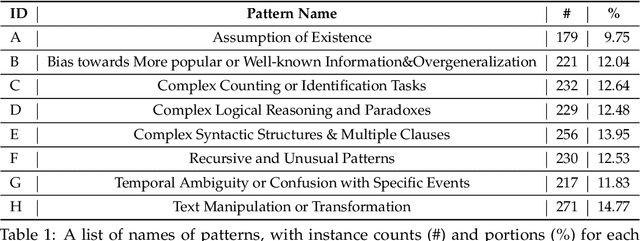


The impressive performance of Large Language Models (LLMs) has consistently surpassed numerous human-designed benchmarks, presenting new challenges in assessing the shortcomings of LLMs. Designing tasks and finding LLMs' limitations are becoming increasingly important. In this paper, we investigate the question of whether an LLM can discover its own limitations from the errors it makes. To this end, we propose a Self-Challenge evaluation framework with human-in-the-loop. Starting from seed instances that GPT-4 fails to answer, we prompt GPT-4 to summarize error patterns that can be used to generate new instances and incorporate human feedback on them to refine these patterns for generating more challenging data, iteratively. We end up with 8 diverse patterns, such as text manipulation and questions with assumptions. We then build a benchmark, SC-G4, consisting of 1,835 instances generated by GPT-4 using these patterns, with human-annotated gold responses. The SC-G4 serves as a challenging benchmark that allows for a detailed assessment of LLMs' abilities. Our results show that only 44.96\% of instances in SC-G4 can be answered correctly by GPT-4. Interestingly, our pilot study indicates that these error patterns also challenge other LLMs, such as Claude-3 and Llama-3, and cannot be fully resolved through fine-tuning. Our work takes the first step to demonstrate that LLMs can autonomously identify their inherent flaws and provide insights for future dynamic and automatic evaluation.
Phi-3 Safety Post-Training: Aligning Language Models with a "Break-Fix" Cycle
Jul 18, 2024

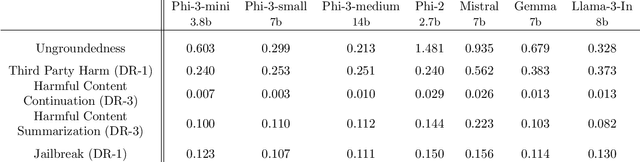

Recent innovations in language model training have demonstrated that it is possible to create highly performant models that are small enough to run on a smartphone. As these models are deployed in an increasing number of domains, it is critical to ensure that they are aligned with human preferences and safety considerations. In this report, we present our methodology for safety aligning the Phi-3 series of language models. We utilized a "break-fix" cycle, performing multiple rounds of dataset curation, safety post-training, benchmarking, red teaming, and vulnerability identification to cover a variety of harm areas in both single and multi-turn scenarios. Our results indicate that this approach iteratively improved the performance of the Phi-3 models across a wide range of responsible AI benchmarks.
Cost-Effective Proxy Reward Model Construction with On-Policy and Active Learning
Jul 02, 2024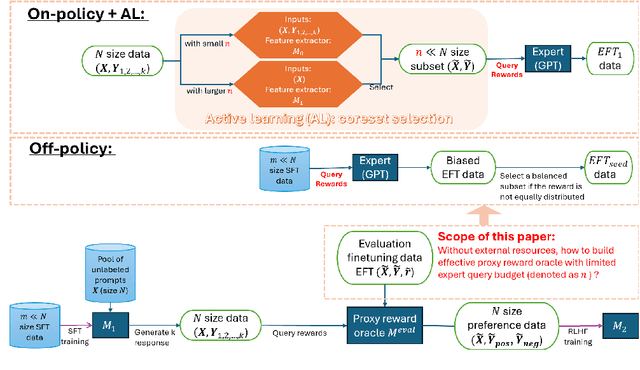
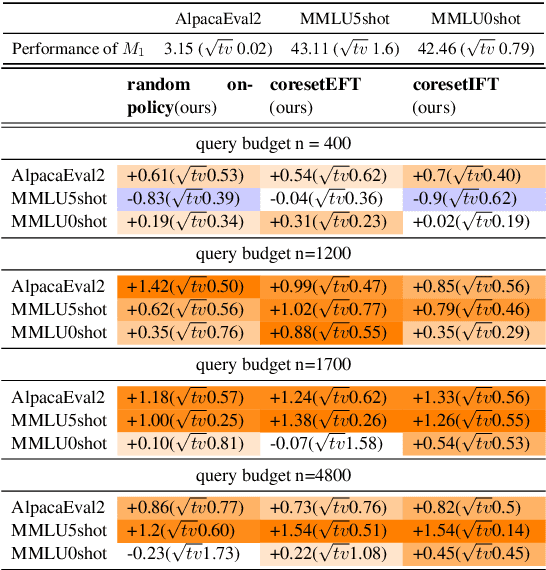
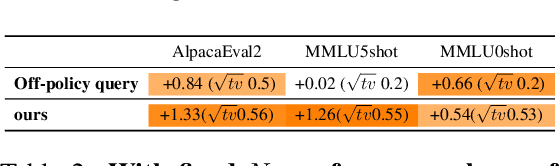
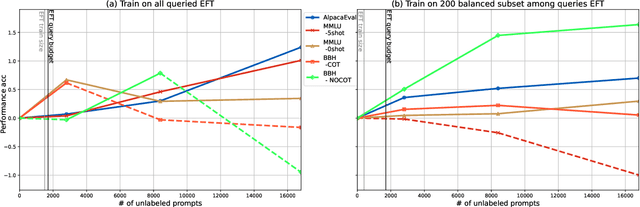
Reinforcement learning with human feedback (RLHF), as a widely adopted approach in current large language model pipelines, is \textit{bottlenecked by the size of human preference data}. While traditional methods rely on offline preference dataset constructions, recent approaches have shifted towards online settings, where a learner uses a small amount of labeled seed data and a large pool of unlabeled prompts to iteratively construct new preference data through self-generated responses and high-quality reward/preference feedback. However, most current online algorithms still focus on preference labeling during policy model updating with given feedback oracles, which incurs significant expert query costs. \textit{We are the first to explore cost-effective proxy reward oracles construction strategies for further labeling preferences or rewards with extremely limited labeled data and expert query budgets}. Our approach introduces two key innovations: (1) on-policy query to avoid OOD and imbalance issues in seed data, and (2) active learning to select the most informative data for preference queries. Using these methods, we train a evaluation model with minimal expert-labeled data, which then effectively labels nine times more preference pairs for further RLHF training. For instance, our model using Direct Preference Optimization (DPO) gains around over 1% average improvement on AlpacaEval2, MMLU-5shot and MMLU-0shot, with only 1.7K query cost. Our methodology is orthogonal to other direct expert query-based strategies and therefore might be integrated with them to further reduce query costs.
Self-Exploring Language Models: Active Preference Elicitation for Online Alignment
May 29, 2024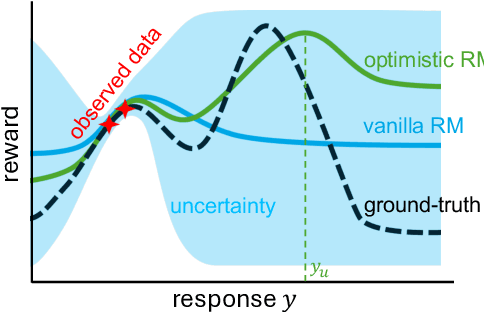


Preference optimization, particularly through Reinforcement Learning from Human Feedback (RLHF), has achieved significant success in aligning Large Language Models (LLMs) to adhere to human intentions. Unlike offline alignment with a fixed dataset, online feedback collection from humans or AI on model generations typically leads to more capable reward models and better-aligned LLMs through an iterative process. However, achieving a globally accurate reward model requires systematic exploration to generate diverse responses that span the vast space of natural language. Random sampling from standard reward-maximizing LLMs alone is insufficient to fulfill this requirement. To address this issue, we propose a bilevel objective optimistically biased towards potentially high-reward responses to actively explore out-of-distribution regions. By solving the inner-level problem with the reparameterized reward function, the resulting algorithm, named Self-Exploring Language Models (SELM), eliminates the need for a separate RM and iteratively updates the LLM with a straightforward objective. Compared to Direct Preference Optimization (DPO), the SELM objective reduces indiscriminate favor of unseen extrapolations and enhances exploration efficiency. Our experimental results demonstrate that when finetuned on Zephyr-7B-SFT and Llama-3-8B-Instruct models, SELM significantly boosts the performance on instruction-following benchmarks such as MT-Bench and AlpacaEval 2.0, as well as various standard academic benchmarks in different settings. Our code and models are available at https://github.com/shenao-zhang/SELM.
Phi-3 Technical Report: A Highly Capable Language Model Locally on Your Phone
Apr 23, 2024


We introduce phi-3-mini, a 3.8 billion parameter language model trained on 3.3 trillion tokens, whose overall performance, as measured by both academic benchmarks and internal testing, rivals that of models such as Mixtral 8x7B and GPT-3.5 (e.g., phi-3-mini achieves 69% on MMLU and 8.38 on MT-bench), despite being small enough to be deployed on a phone. The innovation lies entirely in our dataset for training, a scaled-up version of the one used for phi-2, composed of heavily filtered web data and synthetic data. The model is also further aligned for robustness, safety, and chat format. We also provide some initial parameter-scaling results with a 7B and 14B models trained for 4.8T tokens, called phi-3-small and phi-3-medium, both significantly more capable than phi-3-mini (e.g., respectively 75% and 78% on MMLU, and 8.7 and 8.9 on MT-bench).