 Add to Chrome
 Add to Firefox
 Add to Edge
Intrinsic and Triangulation-Agnostic Attention: A Simple and Powerful Approach for Learning on Meshes
Jul 27, 2026
This work proposes an adaptation of the attention mechanism for triangle meshes. The core observation is that endowing the attention mechanism with critical properties for learning over meshes -- intrinsicality and triangulation-agnosticism -- enables it to attain state-of-the-art results over several learning-based tasks in geometry-processing. The above is achieved by modifying the attention mechanism from the bottom up based on simple principles from geometry-processing. Namely, the quantities used within attention -- queries, keys and values -- are created by an intrinsic, triangulation-agnostic network, and treated as discretizations of continuous functions. From that, we devise an appropriate attention mechanism that operates over triangle meshes through standard FEM discretization of the resulting integrals of the above functions. Surprisingly, as far as we know, this straightforward approach has not been utilized for learning over meshes. Experiments show our method exceeds current state of the art, including both mesh-based architectures as well as point cloud transformers. Namely, we show significant improvements on several common benchmarks and tasks -- predicting canonical high-frequency signals; predicting deformations; computing dense correspondences, both between full shapes and partial ones; and predicting feature descriptors.

Conformal Risk-Averse Decision Making with Action Conditional Guarantee
Jun 04, 2026Reliable decision making pipelines powered by machine learning models require uncertainty quantification (UQ) methods that come with explicit safety guarantees. Conformal prediction provides such UQ by wrapping ML predictions into prediction sets, and recent work by Kiyani et al. (2025b) established that these sets can be translated into optimal risk-averse decision policies -- yet only inheriting marginal safety guarantees. We generalize and strengthen their results by (i) introducing action-conditional conformal prediction, which yields safety guarantees conditioned explicitly on each action taken by the decision maker, (ii) showing that action-conditional prediction sets serve as a proxy for the feasible decision space for risk-averse decision makers aiming to optimize action-conditional value-at-risk, and (iii) proposing a principled finite-sample algorithm based on pinball-loss minimization, connecting the framework of Gibbs et al. (2025) to action-conditional guarantees. Experiments on two real-world datasets confirm that our approach significantly improves action-conditional performance over conformal baselines.
WildPose: A Unified Framework for Robust Pose Estimation in the Wild
May 12, 2026Estimating camera pose in dynamic environments is a critical challenge, as most visual SLAM and SfM methods assume static scenes. While recent dynamic-aware methods exist, they are often not unified: semantic-based approaches are brittle, per-sequence optimization methods fail on short sequences, and other learned models may degrade on static-only scenes. We present WildPose, a unified monocular pose estimation framework that is robust in dynamic environments while maintaining state-of-the-art performance on static and low-ego-motion datasets. Our key insight is to connect two powerful paradigms in modern 3D vision: the rich perceptual frontend of feedforward models and the end-to-end optimization of differentiable bundle adjustment (BA). We achieve this with a 3D-aware update operator built on a frozen, pre-trained MASt3R feature backbone, together with a high-capacity motion mask detector that uses multi-level 3D-aware features from the same backbone. Extensive experiments show WildPose consistently outperforms prior methods across dynamic (Wild-SLAM, Bonn), static (TUM, 7-Scenes), and low-ego-motion (Sintel) benchmarks.
DROID-SLAM in the Wild
Mar 19, 2026We present a robust, real-time RGB SLAM system that handles dynamic environments by leveraging differentiable Uncertainty-aware Bundle Adjustment. Traditional SLAM methods typically assume static scenes, leading to tracking failures in the presence of motion. Recent dynamic SLAM approaches attempt to address this challenge using predefined dynamic priors or uncertainty-aware mapping, but they remain limited when confronted with unknown dynamic objects or highly cluttered scenes where geometric mapping becomes unreliable. In contrast, our method estimates per-pixel uncertainty by exploiting multi-view visual feature inconsistency, enabling robust tracking and reconstruction even in real-world environments. The proposed system achieves state-of-the-art camera poses and scene geometry in cluttered dynamic scenarios while running in real time at around 10 FPS. Code and datasets are available at https://github.com/MoyangLi00/DROID-W.git.
Interactive Benchmarks
Mar 05, 2026Standard benchmarks have become increasingly unreliable due to saturation, subjectivity, and poor generalization. We argue that evaluating model's ability to acquire information actively is important to assess model's intelligence. We propose Interactive Benchmarks, a unified evaluation paradigm that assesses model's reasoning ability in an interactive process under budget constraints. We instantiate this framework across two settings: Interactive Proofs, where models interact with a judge to deduce objective truths or answers in logic and mathematics; and Interactive Games, where models reason strategically to maximize long-horizon utilities. Our results show that interactive benchmarks provide a robust and faithful assessment of model intelligence, revealing that there is still substantial room to improve in interactive scenarios. Project page: https://github.com/interactivebench/interactivebench
Fault-Tolerant Evaluation for Sample-Efficient Model Performance Estimators
Feb 06, 2026In the era of Model-as-a-Service, organizations increasingly rely on third-party AI models for rapid deployment. However, the dynamic nature of emerging AI applications, the continual introduction of new datasets, and the growing number of models claiming superior performance make efficient and reliable validation of model services increasingly challenging. This motivates the development of sample-efficient performance estimators, which aim to estimate model performance by strategically selecting instances for labeling, thereby reducing annotation cost. Yet existing evaluation approaches often fail in low-variance settings: RMSE conflates bias and variance, masking persistent bias when variance is small, while p-value based tests become hypersensitive, rejecting adequate estimators for negligible deviations. To address this, we propose a fault-tolerant evaluation framework that integrates bias and variance considerations within an adjustable tolerance level ${\varepsilon}$, enabling the evaluation of performance estimators within practically acceptable error margins. We theoretically show that proper calibration of ${\varepsilon}$ ensures reliable evaluation across different variance regimes, and we further propose an algorithm that automatically optimizes and selects ${\varepsilon}$. Experiments on real-world datasets demonstrate that our framework provides comprehensive and actionable insights into estimator behavior.
Decoding Rewards in Competitive Games: Inverse Game Theory with Entropy Regularization
Jan 19, 2026Estimating the unknown reward functions driving agents' behaviors is of central interest in inverse reinforcement learning and game theory. To tackle this problem, we develop a unified framework for reward function recovery in two-player zero-sum matrix games and Markov games with entropy regularization, where we aim to reconstruct the underlying reward functions given observed players' strategies and actions. This task is challenging due to the inherent ambiguity of inverse problems, the non-uniqueness of feasible rewards, and limited observational data coverage. To address these challenges, we establish the reward function's identifiability using the quantal response equilibrium (QRE) under linear assumptions. Building upon this theoretical foundation, we propose a novel algorithm to learn reward functions from observed actions. Our algorithm works in both static and dynamic settings and is adaptable to incorporate different methods, such as Maximum Likelihood Estimation (MLE). We provide strong theoretical guarantees for the reliability and sample efficiency of our algorithm. Further, we conduct extensive numerical studies to demonstrate the practical effectiveness of the proposed framework, offering new insights into decision-making in competitive environments.
Statistical Inference for Fuzzy Clustering
Jan 06, 2026Clustering is a central tool in biomedical research for discovering heterogeneous patient subpopulations, where group boundaries are often diffuse rather than sharply separated. Traditional methods produce hard partitions, whereas soft clustering methods such as fuzzy $c$-means (FCM) allow mixed memberships and better capture uncertainty and gradual transitions. Despite the widespread use of FCM, principled statistical inference for fuzzy clustering remains limited. We develop a new framework for weighted fuzzy $c$-means (WFCM) for settings with potential cluster size imbalance. Cluster-specific weights rebalance the classical FCM criterion so that smaller clusters are not overwhelmed by dominant groups, and the weighted objective induces a normalized density model with scale parameter $σ$ and fuzziness parameter $m$. Estimation is performed via a blockwise majorize--minimize (MM) procedure that alternates closed-form membership and centroid updates with likelihood-based updates of $(σ,\bw)$. The intractable normalizing constant is approximated by importance sampling using a data-adaptive Gaussian mixture proposal. We further provide likelihood ratio tests for comparing cluster centers and bootstrap-based confidence intervals. We establish consistency and asymptotic normality of the maximum likelihood estimator, validate the method through simulations, and illustrate it using single-cell RNA-seq and Alzheimer disease Neuroimaging Initiative (ADNI) data. These applications demonstrate stable uncertainty quantification and biologically meaningful soft memberships, ranging from well-separated cell populations under imbalance to a graded AD versus non-AD continuum consistent with disease progression.
MCGS-SLAM: A Multi-Camera SLAM Framework Using Gaussian Splatting for High-Fidelity Mapping
Sep 17, 2025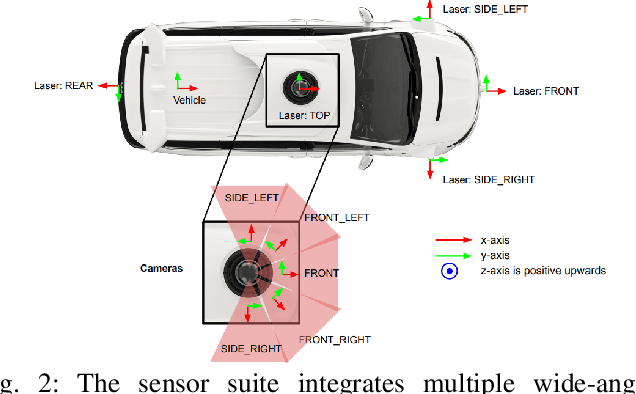
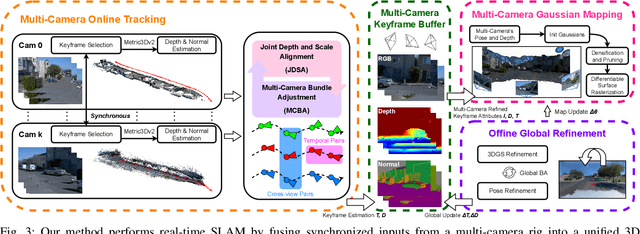
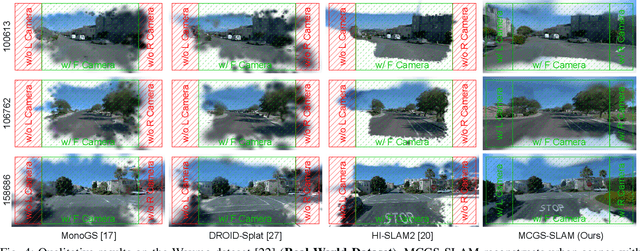
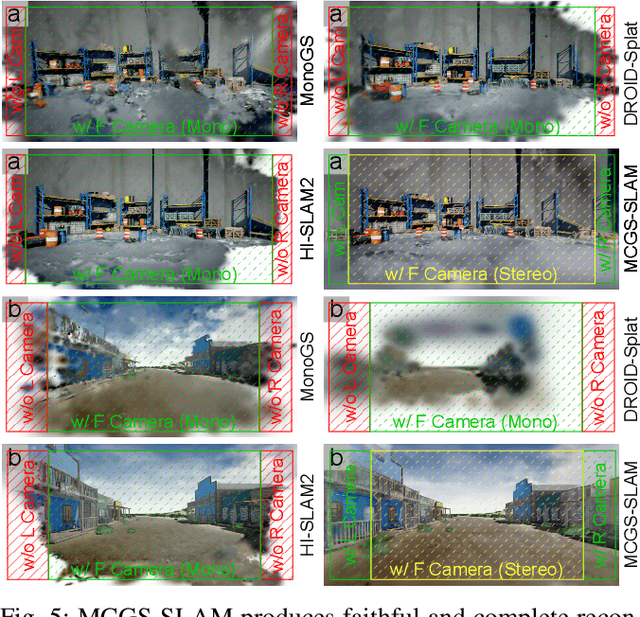
Recent progress in dense SLAM has primarily targeted monocular setups, often at the expense of robustness and geometric coverage. We present MCGS-SLAM, the first purely RGB-based multi-camera SLAM system built on 3D Gaussian Splatting (3DGS). Unlike prior methods relying on sparse maps or inertial data, MCGS-SLAM fuses dense RGB inputs from multiple viewpoints into a unified, continuously optimized Gaussian map. A multi-camera bundle adjustment (MCBA) jointly refines poses and depths via dense photometric and geometric residuals, while a scale consistency module enforces metric alignment across views using low-rank priors. The system supports RGB input and maintains real-time performance at large scale. Experiments on synthetic and real-world datasets show that MCGS-SLAM consistently yields accurate trajectories and photorealistic reconstructions, usually outperforming monocular baselines. Notably, the wide field of view from multi-camera input enables reconstruction of side-view regions that monocular setups miss, critical for safe autonomous operation. These results highlight the promise of multi-camera Gaussian Splatting SLAM for high-fidelity mapping in robotics and autonomous driving.
WildGS-SLAM: Monocular Gaussian Splatting SLAM in Dynamic Environments
Apr 04, 2025We present WildGS-SLAM, a robust and efficient monocular RGB SLAM system designed to handle dynamic environments by leveraging uncertainty-aware geometric mapping. Unlike traditional SLAM systems, which assume static scenes, our approach integrates depth and uncertainty information to enhance tracking, mapping, and rendering performance in the presence of moving objects. We introduce an uncertainty map, predicted by a shallow multi-layer perceptron and DINOv2 features, to guide dynamic object removal during both tracking and mapping. This uncertainty map enhances dense bundle adjustment and Gaussian map optimization, improving reconstruction accuracy. Our system is evaluated on multiple datasets and demonstrates artifact-free view synthesis. Results showcase WildGS-SLAM's superior performance in dynamic environments compared to state-of-the-art methods.