 Add to Chrome
 Add to Firefox
 Add to Edge
AliyunConsoleAgent: Training Web Agents in Real-World Cloud Environments via Distillation and Reinforcement Learning
Jun 08, 2026
We present AliyunConsoleAgent, a web agent framework for automated documentation verification in real-world cloud consoles. Major cloud platforms encompass hundreds of products with rapid feature iteration, causing console UIs to frequently diverge from their corresponding documentation. Verifying that documented procedures accurately reflect the current console and can be executed end-to-end demands an estimated 4 million recurring inspections annually, yet manual coverage remains below 1%. While agent systems built on frontier proprietary models achieve high success rates, their prohibitive cost and data privacy constraints preclude large-scale deployment. We propose a two-stage training paradigm: supervised fine-tuning (SFT) on distilled frontier-model trajectories, followed by reinforcement learning using Group Relative Policy Optimization (GRPO) and a dual-channel outcome reward model in real cloud environments. To support large-scale RL training, we construct a high-determinism rollout system featuring Terraform-based resource pre-provisioning and LLM-driven on-demand provisioning, which effectively isolates environment noise from the training signal. We further introduce a rule-based reward evaluation protocol grounded in backend audit logs, providing objective, reward-hacking-resistant outcome judgment. Our model evolves from mechanical instruction following to autonomous decision-making with cloud console and product-specific understanding. Experiments on a challenging 278-task benchmark where the best frontier model achieves only 65.34% demonstrate that AliyunConsoleAgent-32B achieves a 63.52% mean success rate -- a 20.24 percentage-point improvement over the base model, narrowing the gap to the best frontier proprietary model to 1.82 pp (bootstrap 95% CI [-1.27, 7.39]) -- at 92% lower inference cost.

HAIC: Humanoid Agile Object Interaction Control via Dynamics-Aware World Model
Feb 12, 2026Humanoid robots show promise for complex whole-body tasks in unstructured environments. Although Human-Object Interaction (HOI) has advanced, most methods focus on fully actuated objects rigidly coupled to the robot, ignoring underactuated objects with independent dynamics and non-holonomic constraints. These introduce control challenges from coupling forces and occlusions. We present HAIC, a unified framework for robust interaction across diverse object dynamics without external state estimation. Our key contribution is a dynamics predictor that estimates high-order object states (velocity, acceleration) solely from proprioceptive history. These predictions are projected onto static geometric priors to form a spatially grounded dynamic occupancy map, enabling the policy to infer collision boundaries and contact affordances in blind spots. We use asymmetric fine-tuning, where a world model continuously adapts to the student policy's exploration, ensuring robust state estimation under distribution shifts. Experiments on a humanoid robot show HAIC achieves high success rates in agile tasks (skateboarding, cart pushing/pulling under various loads) by proactively compensating for inertial perturbations, and also masters multi-object long-horizon tasks like carrying a box across varied terrain by predicting the dynamics of multiple objects.
Implicit Kinodynamic Motion Retargeting for Human-to-humanoid Imitation Learning
Sep 18, 2025Human-to-humanoid imitation learning aims to learn a humanoid whole-body controller from human motion. Motion retargeting is a crucial step in enabling robots to acquire reference trajectories when exploring locomotion skills. However, current methods focus on motion retargeting frame by frame, which lacks scalability. Could we directly convert large-scale human motion into robot-executable motion through a more efficient approach? To address this issue, we propose Implicit Kinodynamic Motion Retargeting (IKMR), a novel efficient and scalable retargeting framework that considers both kinematics and dynamics. In kinematics, IKMR pretrains motion topology feature representation and a dual encoder-decoder architecture to learn a motion domain mapping. In dynamics, IKMR integrates imitation learning with the motion retargeting network to refine motion into physically feasible trajectories. After fine-tuning using the tracking results, IKMR can achieve large-scale physically feasible motion retargeting in real time, and a whole-body controller could be directly trained and deployed for tracking its retargeted trajectories. We conduct our experiments both in the simulator and the real robot on a full-size humanoid robot. Extensive experiments and evaluation results verify the effectiveness of our proposed framework.
MCGS-SLAM: A Multi-Camera SLAM Framework Using Gaussian Splatting for High-Fidelity Mapping
Sep 17, 2025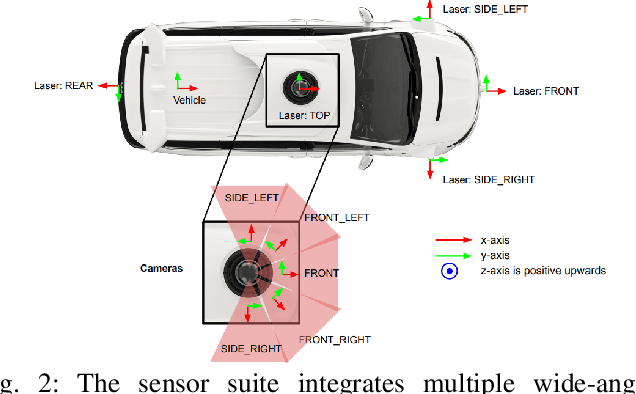
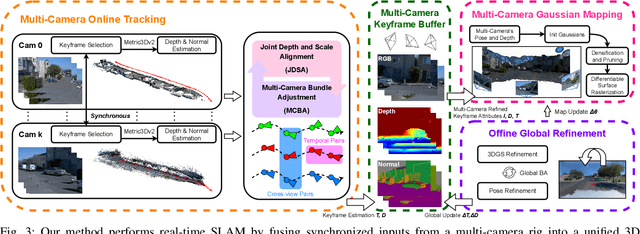
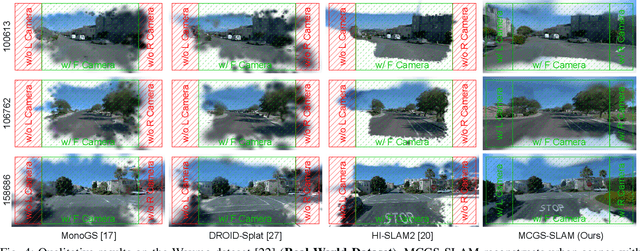
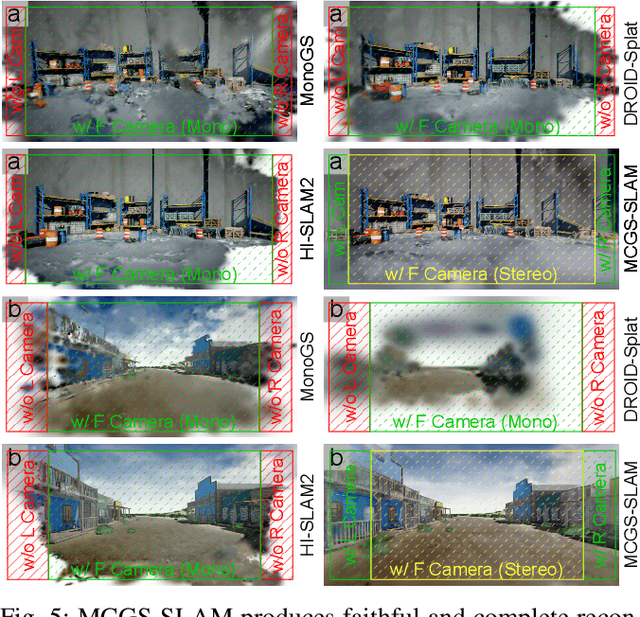
Recent progress in dense SLAM has primarily targeted monocular setups, often at the expense of robustness and geometric coverage. We present MCGS-SLAM, the first purely RGB-based multi-camera SLAM system built on 3D Gaussian Splatting (3DGS). Unlike prior methods relying on sparse maps or inertial data, MCGS-SLAM fuses dense RGB inputs from multiple viewpoints into a unified, continuously optimized Gaussian map. A multi-camera bundle adjustment (MCBA) jointly refines poses and depths via dense photometric and geometric residuals, while a scale consistency module enforces metric alignment across views using low-rank priors. The system supports RGB input and maintains real-time performance at large scale. Experiments on synthetic and real-world datasets show that MCGS-SLAM consistently yields accurate trajectories and photorealistic reconstructions, usually outperforming monocular baselines. Notably, the wide field of view from multi-camera input enables reconstruction of side-view regions that monocular setups miss, critical for safe autonomous operation. These results highlight the promise of multi-camera Gaussian Splatting SLAM for high-fidelity mapping in robotics and autonomous driving.