 Add to Chrome
 Add to Firefox
 Add to Edge
EgoTrack3D: A Modular Framework for Egocentric 3D Object Tracking
Aug 08, 2026
Understanding 3D scenes from egocentric video is fundamental for robotics and autonomous navigation, yet rapid viewpoint changes and partial occlusions make building structured representations challenging. Existing 3D tracking and scene graph construction methods primarily address explicit interactions or assume static scenes, limiting their ability to capture complex dynamics. We introduce EgoTrack3D, a modular framework that reconstructs and maintains a dynamic 3D scene representation directly from egocentric RGB video. The framework lifts 2D segmentation masks into a global 3D coordinate frame, using a point-based motion scoring mechanism alongside a voxel-based merging heuristic to associate object tracks. EgoTrack3D maintains accurate representations over time, achieving an 11% improvement in percentage of correct locations (PCL) relative to the strongest baseline on the Aria Digital Twin (ADT) dataset, while addressing the more general setting of persistent 3D tracking for both static and dynamic objects. Furthermore, to demonstrate the system's robustness under degraded conditions that simulate real-world deployment constraints, we replace dense depth maps with sparse 3D bounding box estimation and integrate interaction-guided dynamic association, enabling EgoTrack3D to maintain accurate spatial representations despite noisy observations.

LIME: Learning Intent-aware Camera Motion from Egocentric Video
Jul 02, 2026Autonomous robots often need to move their camera before they can act: to inspect an object, reveal an occluded region, or obtain a view that responds to a user's intent. While vision-language navigation translates instructions to base motion and vision-language-action policies map instructions to manipulation actions, language-conditioned camera motion remains comparatively underexplored as a first-class action. We formulate language-conditioned camera motion generation: given a current RGB observation and a free-form natural-language intent, predict a relative target camera pose for the next observation. This task is inherently non-trivial: viewpoint changes are driven by latent perceptual intentions, and a valid motion may operate at different semantic granularity, from entering a room to looking around a corner, inspecting a visible object, or revealing an occluded detail. To model this structure, we mine multi-intention camera-motion supervision from egocentric video, pairing plausible intents and observation-gain descriptions with relative SE(3) target poses. We propose LIME, a vision-language camera-motion generator that combines an auto-regressive observation-gain output with a continuous flow-matching pose head. This design lets the model jointly predict what the next view should reveal while representing multi-hypothesis target views. Across experiments and downstream robotic tasks, we show that LIME can learn to actively choose camera poses from passive human video, turning ordinary egocentric recordings into supervision for intent-aware active perception.
LocalNav: Distilling Frontier VLMs and Embodied RL for On-Device Object Goal Navigation
Jun 26, 2026Vision Language Models (VLMs) have emerged in the robotic domain as a powerful tool that enables environmental perception with language context, serving as a catalyst for open-vocabulary tasks like ObjectNav. Yet, their computational footprint typically confines them to cloud execution, hindering low-latency inference with local deployment on resource-constrained robots. To address this challenge, we present a distillation strategy that transfers complex spatial-semantic reasoning from large frontier models into a lightweight, 4B-parameter local VLM for edge execution on embedded GPU devices (e.g., Jetson Orin). We first establish a State of the Art (SotA), Scene Graph (SG)-based pipeline using Claude Sonnet 4.6, achieving a 39.7% Success Rate (SR) on the HM3D OVON benchmark. We then demonstrate that fine-tuning Qwen3.5-4B on just 500 frontier reasoning traces effectively enables navigation capabilities, yielding a SR of 34.5%, narrowing the gap to the performance of large cloud models. Finally, we introduce E-RLVR with Token Generation (TG) regularization to compress output sequence lengths for physical deployment while grounding the agent in its task. This downstream optimization reduces TG overhead by 72.1% and latency by 71.8%. Combined with quantization, this joint strategy yields a cumulative 82.8% reduction in overall inference latency without significantly sacrificing performance, presenting a viable paradigm for local, low-latency VLM execution on mobile robots.
PROSE: Training-Free Egocentric Scene Registration with Vision-Language Models
Jun 15, 2026Registering two captures of the same indoor space taken at different times underpins persistent spatial memory for robots and AR systems, yet the realistic version of this task is egocentric and its most scalable form is RGB-only. Head-mounted cameras yield blurry, fast-moving, partially overlapping views from which dense geometry is hard to recover. Classical registration leans on exactly the clean point clouds this setting lacks, while learned scene-graph methods require a pre-built or annotated graph and a trained matcher that we find brittle under egocentric data. We take a different route, using a pretrained vision-language model as the source of both scene understanding and cross-scan matching. Our method, PROSE (Prompted Scene rEgistration), lifts each RGB sequence into an object-level 3D scene graph using off-the-shelf foundation models for geometry, segmentation, and language, then prompts the same VLM to match object instances across the two RGB sequences. To make this matching tractable and reliable, we leverage object heights as a prior and verify each proposed match with a paired same/different query, then solve for the rigid transform by hypothesizing a candidate per matched object and selecting the one with the strongest geometric consensus. PROSE adds no learned parameters and requires no depth sensor, training, or annotated graph. On the egocentric Aria Digital Twin and Aria Everyday Activities benchmarks, it outperforms both geometric and learned scene-graph baselines in registration accuracy, on ground-truth and RGB-reconstructed point clouds alike, and the scene graph it produces transfers directly to downstream tasks.
MoRe: Modular Representations for Principled Continual Representation Learning on Squantial Data
May 14, 2026Continual learning requires models to adapt to new data while preserving previously acquired knowledge. At its core, this challenge can be viewed as principled one-step adaptation: incorporating new information with minimal interference to existing representations. Most existing approaches address this challenge by modifying model parameters or architectures in a supervised, task-specific manner. However, the underlying issue is representational: tasks require distinct yet structured representations that can be selectively updated without disrupting representations, while structure should reflect intrinsic organization in the data rather than task boundaries. In sequential data, time-delayed dependencies provide a natural signal for uncovering this organization, revealing how fundamental representations give rise to more specific ones. Inspired by the modular organization of the human brain, we propose MoRe, a framework that identifies modularity in the representation itself rather than allocating it at the architectural level. MoRe decomposes knowledge into a hierarchy of fundamental and specific modules with identifiability guarantees, enabling principled module reuse, alignment, and expansion during adaptation while preserving old modules by construction. Experiments on synthetic benchmarks and real-world LLM activations demonstrate interpretable hierarchical structure, improved plasticity-stability trade-offs, suggesting MoRe as a principled foundation for continual adaptation
FunRec: Reconstructing Functional 3D Scenes from Egocentric Interaction Videos
Apr 07, 2026We present FunRec, a method for reconstructing functional 3D digital twins of indoor scenes directly from egocentric RGB-D interaction videos. Unlike existing methods on articulated reconstruction, which rely on controlled setups, multi-state captures, or CAD priors, FunRec operates directly on in-the-wild human interaction sequences to recover interactable 3D scenes. It automatically discovers articulated parts, estimates their kinematic parameters, tracks their 3D motion, and reconstructs static and moving geometry in canonical space, yielding simulation-compatible meshes. Across new real and simulated benchmarks, FunRec surpasses prior work by a large margin, achieving up to +50 mIoU improvement in part segmentation, 5-10 times lower articulation and pose errors, and significantly higher reconstruction accuracy. We further demonstrate applications on URDF/USD export for simulation, hand-guided affordance mapping and robot-scene interaction.
Memory Over Maps: 3D Object Localization Without Reconstruction
Mar 20, 2026Target localization is a prerequisite for embodied tasks such as navigation and manipulation. Conventional approaches rely on constructing explicit 3D scene representations to enable target localization, such as point clouds, voxel grids, or scene graphs. While effective, these pipelines incur substantial mapping time, storage overhead, and scalability limitations. Recent advances in vision-language models suggest that rich semantic reasoning can be performed directly on 2D observations, raising a fundamental question: is a complete 3D scene reconstruction necessary for object localization? In this work, we revisit object localization and propose a map-free pipeline that stores only posed RGB-D keyframes as a lightweight visual memory--without constructing any global 3D representation of the scene. At query time, our method retrieves candidate views, re-ranks them with a vision-language model, and constructs a sparse, on-demand 3D estimate of the queried target through depth backprojection and multi-view fusion. Compared to reconstruction-based pipelines, this design drastically reduces preprocessing cost, enabling scene indexing that is over two orders of magnitude faster to build while using substantially less storage. We further validate the localized targets on downstream object-goal navigation tasks. Despite requiring no task-specific training, our approach achieves strong performance across multiple benchmarks, demonstrating that direct reasoning over image-based scene memory can effectively replace dense 3D reconstruction for object-centric robot navigation. Project page: https://ruizhou-cn.github.io/memory-over-maps/
OpenFrontier: General Navigation with Visual-Language Grounded Frontiers
Mar 05, 2026Open-world navigation requires robots to make decisions in complex everyday environments while adapting to flexible task requirements. Conventional navigation approaches often rely on dense 3D reconstruction and hand-crafted goal metrics, which limits their generalization across tasks and environments. Recent advances in vision--language navigation (VLN) and vision--language--action (VLA) models enable end-to-end policies conditioned on natural language, but typically require interactive training, large-scale data collection, or task-specific fine-tuning with a mobile agent. We formulate navigation as a sparse subgoal identification and reaching problem and observe that providing visual anchoring targets for high-level semantic priors enables highly efficient goal-conditioned navigation. Based on this insight, we select navigation frontiers as semantic anchors and propose OpenFrontier, a training-free navigation framework that seamlessly integrates diverse vision--language prior models. OpenFrontier enables efficient navigation with a lightweight system design, without dense 3D mapping, policy training, or model fine-tuning. We evaluate OpenFrontier across multiple navigation benchmarks and demonstrate strong zero-shot performance, as well as effective real-world deployment on a mobile robot.
Unsupervised Synthetic Image Attribution: Alignment and Disentanglement
Jan 30, 2026As the quality of synthetic images improves, identifying the underlying concepts of model-generated images is becoming increasingly crucial for copyright protection and ensuring model transparency. Existing methods achieve this attribution goal by training models using annotated pairs of synthetic images and their original training sources. However, obtaining such paired supervision is challenging, as it requires either well-designed synthetic concepts or precise annotations from millions of training sources. To eliminate the need for costly paired annotations, in this paper, we explore the possibility of unsupervised synthetic image attribution. We propose a simple yet effective unsupervised method called Alignment and Disentanglement. Specifically, we begin by performing basic concept alignment using contrastive self-supervised learning. Next, we enhance the model's attribution ability by promoting representation disentanglement with the Infomax loss. This approach is motivated by an interesting observation: contrastive self-supervised models, such as MoCo and DINO, inherently exhibit the ability to perform simple cross-domain alignment. By formulating this observation as a theoretical assumption on cross-covariance, we provide a theoretical explanation of how alignment and disentanglement can approximate the concept-matching process through a decomposition of the canonical correlation analysis objective. On the real-world benchmarks, AbC, we show that our unsupervised method surprisingly outperforms the supervised methods. As a starting point, we expect our intuitive insights and experimental findings to provide a fresh perspective on this challenging task.
What Matters in RL-Based Methods for Object-Goal Navigation? An Empirical Study and A Unified Framework
Oct 02, 2025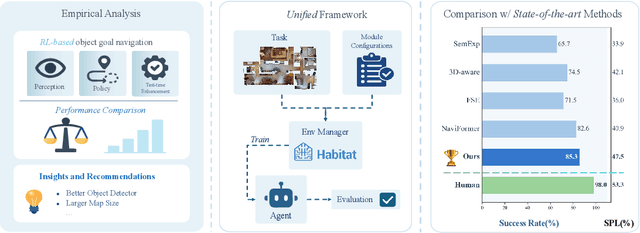
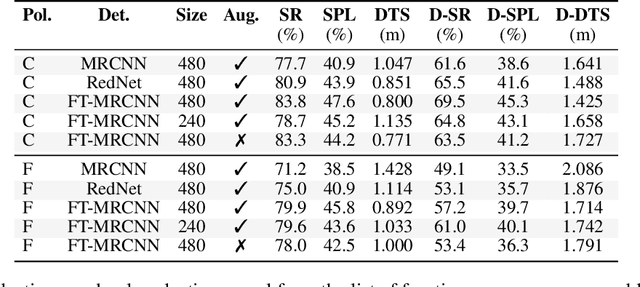
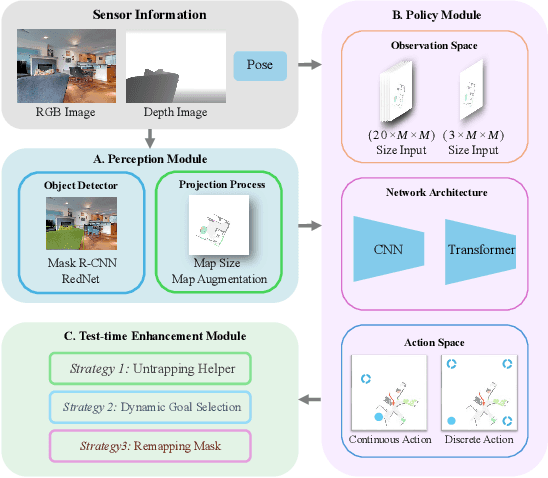
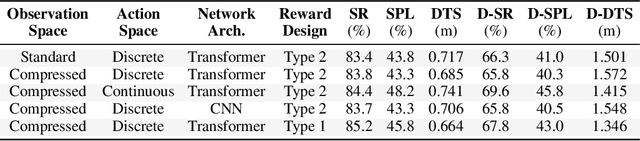
Object-Goal Navigation (ObjectNav) is a critical component toward deploying mobile robots in everyday, uncontrolled environments such as homes, schools, and workplaces. In this context, a robot must locate target objects in previously unseen environments using only its onboard perception. Success requires the integration of semantic understanding, spatial reasoning, and long-horizon planning, which is a combination that remains extremely challenging. While reinforcement learning (RL) has become the dominant paradigm, progress has spanned a wide range of design choices, yet the field still lacks a unifying analysis to determine which components truly drive performance. In this work, we conduct a large-scale empirical study of modular RL-based ObjectNav systems, decomposing them into three key components: perception, policy, and test-time enhancement. Through extensive controlled experiments, we isolate the contribution of each and uncover clear trends: perception quality and test-time strategies are decisive drivers of performance, whereas policy improvements with current methods yield only marginal gains. Building on these insights, we propose practical design guidelines and demonstrate an enhanced modular system that surpasses State-of-the-Art (SotA) methods by 6.6% on SPL and by a 2.7% success rate. We also introduce a human baseline under identical conditions, where experts achieve an average 98% success, underscoring the gap between RL agents and human-level navigation. Our study not only sets the SotA performance but also provides principled guidance for future ObjectNav development and evaluation.