 Add to Chrome
 Add to Firefox
 Add to Edge
Rethinking Token Prediction: Tree-Structured Diffusion Language Model
Apr 04, 2026
Discrete diffusion language models have emerged as a competitive alternative to auto-regressive language models, but training them efficiently under limited parameter and memory budgets remains challenging. Modern architectures are predominantly based on a full-vocabulary token prediction layer, which accounts for a substantial fraction of model parameters (e.g., more than 20% in small scale DiT-style designs) and often dominates peak GPU memory usage. This leads to inefficient use of both parameters and memory under constrained training resources. To address this issue, we revisit the necessity of explicit full-vocabulary prediction, and instead exploit the inherent structure among tokens to build a tree-structured diffusion language model. Specifically, we model the diffusion process with intermediate latent states corresponding to a token's ancestor nodes in a pre-constructed vocabulary tree. This tree-structured factorization exponentially reduces the classification dimensionality, makes the prediction head negligible in size, and enables reallocation of parameters to deepen the attention blocks. Empirically, under the same parameter budget, our method reduces peak GPU memory usage by half while matching the perplexity performance of state-of-the-art discrete diffusion language models.

Learning in Context, Guided by Choice: A Reward-Free Paradigm for Reinforcement Learning with Transformers
Feb 09, 2026In-context reinforcement learning (ICRL) leverages the in-context learning capabilities of transformer models (TMs) to efficiently generalize to unseen sequential decision-making tasks without parameter updates. However, existing ICRL methods rely on explicit reward signals during pretraining, which limits their applicability when rewards are ambiguous, hard to specify, or costly to obtain. To overcome this limitation, we propose a new learning paradigm, In-Context Preference-based Reinforcement Learning (ICPRL), in which both pretraining and deployment rely solely on preference feedback, eliminating the need for reward supervision. We study two variants that differ in the granularity of feedback: Immediate Preference-based RL (I-PRL) with per-step preferences, and Trajectory Preference-based RL (T-PRL) with trajectory-level comparisons. We first show that supervised pretraining, a standard approach in ICRL, remains effective under preference-only context datasets, demonstrating the feasibility of in-context reinforcement learning using only preference signals. To further improve data efficiency, we introduce alternative preference-native frameworks for I-PRL and T-PRL that directly optimize TM policies from preference data without requiring reward signals nor optimal action labels.Experiments on dueling bandits, navigation, and continuous control tasks demonstrate that ICPRL enables strong in-context generalization to unseen tasks, achieving performance comparable to ICRL methods trained with full reward supervision.
Score-based Metropolis-Hastings for Fractional Langevin Algorithms
Jan 31, 2026Sampling from heavy-tailed and multimodal distributions is challenging when neither the target density nor the proposal density can be evaluated, as in $α$-stable Lévy-driven fractional Langevin algorithms. While the target distribution can be estimated from data via score-based or energy-based models, the $α$-stable proposal density and its score are generally unavailable, rendering classical density-based Metropolis--Hastings (MH) corrections impractical. Consequently, existing fractional Langevin methods operate in an unadjusted regime and can exhibit substantial finite-time errors and poor empirical control of tail behavior. We introduce the Metropolis-Adjusted Fractional Langevin Algorithm (MAFLA), an MH-inspired, fully score-based correction mechanism. MAFLA employs designed proxies for fractional proposal score gradients under isotropic symmetric $α$-stable noise and learns an acceptance function via Score Balance Matching. We empirically illustrate the strong performance of MAFLA on a series of tasks including combinatorial optimization problems where the method significantly improves finite time sampling accuracy over unadjusted fractional Langevin dynamics.
In-Context Reinforcement Learning From Suboptimal Historical Data
Jan 27, 2026Transformer models have achieved remarkable empirical successes, largely due to their in-context learning capabilities. Inspired by this, we explore training an autoregressive transformer for in-context reinforcement learning (ICRL). In this setting, we initially train a transformer on an offline dataset consisting of trajectories collected from various RL tasks, and then fix and use this transformer to create an action policy for new RL tasks. Notably, we consider the setting where the offline dataset contains trajectories sampled from suboptimal behavioral policies. In this case, standard autoregressive training corresponds to imitation learning and results in suboptimal performance. To address this, we propose the Decision Importance Transformer(DIT) framework, which emulates the actor-critic algorithm in an in-context manner. In particular, we first train a transformer-based value function that estimates the advantage functions of the behavior policies that collected the suboptimal trajectories. Then we train a transformer-based policy via a weighted maximum likelihood estimation loss, where the weights are constructed based on the trained value function to steer the suboptimal policies to the optimal ones. We conduct extensive experiments to test the performance of DIT on both bandit and Markov Decision Process problems. Our results show that DIT achieves superior performance, particularly when the offline dataset contains suboptimal historical data.
Decoding Rewards in Competitive Games: Inverse Game Theory with Entropy Regularization
Jan 19, 2026Estimating the unknown reward functions driving agents' behaviors is of central interest in inverse reinforcement learning and game theory. To tackle this problem, we develop a unified framework for reward function recovery in two-player zero-sum matrix games and Markov games with entropy regularization, where we aim to reconstruct the underlying reward functions given observed players' strategies and actions. This task is challenging due to the inherent ambiguity of inverse problems, the non-uniqueness of feasible rewards, and limited observational data coverage. To address these challenges, we establish the reward function's identifiability using the quantal response equilibrium (QRE) under linear assumptions. Building upon this theoretical foundation, we propose a novel algorithm to learn reward functions from observed actions. Our algorithm works in both static and dynamic settings and is adaptable to incorporate different methods, such as Maximum Likelihood Estimation (MLE). We provide strong theoretical guarantees for the reliability and sample efficiency of our algorithm. Further, we conduct extensive numerical studies to demonstrate the practical effectiveness of the proposed framework, offering new insights into decision-making in competitive environments.
Neuro-Logic Lifelong Learning
Nov 16, 2025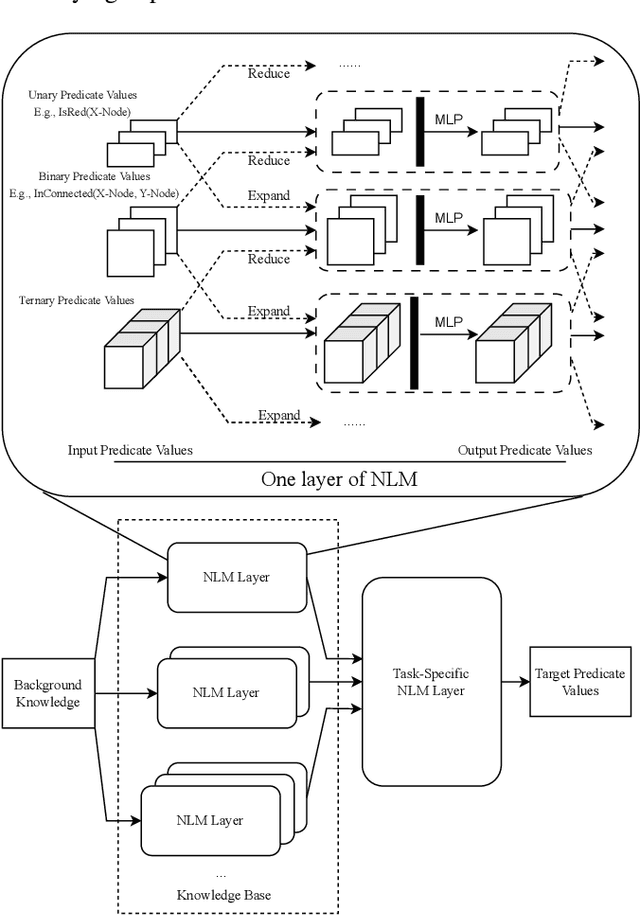
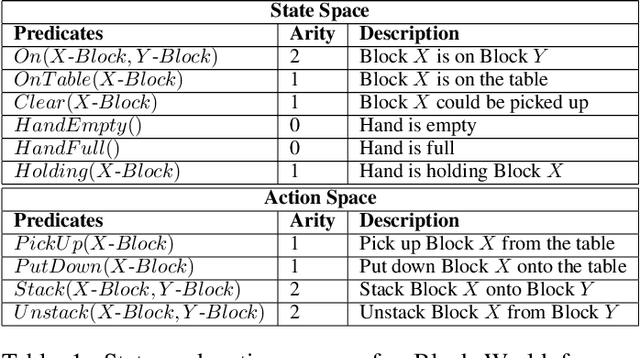
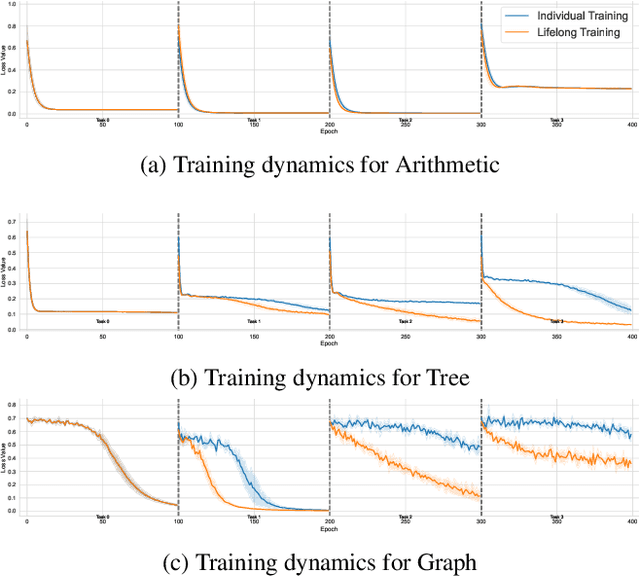
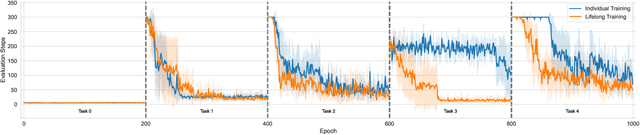
Solving Inductive Logic Programming (ILP) problems with neural networks is a key challenge in Neural-Symbolic Ar- tificial Intelligence (AI). While most research has focused on designing novel network architectures for individual prob- lems, less effort has been devoted to exploring new learning paradigms involving a sequence of problems. In this work, we investigate lifelong learning ILP, which leverages the com- positional and transferable nature of logic rules for efficient learning of new problems. We introduce a compositional framework, demonstrating how logic rules acquired from ear- lier tasks can be efficiently reused in subsequent ones, leading to improved scalability and performance. We formalize our approach and empirically evaluate it on sequences of tasks. Experimental results validate the feasibility and advantages of this paradigm, opening new directions for continual learn- ing in Neural-Symbolic AI.
Conditional Score Learning for Quickest Change Detection in Markov Transition Kernels
Nov 06, 2025We address the problem of quickest change detection in Markov processes with unknown transition kernels. The key idea is to learn the conditional score $\nabla_{\mathbf{y}} \log p(\mathbf{y}|\mathbf{x})$ directly from sample pairs $( \mathbf{x},\mathbf{y})$, where both $\mathbf{x}$ and $\mathbf{y}$ are high-dimensional data generated by the same transition kernel. In this way, we avoid explicit likelihood evaluation and provide a practical way to learn the transition dynamics. Based on this estimation, we develop a score-based CUSUM procedure that uses conditional Hyvarinen score differences to detect changes in the kernel. To ensure bounded increments, we propose a truncated version of the statistic. With Hoeffding's inequality for uniformly ergodic Markov processes, we prove exponential lower bounds on the mean time to false alarm. We also prove asymptotic upper bounds on detection delay. These results give both theoretical guarantees and practical feasibility for score-based detection in high-dimensional Markov models.
Score-Based Quickest Change Detection and Fault Identification for Multi-Stream Signals
Nov 06, 2025This paper introduces an approach to multi-stream quickest change detection and fault isolation for unnormalized and score-based statistical models. Traditional optimal algorithms in the quickest change detection literature require explicit pre-change and post-change distributions to calculate the likelihood ratio of the observations, which can be computationally expensive for higher-dimensional data and sometimes even infeasible for complex machine learning models. To address these challenges, we propose the min-SCUSUM method, a Hyvarinen score-based algorithm that computes the difference of score functions in place of log-likelihood ratios. We provide a delay and false alarm analysis of the proposed algorithm, showing that its asymptotic performance depends on the Fisher divergence between the pre- and post-change distributions. Furthermore, we establish an upper bound on the probability of fault misidentification in distinguishing the affected stream from the unaffected ones.
PASTA: A Unified Framework for Offline Assortment Learning
Oct 02, 2025We study a broad class of assortment optimization problems in an offline and data-driven setting. In such problems, a firm lacks prior knowledge of the underlying choice model, and aims to determine an optimal assortment based on historical customer choice data. The combinatorial nature of assortment optimization often results in insufficient data coverage, posing a significant challenge in designing provably effective solutions. To address this, we introduce a novel Pessimistic Assortment Optimization (PASTA) framework that leverages the principle of pessimism to achieve optimal expected revenue under general choice models. Notably, PASTA requires only that the offline data distribution contains an optimal assortment, rather than providing the full coverage of all feasible assortments. Theoretically, we establish the first finite-sample regret bounds for offline assortment optimization across several widely used choice models, including the multinomial logit and nested logit models. Additionally, we derive a minimax regret lower bound, proving that PASTA is minimax optimal in terms of sample and model complexity. Numerical experiments further demonstrate that our method outperforms existing baseline approaches.
Dual-Function Radar-Communication Beamforming with Outage Probability Metric
Aug 06, 2025The integrated design of communication and sensing may offer a potential solution to address spectrum congestion. In this work, we develop a beamforming method for a dual-function radar-communication system, where the transmit signal is used for both radar surveillance and communication with multiple downlink users, despite imperfect channel state information (CSI). We focus on two scenarios of interest: radar-centric and communication-centric. In the radar-centric scenario, the primary goal is to optimize radar performance while attaining acceptable communication performance. To this end, we minimize a weighted sum of the mean-squared error in achieving a desired beampattern and a mean-squared cross correlation of the radar returns from directions of interest (DOI). We also seek to ensure that the probability of outage for the communication users remains below a desired threshold. In the communication-centric scenario, our main objective is to minimize the maximum probability of outage among the communication users while keeping the aforementioned radar metrics below a desired threshold. Both optimization problems are stochastic and untractable. We first take advantage of central limit theorem to obtain deterministic non-convex problems and then consider relaxations of these problems in the form of semidefinite programs with rank-1 constraints. We provide numerical experiments demonstrating the effectiveness of the proposed designs.