 Add to Chrome
 Add to Firefox
 Add to Edge
ViP-Rig: Visual-Prompted Controllable Rigging
Jul 30, 2026
Rigging is inherently task-dependent because the same mesh may require different skeletons and deformation behaviors across animation tasks. In practice, artists often inspect an initial rig and repeatedly edit its skeletal structure and deformation behavior to meet specific animation requirements. Existing automatic methods primarily generate a plausible rig from geometry, offering limited explicit control over the resulting skeleton and deformation behavior. In this work, we present ViP-Rig, a visual-prompted framework that supports both prompt-first rigging and result-guided editing by injecting features extracted from user-drawn or edited 2D skeletal and rigidity prompts into frozen pretrained backbones. Specifically, ViP-Rig consists of two stages, Skeleton Generation and Skinning Prediction. In the first stage, the skeletal sketch is processed by the Dense-to-Compact Visual Prompt Encoding to produce compact, fixed-length conditioning tokens. The resulting tokens are injected into a frozen pretrained autoregressive generator through gated adapters to control joint placement and branching structure while preserving the generator's geometric prior. In the second stage, the rigidity map is processed using the same visual encoding design, while the pretrained skinning backbone remains frozen. The resulting tokens are symmetrically injected into the point and joint streams to modulate point-joint compatibility and the resulting skinning weights. Experiments on Articulation-XL2.0 and zero-shot evaluation on ModelsResource show that ViP-Rig more accurately recovers target skeletons and skinning weights than geometry-conditioned baselines under prompt-guided evaluation. Qualitative results further demonstrate explicit and localized control in both prompt-first rigging and result-guided editing.

RS-RIE-Bench: Benchmarking Reasoning-Guided Remote Sensing Image Editing
Jul 22, 2026Remote sensing image editing aims to modify remote sensing images according to natural language instructions while preserving geographic rules and sensor observation characteristics. Existing benchmarks mainly target natural images or general visual scenes, and thus may not fully capture the reasoning, regional control, and sensor-consistency abilities required in remote sensing editing. To fill this gap, we introduce RS-RIE-Bench, the first benchmark for reasoning-guided remote sensing image editing. RS-RIE-Bench organizes tasks into three categories: temporal reasoning, causal reasoning, and spatial reasoning. These categories capture temporal evolution, causal consequence, and spatial imaging consistency in remote sensing scenes. The evaluation protocol covers three dimensions: target region plausibility, non-target region preservation, and image quality consistency. We further demonstrate the feasibility of MLLM-based evaluation through cross-judge consistency analysis and stratified expert review. Systematic evaluation on eight open-source and closed-source image editing models shows that current models still have clear limitations in reasoning-guided remote sensing editing. Even the strongest model achieves only 24.28\% overall accuracy under the strict joint-satisfaction criterion, while the mean relaxed joint-4 success rate across all eight models is 32.23\%. Causal reasoning and spatial reasoning remain especially challenging, and several open-source models are close to zero in some categories. These results show that RS-RIE-Bench can effectively reveal the limitations of current models in geographic reasoning, regional control, and sensor-consistent generation. It also provides a standardized benchmark and a clear research direction for future remote sensing intelligent editing models.
From Search to Synthesis: Training LLMs as Zero-Shot Workflow Generators
Jun 29, 2026Large language models (LLMs) excel across a wide range of tasks, yet their instance-specific solutions often lack the structural consistency needed for reliable deployment. Workflows that encode recurring algorithmic patterns at the task level provide a principled framework, offering robustness across instance variations, interpretable traces for debugging, and reusability across problem instances. However, manually designing such workflows requires significant expertise and effort, limiting their broader application. While automatic workflow generation could address this bottleneck, existing methods either produce instance-specific solutions without learning task-level patterns, or cannot generalize beyond their training configurations. We present MetaFlow, which casts workflow generation as a meta-learning problem: given a task and an operator set, the model learns to compose solution strategies. MetaFlow trains in two stages: supervised fine-tuning on synthetic workflow data, followed by reinforcement learning with verifiable rewards (RLVR) that uses execution feedback across problem instances in the task to improve end-to-end success. The resulting model produces effective workflows for trained tasks and exhibits strong generalization to untrained tasks and novel operator sets. Across benchmarks in question answering, code generation, and mathematical reasoning, MetaFlow achieves performance comparable to state-of-the-art baselines on in-domain tasks with single inference, while demonstrating remarkable zero-shot generalization capabilities on out-of-domain tasks and operator sets.
Agentic System as Compressor: Quantifying System Intelligence in Bits
Jun 24, 2026Large language models are turning from isolated predictors into agentic systems: they call tools, retrieve evidence, obey environment constraints, use verifiers, and complete tasks through search and multi-turn interaction. We adopts an analytical viewpoint based on "compression is intelligence": under a fixed task distribution, interface, and compute budget, a stronger agentic system lets a target object be reconstructed with fewer bits. We operationalize the measure with arithmetic coding, seed coding, and a fallback, and evaluate it in five settings: reversed text, chess moves, protein sequences, retrieval-augmented question answering, and semantic story compression; in all of them agentic components reduce codelength. These small, controlled experiments cover component types typical of real agentic systems, show that codelength can analyze how components, observers, and budgets change residual uncertainty, and offer guidance for evaluating real agent systems.
Hunyuan3D Studio: End-to-End AI Pipeline for Game-Ready 3D Asset Generation
Sep 16, 2025
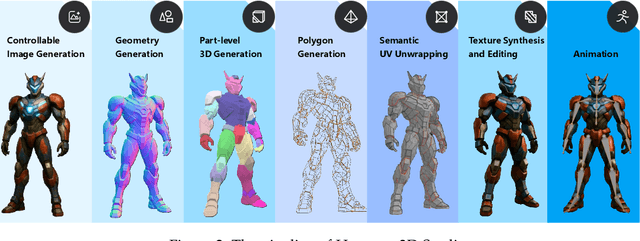

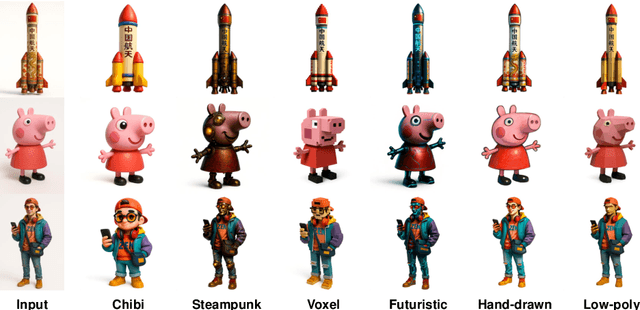
The creation of high-quality 3D assets, a cornerstone of modern game development, has long been characterized by labor-intensive and specialized workflows. This paper presents Hunyuan3D Studio, an end-to-end AI-powered content creation platform designed to revolutionize the game production pipeline by automating and streamlining the generation of game-ready 3D assets. At its core, Hunyuan3D Studio integrates a suite of advanced neural modules (such as Part-level 3D Generation, Polygon Generation, Semantic UV, etc.) into a cohesive and user-friendly system. This unified framework allows for the rapid transformation of a single concept image or textual description into a fully-realized, production-quality 3D model complete with optimized geometry and high-fidelity PBR textures. We demonstrate that assets generated by Hunyuan3D Studio are not only visually compelling but also adhere to the stringent technical requirements of contemporary game engines, significantly reducing iteration time and lowering the barrier to entry for 3D content creation. By providing a seamless bridge from creative intent to technical asset, Hunyuan3D Studio represents a significant leap forward for AI-assisted workflows in game development and interactive media.
The Fourth Monocular Depth Estimation Challenge
Apr 24, 2025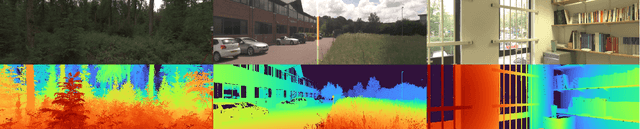
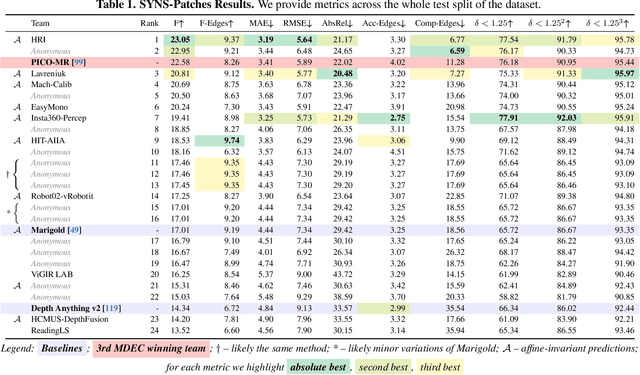
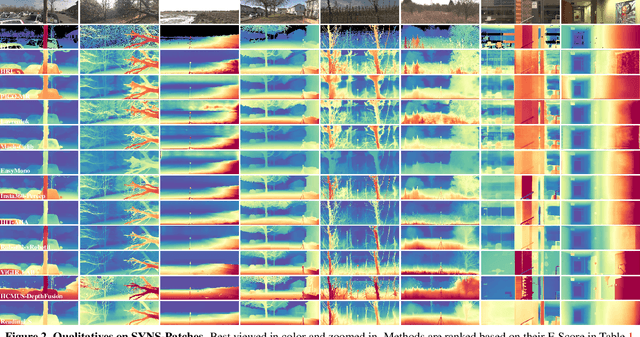
This paper presents the results of the fourth edition of the Monocular Depth Estimation Challenge (MDEC), which focuses on zero-shot generalization to the SYNS-Patches benchmark, a dataset featuring challenging environments in both natural and indoor settings. In this edition, we revised the evaluation protocol to use least-squares alignment with two degrees of freedom to support disparity and affine-invariant predictions. We also revised the baselines and included popular off-the-shelf methods: Depth Anything v2 and Marigold. The challenge received a total of 24 submissions that outperformed the baselines on the test set; 10 of these included a report describing their approach, with most leading methods relying on affine-invariant predictions. The challenge winners improved the 3D F-Score over the previous edition's best result, raising it from 22.58% to 23.05%.
Adaptive Stereo Depth Estimation with Multi-Spectral Images Across All Lighting Conditions
Nov 06, 2024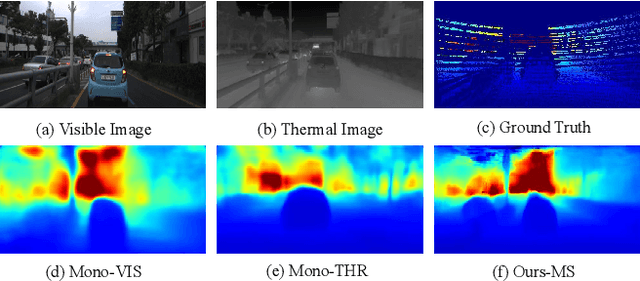
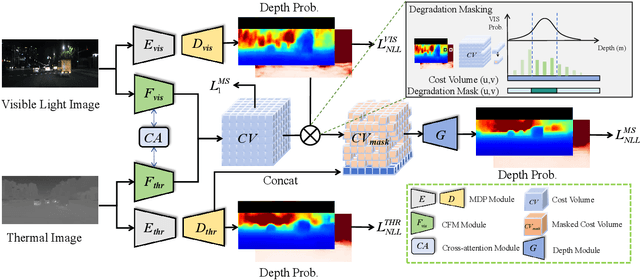
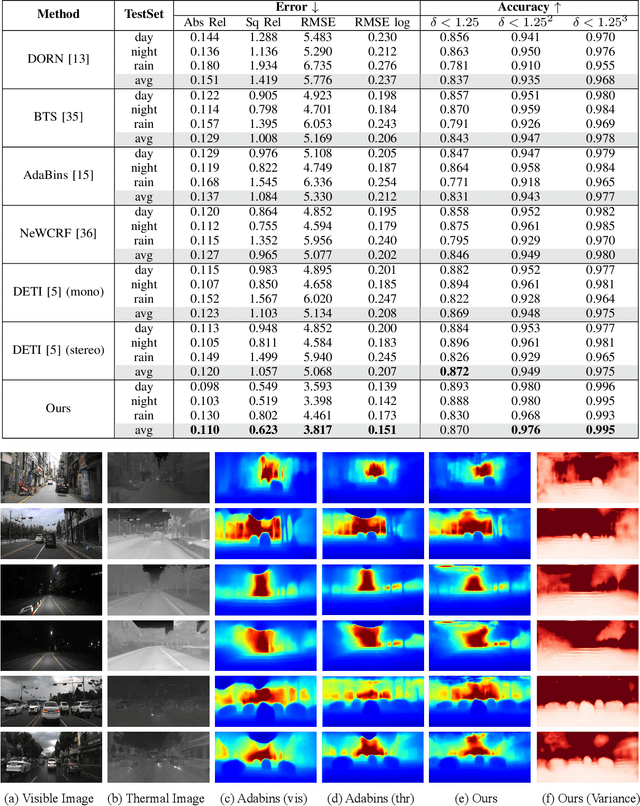
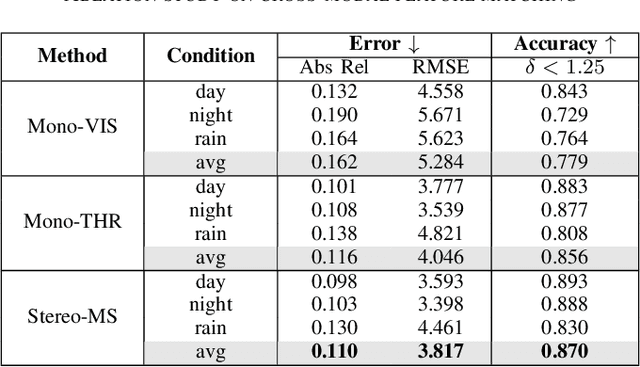
Depth estimation under adverse conditions remains a significant challenge. Recently, multi-spectral depth estimation, which integrates both visible light and thermal images, has shown promise in addressing this issue. However, existing algorithms struggle with precise pixel-level feature matching, limiting their ability to fully exploit geometric constraints across different spectra. To address this, we propose a novel framework incorporating stereo depth estimation to enforce accurate geometric constraints. In particular, we treat the visible light and thermal images as a stereo pair and utilize a Cross-modal Feature Matching (CFM) Module to construct a cost volume for pixel-level matching. To mitigate the effects of poor lighting on stereo matching, we introduce Degradation Masking, which leverages robust monocular thermal depth estimation in degraded regions. Our method achieves state-of-the-art (SOTA) performance on the Multi-Spectral Stereo (MS2) dataset, with qualitative evaluations demonstrating high-quality depth maps under varying lighting conditions.
Herald: A Natural Language Annotated Lean 4 Dataset
Oct 09, 2024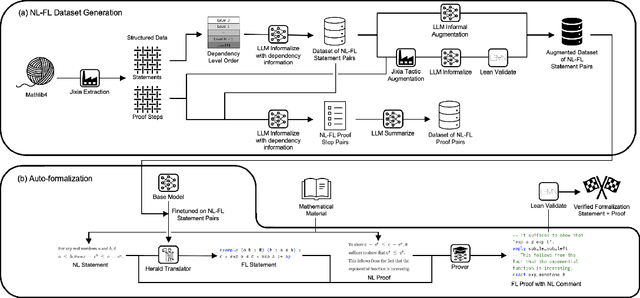

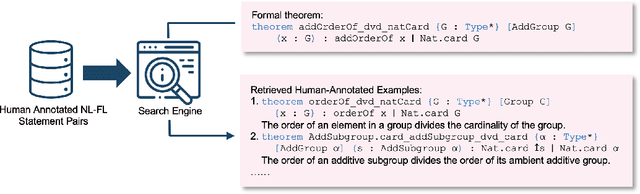
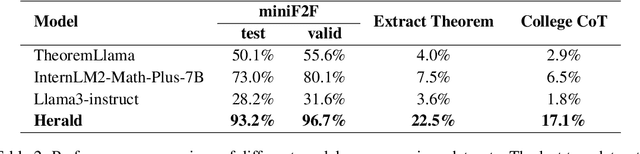
Verifiable formal languages like Lean have profoundly impacted mathematical reasoning, particularly through the use of large language models (LLMs) for automated reasoning. A significant challenge in training LLMs for these formal languages is the lack of parallel datasets that align natural language with formal language proofs. To address this challenge, this paper introduces a novel framework for translating the Mathlib4 corpus (a unified library of mathematics in formal language Lean 4) into natural language. Building upon this, we employ a dual augmentation strategy that combines tactic-based and informal-based approaches, leveraging the Lean-jixia system, a Lean 4 analyzer. We present the results of this pipeline on Mathlib4 as Herald (Hierarchy and Retrieval-based Translated Lean Dataset). We also propose the Herald Translator, which is fine-tuned on Herald. Herald translator achieves a 93.2% accuracy (Pass@128) on formalizing statements in the miniF2F-test and a 22.5% accuracy on our internal graduate-level textbook dataset, outperforming InternLM2-Math-Plus-7B (74.0% and 7.5%) and TheoremLlama (50.1% and 4.0%). Furthermore, we propose a section-level translation framework for real-world applications. As a direct application of Herald translator, we have successfully translated a template section in the Stack project, marking a notable progress in the automatic formalization of graduate-level mathematical literature. Our model, along with the datasets, will be open-sourced to the public soon.
MM-LDM: Multi-Modal Latent Diffusion Model for Sounding Video Generation
Oct 02, 2024Sounding Video Generation (SVG) is an audio-video joint generation task challenged by high-dimensional signal spaces, distinct data formats, and different patterns of content information. To address these issues, we introduce a novel multi-modal latent diffusion model (MM-LDM) for the SVG task. We first unify the representation of audio and video data by converting them into a single or a couple of images. Then, we introduce a hierarchical multi-modal autoencoder that constructs a low-level perceptual latent space for each modality and a shared high-level semantic feature space. The former space is perceptually equivalent to the raw signal space of each modality but drastically reduces signal dimensions. The latter space serves to bridge the information gap between modalities and provides more insightful cross-modal guidance. Our proposed method achieves new state-of-the-art results with significant quality and efficiency gains. Specifically, our method achieves a comprehensive improvement on all evaluation metrics and a faster training and sampling speed on Landscape and AIST++ datasets. Moreover, we explore its performance on open-domain sounding video generation, long sounding video generation, audio continuation, video continuation, and conditional single-modal generation tasks for a comprehensive evaluation, where our MM-LDM demonstrates exciting adaptability and generalization ability.
DINO-SD: Champion Solution for ICRA 2024 RoboDepth Challenge
May 27, 2024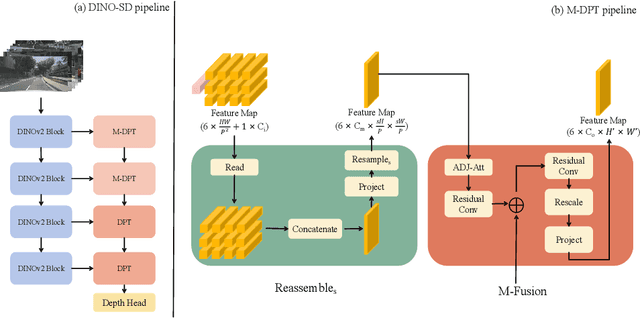

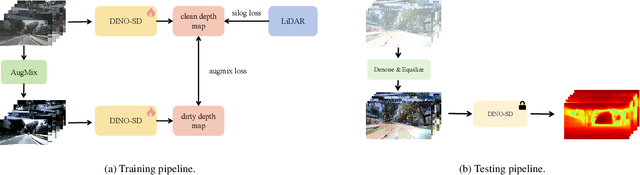
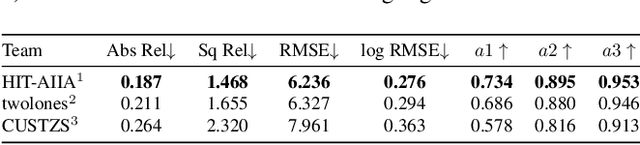
Surround-view depth estimation is a crucial task aims to acquire the depth maps of the surrounding views. It has many applications in real world scenarios such as autonomous driving, AR/VR and 3D reconstruction, etc. However, given that most of the data in the autonomous driving dataset is collected in daytime scenarios, this leads to poor depth model performance in the face of out-of-distribution(OoD) data. While some works try to improve the robustness of depth model under OoD data, these methods either require additional training data or lake generalizability. In this report, we introduce the DINO-SD, a novel surround-view depth estimation model. Our DINO-SD does not need additional data and has strong robustness. Our DINO-SD get the best performance in the track4 of ICRA 2024 RoboDepth Challenge.