 Add to Chrome
 Add to Firefox
 Add to Edge
Tangent classes of matroids and wonderful compactifications
Jul 08, 2026
For every loopless matroid $M$ and every Feichtner--Yuzvinsky building set $\mathcal{G}$ containing the top flat, we construct an integral tangent class $T_{M,\mathcal{G}}^{\mathbb{Z}}\in K_{\mathbb{Z}}(M,\mathcal{G})$; in the realizable case it specializes to the class of the tangent bundle of the corresponding wonderful compactification, it recovers the Hilbert series of the Chow ring through Hirzebruch--Riemann--Roch, and it satisfies the expected Chern-alpha lower bounds. This reproduces the tangent class and its key properties studied by the first author in arXiv:2606.22650. The main body of this paper was produced autonomously, without human mathematical guidance, by Danus, an AI mathematical reasoning agent. Danus solved the problem before arXiv:2606.22650 was publicly available, demonstrating the potential of AI agents in mathematical research. We reproduce its output faithfully, adding only editorial comments; the experiment is documented in Appendix B.

Danus: Orchestrating Mathematical Reasoning Agents with Fact-Graph Memory
Jul 08, 2026Recent LLM-based mathematical reasoning agents have begun to tackle research-level problems and, in several cases, have contributed to the resolution of open problems. However, scaling and orchestrating such agents effectively remains challenging, due to the difficulty of coordinating parallel proof search while keeping intermediate claims organized and reliable. In this paper, we propose Danus, an orchestration system for research-level mathematical reasoning centered on a shared fact graph as a global memory-management mechanism. Danus consists of a main agent that performs planning and coordination, multiple worker agents that carry out proof search in parallel, and a stateless verifier that checks proposed mathematical claims before they are admitted into the fact graph. Each verified fact is stored together with its proof and logical dependencies, allowing the system to build long arguments incrementally while keeping the shared proof state organized. The main agent periodically summarizes the evolving proof state, redirects workers across promising directions, and supports interaction with human mathematicians through progress reports. We evaluate Danus through six research-level case studies in algebraic geometry, singularity theory, and combinatorics, illustrating how the fact-graph memory mechanism enables Danus to construct long, detailed mathematical proofs. Our results suggest that fact-graph-based orchestration provides an effective route toward scaling mathematical reasoning agents for long-horizon research problems. Danus is open source at https://github.com/frenzymath/Danus.
LeanSearch v2: Global Premise Retrieval for Lean 4 Theorem Proving
May 14, 2026Proving theorems in Lean 4 often requires identifying a scattered set of library lemmas whose joint use enables a concise proof -- a task we call global premise retrieval. Existing tools address adjacent problems: semantic search engines find individual declarations matching a query, while premise-selection systems predict useful lemmas one tactic step at a time. Neither recovers the full premise set an entire theorem requires. We present LeanSearch v2, a two-mode retrieval system for this task. Its standard mode applies a hierarchy-informalized Mathlib corpus with an embedding-reranker pipeline, achieving state-of-the-art single-query retrieval without domain-specific fine-tuning (nDCG@10 of 0.62 vs. 0.53 for the next-best system). Its reasoning mode builds on standard mode as its retrieval substrate, targeting global premise retrieval through iterative sketch-retrieve-reflect cycles. On a 69-query benchmark of research-level Mathlib theorems, reasoning mode recovers 46.1% of ground-truth premise groups within 10 retrieved candidates, outperforming strong reasoning retrieval systems (38.0%) and premise-selection baselines (9.3%) on the same benchmark. In a controlled downstream evaluation with a fixed prover loop, replacing alternative retrievers with LeanSearch v2 yields the highest proof success (20% vs. 16% for the next-best system and 4% without retrieval), confirming that retrieval quality propagates to proof generation. We have open-sourced all code, data, and benchmarks. Code and data: https://github.com/frenzymath/LeanSearch-v2 . The standard mode is publicly available with API access at https://leansearch.net/ .
Automated Conjecture Resolution with Formal Verification
Apr 04, 2026Recent advances in large language models have significantly improved their ability to perform mathematical reasoning, extending from elementary problem solving to increasingly capable performance on research-level problems. However, reliably solving and verifying such problems remains challenging due to the inherent ambiguity of natural language reasoning. In this paper, we propose an automated framework for tackling research-level mathematical problems that integrates natural language reasoning with formal verification, enabling end-to-end problem solving with minimal human intervention. Our framework consists of two components: an informal reasoning agent, Rethlas, and a formal verification agent, Archon. Rethlas mimics the workflow of human mathematicians by combining reasoning primitives with our theorem search engine, Matlas, to explore solution strategies and construct candidate proofs. Archon, equipped with our formal theorem search engine LeanSearch, translates informal arguments into formalized Lean 4 projects through structured task decomposition, iterative refinement, and automated proof synthesis, ensuring machine-checkable correctness. Using this framework, we automatically resolve an open problem in commutative algebra and formally verify the resulting proof in Lean 4 with essentially no human involvement. Our experiments demonstrate that strong theorem retrieval tools enable the discovery and application of cross-domain mathematical techniques, while the formal agent is capable of autonomously filling nontrivial gaps in informal arguments. More broadly, our work illustrates a promising paradigm for mathematical research in which informal and formal reasoning systems, equipped with theorem retrieval tools, operate in tandem to produce verifiable results, substantially reduce human effort, and offer a concrete instantiation of human-AI collaborative mathematical research.
Aria: An Agent For Retrieval and Iterative Auto-Formalization via Dependency Graph
Oct 06, 2025Accurate auto-formalization of theorem statements is essential for advancing automated discovery and verification of research-level mathematics, yet remains a major bottleneck for LLMs due to hallucinations, semantic mismatches, and their inability to synthesize new definitions. To tackle these issues, we present Aria (Agent for Retrieval and Iterative Autoformalization), a system for conjecture-level formalization in Lean that emulates human expert reasoning via a two-phase Graph-of-Thought process: recursively decomposing statements into a dependency graph and then constructing formalizations from grounded concepts. To ensure semantic correctness, we introduce AriaScorer, a checker that retrieves definitions from Mathlib for term-level grounding, enabling rigorous and reliable verification. We evaluate Aria on diverse benchmarks. On ProofNet, it achieves 91.6% compilation success rate and 68.5% final accuracy, surpassing previous methods. On FATE-X, a suite of challenging algebra problems from research literature, it outperforms the best baseline with 44.0% vs. 24.0% final accuracy. On a dataset of homological conjectures, Aria reaches 42.9% final accuracy while all other models score 0%.
REAL-Prover: Retrieval Augmented Lean Prover for Mathematical Reasoning
May 27, 2025Nowadays, formal theorem provers have made monumental progress on high-school and competition-level mathematics, but few of them generalize to more advanced mathematics. In this paper, we present REAL-Prover, a new open-source stepwise theorem prover for Lean 4 to push this boundary. This prover, based on our fine-tuned large language model (REAL-Prover-v1) and integrated with a retrieval system (Leansearch-PS), notably boosts performance on solving college-level mathematics problems. To train REAL-Prover-v1, we developed HERALD-AF, a data extraction pipeline that converts natural language math problems into formal statements, and a new open-source Lean 4 interactive environment (Jixia-interactive) to facilitate synthesis data collection. In our experiments, our prover using only supervised fine-tune achieves competitive results with a 23.7% success rate (Pass@64) on the ProofNet dataset-comparable to state-of-the-art (SOTA) models. To further evaluate our approach, we introduce FATE-M, a new benchmark focused on algebraic problems, where our prover achieves a SOTA success rate of 56.7% (Pass@64).
Herald: A Natural Language Annotated Lean 4 Dataset
Oct 09, 2024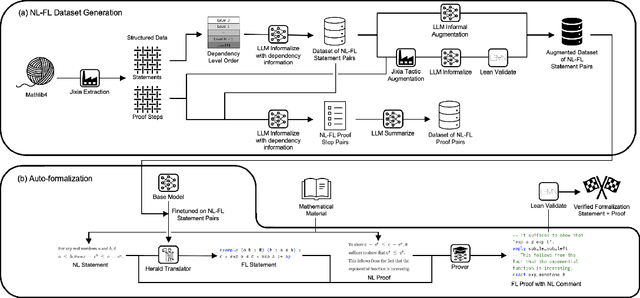

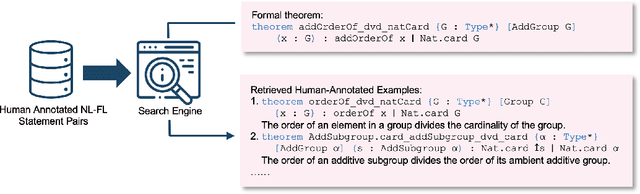
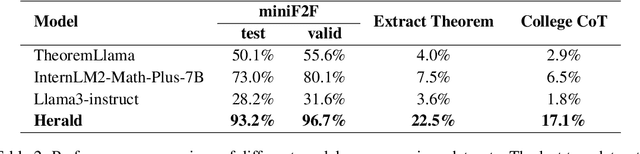
Verifiable formal languages like Lean have profoundly impacted mathematical reasoning, particularly through the use of large language models (LLMs) for automated reasoning. A significant challenge in training LLMs for these formal languages is the lack of parallel datasets that align natural language with formal language proofs. To address this challenge, this paper introduces a novel framework for translating the Mathlib4 corpus (a unified library of mathematics in formal language Lean 4) into natural language. Building upon this, we employ a dual augmentation strategy that combines tactic-based and informal-based approaches, leveraging the Lean-jixia system, a Lean 4 analyzer. We present the results of this pipeline on Mathlib4 as Herald (Hierarchy and Retrieval-based Translated Lean Dataset). We also propose the Herald Translator, which is fine-tuned on Herald. Herald translator achieves a 93.2% accuracy (Pass@128) on formalizing statements in the miniF2F-test and a 22.5% accuracy on our internal graduate-level textbook dataset, outperforming InternLM2-Math-Plus-7B (74.0% and 7.5%) and TheoremLlama (50.1% and 4.0%). Furthermore, we propose a section-level translation framework for real-world applications. As a direct application of Herald translator, we have successfully translated a template section in the Stack project, marking a notable progress in the automatic formalization of graduate-level mathematical literature. Our model, along with the datasets, will be open-sourced to the public soon.
A Semantic Search Engine for Mathlib4
Mar 20, 2024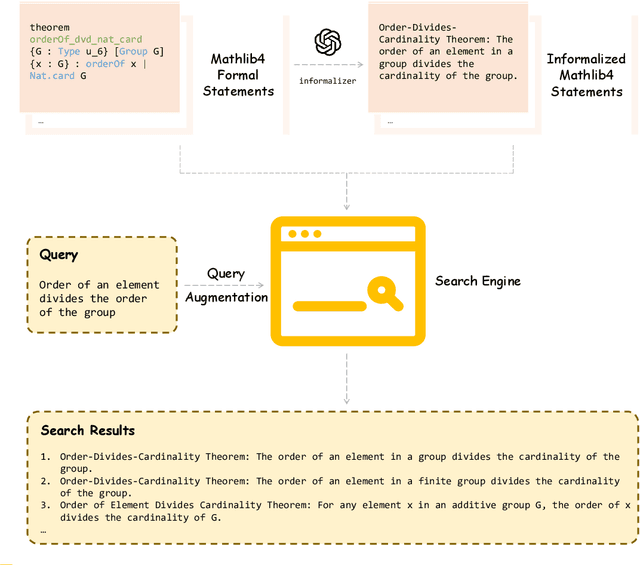
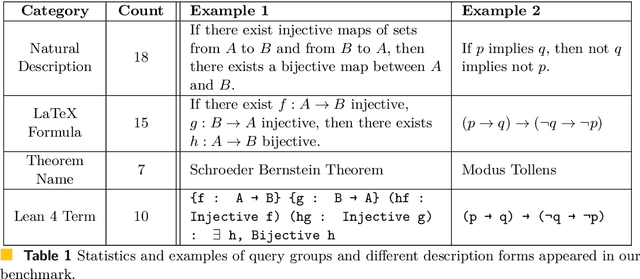
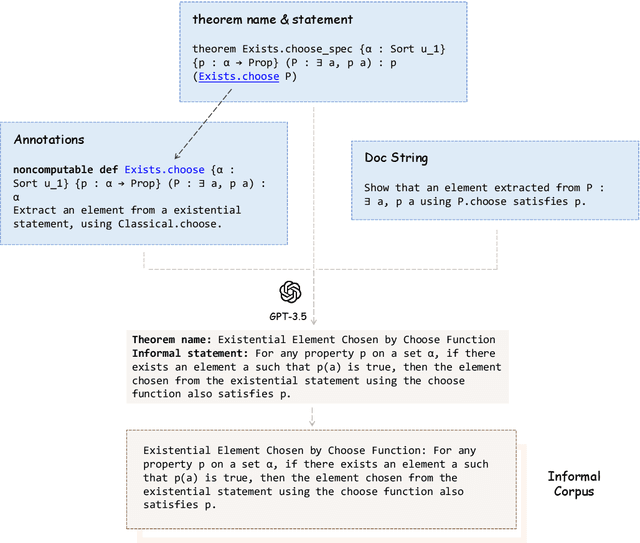

The interactive theorem prover, Lean, enables the verification of formal mathematical proofs and is backed by an expanding community. Central to this ecosystem is its mathematical library, mathlib4, which lays the groundwork for the formalization of an expanding range of mathematical theories. However, searching for theorems in mathlib4 can be challenging. To successfully search in mathlib4, users often need to be familiar with its naming conventions or documentation strings. Therefore, creating a semantic search engine that can be used easily by individuals with varying familiarity with mathlib4 is very important. In this paper, we present a semantic search engine for mathlib4 that accepts informal queries and finds the relevant theorems. We also establish a benchmark for assessing the performance of various search engines for mathlib4.