 Add to Chrome
 Add to Firefox
 Add to Edge
Joint Text-Audio Alignment for EEG-to-Text Decoding in Chinese Speech Production and Perception
Jul 28, 2026
Decoding speech information directly from scalp electroencephalography (EEG) into text provides a potential non-invasive neural communication pathway for individuals with severe speech and motor impairments. Compared with invasive approaches such as electrocorticography, EEG is safer and more widely deployable, yet substantially more challenging to decode.This challenge is exacerbated for Chinese sentence decoding, which must handle a high-dimensional output space with thousands of characters, severe inter-subject variability, and low signal-to-noise ratios for text alignment.Existing methods commit to a single supervisory axis---either text semantics or audio acoustic features---yet neither can simultaneously satisfy the demands of sentence-level discriminability and fine-grained temporal resolution required for large-vocabulary Chinese decoding. We introduce EEGAlign, a novel parameter-efficient framework that jointly aligns EEG with two axes---text alignment with BGE-M3 text embeddings and audio alignment with wav2vec~2.0 speech features via contrastive learning followed by CTC character-sequence decoding. On ChineseEEG-2 data, EEGAlign yields state-of-the-art closed-set sentence classification performance, reaching up to 82.37% Top-1 accuracy on Reading Aloud EEG and 41.43% on Passive Listening EEG out of 101 candidates. Ablation studies show that the two alignment axes are highly complementary: combining them yields consistently better performance than either alone. To the best of our knowledge, this is the first study on decoding large-vocabulary Chinese sentences from non-invasive EEG during overt speech production, and achieving strong classification performance with relatively large closed-set candidate-sentence setting.

Can MLLMs Reason Beyond Language? VisReason: A Comprehensive Benchmark for Vision-Centric Reasoning
May 25, 2026Recent multimodal large language models (MLLMs) achieve strong performance on visual reasoning benchmarks, yet it remains unclear to what extent such performance reflects reasoning directly grounded in visual evidence. We introduce VisReason, a benchmark for vision-centric reasoning in everyday scenarios where perception and inference are tightly coupled. VisReason contains 1,505 questions across 10 categories spanning perceptual, structural, and conceptual reasoning. Our evaluation shows that VisReason poses a qualitatively different challenge from existing benchmarks, exposing substantial gaps between humans and current MLLMs and revealing limited benefits from test-time reasoning strategies. VisReason offers a focused diagnostic for evaluating vision-centric reasoning beyond language.
AdaSpark: Adaptive Sparsity for Efficient Long-Video Understanding
Apr 09, 2026Processing long-form videos with Video Large Language Models (Video-LLMs) is computationally prohibitive. Current efficiency methods often compromise fine-grained perception through irreversible information disposal or inhibit long-range temporal modeling via rigid, predefined sparse patterns. This paper introduces AdaSpark, an adaptive sparsity framework designed to address these limitations. AdaSpark first partitions video inputs into 3D spatio-temporal cubes. It then employs two co-designed, context-aware components: (1) Adaptive Cube-Selective Attention (AdaS-Attn), which adaptively selects a subset of relevant video cubes to attend for each query token, and (2) Adaptive Token-Selective FFN (AdaS-FFN), which selectively processes only the most salient tokens within each cube. An entropy-based (Top-p) selection mechanism adaptively allocates computational resources based on input complexity. Experiments demonstrate that AdaSpark significantly reduces computational load by up to 57% FLOPs while maintaining comparable performance to dense models and preserving fine-grained, long-range dependencies, as validated on challenging hour-scale video benchmarks.
SAGE: Multi-Agent Self-Evolution for LLM Reasoning
Mar 17, 2026Reinforcement learning with verifiable rewards improves reasoning in large language models (LLMs), but many methods still rely on large human-labeled datasets. While self-play reduces this dependency, it often lacks explicit planning and strong quality control, limiting stability in long-horizon multi-step reasoning. We present SAGE (Self-evolving Agents for Generalized reasoning Evolution), a closed-loop framework where four agents: Challenger, Planner, Solver, and Critic, co-evolve from a shared LLM backbone using only a small seed set. The Challenger continuously generates increasingly difficult tasks; the Planner converts each task into a structured multi-step plan; and the Solver follows the plan to produce an answer, whose correctness is determined by external verifiers. The Critic scores and filters both generated questions and plans to prevent curriculum drift and maintain training signal quality, enabling stable self-training. Across mathematics and code-generation benchmarks, SAGE delivers consistent gains across model scales, improving the Qwen-2.5-7B model by 8.9% on LiveCodeBench and 10.7% on OlympiadBench.
SEMAG: Self-Evolutionary Multi-Agent Code Generation
Mar 16, 2026Large Language Models (LLMs) have made significant progress in handling complex programming tasks. However, current methods rely on manual model selection and fixed workflows, which limit their ability to adapt to changing task complexities. To address this, we propose SEMAG, a Self-Evolutionary Multi-Agent code Generation framework that mimics human coding practices. It decomposes programming tasks into stages, including planning, coding, debugging, and discussion, while adapting workflows to task difficulty. Its self-evolutionary agents can access the latest models in real time and automatically upgrade the backbone model. SEMAG sets new state-of-the-art Pass@1 accuracy across benchmarks. Using identical backbone models, SEMAG outperforms prior methods by 3.3% on CodeContests. When augmented with self-evolutionary model selection that automatically identifies optimal backbones, SEMAG reaches 52.6%, showcasing both framework effectiveness and adaptability to evolving LLM capabilities.
ProAV-DiT: A Projected Latent Diffusion Transformer for Efficient Synchronized Audio-Video Generation
Nov 15, 2025Sounding Video Generation (SVG) remains a challenging task due to the inherent structural misalignment between audio and video, as well as the high computational cost of multimodal data processing. In this paper, we introduce ProAV-DiT, a Projected Latent Diffusion Transformer designed for efficient and synchronized audio-video generation. To address structural inconsistencies, we preprocess raw audio into video-like representations, aligning both the temporal and spatial dimensions between audio and video. At its core, ProAV-DiT adopts a Multi-scale Dual-stream Spatio-Temporal Autoencoder (MDSA), which projects both modalities into a unified latent space using orthogonal decomposition, enabling fine-grained spatiotemporal modeling and semantic alignment. To further enhance temporal coherence and modality-specific fusion, we introduce a multi-scale attention mechanism, which consists of multi-scale temporal self-attention and group cross-modal attention. Furthermore, we stack the 2D latents from MDSA into a unified 3D latent space, which is processed by a spatio-temporal diffusion Transformer. This design efficiently models spatiotemporal dependencies, enabling the generation of high-fidelity synchronized audio-video content while reducing computational overhead. Extensive experiments conducted on standard benchmarks demonstrate that ProAV-DiT outperforms existing methods in both generation quality and computational efficiency.
MM-LDM: Multi-Modal Latent Diffusion Model for Sounding Video Generation
Oct 02, 2024Sounding Video Generation (SVG) is an audio-video joint generation task challenged by high-dimensional signal spaces, distinct data formats, and different patterns of content information. To address these issues, we introduce a novel multi-modal latent diffusion model (MM-LDM) for the SVG task. We first unify the representation of audio and video data by converting them into a single or a couple of images. Then, we introduce a hierarchical multi-modal autoencoder that constructs a low-level perceptual latent space for each modality and a shared high-level semantic feature space. The former space is perceptually equivalent to the raw signal space of each modality but drastically reduces signal dimensions. The latter space serves to bridge the information gap between modalities and provides more insightful cross-modal guidance. Our proposed method achieves new state-of-the-art results with significant quality and efficiency gains. Specifically, our method achieves a comprehensive improvement on all evaluation metrics and a faster training and sampling speed on Landscape and AIST++ datasets. Moreover, we explore its performance on open-domain sounding video generation, long sounding video generation, audio continuation, video continuation, and conditional single-modal generation tasks for a comprehensive evaluation, where our MM-LDM demonstrates exciting adaptability and generalization ability.
COMUNI: Decomposing Common and Unique Video Signals for Diffusion-based Video Generation
Oct 02, 2024
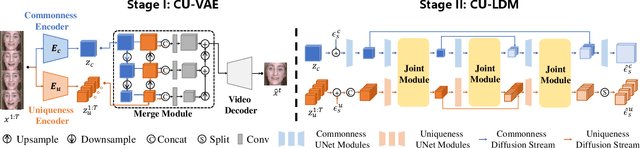


Since videos record objects moving coherently, adjacent video frames have commonness (similar object appearances) and uniqueness (slightly changed postures). To prevent redundant modeling of common video signals, we propose a novel diffusion-based framework, named COMUNI, which decomposes the COMmon and UNIque video signals to enable efficient video generation. Our approach separates the decomposition of video signals from the task of video generation, thus reducing the computation complexity of generative models. In particular, we introduce CU-VAE to decompose video signals and encode them into latent features. To train CU-VAE in a self-supervised manner, we employ a cascading merge module to reconstitute video signals and a time-agnostic video decoder to reconstruct video frames. Then we propose CU-LDM to model latent features for video generation, which adopts two specific diffusion streams to simultaneously model the common and unique latent features. We further utilize additional joint modules for cross modeling of the common and unique latent features, and a novel position embedding method to ensure the content consistency and motion coherence of generated videos. The position embedding method incorporates spatial and temporal absolute position information into the joint modules. Extensive experiments demonstrate the necessity of decomposing common and unique video signals for video generation and the effectiveness and efficiency of our proposed method.
Enhancing and Accelerating Large Language Models via Instruction-Aware Contextual Compression
Aug 28, 2024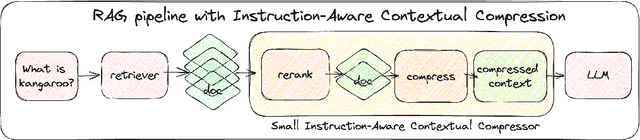


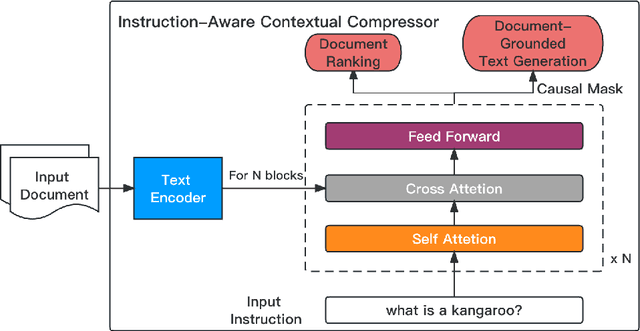
Large Language Models (LLMs) have garnered widespread attention due to their remarkable performance across various tasks. However, to mitigate the issue of hallucinations, LLMs often incorporate retrieval-augmented pipeline to provide them with rich external knowledge and context. Nevertheless, challenges stem from inaccurate and coarse-grained context retrieved from the retriever. Supplying irrelevant context to the LLMs can result in poorer responses, increased inference latency, and higher costs. This paper introduces a method called Instruction-Aware Contextual Compression, which filters out less informative content, thereby accelerating and enhancing the use of LLMs. The experimental results demonstrate that Instruction-Aware Contextual Compression notably reduces memory consumption and minimizes generation latency while maintaining performance levels comparable to those achieved with the use of the full context. Specifically, we achieved a 50% reduction in context-related costs, resulting in a 5% reduction in inference memory usage and a 2.2-fold increase in inference speed, with only a minor drop of 0.047 in Rouge-1. These findings suggest that our method strikes an effective balance between efficiency and performance.
Deep Optimal Timing Strategies for Time Series
Oct 09, 2023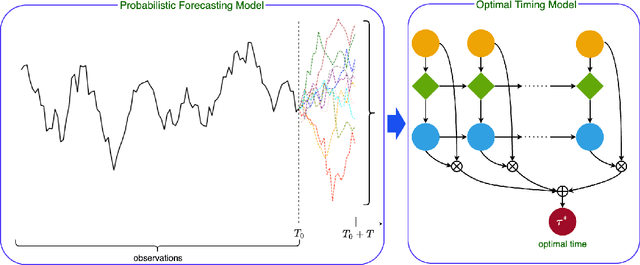
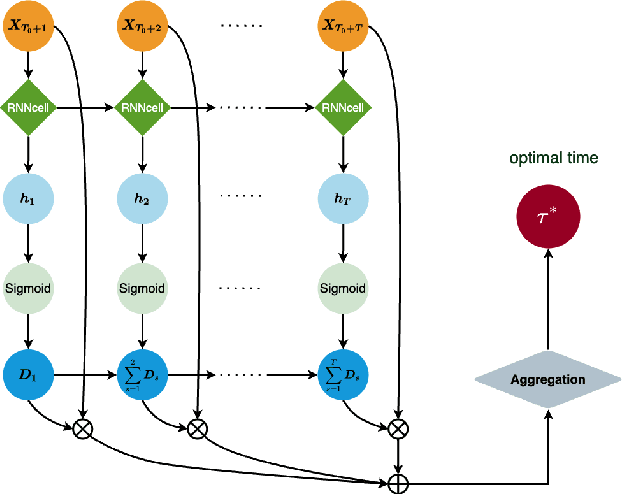
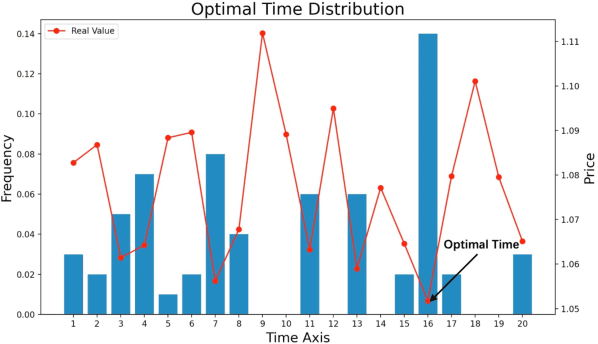
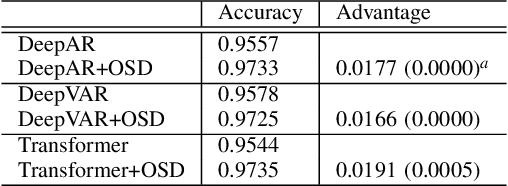
Deciding the best future execution time is a critical task in many business activities while evolving time series forecasting, and optimal timing strategy provides such a solution, which is driven by observed data. This solution has plenty of valuable applications to reduce the operation costs. In this paper, we propose a mechanism that combines a probabilistic time series forecasting task and an optimal timing decision task as a first systematic attempt to tackle these practical problems with both solid theoretical foundation and real-world flexibility. Specifically, it generates the future paths of the underlying time series via probabilistic forecasting algorithms, which does not need a sophisticated mathematical dynamic model relying on strong prior knowledge as most other common practices. In order to find the optimal execution time, we formulate the decision task as an optimal stopping problem, and employ a recurrent neural network structure (RNN) to approximate the optimal times. Github repository: \url{github.com/ChenPopper/optimal_timing_TSF}.