 Add to Chrome
 Add to Firefox
 Add to Edge
Lingvo: a Modular and Scalable Framework for Sequence-to-Sequence Modeling
Feb 21, 2019
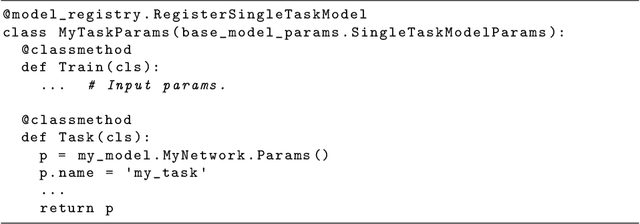
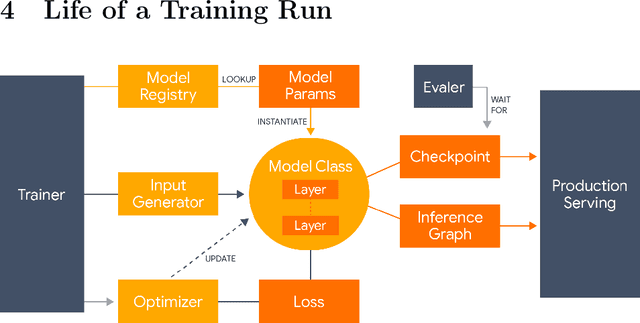
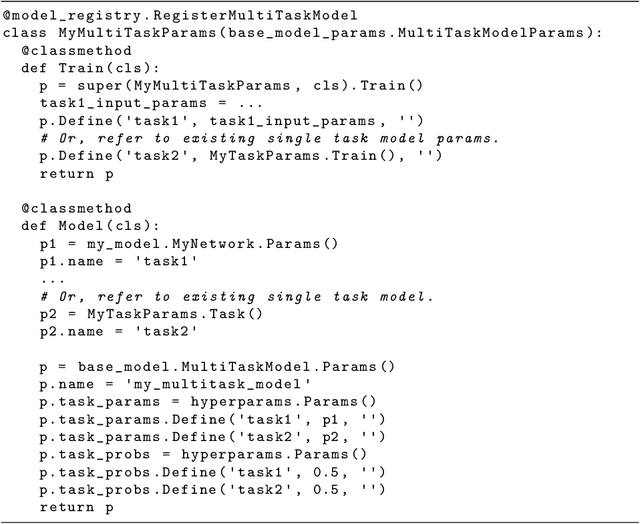
Lingvo is a Tensorflow framework offering a complete solution for collaborative deep learning research, with a particular focus towards sequence-to-sequence models. Lingvo models are composed of modular building blocks that are flexible and easily extensible, and experiment configurations are centralized and highly customizable. Distributed training and quantized inference are supported directly within the framework, and it contains existing implementations of a large number of utilities, helper functions, and the newest research ideas. Lingvo has been used in collaboration by dozens of researchers in more than 20 papers over the last two years. This document outlines the underlying design of Lingvo and serves as an introduction to the various pieces of the framework, while also offering examples of advanced features that showcase the capabilities of the framework.

GPipe: Efficient Training of Giant Neural Networks using Pipeline Parallelism
Dec 12, 2018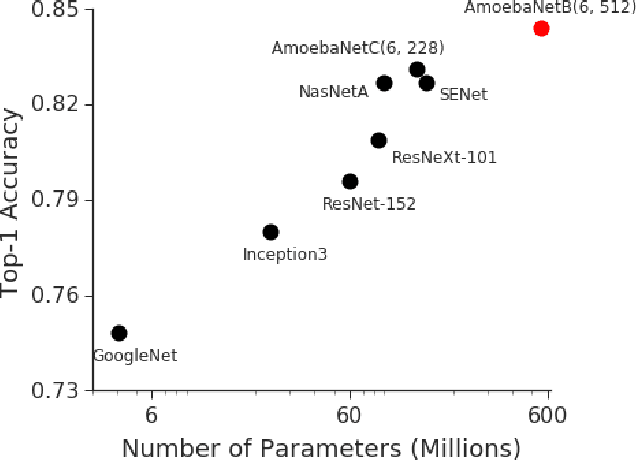



GPipe is a scalable pipeline parallelism library that enables learning of giant deep neural networks. It partitions network layers across accelerators and pipelines execution to achieve high hardware utilization. It leverages recomputation to minimize activation memory usage. For example, using partitions over 8 accelerators, it is able to train networks that are 25x larger, demonstrating its scalability. It also guarantees that the computed gradients remain consistent regardless of the number of partitions. It achieves an almost linear speed up without any changes in the model parameters: when using 4x more accelerators, training the same model is up to 3.5x faster. We train a 557 million parameters AmoebaNet model on ImageNet and achieve a new state-of-the-art 84.3% top-1 / 97.0% top-5 accuracy on ImageNet 2012 dataset. Finally, we use this learned model to finetune multiple popular image classification datasets and obtain competitive results, including pushing the CIFAR-10 accuracy to 99% and CIFAR-100 accuracy to 91.3%.
Transfer Learning from Speaker Verification to Multispeaker Text-To-Speech Synthesis
Nov 05, 2018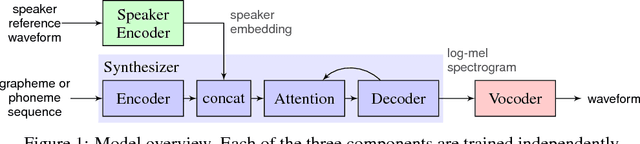

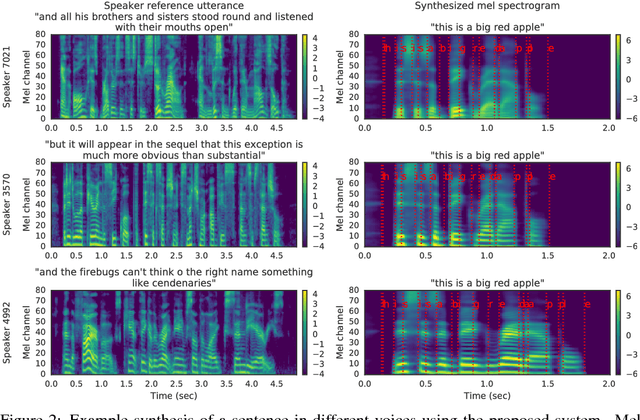
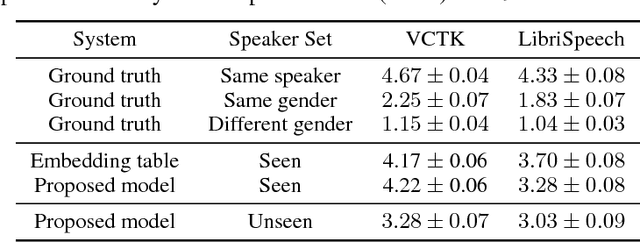
We describe a neural network-based system for text-to-speech (TTS) synthesis that is able to generate speech audio in the voice of many different speakers, including those unseen during training. Our system consists of three independently trained components: (1) a speaker encoder network, trained on a speaker verification task using an independent dataset of noisy speech from thousands of speakers without transcripts, to generate a fixed-dimensional embedding vector from seconds of reference speech from a target speaker; (2) a sequence-to-sequence synthesis network based on Tacotron 2, which generates a mel spectrogram from text, conditioned on the speaker embedding; (3) an auto-regressive WaveNet-based vocoder that converts the mel spectrogram into a sequence of time domain waveform samples. We demonstrate that the proposed model is able to transfer the knowledge of speaker variability learned by the discriminatively-trained speaker encoder to the new task, and is able to synthesize natural speech from speakers that were not seen during training. We quantify the importance of training the speaker encoder on a large and diverse speaker set in order to obtain the best generalization performance. Finally, we show that randomly sampled speaker embeddings can be used to synthesize speech in the voice of novel speakers dissimilar from those used in training, indicating that the model has learned a high quality speaker representation.
Hierarchical Generative Modeling for Controllable Speech Synthesis
Oct 16, 2018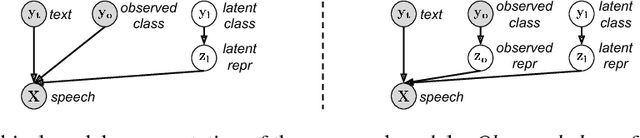
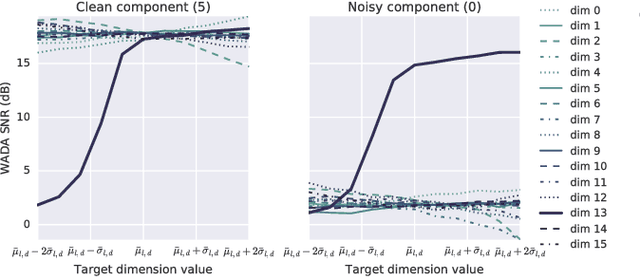
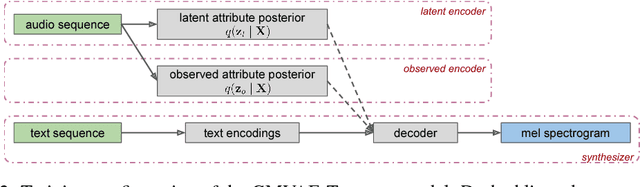

This paper proposes a neural end-to-end text-to-speech (TTS) model which can control latent attributes in the generated speech that are rarely annotated in the training data, such as speaking style, accent, background noise, and recording conditions. The model is formulated as a conditional generative model with two levels of hierarchical latent variables. The first level is a categorical variable, which represents attribute groups (e.g. clean/noisy) and provides interpretability. The second level, conditioned on the first, is a multivariate Gaussian variable, which characterizes specific attribute configurations (e.g. noise level, speaking rate) and enables disentangled fine-grained control over these attributes. This amounts to using a Gaussian mixture model (GMM) for the latent distribution. Extensive evaluation demonstrates its ability to control the aforementioned attributes. In particular, it is capable of consistently synthesizing high-quality clean speech regardless of the quality of the training data for the target speaker.
The Best of Both Worlds: Combining Recent Advances in Neural Machine Translation
Apr 27, 2018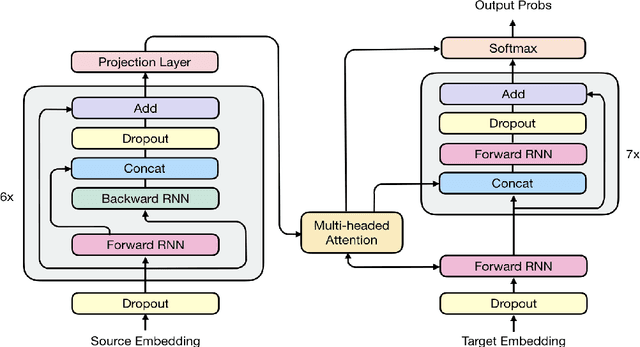
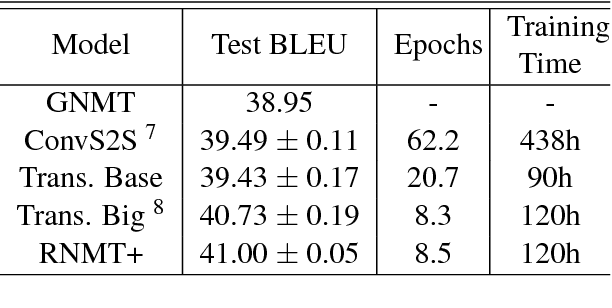
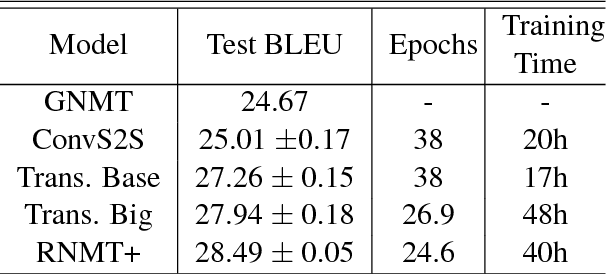
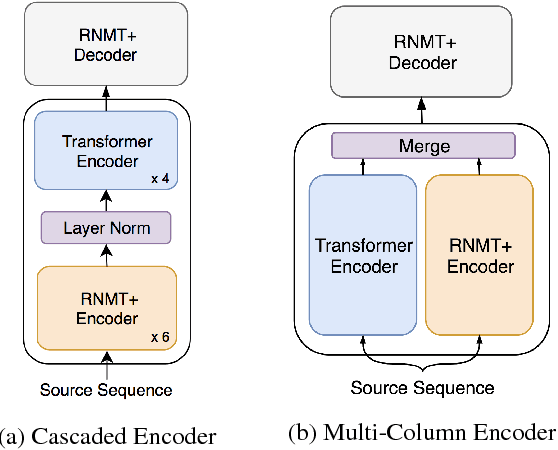
The past year has witnessed rapid advances in sequence-to-sequence (seq2seq) modeling for Machine Translation (MT). The classic RNN-based approaches to MT were first out-performed by the convolutional seq2seq model, which was then out-performed by the more recent Transformer model. Each of these new approaches consists of a fundamental architecture accompanied by a set of modeling and training techniques that are in principle applicable to other seq2seq architectures. In this paper, we tease apart the new architectures and their accompanying techniques in two ways. First, we identify several key modeling and training techniques, and apply them to the RNN architecture, yielding a new RNMT+ model that outperforms all of the three fundamental architectures on the benchmark WMT'14 English to French and English to German tasks. Second, we analyze the properties of each fundamental seq2seq architecture and devise new hybrid architectures intended to combine their strengths. Our hybrid models obtain further improvements, outperforming the RNMT+ model on both benchmark datasets.
State-of-the-art Speech Recognition With Sequence-to-Sequence Models
Feb 23, 2018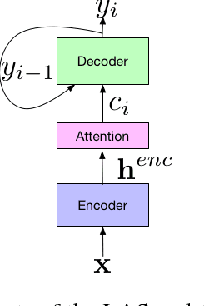
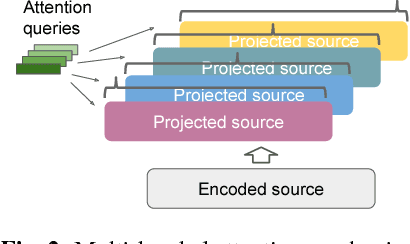
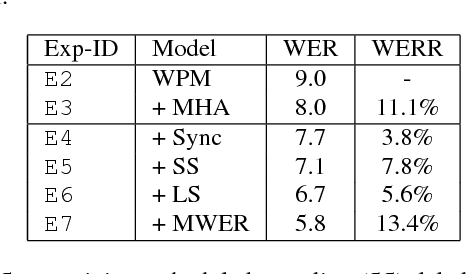

Attention-based encoder-decoder architectures such as Listen, Attend, and Spell (LAS), subsume the acoustic, pronunciation and language model components of a traditional automatic speech recognition (ASR) system into a single neural network. In previous work, we have shown that such architectures are comparable to state-of-theart ASR systems on dictation tasks, but it was not clear if such architectures would be practical for more challenging tasks such as voice search. In this work, we explore a variety of structural and optimization improvements to our LAS model which significantly improve performance. On the structural side, we show that word piece models can be used instead of graphemes. We also introduce a multi-head attention architecture, which offers improvements over the commonly-used single-head attention. On the optimization side, we explore synchronous training, scheduled sampling, label smoothing, and minimum word error rate optimization, which are all shown to improve accuracy. We present results with a unidirectional LSTM encoder for streaming recognition. On a 12, 500 hour voice search task, we find that the proposed changes improve the WER from 9.2% to 5.6%, while the best conventional system achieves 6.7%; on a dictation task our model achieves a WER of 4.1% compared to 5% for the conventional system.
Natural TTS Synthesis by Conditioning WaveNet on Mel Spectrogram Predictions
Feb 16, 2018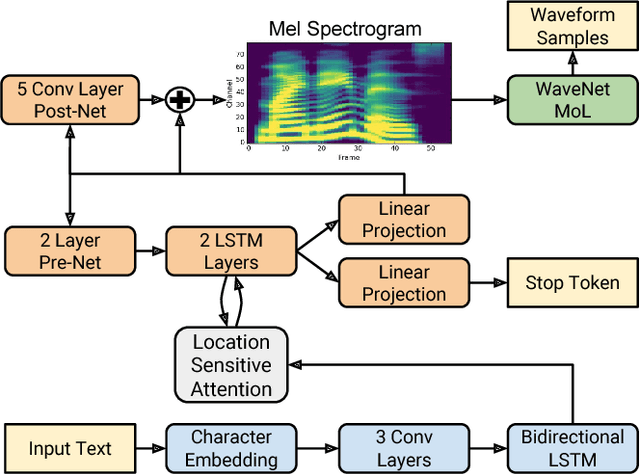
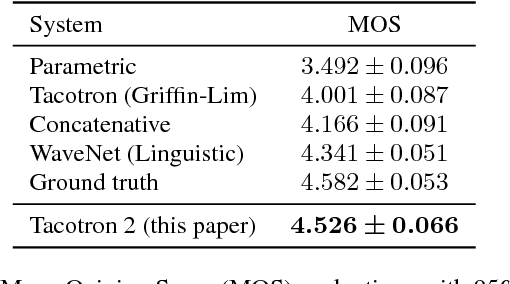
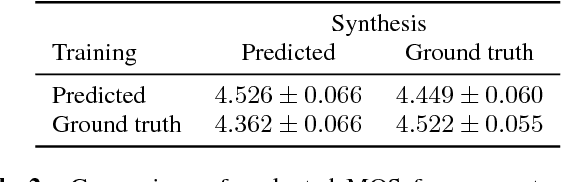
This paper describes Tacotron 2, a neural network architecture for speech synthesis directly from text. The system is composed of a recurrent sequence-to-sequence feature prediction network that maps character embeddings to mel-scale spectrograms, followed by a modified WaveNet model acting as a vocoder to synthesize timedomain waveforms from those spectrograms. Our model achieves a mean opinion score (MOS) of $4.53$ comparable to a MOS of $4.58$ for professionally recorded speech. To validate our design choices, we present ablation studies of key components of our system and evaluate the impact of using mel spectrograms as the input to WaveNet instead of linguistic, duration, and $F_0$ features. We further demonstrate that using a compact acoustic intermediate representation enables significant simplification of the WaveNet architecture.
An analysis of incorporating an external language model into a sequence-to-sequence model
Dec 06, 2017
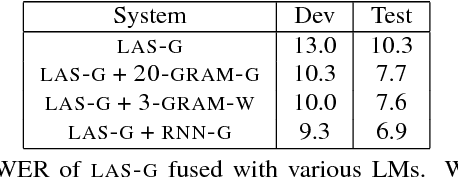
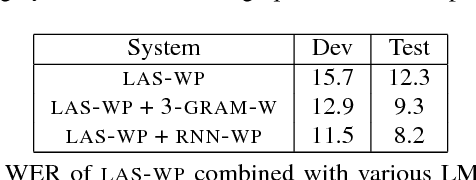
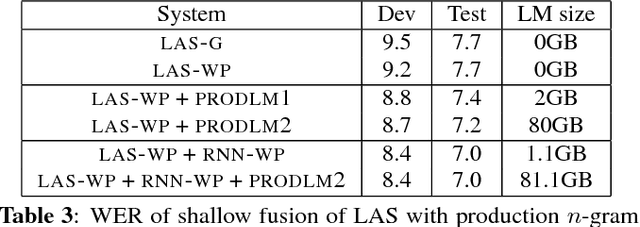
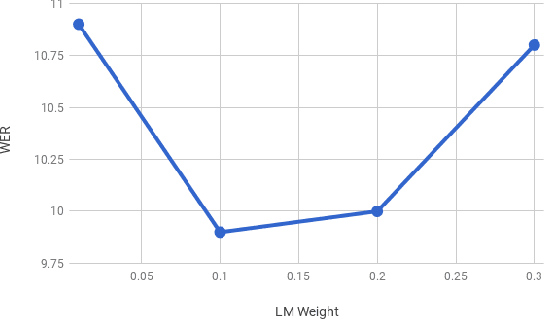
Attention-based sequence-to-sequence models for automatic speech recognition jointly train an acoustic model, language model, and alignment mechanism. Thus, the language model component is only trained on transcribed audio-text pairs. This leads to the use of shallow fusion with an external language model at inference time. Shallow fusion refers to log-linear interpolation with a separately trained language model at each step of the beam search. In this work, we investigate the behavior of shallow fusion across a range of conditions: different types of language models, different decoding units, and different tasks. On Google Voice Search, we demonstrate that the use of shallow fusion with a neural LM with wordpieces yields a 9.1% relative word error rate reduction (WERR) over our competitive attention-based sequence-to-sequence model, obviating the need for second-pass rescoring.
No Need for a Lexicon? Evaluating the Value of the Pronunciation Lexica in End-to-End Models
Dec 05, 2017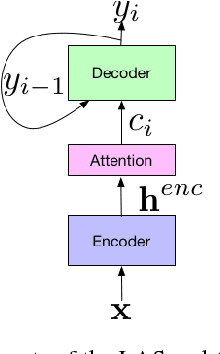
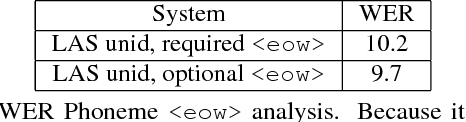
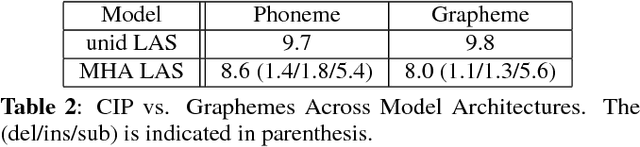
For decades, context-dependent phonemes have been the dominant sub-word unit for conventional acoustic modeling systems. This status quo has begun to be challenged recently by end-to-end models which seek to combine acoustic, pronunciation, and language model components into a single neural network. Such systems, which typically predict graphemes or words, simplify the recognition process since they remove the need for a separate expert-curated pronunciation lexicon to map from phoneme-based units to words. However, there has been little previous work comparing phoneme-based versus grapheme-based sub-word units in the end-to-end modeling framework, to determine whether the gains from such approaches are primarily due to the new probabilistic model, or from the joint learning of the various components with grapheme-based units. In this work, we conduct detailed experiments which are aimed at quantifying the value of phoneme-based pronunciation lexica in the context of end-to-end models. We examine phoneme-based end-to-end models, which are contrasted against grapheme-based ones on a large vocabulary English Voice-search task, where we find that graphemes do indeed outperform phonemes. We also compare grapheme and phoneme-based approaches on a multi-dialect English task, which once again confirm the superiority of graphemes, greatly simplifying the system for recognizing multiple dialects.
Minimum Word Error Rate Training for Attention-based Sequence-to-Sequence Models
Dec 05, 2017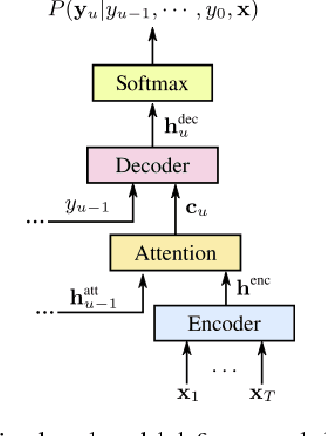
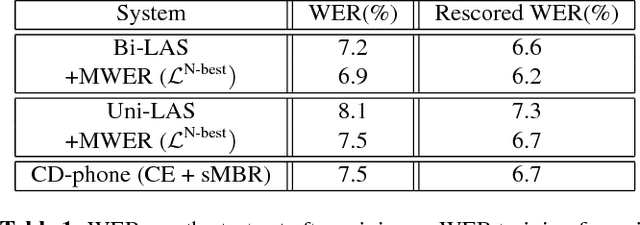
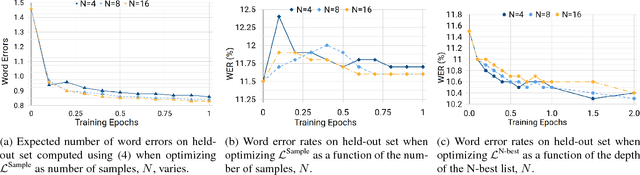
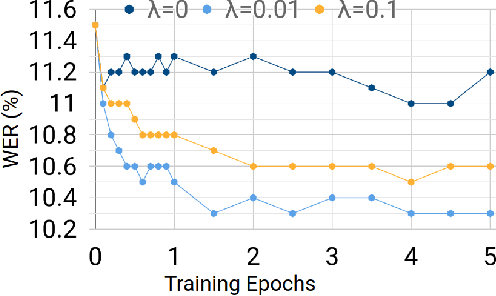
Sequence-to-sequence models, such as attention-based models in automatic speech recognition (ASR), are typically trained to optimize the cross-entropy criterion which corresponds to improving the log-likelihood of the data. However, system performance is usually measured in terms of word error rate (WER), not log-likelihood. Traditional ASR systems benefit from discriminative sequence training which optimizes criteria such as the state-level minimum Bayes risk (sMBR) which are more closely related to WER. In the present work, we explore techniques to train attention-based models to directly minimize expected word error rate. We consider two loss functions which approximate the expected number of word errors: either by sampling from the model, or by using N-best lists of decoded hypotheses, which we find to be more effective than the sampling-based method. In experimental evaluations, we find that the proposed training procedure improves performance by up to 8.2% relative to the baseline system. This allows us to train grapheme-based, uni-directional attention-based models which match the performance of a traditional, state-of-the-art, discriminative sequence-trained system on a mobile voice-search task.