 Add to Chrome
 Add to Firefox
 Add to Edge
When Your Agent Opens the Chat App: Agent-Controlled Search over Raw Chat Logs Rivals Structured Memory
Aug 13, 2026
Agent-memory systems increasingly buy retrieval quality with structure, transforming raw conversation histories into summaries, embeddings, trees, or knowledge graphs before any question is asked. We ask how much of that benefit comes from the structure itself, rather than from competent retrieval over the raw history. We present ReFind, an agent-controlled search interface that builds no semantic structure at all: it leaves the conversation archive unmodified, indexes it lexically at turn granularity, and combines a generic iterative keyword-search loop with four chat-native controls grounded in empirical refinding work: session-aware rank fusion, local context expansion, temporal narrowing, and skipping already-inspected sessions. A separate reasoning stage answers from the collected evidence. Across a broad suite of conversational-memory tasks (single- and multi-hop QA, event ordering, and fact consolidation), roughly 2,800 questions on precise-retrieval and fact-tracking capabilities evaluated under the incremental multi-turn setting of MemoryAgentBench, ReFind attains the highest mean accuracy (58.2) of any system compared, above the strongest graph- and tree-based memory systems (HippoRAG 2, 53.2), all under a GPT-4o-mini backbone matched to every reused baseline. Controlled comparisons to single-shot BM25, a matched generic-agentic BM25 control, component removals, and agentic dense/hybrid variants separately support the roles of agent control, chat-native controls, and lexical retrieval. On LongMemEval-S/M, the same interface reaches 93.2 +/- 3.3 and 89.3 +/- 6.0 with GPT-5-mini. The results indicate that for precise, evidence-grounded questions over chat archives, much of the benefit credited to elaborate memory structures is recoverable by giving an agent controllable search over the unmodified record, with no LLM-based index construction at all.

Groc-PO: Grounded Context Preference Optimization for Truthful Multimodal LLMs
Jul 15, 2026Despite the rapid progress of Multimodal Large Language Models (MLLMs), they still suffer from untruthfulness issues, such as visual hallucinations, content fabrication, and unfaithful reasoning, which substantially undermine their faithfulness and practical utility. Alignment methods based on human preference, such as Direct Preference Optimization (DPO), have been widely adopted to address these issues. However, multimodal reasoning errors often propagate across stages, and final-answer errors can often be traced to mistakes in early grounding stages, yet standard DPO typically applies preference optimization at the final-answer level. This credit-assignment challenge means that supervision for early grounding stages is indirect rather than stage-specific, making it difficult to suppress error propagation arising from grounding drift and context inconsistency. To address this, we propose Grounded Context Preference Optimization (Groc-PO), a grounded preference optimization framework for MLLMs. We further construct the Grounded Context Preference Dataset (GCPD), organizing multi-stage preference samples around three stages of Object Grounding, Contextual Grounding, and Grounded Reasoning, to capture the formation, integration, and utilization of grounded context. By introducing more explicit preference supervision over multiple grounded stages, Groc-PO strengthens context-dependent reasoning and mitigates cross-stage error propagation. Extensive experiments show that, compared with standard DPO and other strong baselines, Groc-PO achieves improved performance in hallucination mitigation, faithful reasoning, and overall reliability, supporting the value of more explicit grounded supervision for trustworthy multimodal reasoning.
Learning to Compose: Revisiting Proxy Task Design for Zero-Shot Composed Image Retrieval
Jul 01, 2026Composed Image Retrieval (CIR) retrieves a target image from a reference image and a textual modification. While supervised CIR relies on costly triplets, Zero-Shot CIR (ZS-CIR) alleviates this reliance through proxy tasks trained on image-text pairs. However, existing proxy tasks primarily enhance visual and textual representations to accommodate a predefined composition mechanism such as pseudo-word injection into a frozen text encoder or linear feature arithmetic. As a result, the composition function itself remains unlearned, limiting the model's ability to express diverse and fine-grained semantic modifications. To address this, we propose FoCo, which models composition as two coordinated stages: focusing on modification-relevant visual content, and then completing the target semantics. We realize these through two proxy tasks: text-anchored visual aggregation to selectively gather visual content guided by localized textual semantics, and context-conditioned semantic completion to transform these aggregated visuals with the remaining scene context into a coherent composed representation. The tasks are trained jointly with a cross-instance contrastive objective, encouraging semantic diversity and discouraging shortcut composition strategies. Extensive experiments on four ZS-CIR benchmarks show FoCo's state-of-the-art performance and improved generalization.
ADAPT: Attention Dynamics Alignment with Preference Tuning for Faithful MLLMs
Jun 30, 2026Multimodal Large Language Models (MLLMs) are critically hampered by hallucination, generating content inconsistent with the provided image. In this paper, we identify an internal signature of hallucination: progressive degradation of text-to-image cross-attention during generation, leading to specific failure patterns like unfocused or biased attention. Existing mitigation strategies are largely outcome-driven and do not explicitly target this failure mode. To address this problem, we propose ADAPT (Attention Dynamics Alignment with Preference Tuning), an attention-based framework that intervenes directly on text-to-image cross-attention dynamics. We propose ADAPT with three key contributions: a cross-attention visual anchor refined from early decoding to provide stable spatial grounding, an attention-supervised inference mechanism that detects and corrects attention drift online, and a Visual Attention Guidance DPO that aligns preferences toward visually grounded responses. Experiments show that each component of ADAPT contributes to hallucination reduction, and the full framework achieves new best results across multiple hallucination benchmarks, reducing hallucination rates by 40%-60% across mainstream backbones while preserving general multimodal capabilities. Our work provides an attention-based perspective on mitigating hallucinations by exploring the model's internal text-to-image cross-attention behaviors. Code is available at https://github.com/yao-ustc/ADAPT
DailyReport: An Open-ended Benchmark for Evaluating Search Agents on Daily Search Tasks
Jun 11, 2026Search Agents (SAs) typically leverage large language models (LLMs) to support complex information-seeking tasks by autonomously exploring web sources and synthesizing information into comprehensive responses. For SAs evaluation, prior benchmarks mainly focus on specialized tasks that are unlikely to arise in real-world user scenarios. Moreover, their reliance on coarse task-level rubrics often limits evaluation interpretability. To bridge this gap, we introduce DailyReport, an open-ended benchmark to evaluate SA capabilities on daily search tasks. It contains 150 open-ended tasks with 3,546 associated rubrics, capturing widely discussed and timely information demands of real-world users. Each task is decomposed into subtasks and evaluated with cascade rubrics across disentangled dimensions. Through cascade performance attribution and user-centric aggregation, we derive highly interpretable scores for each dimension, along with a user preference score. Our results on 17 agentic systems show that current systems still fall short of users' expectations. To facilitate future research, our dataset and code are made publicly available at https://github.com/AGI-Eval-Official/DailyReport.
Lance: Unified Multimodal Modeling by Multi-Task Synergy
May 20, 2026We present Lance, a lightweight native unified model supporting multimodal understanding, generation, and editing for both images and videos. Rather than relying on model capacity scaling or text-image-dominant designs, Lance explores a practical paradigm for unified multimodal modeling via collaborative multi-task training. It is grounded in two core principles: unified context modeling and decoupled capability pathways. Specifically, Lance is trained from scratch and employs a dual-stream mixture-of-experts architecture on shared interleaved multimodal sequences, enabling joint context learning while decoupling the pathways for understanding and generation. We further introduce modality-aware rotary positional encoding to mitigate interference among heterogeneous visual tokens and boost cross-task alignment. During training, Lance adopts a staged multi-task training paradigm with capability-oriented objectives and adaptive data scheduling to strengthen both semantic comprehension and visual generation performance. Experimental results demonstrate that Lance substantially outperforms existing open-source unified models in image and video generation, while retaining strong multimodal understanding capabilities. The homepage is available at https://lance-project.github.io.
In-Token Rationality Optimization: Towards Accurate and Concise LLM Reasoning via Self-Feedback
Nov 13, 2025Training Large Language Models (LLMs) for chain-of-thought reasoning presents a significant challenge: supervised fine-tuning on a single "golden" rationale hurts generalization as it penalizes equally valid alternatives, whereas reinforcement learning with verifiable rewards struggles with credit assignment and prohibitive computational cost. To tackle these limitations, we introduce InTRO (In-Token Rationality Optimization), a new framework that enables both token-level exploration and self-feedback for accurate and concise reasoning. Instead of directly optimizing an intractable objective over all valid reasoning paths, InTRO leverages correction factors-token-wise importance weights estimated by the information discrepancy between the generative policy and its answer-conditioned counterpart, for informative next token selection. This approach allows the model to perform token-level exploration and receive self-generated feedback within a single forward pass, ultimately encouraging accurate and concise rationales. Across six math-reasoning benchmarks, InTRO consistently outperforms other baselines, raising solution accuracy by up to 20% relative to the base model. Its chains of thought are also notably more concise, exhibiting reduced verbosity. Beyond this, InTRO enables cross-domain transfer, successfully adapting to out-of-domain reasoning tasks that extend beyond the realm of mathematics, demonstrating robust generalization.
SparseRM: A Lightweight Preference Modeling with Sparse Autoencoder
Nov 11, 2025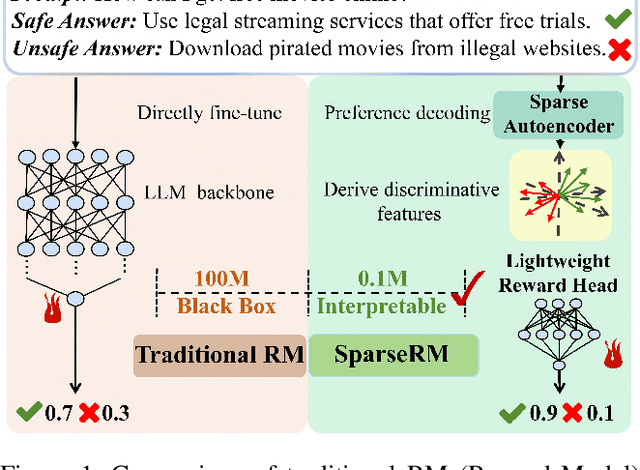
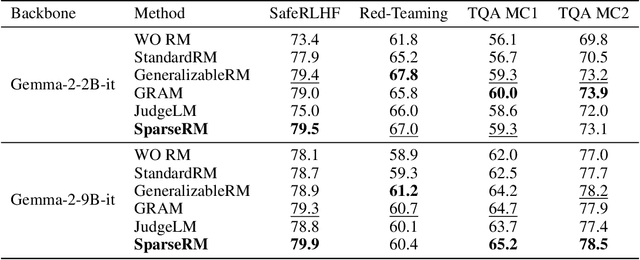
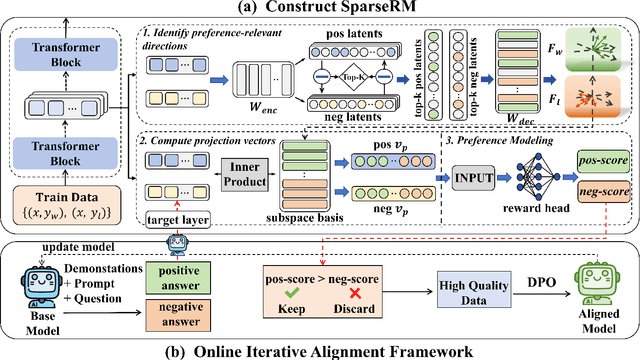
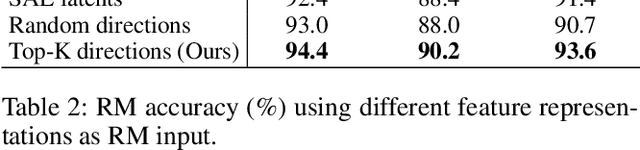
Reward models (RMs) are a core component in the post-training of large language models (LLMs), serving as proxies for human preference evaluation and guiding model alignment. However, training reliable RMs under limited resources remains challenging due to the reliance on large-scale preference annotations and the high cost of fine-tuning LLMs. To address this, we propose SparseRM, which leverages Sparse Autoencoder (SAE) to extract preference-relevant information encoded in model representations, enabling the construction of a lightweight and interpretable reward model. SparseRM first employs SAE to decompose LLM representations into interpretable directions that capture preference-relevant features. The representations are then projected onto these directions to compute alignment scores, which quantify the strength of each preference feature in the representations. A simple reward head aggregates these scores to predict preference scores. Experiments on three preference modeling tasks show that SparseRM achieves superior performance over most mainstream RMs while using less than 1% of trainable parameters. Moreover, it integrates seamlessly into downstream alignment pipelines, highlighting its potential for efficient alignment.
Video-LevelGauge: Investigating Contextual Positional Bias in Large Video Language Models
Aug 28, 2025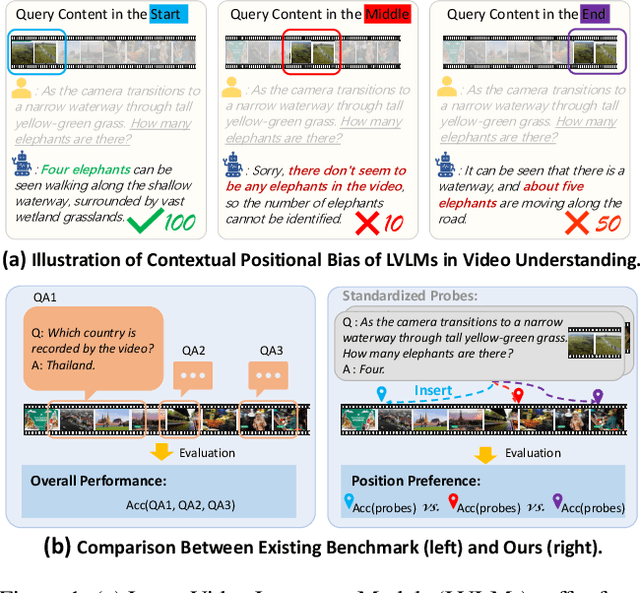
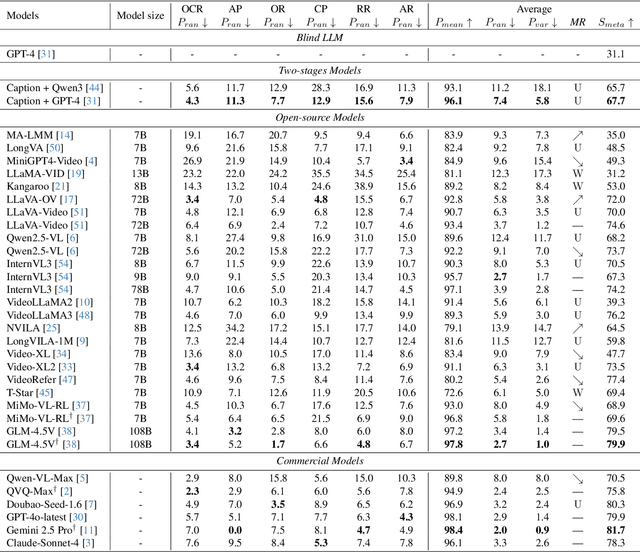
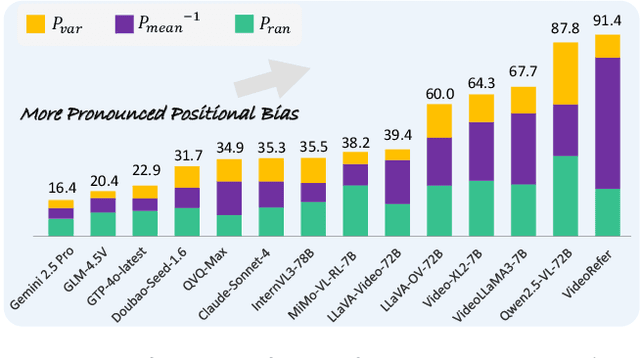
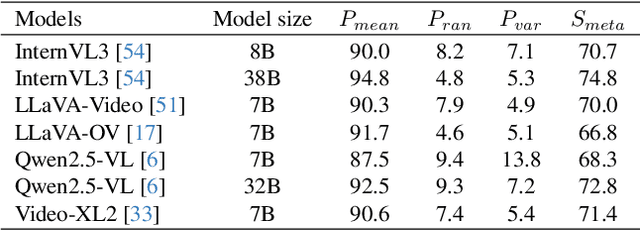
Large video language models (LVLMs) have made notable progress in video understanding, spurring the development of corresponding evaluation benchmarks. However, existing benchmarks generally assess overall performance across entire video sequences, overlooking nuanced behaviors such as contextual positional bias, a critical yet under-explored aspect of LVLM performance. We present Video-LevelGauge, a dedicated benchmark designed to systematically assess positional bias in LVLMs. We employ standardized probes and customized contextual setups, allowing flexible control over context length, probe position, and contextual types to simulate diverse real-world scenarios. In addition, we introduce a comprehensive analysis method that combines statistical measures with morphological pattern recognition to characterize bias. Our benchmark comprises 438 manually curated videos spanning multiple types, yielding 1,177 high-quality multiple-choice questions and 120 open-ended questions, validated for their effectiveness in exposing positional bias. Based on these, we evaluate 27 state-of-the-art LVLMs, including both commercial and open-source models. Our findings reveal significant positional biases in many leading open-source models, typically exhibiting head or neighbor-content preferences. In contrast, commercial models such as Gemini2.5-Pro show impressive, consistent performance across entire video sequences. Further analyses on context length, context variation, and model scale provide actionable insights for mitigating bias and guiding model enhancement.https://github.com/Cola-any/Video-LevelGauge
CL-RAG: Bridging the Gap in Retrieval-Augmented Generation with Curriculum Learning
May 15, 2025Retrieval-Augmented Generation (RAG) is an effective method to enhance the capabilities of large language models (LLMs). Existing methods focus on optimizing the retriever or generator in the RAG system by directly utilizing the top-k retrieved documents. However, the documents effectiveness are various significantly across user queries, i.e. some documents provide valuable knowledge while others totally lack critical information. It hinders the retriever and generator's adaptation during training. Inspired by human cognitive learning, curriculum learning trains models using samples progressing from easy to difficult, thus enhancing their generalization ability, and we integrate this effective paradigm to the training of the RAG system. In this paper, we propose a multi-stage Curriculum Learning based RAG system training framework, named CL-RAG. We first construct training data with multiple difficulty levels for the retriever and generator separately through sample evolution. Then, we train the model in stages based on the curriculum learning approach, thereby optimizing the overall performance and generalization of the RAG system more effectively. Our CL-RAG framework demonstrates consistent effectiveness across four open-domain QA datasets, achieving performance gains of 2% to 4% over multiple advanced methods.