 Add to Chrome
 Add to Firefox
 Add to Edge
DailyReport: An Open-ended Benchmark for Evaluating Search Agents on Daily Search Tasks
Jun 11, 2026
Search Agents (SAs) typically leverage large language models (LLMs) to support complex information-seeking tasks by autonomously exploring web sources and synthesizing information into comprehensive responses. For SAs evaluation, prior benchmarks mainly focus on specialized tasks that are unlikely to arise in real-world user scenarios. Moreover, their reliance on coarse task-level rubrics often limits evaluation interpretability. To bridge this gap, we introduce DailyReport, an open-ended benchmark to evaluate SA capabilities on daily search tasks. It contains 150 open-ended tasks with 3,546 associated rubrics, capturing widely discussed and timely information demands of real-world users. Each task is decomposed into subtasks and evaluated with cascade rubrics across disentangled dimensions. Through cascade performance attribution and user-centric aggregation, we derive highly interpretable scores for each dimension, along with a user preference score. Our results on 17 agentic systems show that current systems still fall short of users' expectations. To facilitate future research, our dataset and code are made publicly available at https://github.com/AGI-Eval-Official/DailyReport.

Air-Decoding: Attribute Distribution Reconstruction for Decoding-Time Controllable Text Generation
Nov 02, 2023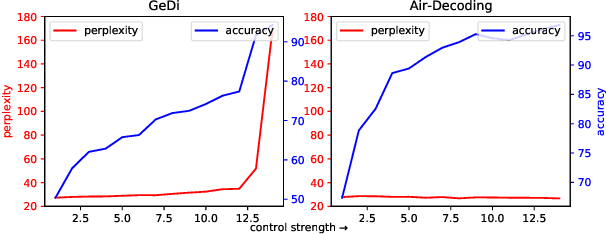
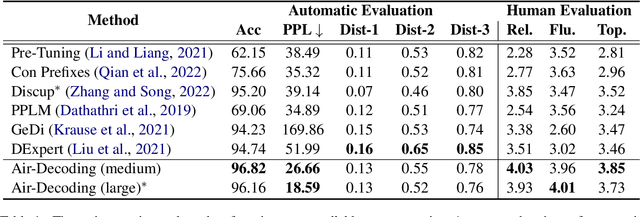
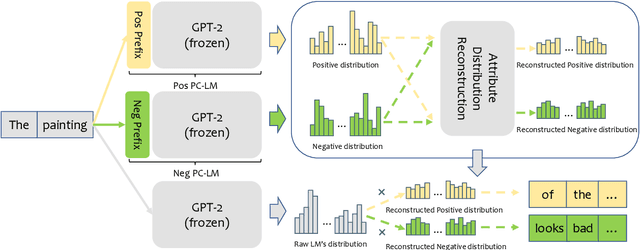
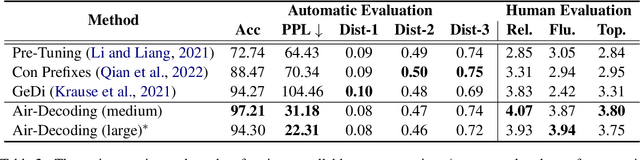
Controllable text generation (CTG) aims to generate text with desired attributes, and decoding-time-based methods have shown promising performance on this task. However, in this paper, we identify the phenomenon of Attribute Collapse for the first time. It causes the fluency of generated text to rapidly decrease when the control strength exceeds a critical value, rendering the text completely unusable. This limitation hinders the effectiveness of decoding methods in achieving high levels of controllability. To address this problem, we propose a novel lightweight decoding framework named Air-Decoding. Its main idea is reconstructing the attribute distributions to balance the weights between attribute words and non-attribute words to generate more fluent text. Specifically, we train prefixes by prefix-tuning to obtain attribute distributions. Then we design a novel attribute distribution reconstruction method to balance the obtained distributions and use the reconstructed distributions to guide language models for generation, effectively avoiding the issue of Attribute Collapse. Experiments on multiple CTG tasks prove that our method achieves a new state-of-the-art control performance.