 Add to Chrome
 Add to Firefox
 Add to Edge
Hi-Token: Hierarchical Coordinate Tokenization for Generative Visual Grounding
Aug 04, 2026
Generative Vision-Language Models (VLMs) commonly treat bounding-box coordinates as independent output symbols, leaving numerical order and axis semantics implicit. We identify this representation as an important source of error in visual grounding. Hi-Token encodes each coordinate with axis-specific tokens for the hundreds, tens, and ones digits, which adds coarse-to-fine structure and increases token reuse while retaining the existing VLM architecture. Hi-GAR complements this representation with a geometry-based reward for Group Relative Policy Optimization (GRPO), using box overlap and coordinate accuracy at multiple scales. Controlled comparisons under matched training conditions show that Hi-Token improves localization throughout the evaluated IoU range. Hi-GAR further reduces low-overlap predictions and is used only during training. Experiments on three VLM backbones and the RefCOCO family show consistent gains across models and benchmarks. Hi-R1 achieves higher values than strong specialist baselines on most reported metrics. Analyses of token frequency, digit boundaries, object scale, and IoU distributions explain the effects of coordinate representation and reward training. The results show that structured coordinate generation provides an effective approach to generative visual grounding.

DailyBench: A Unified Benchmark for AI-Generated and Manipulated Images from Modern Generative Models
Jul 27, 2026Recent advances in generative models have shifted AI-generated image detection from identifying easily distinguishable, fully synthetic images to identifying highly realistic content generated by both modern generation and manipulation pipelines. However, existing detection benchmarks are often built with outdated generative models and primarily emphasize full-image synthesis, creating a growing mismatch between benchmark data and the images encountered in real-world generation and editing scenarios. To bridge this gap, we introduce DailyBench, a high-quality unified benchmark for evaluating whether AI-generated image detectors can generalize across both modern full-image synthesis and object-level manipulation. DailyBench contains two complementary subsets: FakeBench, which includes high-quality images synthesized by recent open-source and commercial generative models, and ManipulationBench, which introduces challenging object-level edits applied to real images using advanced image-conditional models. This design makes DailyBench a realistic testbed for studying both generator-level generalization and manipulation-aware detection under subtle local edits. Experiments on DailyBench reveal substantial robustness gaps in current detectors: methods reporting 91-96% balanced accuracy on GenImage drop to 60-76% on FakeBench and 54-66% on ManipulationBench. These results show that existing detectors remain poorly generalized to realistic synthesis and manipulation, highlighting DailyBench as a rigorous testbed for developing robust and manipulation-aware AI-generated image detection methods. The project is available at https://dailybench.github.io/
IoUPD: IoU-Aware Privileged Distillation for Visual Grounding with Multimodal Large Language Models
Jul 17, 2026Visual grounding with multimodal large language models is commonly formulated as autoregressive coordinate generation, where a model outputs bounding-box coordinates as text given an image and a referring-expression prompt. While this interface is simple and compatible with instruction following, it introduces a mismatch between training and evaluation: training optimizes token-level likelihood over coordinate strings, whereas grounding quality is measured by geometric overlap. We propose IoUPD, an IoU-aware privileged distillation method for coordinate-generating multimodal large language models. IoUPD uses ground-truth boxes not only as coordinate targets, but also as privileged training-time guidance. During training, the student receives the original image and prompt, while a frozen teacher receives a box-marked image and an augmented prompt that indicates the marked region. The student is trained with a supervised fine-tuning anchor and a privileged distillation loss whose token weights reflect both geometric importance and teacher reliability. At inference time, IoUPD requires no box overlay, privileged hint, teacher branch, or additional prediction module. Experiments on standard referring-expression grounding benchmarks show consistent region-level improvements over strong coordinate-generating baselines, demonstrating that ground-truth boxes can provide useful privileged guidance beyond serving as coordinate labels.
Groc-PO: Grounded Context Preference Optimization for Truthful Multimodal LLMs
Jul 15, 2026Despite the rapid progress of Multimodal Large Language Models (MLLMs), they still suffer from untruthfulness issues, such as visual hallucinations, content fabrication, and unfaithful reasoning, which substantially undermine their faithfulness and practical utility. Alignment methods based on human preference, such as Direct Preference Optimization (DPO), have been widely adopted to address these issues. However, multimodal reasoning errors often propagate across stages, and final-answer errors can often be traced to mistakes in early grounding stages, yet standard DPO typically applies preference optimization at the final-answer level. This credit-assignment challenge means that supervision for early grounding stages is indirect rather than stage-specific, making it difficult to suppress error propagation arising from grounding drift and context inconsistency. To address this, we propose Grounded Context Preference Optimization (Groc-PO), a grounded preference optimization framework for MLLMs. We further construct the Grounded Context Preference Dataset (GCPD), organizing multi-stage preference samples around three stages of Object Grounding, Contextual Grounding, and Grounded Reasoning, to capture the formation, integration, and utilization of grounded context. By introducing more explicit preference supervision over multiple grounded stages, Groc-PO strengthens context-dependent reasoning and mitigates cross-stage error propagation. Extensive experiments show that, compared with standard DPO and other strong baselines, Groc-PO achieves improved performance in hallucination mitigation, faithful reasoning, and overall reliability, supporting the value of more explicit grounded supervision for trustworthy multimodal reasoning.
QueryGaussian: Scalable and Training-Free Open-Vocabulary 3D Instance Retrieval
Jun 18, 2026Efficiently retrieving specific 3D instances from large-scale scenes via natural language prompts remains a formidable challenge in multimedia analysis. Existing approaches predominantly follow a "scene-level embedding" paradigm, which requires distilling high-dimensional semantic features into every 3D primitive. This strategy suffers from a fundamental architectural bottleneck: memory and computational costs scale linearly with scene complexity, inevitably triggering out-of-memory (OOM) failures in city-scale environments. To address this barrier, we propose QueryGaussian, a training-free framework for expeditious and scalable open-vocabulary 3D instance retrieval. Unlike holistic semantic distillation, QueryGaussian employs an instance-level query mechanism that decouples semantic understanding from geometric representation. Specifically, we leverage pre-trained 2D vision models to interpret user prompts and lift segmentation masks into 3D via a concurrent maximum-weight association strategy, ensuring semantic-visual consistency. To mitigate projection ambiguity, we introduce a temporal fusion module with multi-stage adaptive density clustering. Experimental results demonstrate that QueryGaussian not only matches the accuracy of state-of-the-art methods but also delivers a decisive efficiency leap, reducing GPU memory usage by over 70% and accelerating inference by 180x. Crucially, QueryGaussian enables expeditious instance retrieval on city-scale scenes containing tens of millions of Gaussians using consumer-grade hardware.
Fast-Fading Channel and Power Optimization of the Magnetic Inductive Cellular Network
Jun 07, 2024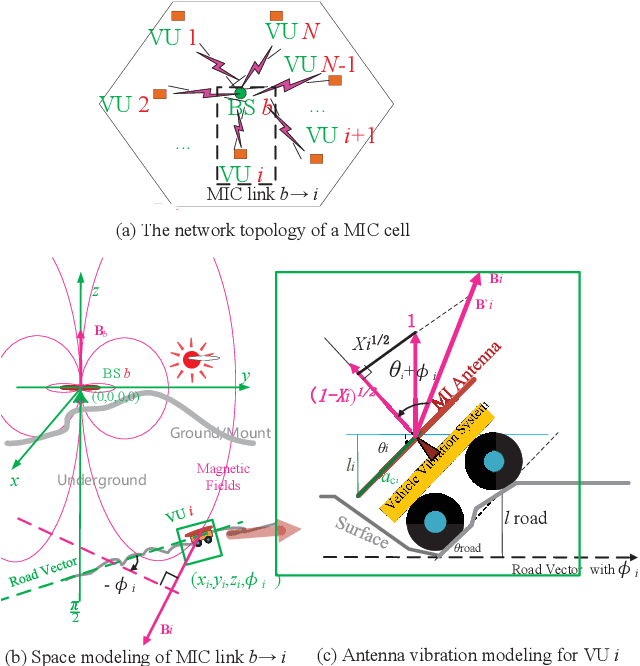
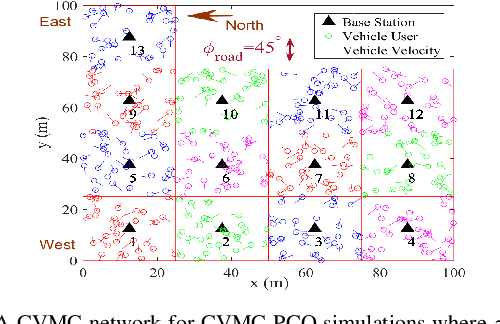
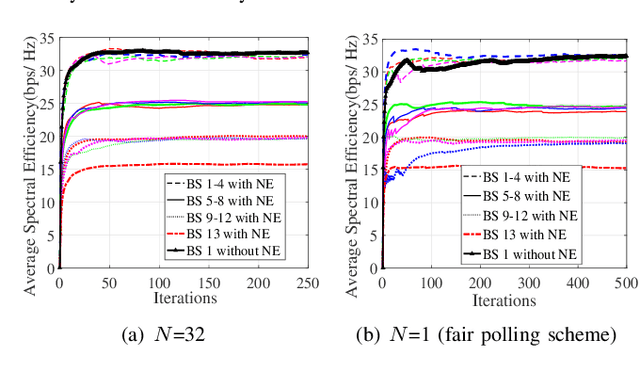
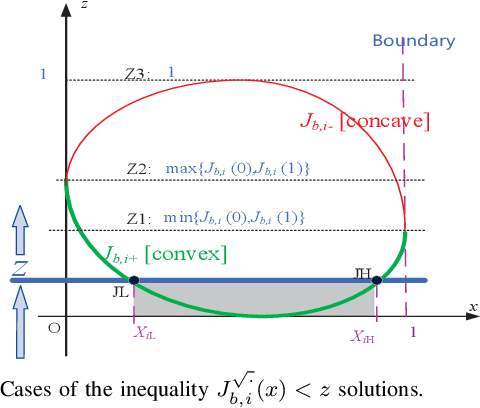
The cellular network of magnetic Induction (MI) communication holds promise in long-distance underground environments. In the traditional MI communication, there is no fast-fading channel since the MI channel is treated as a quasi-static channel. However, for the vehicle (mobile) MI (VMI) communication, the unpredictable antenna vibration brings the remarkable fast-fading. As such fast-fading cannot be modeled by the central limit theorem, it differs radically from other wireless fast-fading channels. Unfortunately, few studies focus on this phenomenon. In this paper, using a novel space modeling based on the electromagnetic field theorem, we propose a 3-dimension model of the VMI antenna vibration. By proposing ``conjugate pseudo-piecewise functions'' and boundary $p(x)$ distribution, we derive the cumulative distribution function (CDF), probability density function (PDF) and the expectation of the VMI fast-fading channel. We also theoretically analyze the effects of the VMI fast-fading on the network throughput, including the VMI outage probability which can be ignored in the traditional MI channel study. We draw several intriguing conclusions different from those in wireless fast-fading studies. For instance, the fast-fading brings more uniformly distributed channel coefficients. Finally, we propose the power control algorithm using the non-cooperative game and multiagent Q-learning methods to optimize the throughput of the cellular VMI network. Simulations validate the derivation and the proposed algorithm.
Unilaterally Aggregated Contrastive Learning with Hierarchical Augmentation for Anomaly Detection
Aug 20, 2023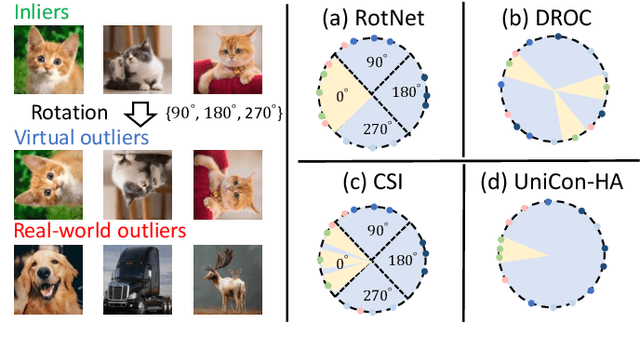
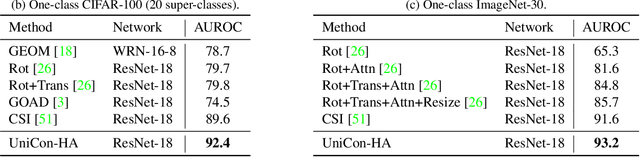
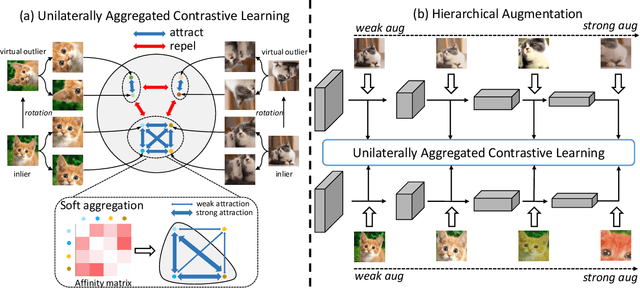
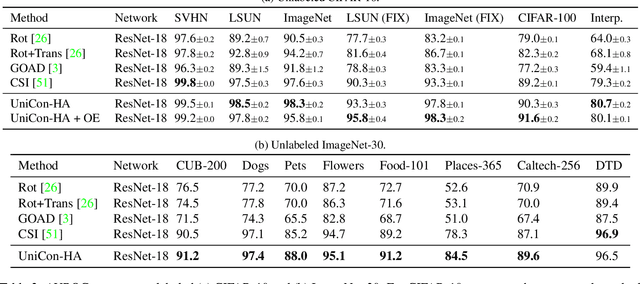
Anomaly detection (AD), aiming to find samples that deviate from the training distribution, is essential in safety-critical applications. Though recent self-supervised learning based attempts achieve promising results by creating virtual outliers, their training objectives are less faithful to AD which requires a concentrated inlier distribution as well as a dispersive outlier distribution. In this paper, we propose Unilaterally Aggregated Contrastive Learning with Hierarchical Augmentation (UniCon-HA), taking into account both the requirements above. Specifically, we explicitly encourage the concentration of inliers and the dispersion of virtual outliers via supervised and unsupervised contrastive losses, respectively. Considering that standard contrastive data augmentation for generating positive views may induce outliers, we additionally introduce a soft mechanism to re-weight each augmented inlier according to its deviation from the inlier distribution, to ensure a purified concentration. Moreover, to prompt a higher concentration, inspired by curriculum learning, we adopt an easy-to-hard hierarchical augmentation strategy and perform contrastive aggregation at different depths of the network based on the strengths of data augmentation. Our method is evaluated under three AD settings including unlabeled one-class, unlabeled multi-class, and labeled multi-class, demonstrating its consistent superiority over other competitors.
Video Anomaly Detection by Solving Decoupled Spatio-Temporal Jigsaw Puzzles
Jul 22, 2022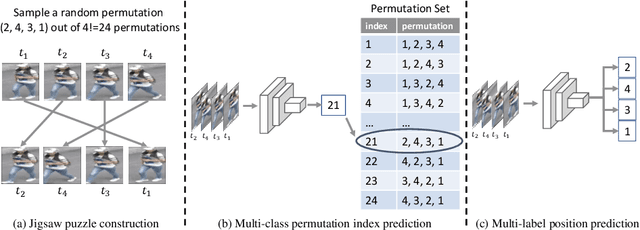
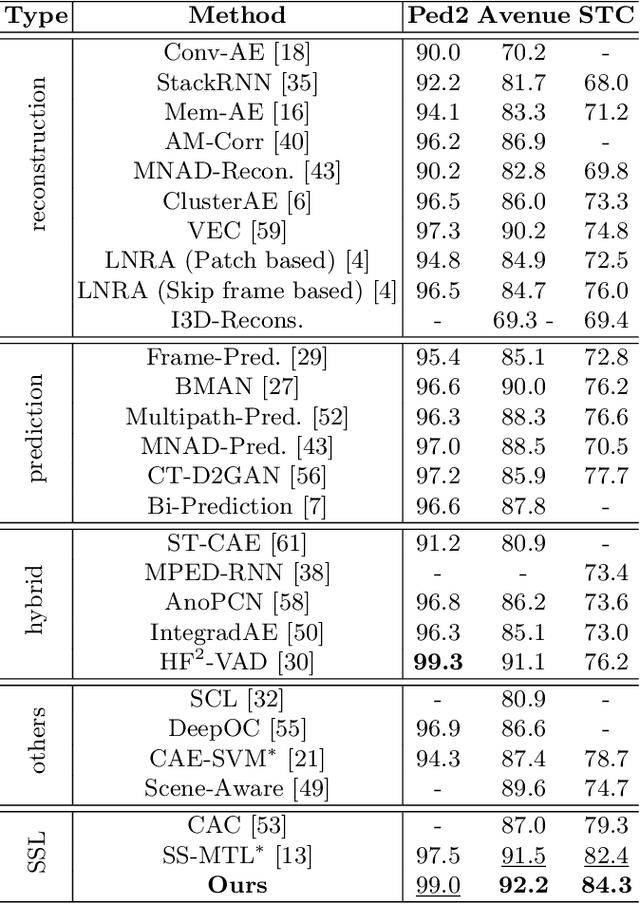
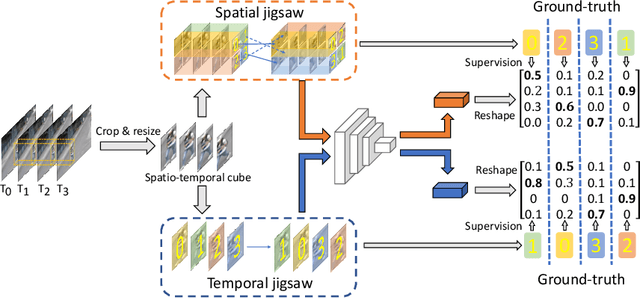
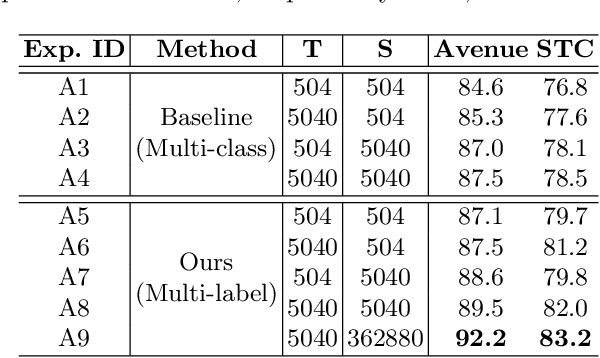
Video Anomaly Detection (VAD) is an important topic in computer vision. Motivated by the recent advances in self-supervised learning, this paper addresses VAD by solving an intuitive yet challenging pretext task, i.e., spatio-temporal jigsaw puzzles, which is cast as a multi-label fine-grained classification problem. Our method exhibits several advantages over existing works: 1) the spatio-temporal jigsaw puzzles are decoupled in terms of spatial and temporal dimensions, responsible for capturing highly discriminative appearance and motion features, respectively; 2) full permutations are used to provide abundant jigsaw puzzles covering various difficulty levels, allowing the network to distinguish subtle spatio-temporal differences between normal and abnormal events; and 3) the pretext task is tackled in an end-to-end manner without relying on any pre-trained models. Our method outperforms state-of-the-art counterparts on three public benchmarks. Especially on ShanghaiTech Campus, the result is superior to reconstruction and prediction-based methods by a large margin.
Representation Learning for Compressed Video Action Recognition via Attentive Cross-modal Interaction with Motion Enhancement
May 10, 2022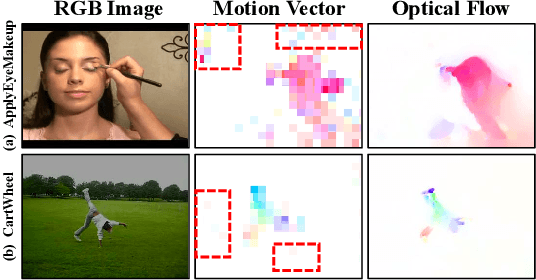
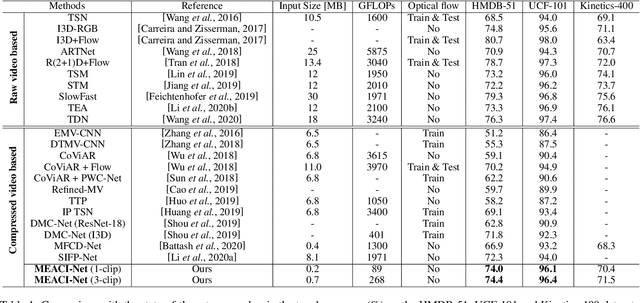
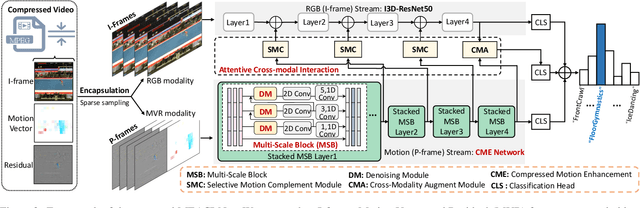
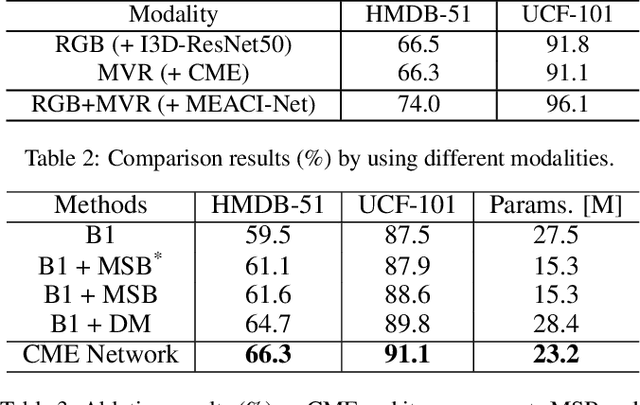
Compressed video action recognition has recently drawn growing attention, since it remarkably reduces the storage and computational cost via replacing raw videos by sparsely sampled RGB frames and compressed motion cues (e.g., motion vectors and residuals). However, this task severely suffers from the coarse and noisy dynamics and the insufficient fusion of the heterogeneous RGB and motion modalities. To address the two issues above, this paper proposes a novel framework, namely Attentive Cross-modal Interaction Network with Motion Enhancement (MEACI-Net). It follows the two-stream architecture, i.e. one for the RGB modality and the other for the motion modality. Particularly, the motion stream employs a multi-scale block embedded with a denoising module to enhance representation learning. The interaction between the two streams is then strengthened by introducing the Selective Motion Complement (SMC) and Cross-Modality Augment (CMA) modules, where SMC complements the RGB modality with spatio-temporally attentive local motion features and CMA further combines the two modalities with selective feature augmentation. Extensive experiments on the UCF-101, HMDB-51 and Kinetics-400 benchmarks demonstrate the effectiveness and efficiency of MEACI-Net.
DR2-Net: Deep Residual Reconstruction Network for Image Compressive Sensing
Nov 16, 2017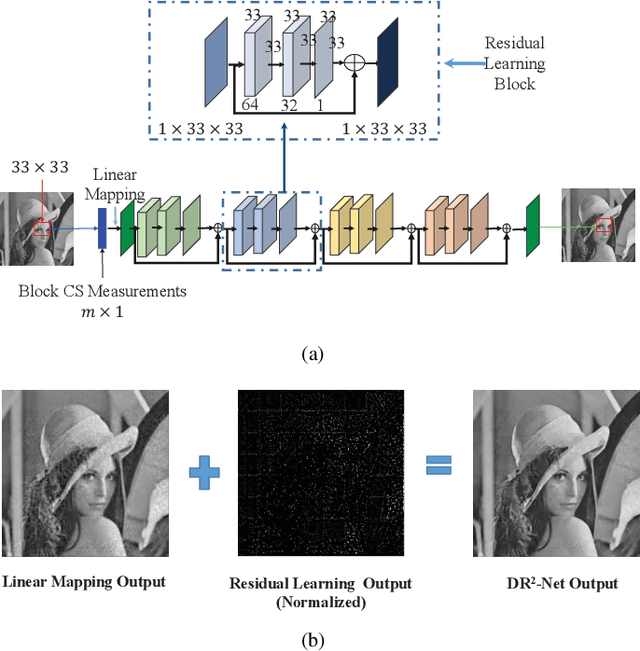
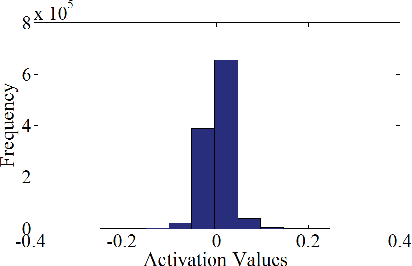
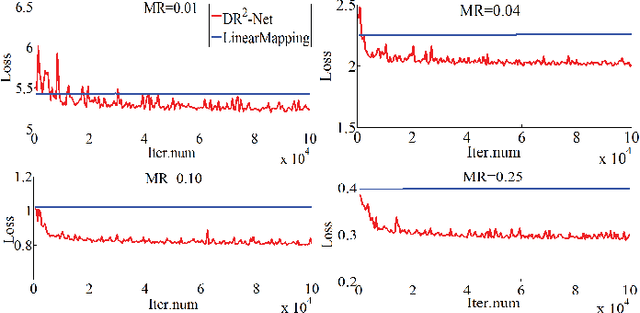
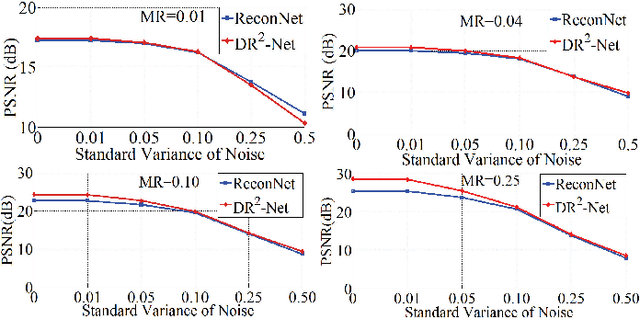
Most traditional algorithms for compressive sensing image reconstruction suffer from the intensive computation. Recently, deep learning-based reconstruction algorithms have been reported, which dramatically reduce the time complexity than iterative reconstruction algorithms. In this paper, we propose a novel \textbf{D}eep \textbf{R}esidual \textbf{R}econstruction Network (DR$^{2}$-Net) to reconstruct the image from its Compressively Sensed (CS) measurement. The DR$^{2}$-Net is proposed based on two observations: 1) linear mapping could reconstruct a high-quality preliminary image, and 2) residual learning could further improve the reconstruction quality. Accordingly, DR$^{2}$-Net consists of two components, \emph{i.e.,} linear mapping network and residual network, respectively. Specifically, the fully-connected layer in neural network implements the linear mapping network. We then expand the linear mapping network to DR$^{2}$-Net by adding several residual learning blocks to enhance the preliminary image. Extensive experiments demonstrate that the DR$^{2}$-Net outperforms traditional iterative methods and recent deep learning-based methods by large margins at measurement rates 0.01, 0.04, 0.1, and 0.25, respectively. The code of DR$^{2}$-Net has been released on: https://github.com/coldrainyht/caffe\_dr2