 Add to Chrome
 Add to Firefox
 Add to Edge
RecRM-Bench: Benchmarking Multidimensional Reward Modeling for Agentic Recommender Systems
May 12, 2026
The integration of Large Language Model (LLM) agents is transforming recommender systems from simple query-item matching towards deeply personalized and interactive recommendations. Reinforcement Learning (RL) provides an essential framework for the optimization of these agents in recommendation tasks. However, current methodologies remain limited by a reliance on single dimensional outcome-based rewards that focus exclusively on final user interactions, overlooking critical intermediate capabilities, such as instruction following and complex intent understanding. Despite the necessity for designing multi-dimensional reward, the field lacks a standardized benchmark to facilitate this development. To bridge this gap, we introduce RecRM-Bench, the largest and most comprehensive benchmark to date for agentic recommender systems. It comprises over 1 million structured entries across four core evaluation dimensions: instruction following, factual consistency, query-item relevance, and fine-grained user behavior prediction. By supporting comprehensive assessment from syntactic compliance to complex intent grounding and preference modeling, RecRM-Bench provides a foundational dataset for training sophisticated reward models. Furthermore, we propose a systematic framework for the construction of multi-dimensional reward models and the integration of a hybrid reward function, establishing a robust foundation for developing reliable and highly capable agentic recommender systems. The complete RecRM-Bench dataset is publicly available at https://huggingface.co/datasets/wwzeng/RecRM-Bench.

CDRRM: Contrast-Driven Rubric Generation for Reliable and Interpretable Reward Modeling
Mar 09, 2026Reward modeling is essential for aligning Large Language Models(LLMs) with human preferences, yet conventional reward models suffer from poor interpretability and heavy reliance on costly expert annotations. While recent rubric-based approaches enhance evaluation transparency, they lack systematic quality control, yielding noisy and redundant criteria, failing to mitigate persistent biases (e.g., verbosity, position) in LLM evaluators, and creating a scalability-reliability trade-off. To address these limitations, we propose CDRRM (Contrast-Driven Rubric Reward Model), a framework built on a novel Contrast-then-Synthesis paradigm for high-quality rubric generation and guided preference judgment. CDRRM first conducts multi-dimensional contrastive profiling on preference pairs to identify causal discriminative factors, then synthesizes these insights into compact, context-aware rubrics to guide preference judg- ments. Extensive experiments on three authoritative benchmarks (RewardBench, RMBench, RMB) demonstrate that CDRRM achieves state-of-the-art performance across diverse domains and effectively mitigates aforementioned evaluation biases. Notably, our approach delivers exceptional data efficiency: training the rubric generator on only 3k high-quality samples empowers a frozen pre-trained judge model to outperform fully fine-tuned baselines. This work offers a scalable, interpretable, and data-efficient path for reward modeling.
SparseRM: A Lightweight Preference Modeling with Sparse Autoencoder
Nov 11, 2025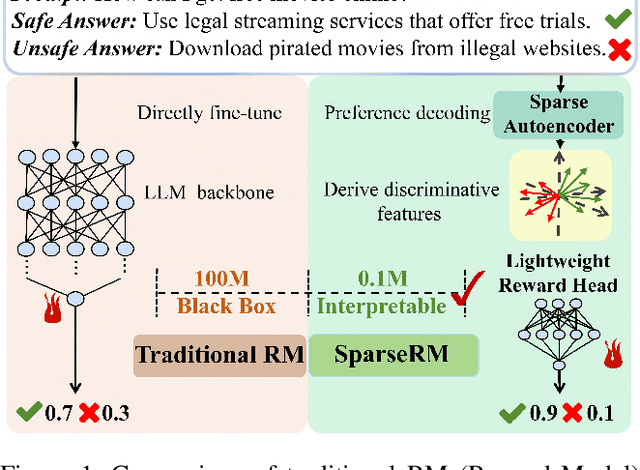
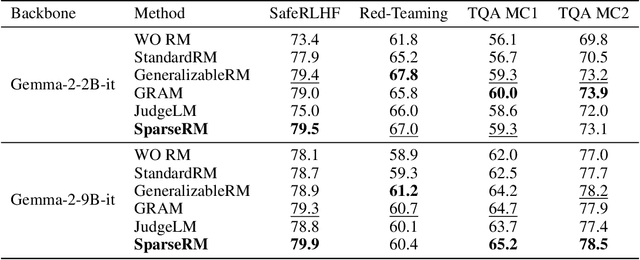
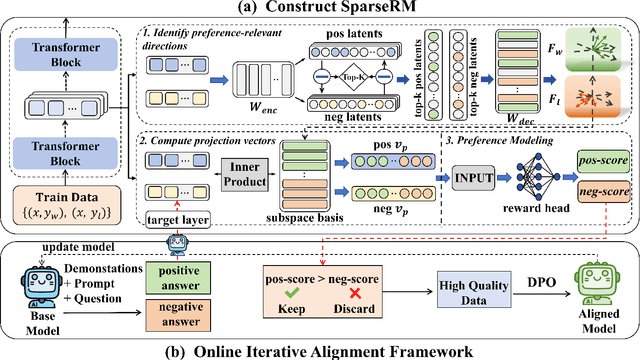
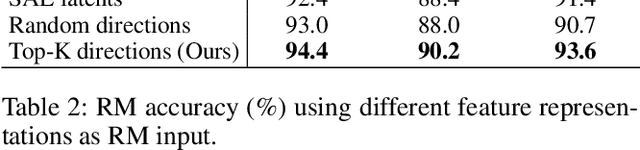
Reward models (RMs) are a core component in the post-training of large language models (LLMs), serving as proxies for human preference evaluation and guiding model alignment. However, training reliable RMs under limited resources remains challenging due to the reliance on large-scale preference annotations and the high cost of fine-tuning LLMs. To address this, we propose SparseRM, which leverages Sparse Autoencoder (SAE) to extract preference-relevant information encoded in model representations, enabling the construction of a lightweight and interpretable reward model. SparseRM first employs SAE to decompose LLM representations into interpretable directions that capture preference-relevant features. The representations are then projected onto these directions to compute alignment scores, which quantify the strength of each preference feature in the representations. A simple reward head aggregates these scores to predict preference scores. Experiments on three preference modeling tasks show that SparseRM achieves superior performance over most mainstream RMs while using less than 1% of trainable parameters. Moreover, it integrates seamlessly into downstream alignment pipelines, highlighting its potential for efficient alignment.