 Add to Chrome
 Add to Firefox
 Add to Edge
Dataset Distillation by Influence Matching
Jul 18, 2026
We revisit dataset distillation from an outcome-centric perspective. Rather than aligning process surrogates (per-step gradients or training trajectories), Influence Matching (Inf-Match) aligns the final outcome of training: it learns a compact synthetic set whose effect on the converged parameters matches that of the full dataset. Concretely, we introduce a fully differentiable, sample-level influence estimator that quantifies parameter shifts from adding or removing data, without time-consuming inverse-Hessian products or convexity assumptions. The estimator runs in linear time by unrolling the optimization dynamics and applying a first-order Taylor approximation. We then learn the synthetic set by minimizing the mismatch between its influence and that of the real dataset, yielding outcome alignment rather than heuristic process imitation. Inf-Match delivers the best accuracy across standard classification benchmarks. For instance, on Tiny-ImageNet (IPC=10), Inf-Match attains 31.5\%, a +4.7\% improvement over NCFM. Beyond classification, Inf-Match scales to vision-language distillation on Flickr30K, outperforming strong process-matching baselines. For instance, with 200 to 1000 synthetic samples, our method achieved a leading impressive average on image/text retrieval tasks, higher than NCFM by 2.5\%. The code will be released via https://github.com/hrtan/infmatch.

AnimaX: Animating the Inanimate in 3D with Joint Video-Pose Diffusion Models
Jun 24, 2025We present AnimaX, a feed-forward 3D animation framework that bridges the motion priors of video diffusion models with the controllable structure of skeleton-based animation. Traditional motion synthesis methods are either restricted to fixed skeletal topologies or require costly optimization in high-dimensional deformation spaces. In contrast, AnimaX effectively transfers video-based motion knowledge to the 3D domain, supporting diverse articulated meshes with arbitrary skeletons. Our method represents 3D motion as multi-view, multi-frame 2D pose maps, and enables joint video-pose diffusion conditioned on template renderings and a textual motion prompt. We introduce shared positional encodings and modality-aware embeddings to ensure spatial-temporal alignment between video and pose sequences, effectively transferring video priors to motion generation task. The resulting multi-view pose sequences are triangulated into 3D joint positions and converted into mesh animation via inverse kinematics. Trained on a newly curated dataset of 160,000 rigged sequences, AnimaX achieves state-of-the-art results on VBench in generalization, motion fidelity, and efficiency, offering a scalable solution for category-agnostic 3D animation. Project page: \href{https://anima-x.github.io/}{https://anima-x.github.io/}.
Spec-Gaussian: Anisotropic View-Dependent Appearance for 3D Gaussian Splatting
Feb 24, 2024
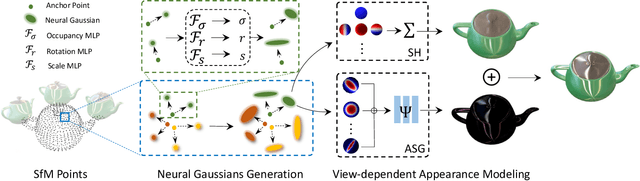
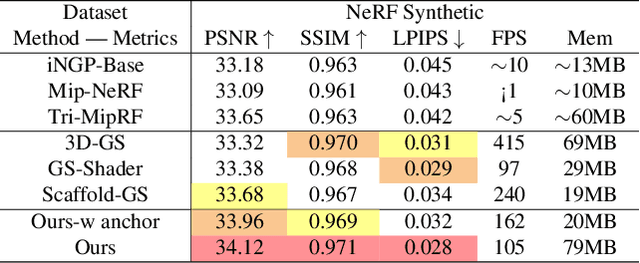
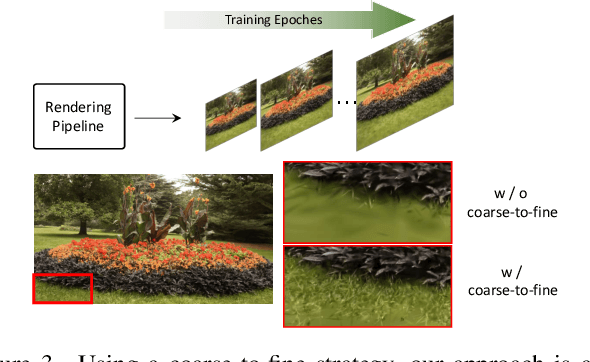
The recent advancements in 3D Gaussian splatting (3D-GS) have not only facilitated real-time rendering through modern GPU rasterization pipelines but have also attained state-of-the-art rendering quality. Nevertheless, despite its exceptional rendering quality and performance on standard datasets, 3D-GS frequently encounters difficulties in accurately modeling specular and anisotropic components. This issue stems from the limited ability of spherical harmonics (SH) to represent high-frequency information. To overcome this challenge, we introduce Spec-Gaussian, an approach that utilizes an anisotropic spherical Gaussian (ASG) appearance field instead of SH for modeling the view-dependent appearance of each 3D Gaussian. Additionally, we have developed a coarse-to-fine training strategy to improve learning efficiency and eliminate floaters caused by overfitting in real-world scenes. Our experimental results demonstrate that our method surpasses existing approaches in terms of rendering quality. Thanks to ASG, we have significantly improved the ability of 3D-GS to model scenes with specular and anisotropic components without increasing the number of 3D Gaussians. This improvement extends the applicability of 3D GS to handle intricate scenarios with specular and anisotropic surfaces.