 Add to Chrome
 Add to Firefox
 Add to Edge
BALTO: Balanced Token-Level Policy Optimization for Hallucination Mitigation
Jun 14, 2026
Hallucinations remain a major obstacle to deploying large language models (LLMs) in knowledge-intensive settings, where generated responses must be faithfully grounded in provided evidence. Reinforcement learning (RL) is a promising direction for hallucination mitigation, but response-level faithfulness rewards suffer from a granularity mismatch: localized hallucinations can cause supported content to receive spurious penalties. Although recent work introduces fine-grained feedback such as claim-level verification and token-level rewards, unbalanced credit assignment can still induce length, verbosity, or optimization-noise biases. We propose BALTO, a Balanced Token-level Policy Optimization framework for hallucination mitigation. BALTO extracts checkable factual claims, verifies them against the reference context, and projects claim-level judgments to token-level labels. A balanced token-level credit assignment mechanism is introduced into the framework. This design redistributes probability mass from unsupported content toward faithful content, rather than suppressing the entire response. We systematically analyze the limitations of response-level rewards from a theoretical standpoint, and prove BALTO's advantages in training stability and optimization efficiency for hallucination mitigation. Experiments on ConFiQA, RAGTruth, and FinLLM-Eval show that BALTO achieves the highest faithfulness across all six model--benchmark settings and consistently outperforms existing post-training baselines in Q-Score, demonstrating a stronger faithfulness--informativeness trade-off.

Breaking the Tokenizer Barrier: On-Policy Distillation across Model Families
Jun 08, 2026On-Policy Distillation (OPD) has become a core technique in the post-training of Large Language Models (LLMs) for transferring knowledge from domain experts to student models. However, existing OPD distillation methods require teacher and student models to share the same tokenizer, restricting the applicability of OPD within the model series. Current mainstream practice typically employs Supervised Fine-Tuning (SFT) on teacher-generated responses for cross-tokenizer distillation, which fails to capture the rich knowledge embedded in the teacher's probability distribution. In this work, we enable the standard on-policy distillation method to operate across model families, ensuring that high-fidelity token-level signals can propagate across different tokenizers with a precise token-mapping algorithm. Extensive experiments show that cross-tokenizer OPD is significantly more compute-efficient than baselines on various benchmarks. Our results unlock a broader range of teacher-student pairs for OPD, opening up new avenues for adapting and enhancing interactions between LLMs.
PiCA: Pivot-Based Credit Assignment for Search Agentic Reinforcement Learning
May 10, 2026Large Language Model (LLM)-based search agents trained with reinforcement learning (RL) have significantly improved the performance of knowledge-intensive tasks. However, existing methods encounter critical challenges in long-horizon credit assignment: (i) Reward Sparsity, where models receive only outcome feedback without step-level guidance to differentiate action quality; (ii) Isolated Credit, where credit is assigned to steps independently, failing to capture sequential dependencies; and (iii) Distributional Shift, where rewards are estimated on templates that deviate from the model's natural generative distribution. To address these issues, we propose Pivot-Based Credit Assignment (PiCA), a novel step reward mechanism that reformulates the search trajectory as a sequential process of cumulative search progress. Unlike prior isolated step rewards, PiCA defines process rewards as success probabilities dependent on the historical context based on Potential-Based Reward Shaping (PBRS). This approach identifies pivot steps, which comprise target golden sub-queries and sub-answers derived from historical trajectories, as information peaks that significantly boost the likelihood of a correct final answer. By anchoring these step rewards to the final task objective, PiCA provides dense, pivot-aware and trajectory-dependent guidance while maintaining distributional consistency. Extensive experiments show that PiCA outperforms existing strong baselines across seven knowledge-intensive QA benchmarks, achieving 15.2% and 2.2% improvements for 3B and 7B models. The consistent performance gains across various models show PiCA's robust generalization. The code is available at https://github.com/novdream/PiCA.
Stereo World Model: Camera-Guided Stereo Video Generation
Mar 18, 2026We present StereoWorld, a camera-conditioned stereo world model that jointly learns appearance and binocular geometry for end-to-end stereo video generation.Unlike monocular RGB or RGBD approaches, StereoWorld operates exclusively within the RGB modality, while simultaneously grounding geometry directly from disparity. To efficiently achieve consistent stereo generation, our approach introduces two key designs: (1) a unified camera-frame RoPE that augments latent tokens with camera-aware rotary positional encoding, enabling relative, view- and time-consistent conditioning while preserving pretrained video priors via a stable attention initialization; and (2) a stereo-aware attention decomposition that factors full 4D attention into 3D intra-view attention plus horizontal row attention, leveraging the epipolar prior to capture disparity-aligned correspondences with substantially lower compute. Across benchmarks, StereoWorld improves stereo consistency, disparity accuracy, and camera-motion fidelity over strong monocular-then-convert pipelines, achieving more than 3x faster generation with an additional 5% gain in viewpoint consistency. Beyond benchmarks, StereoWorld enables end-to-end binocular VR rendering without depth estimation or inpainting, enhances embodied policy learning through metric-scale depth grounding, and is compatible with long-video distillation for extended interactive stereo synthesis.
IBCircuit: Towards Holistic Circuit Discovery with Information Bottleneck
Feb 26, 2026Circuit discovery has recently attracted attention as a potential research direction to explain the non-trivial behaviors of language models. It aims to find the computational subgraphs, also known as circuits, within the model that are responsible for solving specific tasks. However, most existing studies overlook the holistic nature of these circuits and require designing specific corrupted activations for different tasks, which is inaccurate and inefficient. In this work, we propose an end-to-end approach based on the principle of Information Bottleneck, called IBCircuit, to identify informative circuits holistically. IBCircuit is an optimization framework for holistic circuit discovery and can be applied to any given task without tediously corrupted activation design. In both the Indirect Object Identification (IOI) and Greater-Than tasks, IBCircuit identifies more faithful and minimal circuits in terms of critical node components and edge components compared to recent related work.
DHP: Efficient Scaling of MLLM Training with Dynamic Hybrid Parallelism
Feb 25, 2026Scaling long-context capabilities is crucial for Multimodal Large Language Models (MLLMs). However, real-world multimodal datasets are extremely heterogeneous. Existing training frameworks predominantly rely on static parallelism strategies, which suffer from severe load imbalance, redundant communication, and suboptimal hardware utilization under data heterogeneity. In this work, we propose Dynamic Hybrid Parallelism (DHP), an efficient parallelism strategy that adaptively reconfigures communication groups and parallelism degrees during MLLM training. We generalize the non-power-of-two parallelism degrees and develop a polynomial-time algorithm to generate near-optimal parallelism strategies with only millisecond-level overhead per training batch. DHP is able to maintain high hardware efficiency even under extreme data variability. Experimental results demonstrate that DHP significantly outperforms Megatron-LM and DeepSpeed, achieving up to 1.36 $\times$ speedup in training throughput while maintaining near-linear scaling efficiency across large-scale NPU clusters.
Mitigating the Safety Alignment Tax with Null-Space Constrained Policy Optimization
Dec 12, 2025As Large Language Models (LLMs) are increasingly deployed in real-world applications, it is important to ensure their behaviors align with human values, societal norms, and ethical principles. However, safety alignment under Reinforcement Learning (RL) often suffers from forgetting learned general abilities, which is also known as the alignment tax. To address this issue, we introduce Null-Space constrained Policy Optimization (NSPO), a novel RL framework for LLM safety alignment while preserving their core abilities. The safety policy gradients are geometrically projected into the null space of general tasks, thereby mitigating the safety alignment tax. In addition, we theoretically prove that NSPO preserves the model's original core capabilities, while still guaranteeing a descent direction for effective safety alignment. Extensive experiments demonstrate that NSPO outperforms existing methods by a large margin, achieving state-of-the-art safety performance without sacrificing accuracy on general tasks, including math, code, and instruction-following tasks. Notably, NSPO is data-efficient and only requires 40% of public human-annotated safety data from PKU-SafeRLHF to achieve promising safety performance, without a large amount of mixed general tasks data in existing alignment methods.
Attacking and Securing Community Detection: A Game-Theoretic Framework
Dec 12, 2025It has been demonstrated that adversarial graphs, i.e., graphs with imperceptible perturbations, can cause deep graph models to fail on classification tasks. In this work, we extend the concept of adversarial graphs to the community detection problem, which is more challenging. We propose novel attack and defense techniques for community detection problem, with the objective of hiding targeted individuals from detection models and enhancing the robustness of community detection models, respectively. These techniques have many applications in real-world scenarios, for example, protecting personal privacy in social networks and understanding camouflage patterns in transaction networks. To simulate interactive attack and defense behaviors, we further propose a game-theoretic framework, called CD-GAME. One player is a graph attacker, while the other player is a Rayleigh Quotient defender. The CD-GAME models the mutual influence and feedback mechanisms between the attacker and the defender, revealing the dynamic evolutionary process of the game. Both players dynamically update their strategies until they reach the Nash equilibrium. Extensive experiments demonstrate the effectiveness of our proposed attack and defense methods, and both outperform existing baselines by a significant margin. Furthermore, CD-GAME provides valuable insights for understanding interactive attack and defense scenarios in community detection problems. We found that in traditional single-step attack or defense, attacker tends to employ strategies that are most effective, but are easily detected and countered by defender. When the interactive game reaches a Nash equilibrium, attacker adopts more imperceptible strategies that can still achieve satisfactory attack effectiveness even after defense.
InversionGNN: A Dual Path Network for Multi-Property Molecular Optimization
Mar 03, 2025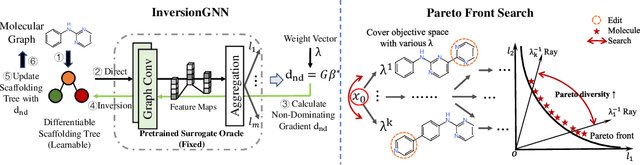
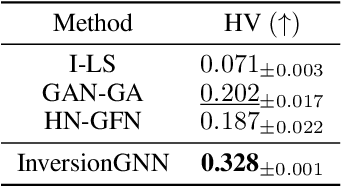
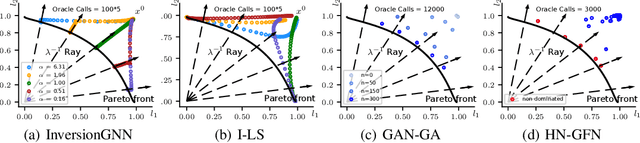
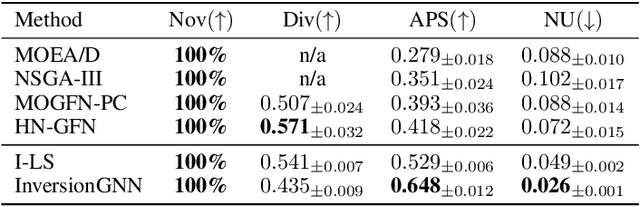
Exploring chemical space to find novel molecules that simultaneously satisfy multiple properties is crucial in drug discovery. However, existing methods often struggle with trading off multiple properties due to the conflicting or correlated nature of chemical properties. To tackle this issue, we introduce InversionGNN framework, an effective yet sample-efficient dual-path graph neural network (GNN) for multi-objective drug discovery. In the direct prediction path of InversionGNN, we train the model for multi-property prediction to acquire knowledge of the optimal combination of functional groups. Then the learned chemical knowledge helps the inversion generation path to generate molecules with required properties. In order to decode the complex knowledge of multiple properties in the inversion path, we propose a gradient-based Pareto search method to balance conflicting properties and generate Pareto optimal molecules. Additionally, InversionGNN is able to search the full Pareto front approximately in discrete chemical space. Comprehensive experimental evaluations show that InversionGNN is both effective and sample-efficient in various discrete multi-objective settings including drug discovery.
Handling Missing Data via Max-Entropy Regularized Graph Autoencoder
Nov 30, 2022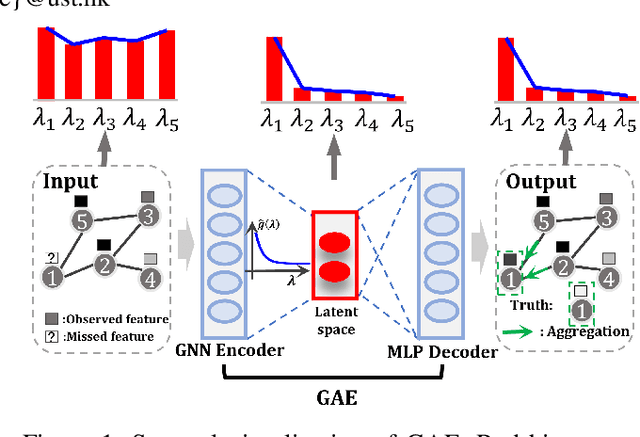

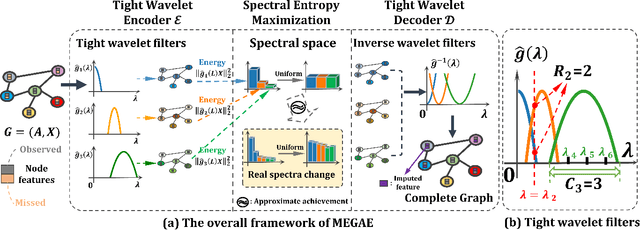

Graph neural networks (GNNs) are popular weapons for modeling relational data. Existing GNNs are not specified for attribute-incomplete graphs, making missing attribute imputation a burning issue. Until recently, many works notice that GNNs are coupled with spectral concentration, which means the spectrum obtained by GNNs concentrates on a local part in spectral domain, e.g., low-frequency due to oversmoothing issue. As a consequence, GNNs may be seriously flawed for reconstructing graph attributes as graph spectral concentration tends to cause a low imputation precision. In this work, we present a regularized graph autoencoder for graph attribute imputation, named MEGAE, which aims at mitigating spectral concentration problem by maximizing the graph spectral entropy. Notably, we first present the method for estimating graph spectral entropy without the eigen-decomposition of Laplacian matrix and provide the theoretical upper error bound. A maximum entropy regularization then acts in the latent space, which directly increases the graph spectral entropy. Extensive experiments show that MEGAE outperforms all the other state-of-the-art imputation methods on a variety of benchmark datasets.