 Add to Chrome
 Add to Firefox
 Add to Edge
Equivariant Neural Belief Propagation
Jun 04, 2026
Probabilistic inference over spatially embedded variables requires beliefs that respect $SE(3)$ symmetry, yet existing equivariant networks produce only scalars and vectors -- not the rank-2 precision tensors needed for anisotropic uncertainty, and single-component messages collapse multi-modal energy landscapes to physically meaningless averages. We introduce Equivariant Neural Belief Propagation (ENBP), a factor-graph framework whose messages are equivariant Gaussian mixture models with sufficient statistics that transform exactly under $SE(3)$. Rank-2 precision matrices are synthesised via equivariant outer products, ingested through differentiable spectral decomposition, and kept tractable by a greedy KL-based mixture reduction that provably commutes with $SE(3)$. On GEOM-QM9 and GEOM-Drugs, ENBP achieves 98.9% conformational coverage at 0.090 $\mathring{A}$ error with sub-second latency -- over $100\times$ faster than diffusion baselines at higher accuracy. On multi-body robotic inference, vanilla loopy BP diverges at 15+ agents while ENBP converges with near-zero collision rates and machine-precision equivariance error (${\sim}10^{-7}$ vs.\ $10^{-1}$ for augmented baselines).

In-Context Graphical Inference
Jun 03, 2026Marginal inference in discrete graphical models forces a choice between exactness and scalability: exact algorithms are intractable for high-treewidth graphs, while iterative approximations (Belief Propagation, variational methods) sacrifice convergence guarantees on frustrated topologies. We argue that this dichotomy stems from a mismatched inductive bias: iterative methods abandon the sequential elimination structure that makes exact inference correct. We introduce In-Context Graphical Inference (ICG-I), an autoregressive Graph Transformer that restores this structure by mimicking Variable Elimination with learned, Tensor- Train-compressed intermediate factors, paired with a Dirichlet output layer and Weighted Conformal Prediction for calibrated, distribution-free coverage guarantees under topological shift. We prove that TT compression errors propagate at most lincarly through the autoregressive chain, that the Dirichlet-Multinomial loss is a proper scoring rule, and that WCP maintains coverage with a quantifiable degradation under estimated density ratios. We conducted intensive experiments to evaluate ICG-I and achieved state-of-the-art performance across all benchmarks. ICG-I reduces MAE from 0.041 (best baseline) to 0.020 on standard instances and achieves 0.048 on N=500 frustrated spin glasses where BP diverges entirely.
Invariant Gradient Alignment for Robust Reasoning Distillation
Jun 03, 2026Large language models (LLMs) suffer from shortcut learning: they systematically fail on out-of-distribution (OOD) inputs whose semantic surface differs from training data, even when the logical structure is identical. This undermines knowledge distillation pipelines that transfer chain-of-thought reasoning to smaller students. We introduce Invariant Gradient Alignment (IGA), a training framework that aligns gradient updates across semantically diverse but logically isomorphic examples via three innovations: (i) Logical Isomer Sets, groups of problems sharing identical logical structure across distinct semantic domains (mathematics, medicine, law, science); (ii) a differentiable \emph{Continuous Gradient Conflict Mask}, that suppresses parameter dimensions with high cross-domain gradient variance while preserving invariant directions; and (iii) a truncated SVD projection of the masked gradient back onto the LoRA low-rank manifold, maintaining parameter efficiency throughout. Theoretically, IGA yields tighter OOD generalization bounds than ERM, scaling with the number of isomer domains, and converges at the standard SGD rate under mild regularity. Empirically, IGA outperforms eight baselines across four benchmarks with accuracy gains up to 14.3 pp over ERM-SFT and a Logical Consistency Score of 0.031 versus 0.142 -- a fourfold improvement in representational invariance.
* 30 Pages
Imbuing Large Language Models with Bidirectional Logic for Robust Chain Repair
Jun 03, 2026Autoregressive chain-of-thought (CoT) reasoning in large language models (LLMs) is fundamentally forward-directed: each step conditions only on prior tokens. This unidirectional inductive bias renders even capable models susceptible to error snowballing, wherein a single logical or arithmetic mistake in an early step irreversibly corrupts the entire reasoning chain. We introduce Teleological Reasoning Infilling (\TRI{}), a training framework that endows decoder-only transformers with a native \emph{goal-conditioned bridging} capability. The key insight is to reframe erroneous reasoning segments as fill-in-the-middle (FIM) tasks: given a verified prefix premise $P$, a verified downstream milestone $S$, and the original query $Q$, the model must synthesise the logical bridge $M$ that connects $P$ to $S$ rigorously and completely. To achieve this with standard causal architectures, we introduce a Prefix-Suffix-Middle (PSM) sequence rearrangement with three non-overlapping sentinel tokens, enabling $M$ to attend to both $P$ and $S$ without any structural modification to the self-attention mechanism. Training proceeds in two stages: (i) Supervised Fine-Tuning (SFT) on symbolically verified $(P, S, M)$ triples extracted from formal mathematics corpora, and (ii) Direct Preference Optimisation (DPO) with a deterministic symbolic verifier (Lean 4 / Python) as the sole reward oracle, eliminating LLM-judge sycophancy. At inference, TRI operates as a surgical repair module within a dual-system loop: a causal draft model generates an initial trace, the verifier pinpoints failures, and TRI infills only the damaged segment, leaving verified sections intact. Comprehensive experiments on three benchmarks demonstrate that TRI achieves state-of-the-art performance across all tasks, while reducing per-problem token expenditure by 31.2%.
* 25 Pages
Identity-Decoupled Anonymization for Visual Evidence in Multi-modal Retrieval-Augmented Generation
Apr 26, 2026Multi-modal retrieval-augmented generation (MRAG) systems retrieve visual evidence from large image corpora to ground the responses of large multi-modal models, yet the retrieved images frequently contain human faces whose identities constitute sensitive personal information. Existing anonymization techniques that destroy the non-identity visual cues that downstream reasoning depends on or fail to provide principled privacy guarantees. We propose Identity-Decoupled MRAG, a framework that interposes a generative anonymization module between retrieval and generation. Our approach consists of three components: (i)a disentangled variational encoder that factorizes each face into an identity code and a spatially-structured attribute code, regularized by a mutual-information penalty and a gradient-based independence term; (ii)a manifold-aware rejection sampler that replaces the identity code with a synthetic one guaranteed to be both distinct from the original and realistic; and (iii)a conditional latent diffusion generator that synthesizes the anonymized face from the replacement identity and the preserved attributes, distilled into a latent consistency model for low-latency deployment. Privacy is enforced through a multi-oracle ensemble of face recognition models with a hinge-based loss that halts optimization once identity similarity drops below the impostor-regime threshold.
CircuitSynth: Reliable Synthetic Data Generation
Apr 11, 2026The generation of high-fidelity synthetic data is a cornerstone of modern machine learning, yet Large Language Models (LLMs) frequently suffer from hallucinations, logical inconsistencies, and mode collapse when tasked with structured generation. Existing approaches, such as prompting or retrieval-augmented generation, lack the mechanisms to balance linguistic expressivity with formal guarantees regarding validity and coverage. To address this, we propose CircuitSynth, a novel neuro-symbolic framework that decouples semantic reasoning from surface realization. By distilling the reasoning capabilities of a Teacher LLM into a Probabilistic Sentential Decision Diagram (PSDD), CircuitSynth creates a tractable semantic prior that structurally enforces hard logical constraints. Furthermore, we introduce a convex optimization mechanism to rigorously satisfy soft distributional goals. Empirical evaluations across diverse benchmarks demonstrate that CircuitSynth achieves 100% Schema Validity even in complex logic puzzles where unconstrained baselines fail (12.4%) while significantly outperforming state-of-the-art methods in rare-combination coverage.
Visual Set Program Synthesizer
Mar 16, 2026A user pointing their phone at a supermarket shelf and asking "Which soda has the least sugar?" poses a difficult challenge for current visual Al assistants. Such queries require not only object recognition, but explicit set-based reasoning such as filtering, comparison, and aggregation. Standard endto-end MLLMs often fail at these tasks because they lack an explicit mechanism for compositional logic. We propose treating visual reasoning as Visual Program Synthesis, where the model first generates a symbolic program that is executed by a separate engine grounded in visual scenes. We also introduce Set-VQA, a new benchmark designed specifically for evaluating set-based visual reasoning. Experiments show that our approach significantly outperforms state-of-the-art baselines on complex reasoning tasks, producing more systematic and transparent behavior while substantially improving answer accuracy. These results demonstrate that program-driven reasoning provides a principled alternative to black-box visual-language inference.
* 10 pages, IEEE International Conference on Multimedia and Expo 2026
Provable Defense Framework for LLM Jailbreaks via Noise-Augumented Alignment
Feb 02, 2026Large Language Models (LLMs) remain vulnerable to adaptive jailbreaks that easily bypass empirical defenses like GCG. We propose a framework for certifiable robustness that shifts safety guarantees from single-pass inference to the statistical stability of an ensemble. We introduce Certified Semantic Smoothing (CSS) via Stratified Randomized Ablation, a technique that partitions inputs into immutable structural prompts and mutable payloads to derive rigorous lo norm guarantees using the Hypergeometric distribution. To resolve performance degradation on sparse contexts, we employ Noise-Augmented Alignment Tuning (NAAT), which transforms the base model into a semantic denoiser. Extensive experiments on Llama-3 show that our method reduces the Attack Success Rate of gradient-based attacks from 84.2% to 1.2% while maintaining 94.1% benign utility, significantly outperforming character-level baselines which degrade utility to 74.3%. This framework provides a deterministic certificate of safety, ensuring that a model remains robust against all adversarial variants within a provable radius.
Affinity-Graph-Guided Contractive Learning for Pretext-Free Medical Image Segmentation with Minimal Annotation
Oct 14, 2024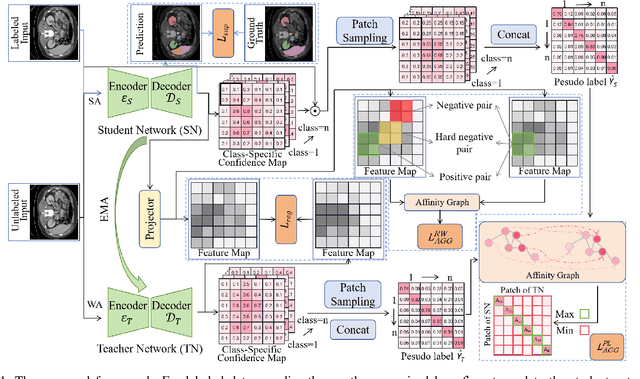

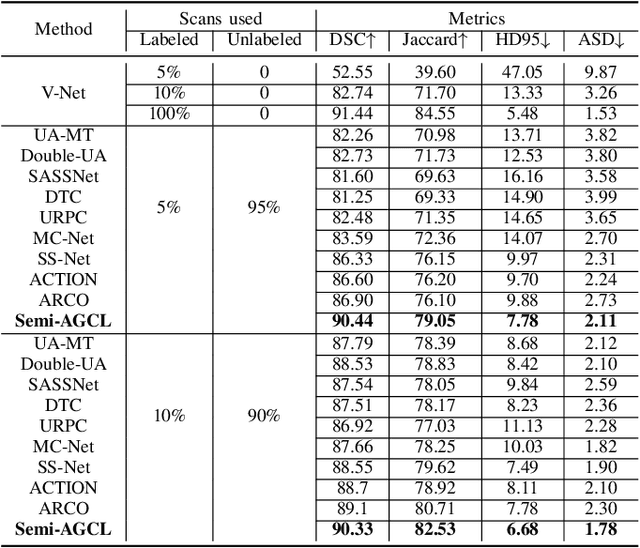
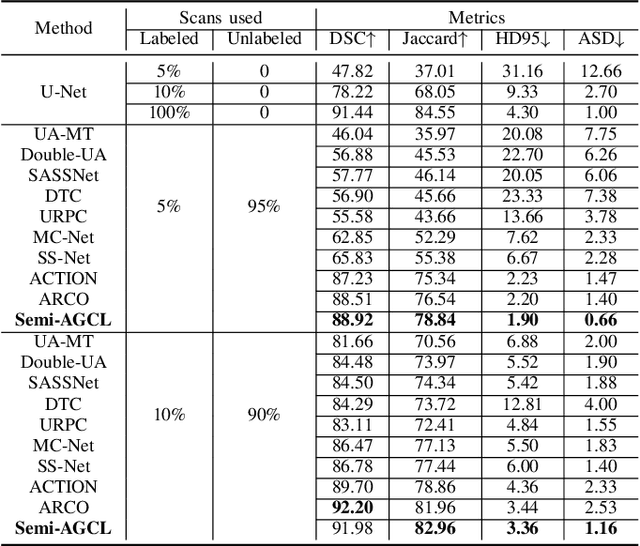
The combination of semi-supervised learning (SemiSL) and contrastive learning (CL) has been successful in medical image segmentation with limited annotations. However, these works often rely on pretext tasks that lack the specificity required for pixel-level segmentation, and still face overfitting issues due to insufficient supervision signals resulting from too few annotations. Therefore, this paper proposes an affinity-graph-guided semi-supervised contrastive learning framework (Semi-AGCL) by establishing additional affinity-graph-based supervision signals between the student and teacher network, to achieve medical image segmentation with minimal annotations without pretext. The framework first designs an average-patch-entropy-driven inter-patch sampling method, which can provide a robust initial feature space without relying on pretext tasks. Furthermore, the framework designs an affinity-graph-guided loss function, which can improve the quality of the learned representation and the model generalization ability by exploiting the inherent structure of the data, thus mitigating overfitting. Our experiments indicate that with merely 10% of the complete annotation set, our model approaches the accuracy of the fully annotated baseline, manifesting a marginal deviation of only 2.52%. Under the stringent conditions where only 5% of the annotations are employed, our model exhibits a significant enhancement in performance surpassing the second best baseline by 23.09% on the dice metric and achieving an improvement of 26.57% on the notably arduous CRAG and ACDC datasets.
SoccerNet 2024 Challenges Results
Sep 16, 2024
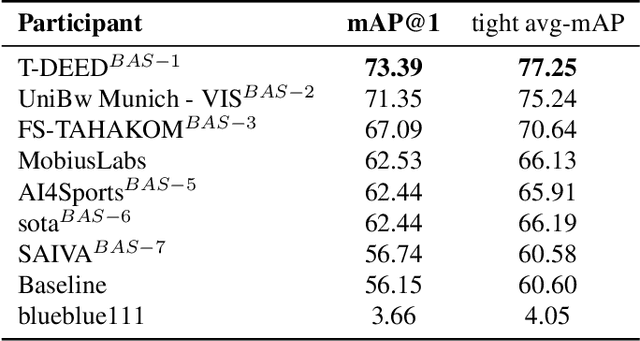
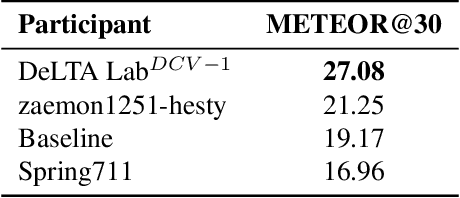
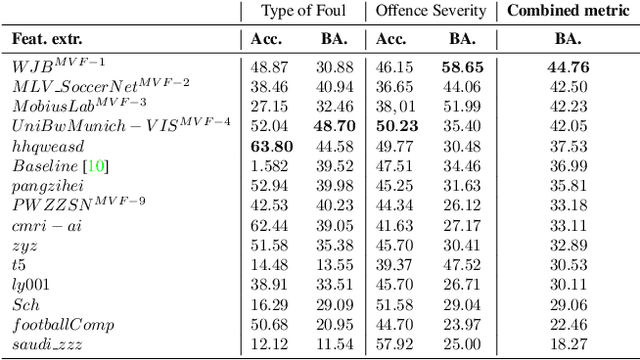
The SoccerNet 2024 challenges represent the fourth annual video understanding challenges organized by the SoccerNet team. These challenges aim to advance research across multiple themes in football, including broadcast video understanding, field understanding, and player understanding. This year, the challenges encompass four vision-based tasks. (1) Ball Action Spotting, focusing on precisely localizing when and which soccer actions related to the ball occur, (2) Dense Video Captioning, focusing on describing the broadcast with natural language and anchored timestamps, (3) Multi-View Foul Recognition, a novel task focusing on analyzing multiple viewpoints of a potential foul incident to classify whether a foul occurred and assess its severity, (4) Game State Reconstruction, another novel task focusing on reconstructing the game state from broadcast videos onto a 2D top-view map of the field. Detailed information about the tasks, challenges, and leaderboards can be found at https://www.soccer-net.org, with baselines and development kits available at https://github.com/SoccerNet.