 Add to Chrome
 Add to Firefox
 Add to Edge
Episodic Memory Temporal Consistency for Cooperative Multi-Agent Reinforcement Learning
Jun 03, 2026
Cooperative Multi-Agent Reinforcement Learning (MARL) frequently suffers from severe reward sparsity and exploration bottlenecks. While episodic memory mechanisms mitigate these issues by reusing high-return trajectories, they often trap agents in local optima due to unconstrained incentive distribution and semantic representation collapse. To address this, we propose Episodic Memory Temporal Consistency (EMTC), a framework that robustly constructs and selectively leverages historical experiences. EMTC introduces two synergistic components: (1) a Temporally Consistent Semantic Embedder that integrates contrastive learning with time-conditioned state reconstruction, preventing representation collapse and enabling precise memory retrieval; and (2) a Temporal Consistency Gating Mechanism that dynamically modulates episodic incentives based on temporal consistency error. This adaptive gate filters misleading signals from pseudo-successful trajectories, effectively mitigating Q-value overestimation. We provide theoretical guarantees, establishing a strict error bound that directly links the observable temporal consistency error to the underlying trajectory optimality and representation quality. Extensive evaluations on the SMAC and GRF benchmarks demonstrate that EMTC consistently outperforms state-of-the-art baselines. Notably, compared to the strongest episodic baseline, EMTC achieves absolute win-rate improvements of up to 24% in super-hard SMAC scenarios and an average improvement of 28% across GRF tasks.

Thinking as Compression: Your Reasoning Model is Secretly a Context Compressor
May 27, 2026Context compression aims to shorten long context inputs with minimal information loss for LLM inference acceleration. While existing methods have shown promise, they typically rely on complex compression modules or compression-specific training, leaving the intrinsic capabilities of LLMs underexplored. In contrast, this work reveals that a thinking model itself can naturally compress long contexts by organizing task-relevant information. We thus derive Thinking as Compression (TaC), a new compression paradigm that treats thinking itself as compressed context. Without relying on specific dedicated compressor, TaC directly prompts the thinking model to generate thinking traces as the shortened context, already outperforming most representative compression methods. Further, given that raw thinking output may struggle with budget control and shortcut behaviors, we introduce Thinking as Compression Constrained (TaC-C), leveraging a simple reward-driven optimization framework to elicit intrinsic thinking as compact and controllable compressed context. Experiments across four long-context QA benchmarks demonstrate that TaC-C consistently outperforms existing baselines. At 4x and 8x compression ratios, it surpasses the strongest competitor by 17.4% and 23.4% in average F1, and by 15.7% and 21.7% in average Exact Match Score (EM), respectively.
MGTEVAL: An Interactive Platform for Systemtic Evaluation of Machine-Generated Text Detectors
Apr 28, 2026We present MGTEVAL, an extensible platform for systematic evaluation of Machine-Generated Text (MGT) detectors. Despite rapid progress in MGT detection, existing evaluations are often fragmented across datasets, preprocessing, attacks, and metrics, making results hard to compare and reproduce. MGTEVAL organizes the workflow into four components: Dataset Building, Dataset Attack, Detector Training, and Performance Evaluation. It supports constructing custom benchmarks by generating MGT with configurable LLMs, applying 12 text attacks to test sets, training detectors via a unified interface, and reporting effectiveness, robustness, and efficiency. The platform provides both command-line and Web-based interfaces for user-friendly experimentation without code rewriting.
Confidence Should Be Calibrated More Than One Turn Deep
Apr 07, 2026Large Language Models (LLMs) are increasingly applied in high-stakes domains such as finance, healthcare, and education, where reliable multi-turn interactions with users are essential. However, existing work on confidence estimation and calibration, a major approach to building trustworthy LLM systems, largely focuses on single-turn settings and overlooks the risks and potential of multi-turn conversations. In this work, we introduce the task of multi-turn calibration to reframe calibration from a static property into a dynamic challenge central to reliable multi-turn conversation, where calibrating model confidence at each turn conditioned on the conversation history is required. We first reveal the risks of this setting: using Expected Calibration Error at turn T (ECE@T), a new metric that tracks calibration dynamics over turns, we show that user feedback (e.g., persuasion) can degrade multi-turn calibration. To address this, we propose MTCal, which minimises ECE@T via a surrogate calibration target, and further leverage calibrated confidence in ConfChat, a decoding strategy that improves both factuality and consistency of the model response in multi-turn interactions. Extensive experiments demonstrate that MT-Cal achieves outstanding and consistent performance in multi-turn calibration, and ConfChat preserves and even enhances model performance in multi-turn interactions. Our results mark multi-turn calibration as one missing link for scaling LLM calibration toward safe, reliable, and real-world use.
GrACE: A Generative Approach to Better Confidence Elicitation in Large Language Models
Sep 11, 2025Assessing the reliability of Large Language Models (LLMs) by confidence elicitation is a prominent approach to AI safety in high-stakes applications, such as healthcare and finance. Existing methods either require expensive computational overhead or suffer from poor calibration, making them impractical and unreliable for real-world deployment. In this work, we propose GrACE, a Generative Approach to Confidence Elicitation that enables scalable and reliable confidence elicitation for LLMs. GrACE adopts a novel mechanism in which the model expresses confidence by the similarity between the last hidden state and the embedding of a special token appended to the vocabulary, in real-time. We fine-tune the model for calibrating the confidence with calibration targets associated with accuracy. Experiments with three LLMs and two benchmark datasets show that the confidence produced by GrACE achieves the best discriminative capacity and calibration on open-ended generation tasks, outperforming six competing methods without resorting to additional sampling or an auxiliary model. Moreover, we propose two strategies for improving test-time scaling based on confidence induced by GrACE. Experimental results show that using GrACE not only improves the accuracy of the final decision but also significantly reduces the number of required samples in the test-time scaling scheme, indicating the potential of GrACE as a practical solution for deploying LLMs with scalable, reliable, and real-time confidence estimation.
Iron Sharpens Iron: Defending Against Attacks in Machine-Generated Text Detection with Adversarial Training
Feb 18, 2025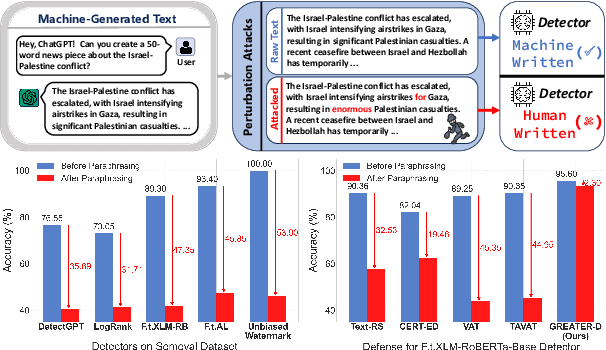
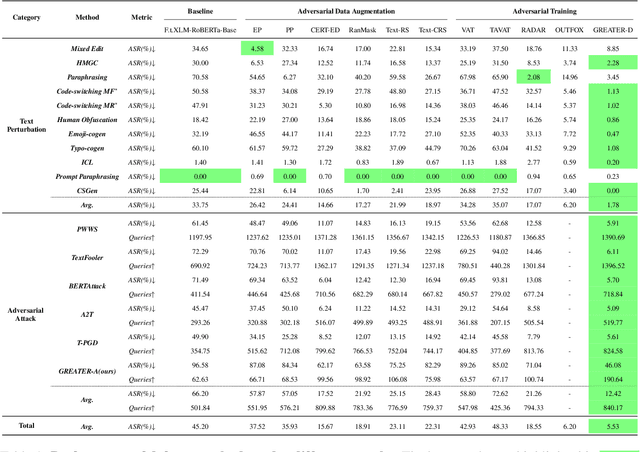
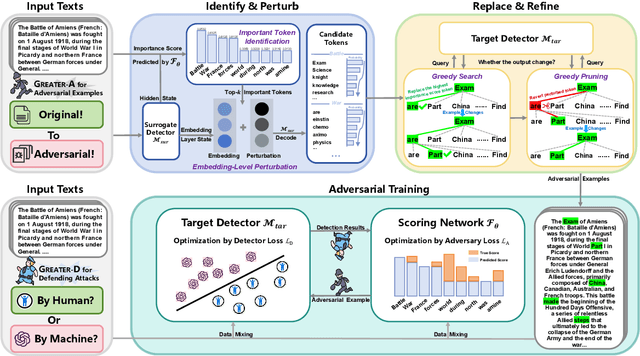
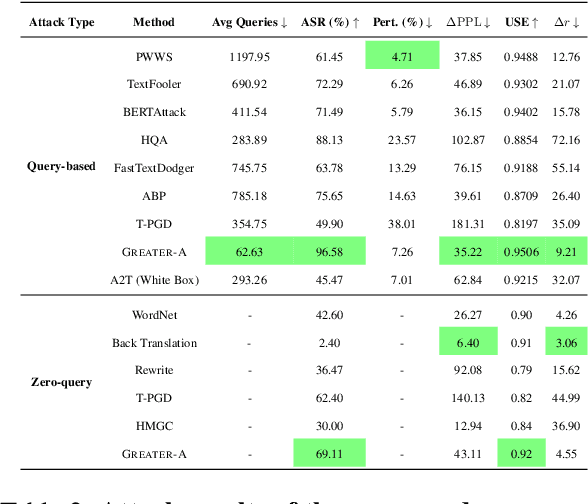
Machine-generated Text (MGT) detection is crucial for regulating and attributing online texts. While the existing MGT detectors achieve strong performance, they remain vulnerable to simple perturbations and adversarial attacks. To build an effective defense against malicious perturbations, we view MGT detection from a threat modeling perspective, that is, analyzing the model's vulnerability from an adversary's point of view and exploring effective mitigations. To this end, we introduce an adversarial framework for training a robust MGT detector, named GREedy Adversary PromoTed DefendER (GREATER). The GREATER consists of two key components: an adversary GREATER-A and a detector GREATER-D. The GREATER-D learns to defend against the adversarial attack from GREATER-A and generalizes the defense to other attacks. GREATER-A identifies and perturbs the critical tokens in embedding space, along with greedy search and pruning to generate stealthy and disruptive adversarial examples. Besides, we update the GREATER-A and GREATER-D synchronously, encouraging the GREATER-D to generalize its defense to different attacks and varying attack intensities. Our experimental results across 9 text perturbation strategies and 5 adversarial attacks show that our GREATER-D reduces the Attack Success Rate (ASR) by 10.61% compared with SOTA defense methods while our GREATER-A is demonstrated to be more effective and efficient than SOTA attack approaches.
Get Confused Cautiously: Textual Sequence Memorization Erasure with Selective Entropy Maximization
Aug 09, 2024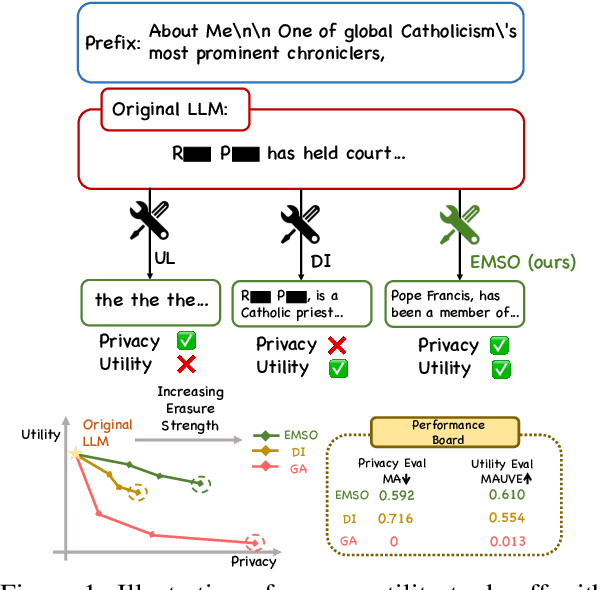
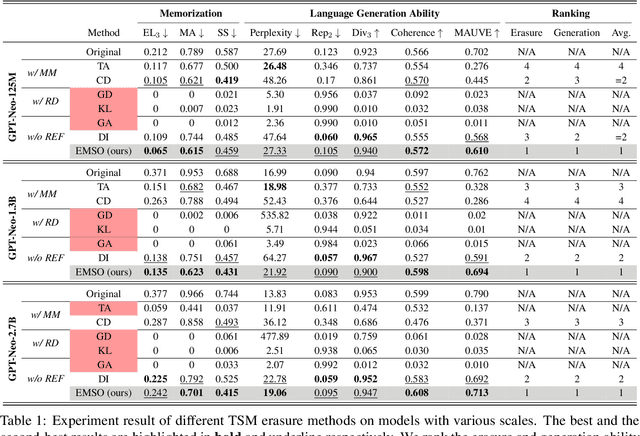
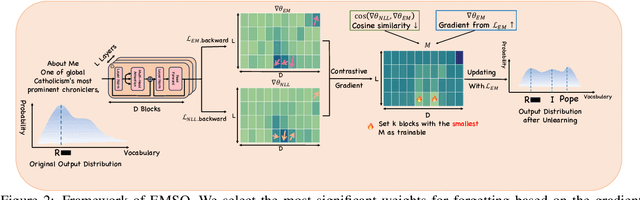

Large Language Models (LLMs) have been found to memorize and recite some of the textual sequences from their training set verbatim, raising broad concerns about privacy and copyright issues when using LLMs. This Textual Sequence Memorization (TSM) phenomenon leads to a high demand to regulate LLM output to prevent it from generating certain memorized text to meet user requirements. However, our empirical study reveals that existing methods for TSM erasure fail to forget massive memorized samples without substantially jeopardizing the model utility. To achieve a better trade-off between the effectiveness of TSM erasure and model utility in LLMs, our paper proposes a new framework based on Entropy Maximization with Selective Optimization (EMSO), where the updated weights are chosen with a novel contrastive gradient metric without any participation of additional model or data. Our analysis shows that training with the entropy maximization loss has a more stable optimization process and better keeps model utility than existing methods. The contrastive gradient metric localizes the most influential weight for TSM erasure by taking both the gradient magnitude and direction into consideration. Extensive experiments across three model scales demonstrate that our method excels in handling large-scale forgetting requests while preserving model ability in language generation and reasoning.
Concentrate Attention: Towards Domain-Generalizable Prompt Optimization for Language Models
Jun 15, 2024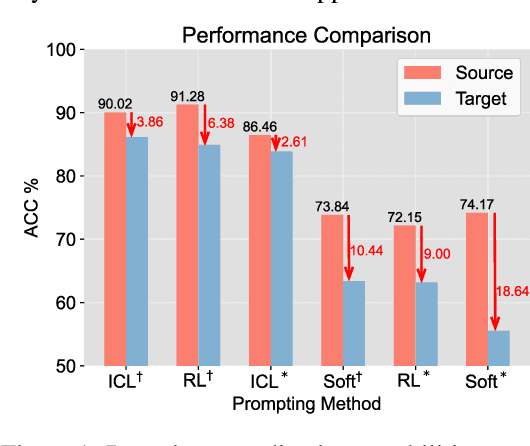
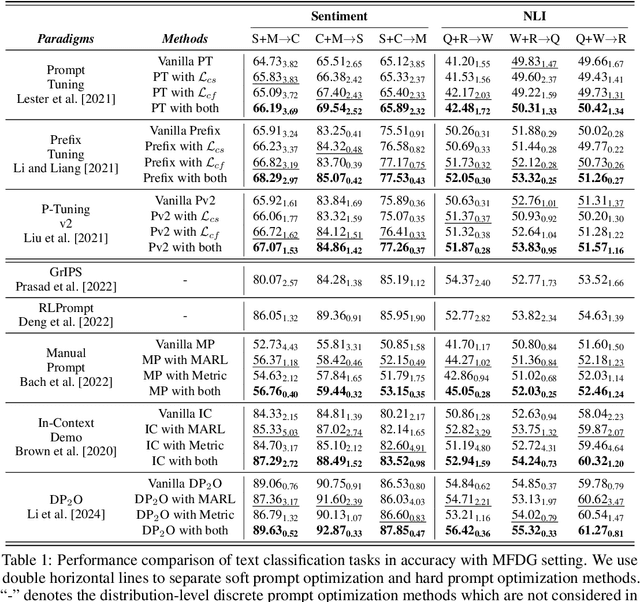

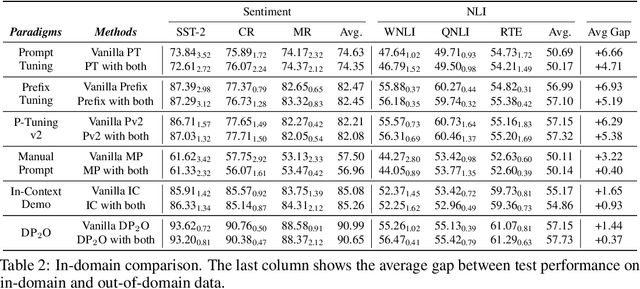
Recent advances in prompt optimization have notably enhanced the performance of pre-trained language models (PLMs) on downstream tasks. However, the potential of optimized prompts on domain generalization has been under-explored. To explore the nature of prompt generalization on unknown domains, we conduct pilot experiments and find that (i) Prompts gaining more attention weight from PLMs' deep layers are more generalizable and (ii) Prompts with more stable attention distributions in PLMs' deep layers are more generalizable. Thus, we offer a fresh objective towards domain-generalizable prompts optimization named "Concentration", which represents the "lookback" attention from the current decoding token to the prompt tokens, to increase the attention strength on prompts and reduce the fluctuation of attention distribution. We adapt this new objective to popular soft prompt and hard prompt optimization methods, respectively. Extensive experiments demonstrate that our idea improves comparison prompt optimization methods by 1.42% for soft prompt generalization and 2.16% for hard prompt generalization in accuracy on the multi-source domain generalization setting, while maintaining satisfying in-domain performance. The promising results validate the effectiveness of our proposed prompt optimization objective and provide key insights into domain-generalizable prompts.
StablePT: Towards Stable Prompting for Few-shot Learning via Input Separation
Apr 30, 2024Large language models have shown their ability to become effective few-shot learners with prompting, revoluting the paradigm of learning with data scarcity. However, this approach largely depends on the quality of prompt initialization, and always exhibits large variability among different runs. Such property makes prompt tuning highly unreliable and vulnerable to poorly constructed prompts, which limits its extension to more real-world applications. To tackle this issue, we propose to treat the hard prompt and soft prompt as separate inputs to mitigate noise brought by the prompt initialization. Furthermore, we optimize soft prompts with contrastive learning for utilizing class-aware information in the training process to maintain model performance. Experimental results demonstrate that \sysname outperforms state-of-the-art methods by 7.20% in accuracy and reduces the standard deviation by 2.02 on average. Furthermore, extensive experiments underscore its robustness and stability across 7 datasets covering various tasks.
Does DetectGPT Fully Utilize Perturbation? Selective Perturbation on Model-Based Contrastive Learning Detector would be Better
Feb 04, 2024

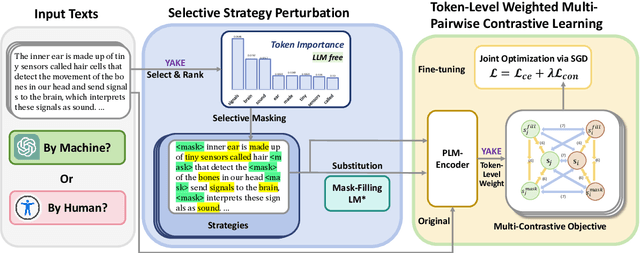

The burgeoning capabilities of large language models (LLMs) have raised growing concerns about abuse. DetectGPT, a zero-shot metric-based unsupervised machine-generated text detector, first introduces perturbation and shows great performance improvement. However, DetectGPT's random perturbation strategy might introduce noise, limiting the distinguishability and further performance improvements. Moreover, its logit regression module relies on setting the threshold, which harms the generalizability and applicability of individual or small-batch inputs. Hence, we propose a novel detector, Pecola, which uses selective strategy perturbation to relieve the information loss caused by random masking, and multi-pair contrastive learning to capture the implicit pattern information during perturbation, facilitating few-shot performance. The experiments show that Pecola outperforms the SOTA method by 1.20% in accuracy on average on four public datasets. We further analyze the effectiveness, robustness, and generalization of our perturbation method.