 Add to Chrome
 Add to Firefox
 Add to Edge
FLIP: Real-Time and Resilient Formation Planning for Large-Scale DIstributed Swarms via Point Cloud Registration
May 28, 2026
Traditional large-scale formation planning either oversimplify the formation representation which leads to poor performance, or they employ complete collaborative relationships, which results in excessive computational load. To achieve high-performance and large-scale formation planning, we transform the Optimal Formation Position Sequence \cite{c1} (OFPS) calculation problem into a spatiotemporal Point Cloud Registration (PCR) problem. Each agent derives its OFPS by distributively computing the matching result between current positions and the desired formation positions of all other agents. Then each agent optimizes the cooperative formation trajectory by using OFPS. We leverage the PCR method with outlier rejection to rapidly perform large-scale formation position registration. This prevents suboptimal trajectories and failed agents from propagating through the cooperative network and affecting more agents. Consequently, we uniformly achieve resilient, efficient, and distributed trajectory planning for large-scale swarms. The effectiveness and the superiority of the proposed method are demonstrated through large-scale simulations of 120-drone formation, and rigorous benchmarking against state-of-the-art (SOTA) methods.

Precise Aggressive Aerial Maneuvers with Sensorimotor Policies
Apr 07, 2026Precise aggressive maneuvers with lightweight onboard sensors remains a key bottleneck in fully exploiting the maneuverability of drones. Such maneuvers are critical for expanding the systems' accessible area by navigating through narrow openings in the environment. Among the most relevant problems, a representative one is aggressive traversal through narrow gaps with quadrotors under SE(3) constraints, which require the quadrotors to leverage a momentary tilted attitude and the asymmetry of the airframe to navigate through gaps. In this paper, we achieve such maneuvers by developing sensorimotor policies directly mapping onboard vision and proprioception into low-level control commands. The policies are trained using reinforcement learning (RL) with end-to-end policy distillation in simulation. We mitigate the fundamental hardness of model-free RL's exploration on the restricted solution space with an initialization strategy leveraging trajectories generated by a model-based planner. Careful sim-to-real design allows the policy to control a quadrotor through narrow gaps with low clearances and high repeatability. For instance, the proposed method enables a quadrotor to navigate a rectangular gap at a 5 cm clearance, tilted at up to 90-degree orientation, without knowledge of the gap's position or orientation. Without training on dynamic gaps, the policy can reactively servo the quadrotor to traverse through a moving gap. The proposed method is also validated by training and deploying policies on challenging tracks of narrow gaps placed closely. The flexibility of the policy learning method is demonstrated by developing policies for geometrically diverse gaps, without relying on manually defined traversal poses and visual features.
Sparse-Graph-Enabled Formation Planning for Large-Scale Aerial Swarms
Mar 26, 2024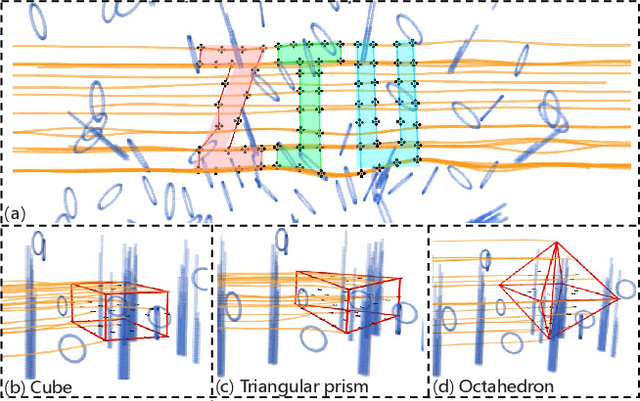
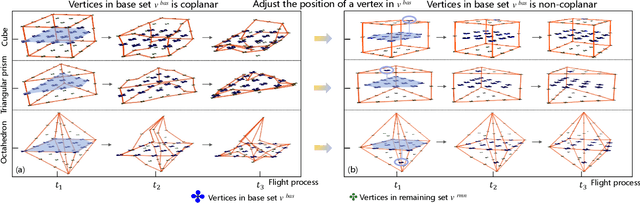
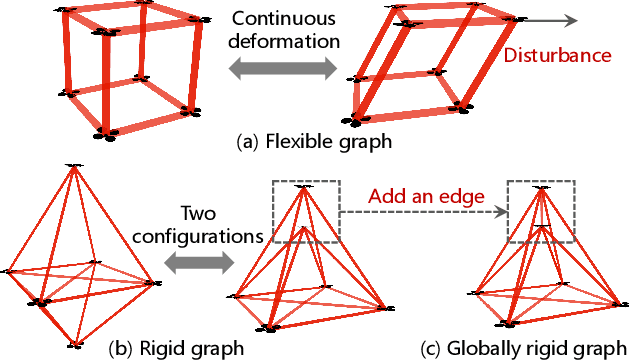
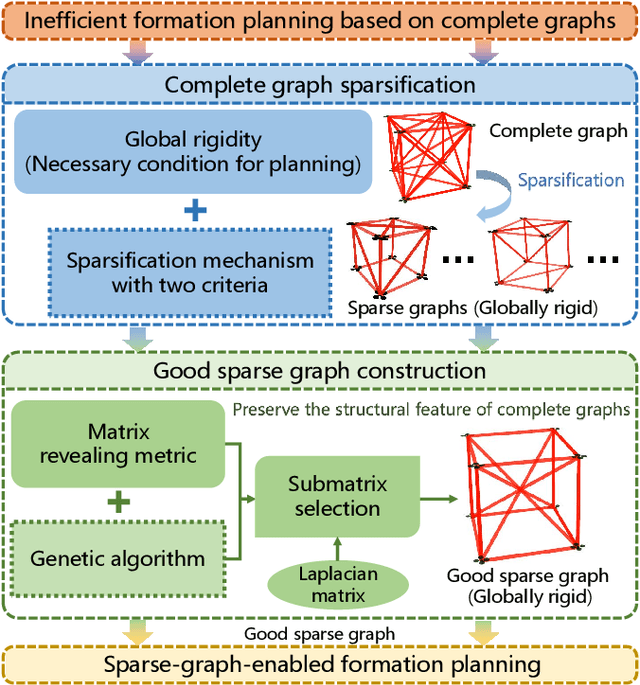
The formation trajectory planning using complete graphs to model collaborative constraints becomes computationally intractable as the number of drones increases due to the curse of dimensionality. To tackle this issue, this paper presents a sparse graph construction method for formation planning to realize better efficiency-performance trade-off. Firstly, a sparsification mechanism for complete graphs is designed to ensure the global rigidity of sparsified graphs, which is a necessary condition for uniquely corresponding to a geometric shape. Secondly, a good sparse graph is constructed to preserve the main structural feature of complete graphs sufficiently. Since the graph-based formation constraint is described by Laplacian matrix, the sparse graph construction problem is equivalent to submatrix selection, which has combinatorial time complexity and needs a scoring metric. Via comparative simulations, the Max-Trace matrix-revealing metric shows the promising performance. The sparse graph is integrated into the formation planning. Simulation results with 72 drones in complex environments demonstrate that when preserving 30\% connection edges, our method has comparative formation error and recovery performance w.r.t. complete graphs. Meanwhile, the planning efficiency is improved by approximate an order of magnitude. Benchmark comparisons and ablation studies are conducted to fully validate the merits of our method.