 Add to Chrome
 Add to Firefox
 Add to Edge
DPEPO: Diverse Parallel Exploration Policy Optimization for LLM-based Agents
Apr 27, 2026
Large language model (LLM) agents that follow the sequential "reason-then-act" paradigm have achieved superior performance in many complex tasks.However, these methods suffer from limited exploration and incomplete environmental understanding, as they interact with only a single environment per step. In this paper, we first introduce a novel paradigm that enables an agent to interact with multiple environments simultaneously and share cross-trajectory experiences. Building upon this paradigm, we further propose DPEPO, a reinforcement learning (RL) algorithm that encourages the agent to perform diverse parallel exploration. There are two stages in DPEPO: initial supervised fine-tuning (SFT) imparts basic parallel reasoning and action generation, followed by reinforcement learning stage with a hierarchical reward scheme. We design a parallel trajectory-level success reward and two step-level rewards: Diverse Action Reward and Diverse State Transition Reward, which actively penalize behavioral redundancy and promote broad exploration. Extensive experiments on ALFWorld and ScienceWorld show that DPEPO achieves state-of-the-art (SOTA) success rates, while maintaining comparable efficiency to strong sequential baselines. (Code is available at https://github.com/LePanda026/Code-for-DPEPO)

HTAA: Enhancing LLM Planning via Hybrid Toolset Agentization & Adaptation
Apr 13, 2026Enabling large language models to scale and reliably use hundreds of tools is critical for real-world applications, yet challenging due to the inefficiency and error accumulation inherent in flat tool-calling architectures. To address this, we propose Hybrid Toolset Agentization & Adaptation (HTAA), a hierarchical framework for scalable tool-use planning. We propose a novel toolset agentization paradigm, which encapsulates frequently co-used tools into specialized agent tools, thereby reducing the planner's action space and mitigating redundancy. To ensure effective coordination, we design Asymmetric Planner Adaptation, a trajectory-based training paradigm that aligns the high-level planner with agent tools via backward reconstruction and forward refinement. To validate the performance of HTAA, we conduct experiments on a real-world internal dataset, InfoVerify, based on the POI validation workflow of China's largest online large-scale ride-hailing platform, featuring long-horizon executable tool trajectories. Experiments on InfoVerify and widely-used benchmarks show that HTAA consistently achieves higher task success rates, requires short tool calling trajectories, and significantly reduces context overhead compared to strong baselines. Furthermore, in a production deployment, HTAA substantially reduces manual validation effort and operational cost, demonstrating its practical efficacy.
DaQ-MSA: Denoising and Qualifying Diffusion Augmentations for Multimodal Sentiment Analysis
Jan 11, 2026Multimodal large language models (MLLMs) have demonstrated strong performance on vision-language tasks, yet their effectiveness on multimodal sentiment analysis remains constrained by the scarcity of high-quality training data, which limits accurate multimodal understanding and generalization. To alleviate this bottleneck, we leverage diffusion models to perform semantics-preserving augmentation on the video and audio modalities, expanding the multimodal training distribution. However, increasing data quantity alone is insufficient, as diffusion-generated samples exhibit substantial quality variation and noisy augmentations may degrade performance. We therefore propose DaQ-MSA (Denoising and Qualifying Diffusion Augmentations for Multimodal Sentiment Analysis), which introduces a quality scoring module to evaluate the reliability of augmented samples and assign adaptive training weights. By down-weighting low-quality samples and emphasizing high-fidelity ones, DaQ-MSA enables more stable learning. By integrating the generative capability of diffusion models with the semantic understanding of MLLMs, our approach provides a robust and generalizable automated augmentation strategy for training MLLMs without any human annotation or additional supervision.
Disentangling Bias by Modeling Intra- and Inter-modal Causal Attention for Multimodal Sentiment Analysis
Aug 07, 2025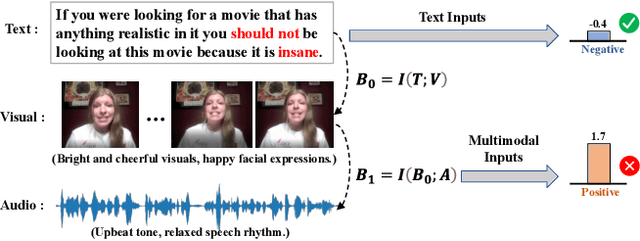
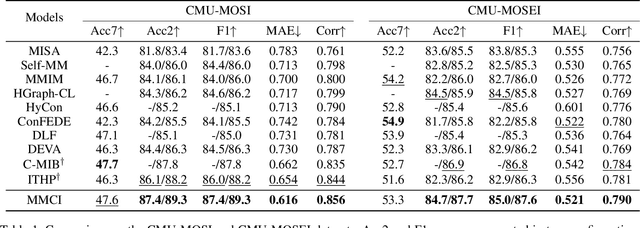
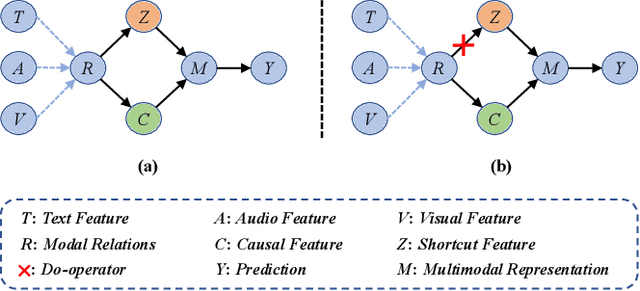
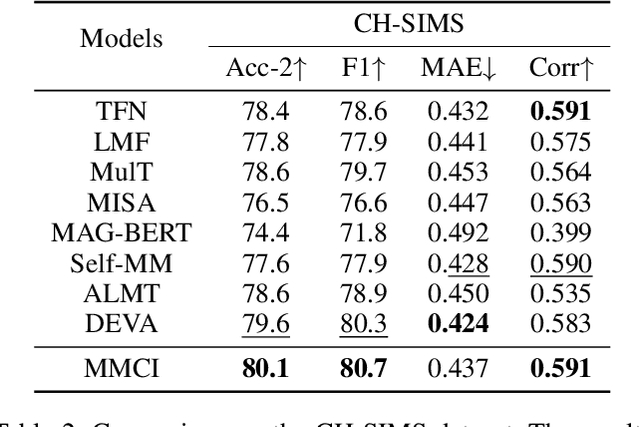
Multimodal sentiment analysis (MSA) aims to understand human emotions by integrating information from multiple modalities, such as text, audio, and visual data. However, existing methods often suffer from spurious correlations both within and across modalities, leading models to rely on statistical shortcuts rather than true causal relationships, thereby undermining generalization. To mitigate this issue, we propose a Multi-relational Multimodal Causal Intervention (MMCI) model, which leverages the backdoor adjustment from causal theory to address the confounding effects of such shortcuts. Specifically, we first model the multimodal inputs as a multi-relational graph to explicitly capture intra- and inter-modal dependencies. Then, we apply an attention mechanism to separately estimate and disentangle the causal features and shortcut features corresponding to these intra- and inter-modal relations. Finally, by applying the backdoor adjustment, we stratify the shortcut features and dynamically combine them with the causal features to encourage MMCI to produce stable predictions under distribution shifts. Extensive experiments on several standard MSA datasets and out-of-distribution (OOD) test sets demonstrate that our method effectively suppresses biases and improves performance.