 Add to Chrome
 Add to Firefox
 Add to Edge
Gene Expression-Informed Jointly Controlled Generative Modeling for Precision Molecular Design
Jul 13, 2026
Precision molecular design aims to discover personalized drug candidates through joint control of multiple conditions, such as biological relevance and molecular design strategies. Biological relevance reflects cellular functional states under disease or perturbation conditions, while molecular design strategies provide complementary guidance in terms of structural intentions and property optimization. In this study, we propose JoPMol, a jointly controlled precision molecular generative model that integrates biological states encoded by gene expression profiles with molecular structure information expressed in text, and chemical properties quantified by numerical values within a unified modeling framework. This formulation enables coordinated generation and optimization of candidate molecules under joint condition control. Experimental results show that JoPMol outperforms state-of-the-art methods across multiple evaluation metrics. Moreover, JoPMol demonstrates strong generalization ability in both transfer tasks and biologically grounded simulation scenarios, validating its effectiveness for precision molecular design. The source code is publicly available at https://github.com/hala-yh/JoPMol.

Factorization-Error-Free Discrete Diffusion Language Model via Speculative Decoding
May 14, 2026Discrete diffusion language models improve generation efficiency through parallel token prediction, but standard $X_0$ prediction methods introduce factorization errors by approximating the clean token posterior with independent token-wise distributions. This paper proposes Factorization-Error-Free Discrete Diffusion Language Modeling (FeF-DLLM), which replaces independent clean-token prediction with an exact prefix-conditioned factorization of the clean posterior to better preserve token dependencies. To reduce the sequential cost introduced by prefix conditioning, FeF-DLLM further incorporates speculative decoding within diffusion denoising, accelerating inference while maintaining the parallel prediction and re-masking properties of DLLMs. Theoretically, we prove that FeF-DLLM generates from the true joint distribution and derive its expected acceleration ratio. Experiments on GSM8K, MATH, HumanEval, and MBPP demonstrate that our method improves accuracy by an average of 5.04 percentage points while achieving an average inference speedup of $3.86\times$.
IntentVLA: Short-Horizon Intent Modeling for Aliased Robot Manipulation
May 14, 2026Robot imitation data are often multimodal: similar visual-language observations may be followed by different action chunks because human demonstrators act with different short-horizon intents, task phases, or recent context. Existing frame-conditioned VLA policies infer each chunk from the current observation and instruction alone, so under partial observability they may resample different intents across adjacent replanning steps, leading to inter-chunk conflict and unstable execution. We introduce IntentVLA, a history-conditioned VLA framework that encodes recent visual observations into a compact short-horizon intent representation and uses it to condition chunk generation. We further introduce AliasBench, a 12-task ambiguity-aware benchmark on RoboTwin2 with matched training data and evaluation environments that isolate short-horizon observation aliasing. Across AliasBench, SimplerEnv, LIBERO, and RoboCasa, IntentVLA improves rollout stability and outperforms strong VLA baselines
FrameSkip: Learning from Fewer but More Informative Frames in VLA Training
May 13, 2026Vision-Language-Action (VLA) policies are commonly trained from dense robot demonstration trajectories, often collected through teleoperation, by sampling every recorded frame as if it provided equally useful supervision. We argue that this convention creates a temporal supervision imbalance: long low-change segments dominate the training stream, while manipulation-critical transitions such as alignment, contact, grasping, and release appear only sparsely. We introduce FrameSkip, a data-layer frame selection framework that scores trajectory frames using action variation, visual-action coherence, task-progress priors, and gripper-transition preservation, then remaps training samples toward high-importance frames under a target retention ratio. Because FrameSkip operates only in the dataloader, it leaves the VLA architecture, action head, training objective, and inference procedure unchanged. Across RoboCasa-GR1, SimplerEnv, and LIBERO, FrameSkip improves the success-retention trade-off over full-frame training and simpler frame selection variants, achieving a macro-average success rate of 76.15% across the three benchmarks compared with 66.50% for full-frame training while using a compressed trajectory view that retains 20% of unique frames in the main setting.
DanceCrafter: Fine-Grained Text-Driven Controllable Dance Generation via Choreographic Syntax
Apr 20, 2026Text-driven controllable dance generation remains under-explored, primarily due to the severe scarcity of high-quality datasets and the inherent difficulty of articulating complex choreographies. Characterizing dance is particularly challenging owing to its intricate spatial dynamics, strong directionality, and the highly decoupled movements of distinct body parts. To overcome these bottlenecks, we bridge principles from dance studies, human anatomy, and biomechanics to propose \textit{Choreographic Syntax}, a novel theoretical framework with a tailored annotation system. Grounded in this syntax, we combine professional dance archives with high-fidelity motion capture data to construct \textbf{DanceFlow}, the most fine-grained dance dataset to date. It encompasses 41 hours of high-quality motions paired with 6.34 million words of detailed descriptions. At the model level, we introduce \textbf{DanceCrafter}, a tailored motion transformer built upon the Momentum Human Rig. To circumvent optimization instabilities, we construct a continuous manifold motion representation paired with a hybrid normalization strategy. Furthermore, we design an anatomy-aware loss to explicitly regulate the decoupled nature of body parts. Together, these adaptations empower DanceCrafter to achieve the high-fidelity and stable generation of complex dance sequences. Extensive evaluations and user studies demonstrate our state-of-the-art performance in motion quality, fine-grained controllability, and generation naturalness.
3D-Mix for VLA: A Plug-and-Play Module for Integrating VGGT-based 3D Information into Vision-Language-Action Models
Mar 25, 2026Vision-Language-Action (VLA) models leverage Multimodal Large Language Models (MLLMs) for robotic control, but recent studies reveal that MLLMs exhibit limited spatial intelligence due to training predominantly on 2D data, resulting in inadequate 3D perception for manipulation tasks. While recent approaches incorporate specialized 3D vision models such as VGGT to enhance spatial understanding, they employ diverse integration mechanisms without systematic investigation, leaving the optimal fusion strategy unclear. We conduct a comprehensive pilot study comparing nine VGGT integration schemes on standardized benchmarks and find that semantic-conditioned gated fusion, which adaptively balances 2D semantic and 3D geometric features based on task context, achieved the strongest performance among all nine evaluated fusion schemes in our pilot study. We present 3D-Mix, a plug-and-play module that integrates into diverse VLA architectures (GR00T-style and $π$-style) without modifying existing MLLM or action expert components. Experiments across six MLLM series (nine model variants, 2B--8B parameters) on SIMPLER and LIBERO show that 3D-Mix delivers consistent performance gains, averaging +7.0% on the out-of-domain (OOD) SIMPLER benchmark across all nine GR00T-style variants, establishing a principled approach for enhancing spatial intelligence in VLA systems.
Motion Capture is Not the Target Domain: Scaling Synthetic Data for Learning Motion Representations
Feb 11, 2026Synthetic data offers a compelling path to scalable pretraining when real-world data is scarce, but models pretrained on synthetic data often fail to transfer reliably to deployment settings. We study this problem in full-body human motion, where large-scale data collection is infeasible but essential for wearable-based Human Activity Recognition (HAR), and where synthetic motion can be generated from motion-capture-derived representations. We pretrain motion time-series models using such synthetic data and evaluate their transfer across diverse downstream HAR tasks. Our results show that synthetic pretraining improves generalisation when mixed with real data or scaled sufficiently. We also demonstrate that large-scale motion-capture pretraining yields only marginal gains due to domain mismatch with wearable signals, clarifying key sim-to-real challenges and the limits and opportunities of synthetic motion data for transferable HAR representations.
A$^2$-LLM: An End-to-end Conversational Audio Avatar Large Language Model
Feb 04, 2026Developing expressive and responsive conversational digital humans is a cornerstone of next-generation human-computer interaction. While large language models (LLMs) have significantly enhanced dialogue capabilities, most current systems still rely on cascaded architectures that connect independent modules. These pipelines are often plagued by accumulated errors, high latency, and poor real-time performance. Lacking access to the underlying conversational context, these pipelines inherently prioritize rigid lip-sync over emotional depth. To address these challenges, we propose A$^2$-LLM, an end-to-end conversational audio avatar large language model that jointly reasons about language, audio prosody, and 3D facial motion within a unified framework. To facilitate training, we introduce FLAME-QA, a high-quality multimodal dataset designed to align semantic intent with expressive facial dynamics within a QA format. By leveraging deep semantic understanding, A$^2$-LLM generates emotionally rich facial movements beyond simple lip-synchronization. Experimental results demonstrate that our system achieves superior emotional expressiveness while maintaining real-time efficiency (500 ms latency, 0.7 RTF).
Not All Tokens Are What You Need In Thinking
May 23, 2025Modern reasoning models, such as OpenAI's o1 and DeepSeek-R1, exhibit impressive problem-solving capabilities but suffer from critical inefficiencies: high inference latency, excessive computational resource consumption, and a tendency toward overthinking -- generating verbose chains of thought (CoT) laden with redundant tokens that contribute minimally to the final answer. To address these issues, we propose Conditional Token Selection (CTS), a token-level compression framework with a flexible and variable compression ratio that identifies and preserves only the most essential tokens in CoT. CTS evaluates each token's contribution to deriving correct answers using conditional importance scoring, then trains models on compressed CoT. Extensive experiments demonstrate that CTS effectively compresses long CoT while maintaining strong reasoning performance. Notably, on the GPQA benchmark, Qwen2.5-14B-Instruct trained with CTS achieves a 9.1% accuracy improvement with 13.2% fewer reasoning tokens (13% training token reduction). Further reducing training tokens by 42% incurs only a marginal 5% accuracy drop while yielding a 75.8% reduction in reasoning tokens, highlighting the prevalence of redundancy in existing CoT.
Long-Short Chain-of-Thought Mixture Supervised Fine-Tuning Eliciting Efficient Reasoning in Large Language Models
May 06, 2025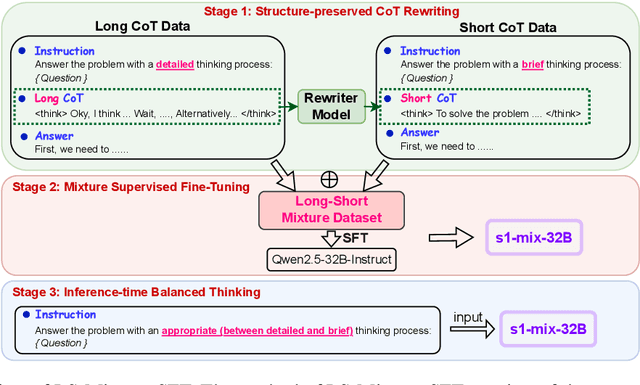
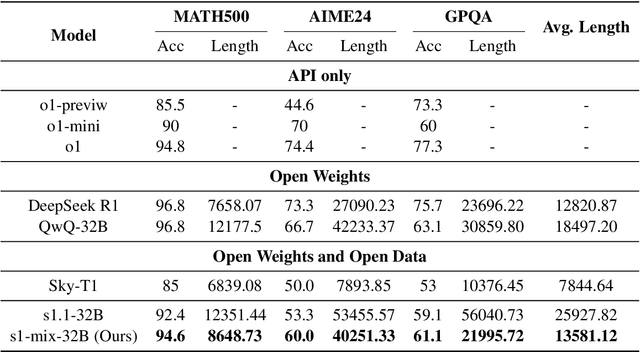
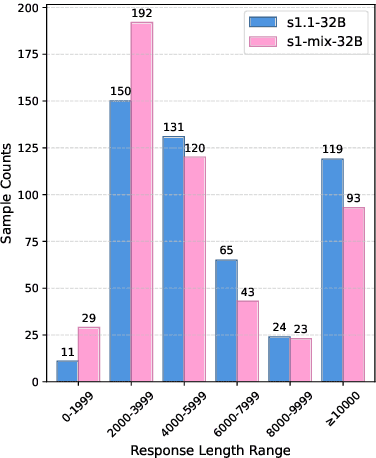
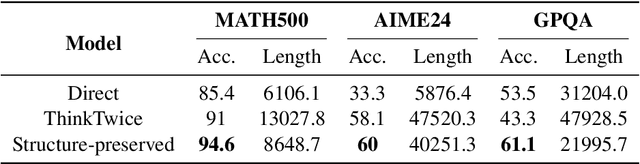
Recent advances in large language models have demonstrated that Supervised Fine-Tuning (SFT) with Chain-of-Thought (CoT) reasoning data distilled from large reasoning models (e.g., DeepSeek R1) can effectively transfer reasoning capabilities to non-reasoning models. However, models fine-tuned with this approach inherit the "overthinking" problem from teacher models, producing verbose and redundant reasoning chains during inference. To address this challenge, we propose \textbf{L}ong-\textbf{S}hort Chain-of-Thought \textbf{Mixture} \textbf{S}upervised \textbf{F}ine-\textbf{T}uning (\textbf{LS-Mixture SFT}), which combines long CoT reasoning dataset with their short counterparts obtained through structure-preserved rewriting. Our experiments demonstrate that models trained using the LS-Mixture SFT method, compared to those trained with direct SFT, achieved an average accuracy improvement of 2.3\% across various benchmarks while substantially reducing model response length by approximately 47.61\%. This work offers an approach to endow non-reasoning models with reasoning capabilities through supervised fine-tuning while avoiding the inherent overthinking problems inherited from teacher models, thereby enabling efficient reasoning in the fine-tuned models.