 Add to Chrome
 Add to Firefox
 Add to Edge
Self-consistent Deep Geometric Learning for Heterogeneous Multi-source Spatial Point Data Prediction
Jun 30, 2024
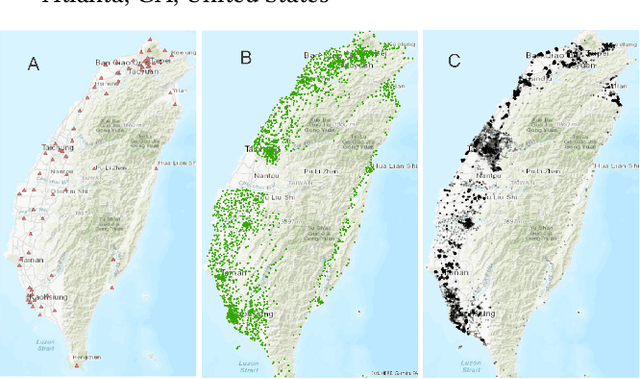
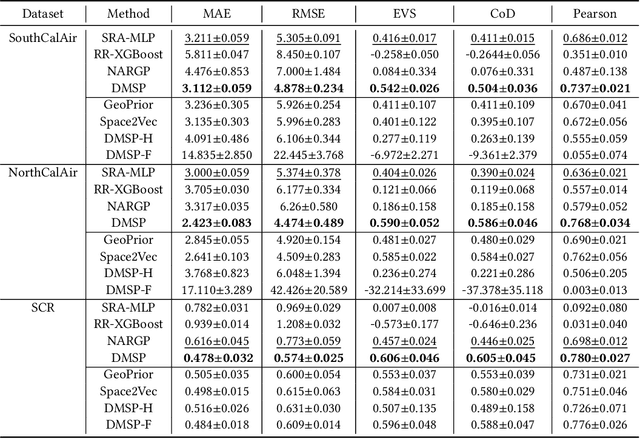
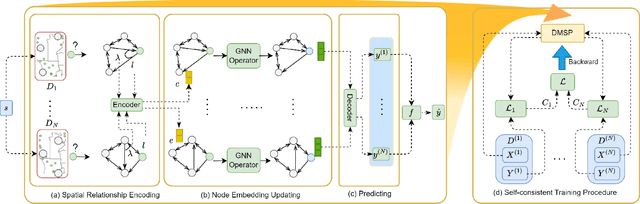
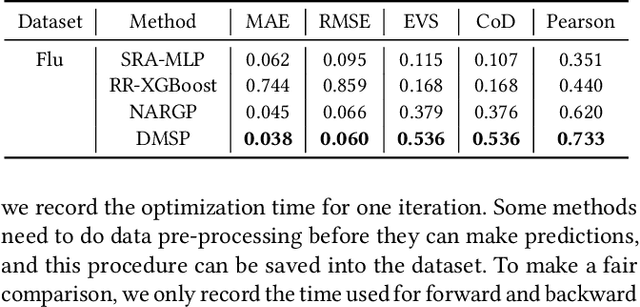
Multi-source spatial point data prediction is crucial in fields like environmental monitoring and natural resource management, where integrating data from various sensors is the key to achieving a holistic environmental understanding. Existing models in this area often fall short due to their domain-specific nature and lack a strategy for integrating information from various sources in the absence of ground truth labels. Key challenges include evaluating the quality of different data sources and modeling spatial relationships among them effectively. Addressing these issues, we introduce an innovative multi-source spatial point data prediction framework that adeptly aligns information from varied sources without relying on ground truth labels. A unique aspect of our method is the 'fidelity score,' a quantitative measure for evaluating the reliability of each data source. Furthermore, we develop a geo-location-aware graph neural network tailored to accurately depict spatial relationships between data points. Our framework has been rigorously tested on two real-world datasets and one synthetic dataset. The results consistently demonstrate its superior performance over existing state-of-the-art methods.

STimage-1K4M: A histopathology image-gene expression dataset for spatial transcriptomics
Jun 10, 2024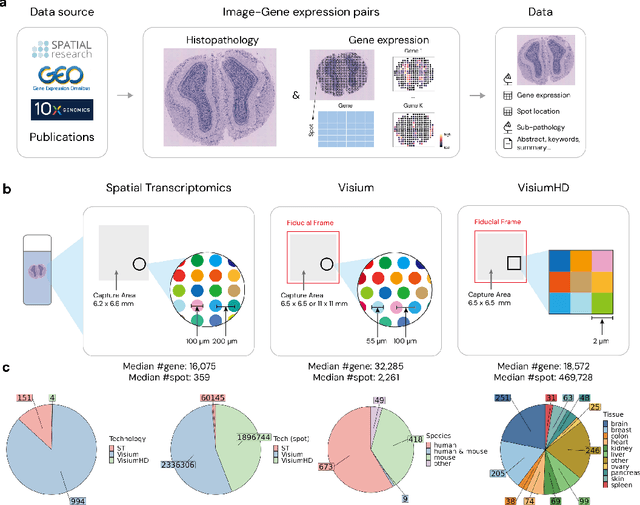
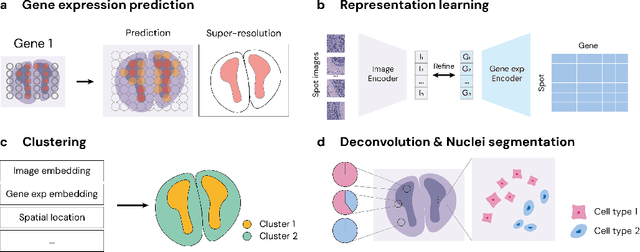
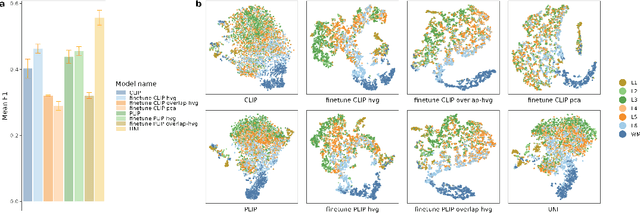
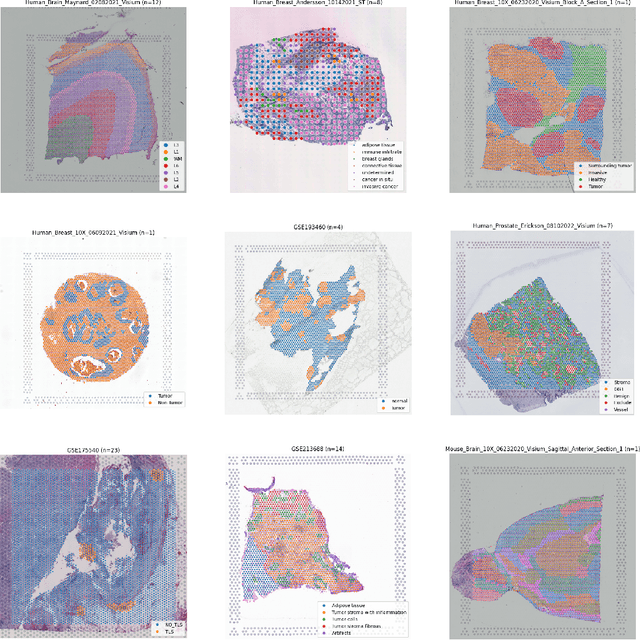
Recent advances in multi-modal algorithms have driven and been driven by the increasing availability of large image-text datasets, leading to significant strides in various fields, including computational pathology. However, in most existing medical image-text datasets, the text typically provides high-level summaries that may not sufficiently describe sub-tile regions within a large pathology image. For example, an image might cover an extensive tissue area containing cancerous and healthy regions, but the accompanying text might only specify that this image is a cancer slide, lacking the nuanced details needed for in-depth analysis. In this study, we introduce STimage-1K4M, a novel dataset designed to bridge this gap by providing genomic features for sub-tile images. STimage-1K4M contains 1,149 images derived from spatial transcriptomics data, which captures gene expression information at the level of individual spatial spots within a pathology image. Specifically, each image in the dataset is broken down into smaller sub-image tiles, with each tile paired with 15,000-30,000 dimensional gene expressions. With 4,293,195 pairs of sub-tile images and gene expressions, STimage-1K4M offers unprecedented granularity, paving the way for a wide range of advanced research in multi-modal data analysis an innovative applications in computational pathology, and beyond.
CARES: A Comprehensive Benchmark of Trustworthiness in Medical Vision Language Models
Jun 10, 2024


Artificial intelligence has significantly impacted medical applications, particularly with the advent of Medical Large Vision Language Models (Med-LVLMs), sparking optimism for the future of automated and personalized healthcare. However, the trustworthiness of Med-LVLMs remains unverified, posing significant risks for future model deployment. In this paper, we introduce CARES and aim to comprehensively evaluate the Trustworthiness of Med-LVLMs across the medical domain. We assess the trustworthiness of Med-LVLMs across five dimensions, including trustfulness, fairness, safety, privacy, and robustness. CARES comprises about 41K question-answer pairs in both closed and open-ended formats, covering 16 medical image modalities and 27 anatomical regions. Our analysis reveals that the models consistently exhibit concerns regarding trustworthiness, often displaying factual inaccuracies and failing to maintain fairness across different demographic groups. Furthermore, they are vulnerable to attacks and demonstrate a lack of privacy awareness. We publicly release our benchmark and code in https://github.com/richard-peng-xia/CARES.
Calibrated Self-Rewarding Vision Language Models
May 23, 2024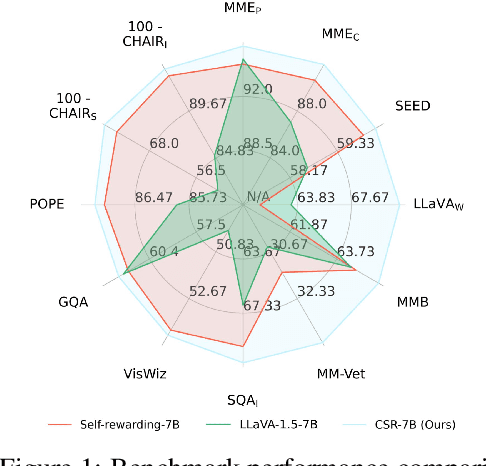
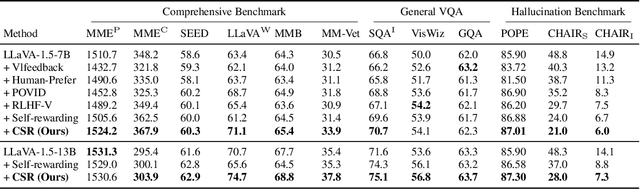
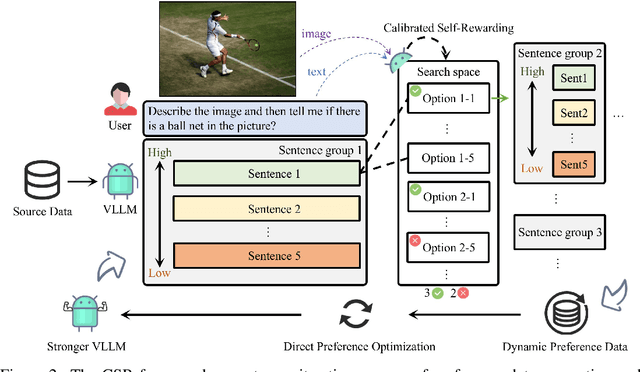
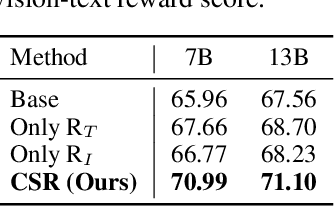
Large Vision-Language Models (LVLMs) have made substantial progress by integrating pre-trained large language models (LLMs) and vision models through instruction tuning. Despite these advancements, LVLMs often exhibit the hallucination phenomenon, where generated text responses appear linguistically plausible but contradict the input image, indicating a misalignment between image and text pairs. This misalignment arises because the model tends to prioritize textual information over visual input, even when both the language model and visual representations are of high quality. Existing methods leverage additional models or human annotations to curate preference data and enhance modality alignment through preference optimization. These approaches may not effectively reflect the target LVLM's preferences, making the curated preferences easily distinguishable. Our work addresses these challenges by proposing the Calibrated Self-Rewarding (CSR) approach, which enables the model to self-improve by iteratively generating candidate responses, evaluating the reward for each response, and curating preference data for fine-tuning. In the reward modeling, we employ a step-wise strategy and incorporate visual constraints into the self-rewarding process to place greater emphasis on visual input. Empirical results demonstrate that CSR enhances performance and reduces hallucinations across ten benchmarks and tasks, achieving substantial improvements over existing methods by 7.62%. Our empirical results are further supported by rigorous theoretical analysis, under mild assumptions, verifying the effectiveness of introducing visual constraints into the self-rewarding paradigm. Additionally, CSR shows compatibility with different vision-language models and the ability to incrementally improve performance through iterative fine-tuning. Our data and code are available at https://github.com/YiyangZhou/CSR.
Hunyuan-DiT: A Powerful Multi-Resolution Diffusion Transformer with Fine-Grained Chinese Understanding
May 14, 2024
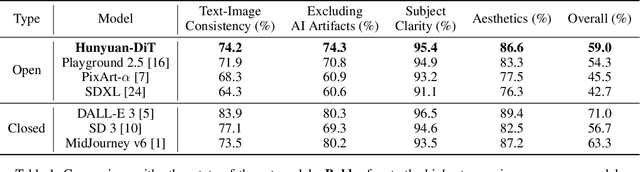
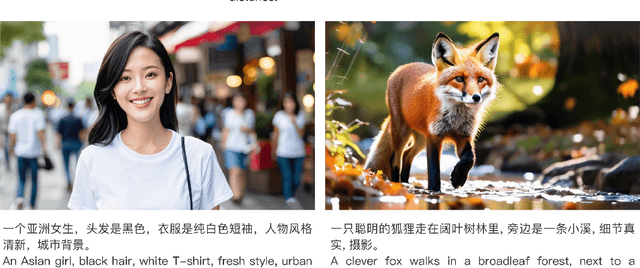
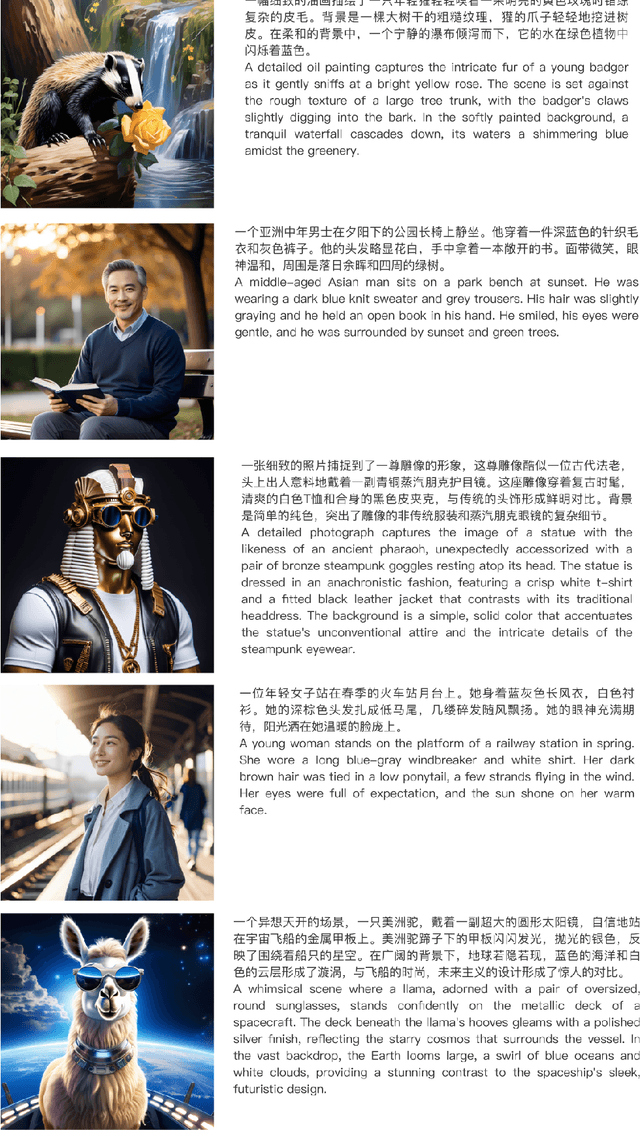
We present Hunyuan-DiT, a text-to-image diffusion transformer with fine-grained understanding of both English and Chinese. To construct Hunyuan-DiT, we carefully design the transformer structure, text encoder, and positional encoding. We also build from scratch a whole data pipeline to update and evaluate data for iterative model optimization. For fine-grained language understanding, we train a Multimodal Large Language Model to refine the captions of the images. Finally, Hunyuan-DiT can perform multi-turn multimodal dialogue with users, generating and refining images according to the context. Through our holistic human evaluation protocol with more than 50 professional human evaluators, Hunyuan-DiT sets a new state-of-the-art in Chinese-to-image generation compared with other open-source models. Code and pretrained models are publicly available at github.com/Tencent/HunyuanDiT
Prompt-tuning for Clickbait Detection via Text Summarization
Apr 17, 2024Clickbaits are surprising social posts or deceptive news headlines that attempt to lure users for more clicks, which have posted at unprecedented rates for more profit or commercial revenue. The spread of clickbait has significant negative impacts on the users, which brings users misleading or even click-jacking attacks. Different from fake news, the crucial problem in clickbait detection is determining whether the headline matches the corresponding content. Most existing methods compute the semantic similarity between the headlines and contents for detecting clickbait. However, due to significant differences in length and semantic features between headlines and contents, directly calculating semantic similarity is often difficult to summarize the relationship between them. To address this problem, we propose a prompt-tuning method for clickbait detection via text summarization in this paper, text summarization is introduced to summarize the contents, and clickbait detection is performed based on the similarity between the generated summary and the contents. Specifically, we first introduce a two-stage text summarization model to produce high-quality news summaries based on pre-trained language models, and then both the headlines and new generated summaries are incorporated as the inputs for prompt-tuning. Additionally, a variety of strategies are conducted to incorporate external knowledge for improving the performance of clickbait detection. The extensive experiments on well-known clickbait detection datasets demonstrate that our method achieved state-of-the-art performance.
Survey on Large Language Model-Enhanced Reinforcement Learning: Concept, Taxonomy, and Methods
Mar 30, 2024With extensive pre-trained knowledge and high-level general capabilities, large language models (LLMs) emerge as a promising avenue to augment reinforcement learning (RL) in aspects such as multi-task learning, sample efficiency, and task planning. In this survey, we provide a comprehensive review of the existing literature in $\textit{LLM-enhanced RL}$ and summarize its characteristics compared to conventional RL methods, aiming to clarify the research scope and directions for future studies. Utilizing the classical agent-environment interaction paradigm, we propose a structured taxonomy to systematically categorize LLMs' functionalities in RL, including four roles: information processor, reward designer, decision-maker, and generator. Additionally, for each role, we summarize the methodologies, analyze the specific RL challenges that are mitigated, and provide insights into future directions. Lastly, potential applications, prospective opportunities and challenges of the $\textit{LLM-enhanced RL}$ are discussed.
Context-based and Diversity-driven Specificity in Compositional Zero-Shot Learning
Feb 27, 2024Compositional Zero-Shot Learning (CZSL) aims to recognize unseen attribute-object pairs based on a limited set of observed examples. Current CZSL methodologies, despite their advancements, tend to neglect the distinct specificity levels present in attributes. For instance, given images of sliced strawberries, they may fail to prioritize `Sliced-Strawberry' over a generic `Red-Strawberry', despite the former being more informative. They also suffer from ballooning search space when shifting from Close-World (CW) to Open-World (OW) CZSL. To address the issues, we introduce the Context-based and Diversity-driven Specificity learning framework for CZSL (CDS-CZSL). Our framework evaluates the specificity of attributes by considering the diversity of objects they apply to and their related context. This novel approach allows for more accurate predictions by emphasizing specific attribute-object pairs and improves composition filtering in OW-CZSL. We conduct experiments in both CW and OW scenarios, and our model achieves state-of-the-art results across three datasets.
Exploring the Impact of Table-to-Text Methods on Augmenting LLM-based Question Answering with Domain Hybrid Data
Feb 20, 2024Augmenting Large Language Models (LLMs) for Question Answering (QA) with domain specific data has attracted wide attention. However, domain data often exists in a hybrid format, including text and semi-structured tables, posing challenges for the seamless integration of information. Table-to-Text Generation is a promising solution by facilitating the transformation of hybrid data into a uniformly text-formatted corpus. Although this technique has been widely studied by the NLP community, there is currently no comparative analysis on how corpora generated by different table-to-text methods affect the performance of QA systems. In this paper, we address this research gap in two steps. First, we innovatively integrate table-to-text generation into the framework of enhancing LLM-based QA systems with domain hybrid data. Then, we utilize this framework in real-world industrial data to conduct extensive experiments on two types of QA systems (DSFT and RAG frameworks) with four representative methods: Markdown format, Template serialization, TPLM-based method, and LLM-based method. Based on the experimental results, we draw some empirical findings and explore the underlying reasons behind the success of some methods. We hope the findings of this work will provide a valuable reference for the academic and industrial communities in developing robust QA systems.
FADI-AEC: Fast Score Based Diffusion Model Guided by Far-end Signal for Acoustic Echo Cancellation
Jan 08, 2024Despite the potential of diffusion models in speech enhancement, their deployment in Acoustic Echo Cancellation (AEC) has been restricted. In this paper, we propose DI-AEC, pioneering a diffusion-based stochastic regeneration approach dedicated to AEC. Further, we propose FADI-AEC, fast score-based diffusion AEC framework to save computational demands, making it favorable for edge devices. It stands out by running the score model once per frame, achieving a significant surge in processing efficiency. Apart from that, we introduce a novel noise generation technique where far-end signals are utilized, incorporating both far-end and near-end signals to refine the score model's accuracy. We test our proposed method on the ICASSP2023 Microsoft deep echo cancellation challenge evaluation dataset, where our method outperforms some of the end-to-end methods and other diffusion based echo cancellation methods.