 Add to Chrome
 Add to Firefox
 Add to Edge
Code as Representation: A Compilable Parsing Paradigm for Academic Documents
Aug 18, 2026
Academic papers are a primary carrier of scientific knowledge, yet most of this knowledge remains locked in PDFs that are optimized for human reading rather than machine use. For Multimodal Large Language Models (MLLMs), the core challenge is not only perception, but representation: scientific pages interleave text with Structured Academic Elements (SAEs) such as tables, formulas, charts, and pseudocode, whose structure, data, and logic are poorly preserved by common surrogates like Markdown. We therefore propose Compilable Academic Document Parsing (CADP), a paradigm that reconstructs a full page as contextual \LaTeX{} plus executable Python, so that structure-preserving elements and executable chart representations can be reconstructed, recompiled, and directly verified against the source page. To support this setting, we introduce CADP-Bench, an expert-verified benchmark of full academic pages containing tightly coupled text and multiple SAE types, evaluated through a re-injection compilation protocol. We further study current capabilities using SOTA MLLMs and an exploratory multi-agent baseline that incorporates common agentic techniques. Results show that even frontier models still struggle to produce high-fidelity executable reconstructions, highlighting substantial room for improvement in structure-aware scientific document parsing. CADP-Bench is released for future research.

EvoThink: Evolving Thinking in Large Reasoning Models via Self-Pruning and Aha-Moment Preference Optimization
Jul 22, 2026Large Reasoning Models (LRMs) often suffer from overthinking due to redundant verification steps. Existing approaches for mitigating overthinking, such as fast-slow thinking switching and reasoning trajectory compression, fail to make a fine-grained distinction between beneficial and redundant steps within the LRM's reasoning process, and may thus impair reasoning capability in their pursuit of efficiency. To simultaneously improve reasoning efficiency and capability, we propose EvoThink, a framework that reduces redundant verification and encourages the exploration of new reasoning paths. EvoThink comprises two key components: Self-Pruning Training (SPT), an unsupervised method that iteratively prunes redundant reasoning steps and self-trains on the concise trajectories; and Aha-Moment Preference Optimization (AMPO), which, inspired by genetic algorithms, identifies valuable failed reasoning attempts, synthesizes from-wrong-to-right aha-moment data, and optimizes the model to internalize this reasoning pattern. Extensive evaluations across mathematical reasoning and code generation benchmarks demonstrate that EvoThink not only substantially reduces inference-time token usage but also improves the reasoning capability of LRMs.
ChartSync: A Benchmark for Visuo-Logical Cascading Chart Editing
Jul 11, 2026Generative image editing models struggle with structured statistical charts when data modifications require geometric synchronization. We formalize this task as Visuo-Logical Cascading Editing (VLCE). However, existing methods remain confined to localized text substitutions and struggle with dependency-aware cascading updates. To systematically evaluate this capability, we introduce ChartSync, an expert-validated benchmark constructed via a programmatic rendering pipeline that guarantees deterministic visuo-logical coupling for the ground truth. ChartSync comprises 870 triplets across 9 chart categories and 4 task types, including 235 geometry-coupled VLCE instances that specifically test cascading text-to-geometry synchronization. We further evaluate these instances via a two-tier framework combining objective visual metrics with a vision-language model judge paradigm to assess low-level fidelity alongside multimodal comprehension and reasoning. Evaluating 14 image editing models and one code-mediated pipeline reveals a nuanced capability gap: most open-source models suffer severe drops in geometric synchronization, while only two frontier proprietary models show emerging VLCE capability, with their residual errors mainly involving semantic isolation and background corruption. Our detailed error analysis deconstructs these failure paradigms to identify core meta-abilities for guiding future multimodal architectures. The ChartSync dataset and code are publicly released at https://github.com/kaka-yjk/ChartSyncCodebase.
Pandora: Leveraging Code-driven Knowledge Transfer for Unified Structured Knowledge Reasoning
Aug 25, 2025Unified Structured Knowledge Reasoning (USKR) aims to answer natural language questions by using structured sources such as tables, databases, and knowledge graphs in a unified way. Existing USKR methods rely on task-specific strategies or bespoke representations, which hinder their ability to dismantle barriers between different SKR tasks, thereby constraining their overall performance in cross-task scenarios. In this paper, we introduce \textsc{Pandora}, a novel USKR framework that addresses the limitations of existing methods by leveraging two key innovations. First, we propose a code-based unified knowledge representation using \textsc{Python}'s \textsc{Pandas} API, which aligns seamlessly with the pre-training of LLMs. This representation facilitates a cohesive approach to handling different structured knowledge sources. Building on this foundation, we employ knowledge transfer to bolster the unified reasoning process of LLMs by automatically building cross-task memory. By adaptively correcting reasoning using feedback from code execution, \textsc{Pandora} showcases impressive unified reasoning capabilities. Extensive experiments on six widely used benchmarks across three SKR tasks demonstrate that \textsc{Pandora} outperforms existing unified reasoning frameworks and competes effectively with task-specific methods.
Table-r1: Self-supervised and Reinforcement Learning for Program-based Table Reasoning in Small Language Models
Jun 06, 2025Table reasoning (TR) requires structured reasoning over semi-structured tabular data and remains challenging, particularly for small language models (SLMs, e.g., LLaMA-8B) due to their limited capacity compared to large LMs (LLMs, e.g., GPT-4o). To narrow this gap, we explore program-based TR (P-TR), which circumvents key limitations of text-based TR (T-TR), notably in numerical reasoning, by generating executable programs. However, applying P-TR to SLMs introduces two challenges: (i) vulnerability to heterogeneity in table layouts, and (ii) inconsistency in reasoning due to limited code generation capability. We propose Table-r1, a two-stage P-TR method designed for SLMs. Stage 1 introduces an innovative self-supervised learning task, Layout Transformation Inference, to improve tabular layout generalization from a programmatic view. Stage 2 adopts a mix-paradigm variant of Group Relative Policy Optimization, enhancing P-TR consistency while allowing dynamic fallback to T-TR when needed. Experiments on four TR benchmarks demonstrate that Table-r1 outperforms all SLM-based methods, achieving at least a 15% accuracy improvement over the base model (LLaMA-8B) across all datasets and reaching performance competitive with LLMs.
After Retrieval, Before Generation: Enhancing the Trustworthiness of Large Language Models in RAG
May 21, 2025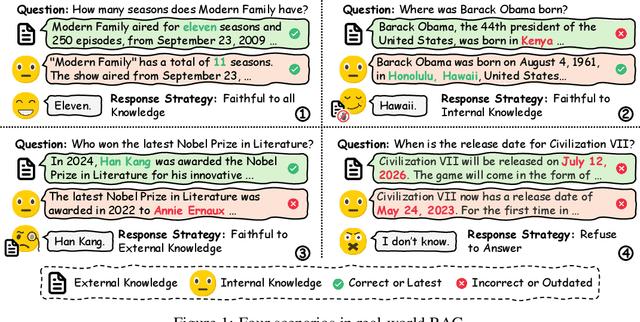
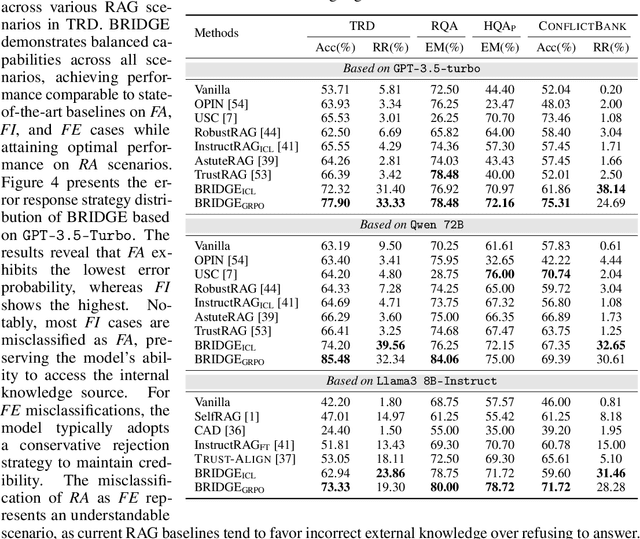
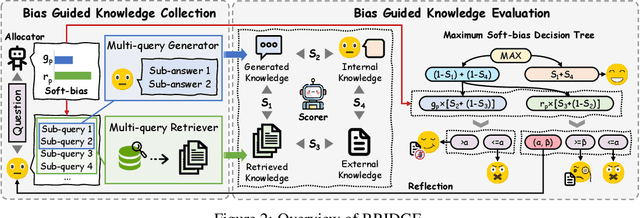

Retrieval-augmented generation (RAG) systems face critical challenges in balancing internal (parametric) and external (retrieved) knowledge, especially when these sources conflict or are unreliable. To analyze these scenarios comprehensively, we construct the Trustworthiness Response Dataset (TRD) with 36,266 questions spanning four RAG settings. We reveal that existing approaches address isolated scenarios-prioritizing one knowledge source, naively merging both, or refusing answers-but lack a unified framework to handle different real-world conditions simultaneously. Therefore, we propose the BRIDGE framework, which dynamically determines a comprehensive response strategy of large language models (LLMs). BRIDGE leverages an adaptive weighting mechanism named soft bias to guide knowledge collection, followed by a Maximum Soft-bias Decision Tree to evaluate knowledge and select optimal response strategies (trust internal/external knowledge, or refuse). Experiments show BRIDGE outperforms baselines by 5-15% in accuracy while maintaining balanced performance across all scenarios. Our work provides an effective solution for LLMs' trustworthy responses in real-world RAG applications.
Pandora: A Code-Driven Large Language Model Agent for Unified Reasoning Across Diverse Structured Knowledge
Apr 17, 2025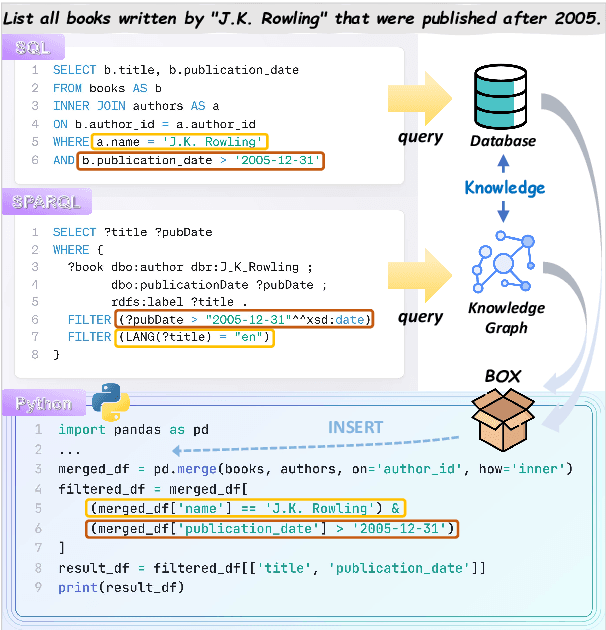
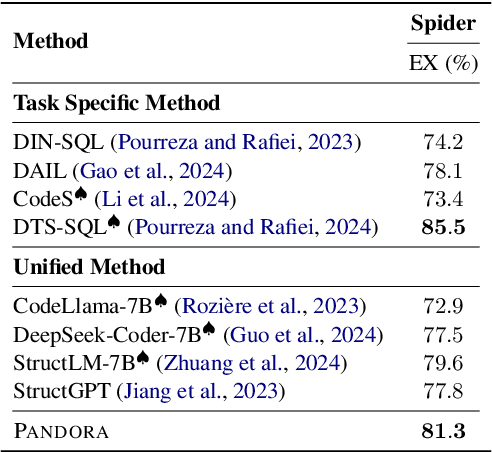
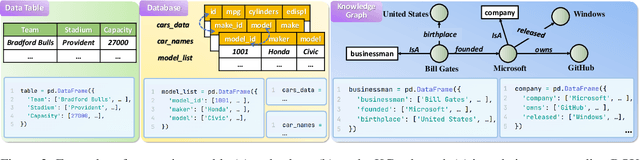
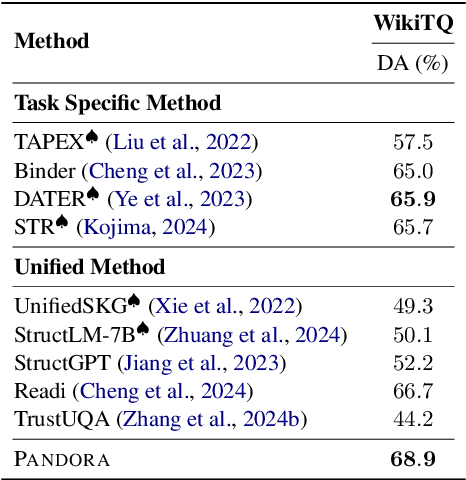
Unified Structured Knowledge Reasoning (USKR) aims to answer natural language questions (NLQs) by using structured sources such as tables, databases, and knowledge graphs in a unified way. Existing USKR methods either rely on employing task-specific strategies or custom-defined representations, which struggle to leverage the knowledge transfer between different SKR tasks or align with the prior of LLMs, thereby limiting their performance. This paper proposes a novel USKR framework named \textsc{Pandora}, which takes advantage of \textsc{Python}'s \textsc{Pandas} API to construct a unified knowledge representation for alignment with LLM pre-training. It employs an LLM to generate textual reasoning steps and executable Python code for each question. Demonstrations are drawn from a memory of training examples that cover various SKR tasks, facilitating knowledge transfer. Extensive experiments on four benchmarks involving three SKR tasks demonstrate that \textsc{Pandora} outperforms existing unified frameworks and competes effectively with task-specific methods.
HGT: Leveraging Heterogeneous Graph-enhanced Large Language Models for Few-shot Complex Table Understanding
Mar 28, 2024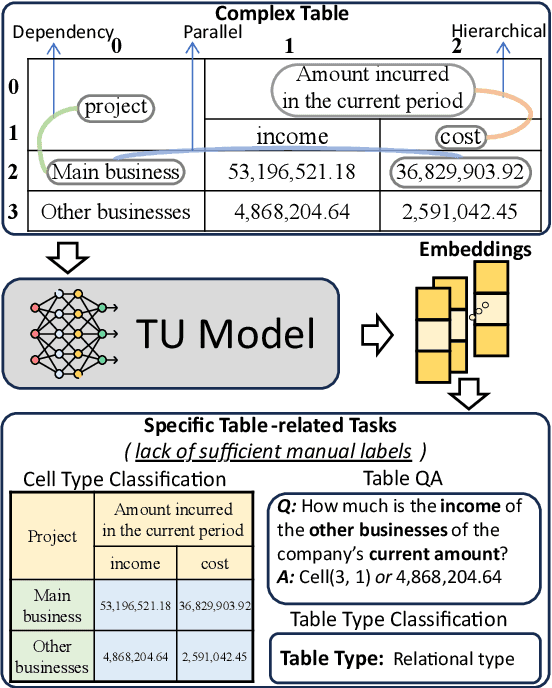
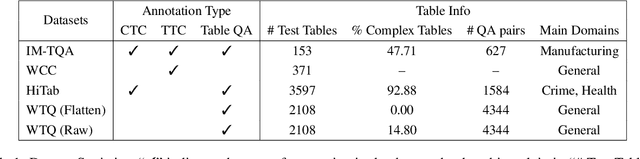
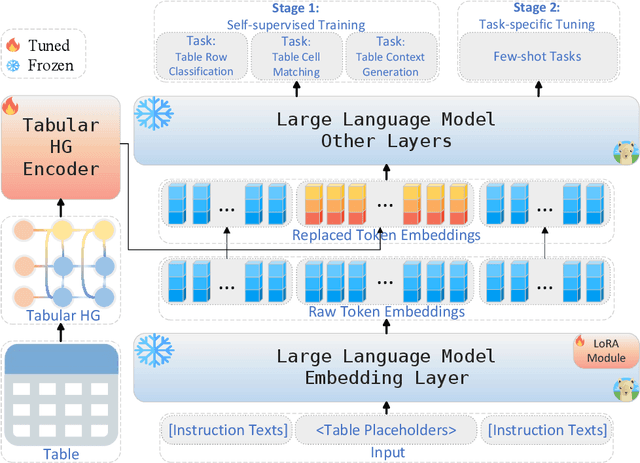

Table understanding (TU) has achieved promising advancements, but it faces the challenges of the scarcity of manually labeled tables and the presence of complex table structures.To address these challenges, we propose HGT, a framework with a heterogeneous graph (HG)-enhanced large language model (LLM) to tackle few-shot TU tasks.It leverages the LLM by aligning the table semantics with the LLM's parametric knowledge through soft prompts and instruction turning and deals with complex tables by a multi-task pre-training scheme involving three novel multi-granularity self-supervised HG pre-training objectives.We empirically demonstrate the effectiveness of HGT, showing that it outperforms the SOTA for few-shot complex TU on several benchmarks.
Exploring the Impact of Table-to-Text Methods on Augmenting LLM-based Question Answering with Domain Hybrid Data
Feb 20, 2024Augmenting Large Language Models (LLMs) for Question Answering (QA) with domain specific data has attracted wide attention. However, domain data often exists in a hybrid format, including text and semi-structured tables, posing challenges for the seamless integration of information. Table-to-Text Generation is a promising solution by facilitating the transformation of hybrid data into a uniformly text-formatted corpus. Although this technique has been widely studied by the NLP community, there is currently no comparative analysis on how corpora generated by different table-to-text methods affect the performance of QA systems. In this paper, we address this research gap in two steps. First, we innovatively integrate table-to-text generation into the framework of enhancing LLM-based QA systems with domain hybrid data. Then, we utilize this framework in real-world industrial data to conduct extensive experiments on two types of QA systems (DSFT and RAG frameworks) with four representative methods: Markdown format, Template serialization, TPLM-based method, and LLM-based method. Based on the experimental results, we draw some empirical findings and explore the underlying reasons behind the success of some methods. We hope the findings of this work will provide a valuable reference for the academic and industrial communities in developing robust QA systems.