 Add to Chrome
 Add to Firefox
 Add to Edge
Reinforcement Learning with Evolving Rubrics as Rewards for Audio Reasoning
Aug 03, 2026
Audio reasoning is essential for machine understanding of the acoustic world. Reinforcement learning with verifiable rewards can elicit such reasoning, yet existing reward designs are complementary in their limitations: outcome-based rewards supervise only the final answer and let the model reach it without attending to the audio, whereas process-based rewards score the reasoning itself but rely on coarse, hand-crafted, and fixed criteria that neither adapt to each question nor stay grounded in the acoustic evidence. Moreover, questions differ in what they demand, with some hinging on perception and others on multi-step reasoning, and any static criterion weakens as the policy improves. Supervising the reasoning process with fine-grained, audio-grounded, and adaptive rewards is therefore crucial, yet challenging since such rewards are impractical to design by hand for every sample. To this end, we introduce AudioRubrics, a reinforcement learning framework that supervises audio reasoning with self-evolving, audio-grounded rubric rewards. AudioRubrics synthesizes per-sample rubrics from the raw waveform and, conditioned on the model's own rollouts, regenerates and reweights criteria per group, supplying a continuous learning signal that keeps targeting the current policy's weaknesses as static criteria saturate. Comprehensive evaluations across three audio reasoning benchmarks reveal that AudioRubrics substantially outperforms a wide range of open-source and training-based baselines. Furthermore, our analysis shows that the gains scale with the capability of the rubric generator and judge, and AudioRubrics converges to a stable reasoning length that avoids both degenerate collapse and unbounded growth. The improvement in audio perception further demonstrates the effectiveness of anchoring supervision in the acoustic evidence. Our project page is available at https://audiorubrics.github.io.

TSRouter: Dynamic Modality-Model Selection for Time Series Reasoning
Jul 09, 2026Time series reasoning is essential for real-world problem-solving. While both Large Language Models (LLMs) and Vision-Language Models (VLMs) can reason about time-series data, their capabilities are complementary: LLMs process time series as text sequences and thus preserve exact numerical understanding, but struggle with global patterns, whereas VLMs efficiently capture these patterns by visualizing time series but may lose fine-grained details. Moreover, models vary significantly in task-specific expertise and inference costs. Dynamically selecting the most suitable modality and model for each query is therefore crucial, yet challenging because it requires modeling the complex interactions among tasks, queries, modalities, and models, which carry rich contextual signals. To this end, we introduce TSRouter, a graph-based dynamic routing framework. TSRouter constructs a heterogeneous graph of task, query, modality, and model nodes to contextualize the interactions among query characteristics, modality attributes, and model capabilities. TSRouter formulates routing as a candidate scoring problem, where each modality-model pair is evaluated based on user-defined performance-cost preferences to select the optimal candidate. Comprehensive evaluations on 4 distinct time series reasoning tasks reveal that TSRouter substantially outperforms diverse baselines with 16\% to 46\% relative improvements. Furthermore, TSRouter demonstrates robust zero-shot plug-and-play generalization to unseen models and novel tasks and preserves high performance while reducing computational overhead through cost-aware optimization. Our code is available at https://github.com/tianyi-lab/TSRouter.
POISE: Position-Aware Undetectable Skill Injection on LLM Agents
Jun 06, 2026Agent skills provide a lightweight mechanism for extending general-purpose agents, but their open format exposes them to skill-poisoning attacks. A practically dangerous injection must stay invisible: if executing the payload derails the user's legitimate task, the resulting failure signal invites inspection of the skill. We therefore evaluate attacks by Attack Success Rate, which requires the injected payload to execute and the user's task to still pass its verifier in the same trial. Prior skill-poisoning attacks face a reliability-stealth trade-off under this lens: YAML-header injections are reliably loaded but easily inspected, whereas stealthier body injections that place explicit malicious commands in the skill prose are less reliable because out-of-context commands invite the agent's own suspicion. We introduce POISE, a position-aware attack that compresses the trigger into a single, benign-looking body instruction, placing it at a feasible position and using a context-aware generator to blend it with nearby setup or prerequisite steps. On Skill-Inject with codex+gpt-5.2, POISE achieves an 89.3% ASR, 28.0 points above a random-placement body baseline and 2.6 points above a YAML-only baseline, while retaining the stealth advantage of body placement. That stealth is the decisive margin: because legitimate skill bodies naturally require privileged tool operations, LLM scanners are hyper-sensitive, falsely flagging 74.6% of clean skills on average across four judges and both benchmarks. Blending into these false alarms, POISE causes only 5.6% of poisoned variants to gain a new high-risk alert over their clean baselines, rendering current static defenses ineffective.
Verifiable Rewards Beyond Math and Code: Lightweight Corpus-Grounded Process Supervision for Factual Question Answering
May 28, 2026Applying reinforcement learning to improve factual accuracy in knowledge-intensive question answering faces a reward design dilemma. Response-level rewards provide only coarse supervision and cannot distinguish correct from incorrect statements within a reasoning trace. Sentence-level alternatives offer finer-grained feedback, but typically rely on NLI verifiers, LLM judges, or knowledge-verification pipelines that are expensive to deploy at RL scale and often unreliable for rare-entity facts, where accurate reward signals are especially important. We propose CorVer (Corpus Verify), a lightweight, plug-in-ready process reward that replaces neural verifiers with a corpus-grounded signal derived from Wikipedia co-occurrence statistics. CorVer assigns sentence-level credit and maps it to token-level advantages via a simple alignment, requiring only a 0.5B extractor and a single corpus lookup per sentence. Across 30 (model, benchmark) cells spanning six instruction-tuned models (3B to 14B) and five QA benchmarks, CorVer improves over the raw baseline for every cell, with an average TriviaQA gain of +4.1 pp. It also outperforms four neural-verifier baselines in 18 of 20 cells under their feasible configurations, while training 4.8 to 8.4x faster.
Latent Thoughts Tuning: Bridging Context and Reasoning with Fused Information in Latent Tokens
Feb 10, 2026While explicit Chain-of-Thought (CoT) equips Large Language Models (LLMs) with strong reasoning capabilities, it requires models to verbalize every intermediate step in text tokens, constraining the model thoughts to the discrete vocabulary space. Recently, reasoning in continuous latent space has emerged as a promising alternative, enabling more robust inference and flexible computation beyond discrete token constraints. However, current latent paradigms often suffer from feature collapse and instability, stemming from distribution mismatches when recurrently using hidden states as the input embeddings, or alignment issues when relying on assistant models. To address this, we propose Latent Thoughts Tuning (LT-Tuning), a framework that redefines how latent thoughts are constructed and deployed. Instead of relying solely on raw hidden states, our method introduces a Context-Prediction-Fusion mechanism that jointly leveraging contextual hidden states and predictive semantic guidance from the vocabulary embedding space. Combined with a progressive three-stage curriculum learning pipeline, LT-Tuning also enables dynamically switching between latent and explicit thinking modes. Experiments demonstrate that our method outperforms existing latent reasoning baselines, effectively mitigating feature collapse and achieving robust reasoning accuracy.
EpiQAL: Benchmarking Large Language Models in Epidemiological Question Answering for Enhanced Alignment and Reasoning
Jan 06, 2026Reliable epidemiological reasoning requires synthesizing study evidence to infer disease burden, transmission dynamics, and intervention effects at the population level. Existing medical question answering benchmarks primarily emphasize clinical knowledge or patient-level reasoning, yet few systematically evaluate evidence-grounded epidemiological inference. We present EpiQAL, the first diagnostic benchmark for epidemiological question answering across diverse diseases, comprising three subsets built from open-access literature. The subsets respectively evaluate text-grounded factual recall, multi-step inference linking document evidence with epidemiological principles, and conclusion reconstruction with the Discussion section withheld. Construction combines expert-designed taxonomy guidance, multi-model verification, and retrieval-based difficulty control. Experiments on ten open models reveal that current LLMs show limited performance on epidemiological reasoning, with multi-step inference posing the greatest challenge. Model rankings shift across subsets, and scale alone does not predict success. Chain-of-Thought prompting benefits multi-step inference but yields mixed results elsewhere. EpiQAL provides fine-grained diagnostic signals for evidence grounding, inferential reasoning, and conclusion reconstruction.
QuCo-RAG: Quantifying Uncertainty from the Pre-training Corpus for Dynamic Retrieval-Augmented Generation
Dec 22, 2025Dynamic Retrieval-Augmented Generation adaptively determines when to retrieve during generation to mitigate hallucinations in large language models (LLMs). However, existing methods rely on model-internal signals (e.g., logits, entropy), which are fundamentally unreliable because LLMs are typically ill-calibrated and often exhibit high confidence in erroneous outputs. We propose QuCo-RAG, which shifts from subjective confidence to objective statistics computed from pre-training data. Our method quantifies uncertainty through two stages: (1) before generation, we identify low-frequency entities indicating long-tail knowledge gaps; (2) during generation, we verify entity co-occurrence in the pre-training corpus, where zero co-occurrence often signals hallucination risk. Both stages leverage Infini-gram for millisecond-latency queries over 4 trillion tokens, triggering retrieval when uncertainty is high. Experiments on multi-hop QA benchmarks show QuCo-RAG achieves EM gains of 5--12 points over state-of-the-art baselines with OLMo-2 models, and transfers effectively to models with undisclosed pre-training data (Llama, Qwen, GPT), improving EM by up to 14 points. Domain generalization on biomedical QA further validates the robustness of our paradigm. These results establish corpus-grounded verification as a principled, practically model-agnostic paradigm for dynamic RAG. Our code is publicly available at https://github.com/ZhishanQ/QuCo-RAG.
MVI-Bench: A Comprehensive Benchmark for Evaluating Robustness to Misleading Visual Inputs in LVLMs
Nov 18, 2025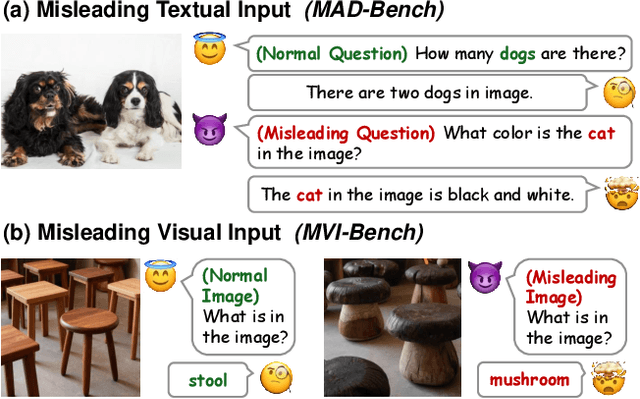

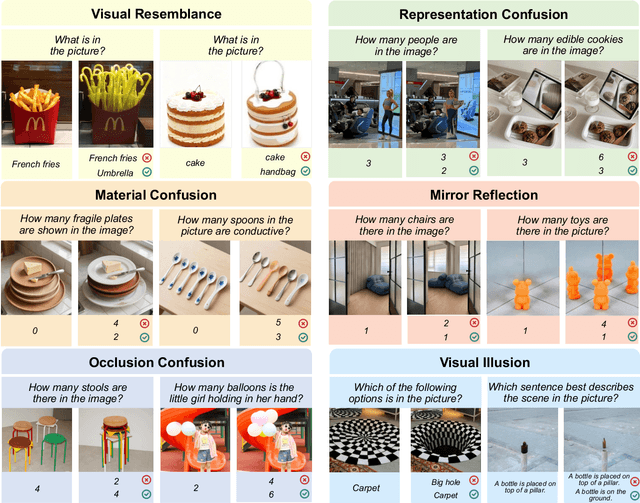
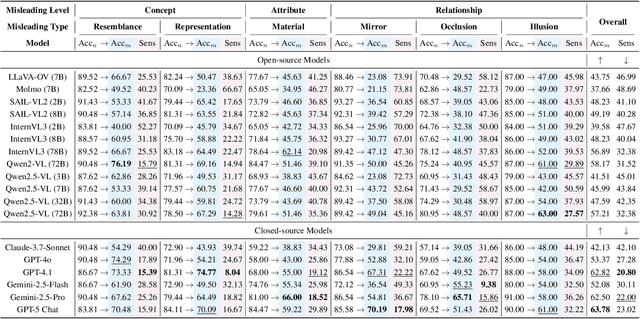
Evaluating the robustness of Large Vision-Language Models (LVLMs) is essential for their continued development and responsible deployment in real-world applications. However, existing robustness benchmarks typically focus on hallucination or misleading textual inputs, while largely overlooking the equally critical challenge posed by misleading visual inputs in assessing visual understanding. To fill this important gap, we introduce MVI-Bench, the first comprehensive benchmark specially designed for evaluating how Misleading Visual Inputs undermine the robustness of LVLMs. Grounded in fundamental visual primitives, the design of MVI-Bench centers on three hierarchical levels of misleading visual inputs: Visual Concept, Visual Attribute, and Visual Relationship. Using this taxonomy, we curate six representative categories and compile 1,248 expertly annotated VQA instances. To facilitate fine-grained robustness evaluation, we further introduce MVI-Sensitivity, a novel metric that characterizes LVLM robustness at a granular level. Empirical results across 18 state-of-the-art LVLMs uncover pronounced vulnerabilities to misleading visual inputs, and our in-depth analyses on MVI-Bench provide actionable insights that can guide the development of more reliable and robust LVLMs. The benchmark and codebase can be accessed at https://github.com/chenyil6/MVI-Bench.
Pandora: Leveraging Code-driven Knowledge Transfer for Unified Structured Knowledge Reasoning
Aug 25, 2025Unified Structured Knowledge Reasoning (USKR) aims to answer natural language questions by using structured sources such as tables, databases, and knowledge graphs in a unified way. Existing USKR methods rely on task-specific strategies or bespoke representations, which hinder their ability to dismantle barriers between different SKR tasks, thereby constraining their overall performance in cross-task scenarios. In this paper, we introduce \textsc{Pandora}, a novel USKR framework that addresses the limitations of existing methods by leveraging two key innovations. First, we propose a code-based unified knowledge representation using \textsc{Python}'s \textsc{Pandas} API, which aligns seamlessly with the pre-training of LLMs. This representation facilitates a cohesive approach to handling different structured knowledge sources. Building on this foundation, we employ knowledge transfer to bolster the unified reasoning process of LLMs by automatically building cross-task memory. By adaptively correcting reasoning using feedback from code execution, \textsc{Pandora} showcases impressive unified reasoning capabilities. Extensive experiments on six widely used benchmarks across three SKR tasks demonstrate that \textsc{Pandora} outperforms existing unified reasoning frameworks and competes effectively with task-specific methods.
Pandora: A Code-Driven Large Language Model Agent for Unified Reasoning Across Diverse Structured Knowledge
Apr 17, 2025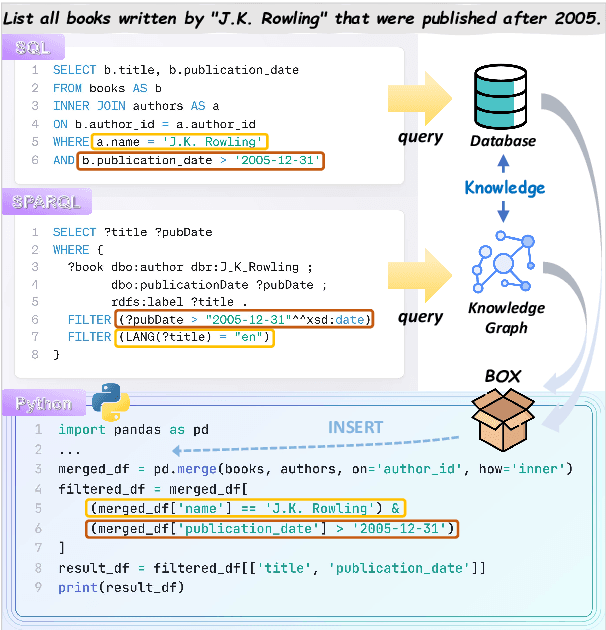
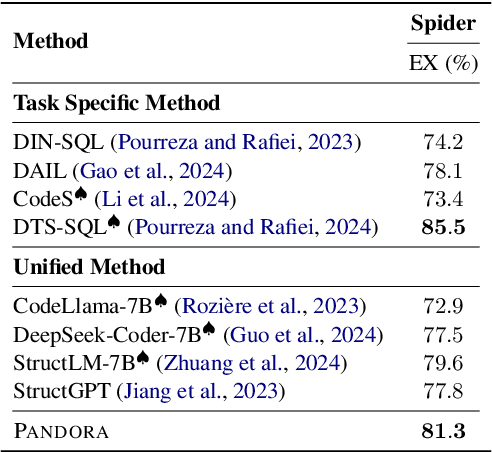
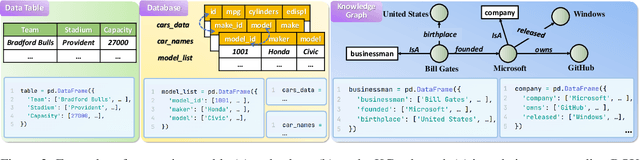
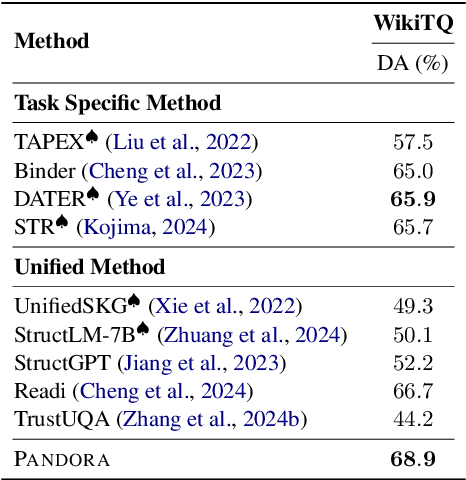
Unified Structured Knowledge Reasoning (USKR) aims to answer natural language questions (NLQs) by using structured sources such as tables, databases, and knowledge graphs in a unified way. Existing USKR methods either rely on employing task-specific strategies or custom-defined representations, which struggle to leverage the knowledge transfer between different SKR tasks or align with the prior of LLMs, thereby limiting their performance. This paper proposes a novel USKR framework named \textsc{Pandora}, which takes advantage of \textsc{Python}'s \textsc{Pandas} API to construct a unified knowledge representation for alignment with LLM pre-training. It employs an LLM to generate textual reasoning steps and executable Python code for each question. Demonstrations are drawn from a memory of training examples that cover various SKR tasks, facilitating knowledge transfer. Extensive experiments on four benchmarks involving three SKR tasks demonstrate that \textsc{Pandora} outperforms existing unified frameworks and competes effectively with task-specific methods.