 Add to Chrome
 Add to Firefox
 Add to Edge
ShopX: A Foundation Model for Intent-to-Item Fulfillment in Agentic Shopping
Jun 30, 2026
The wave of AI-native applications is moving shopping beyond page- and feed-based browsing toward intent-driven experiences orchestrated by LLM agents. A common design wraps an LLM around existing search and recommendation pipelines, forcing complex intents through low-bandwidth retrieval or ranking interfaces and leaving a gap between language understanding and item-space fulfillment. Generative recommendation gives LLMs a direct item-space interface through semantic IDs (SIDs), but existing models mainly generate candidates for retrieval rather than translate flexible intents into item-space outcomes. We propose ShopX to address this bottleneck by unifying intent understanding, execution planning, and flexible SID-native item-space operations into a single foundation model. We deploy ShopX in agentic shopping workflows through a model-native item-fulfillment framework with a serving harness that defines a model-facing action protocol and exposes support surfaces for context access, catalog grounding, and state management. Within this framework, ShopX plans and composes SID-based item-space operations such as SID beam-search retrieval, listwise ranking, or product bundling. This model-centric design reduces lossy hand-offs between agent orchestration and item-space execution. To build ShopX, we design semantically recoverable, LLM-operable SIDs and a training recipe that equips a general LLM for flexible multi-turn item-space fulfillment while retaining the knowledge and instruction-following abilities needed by a shopping agent. We evaluate the ShopX framework against tool-mediated agentic systems on single- and multi-turn fulfillment tasks derived from anonymized Taobao production logs, showing that model-native fulfillment improves overall framework behavior, especially on complex or ambiguous requests.

PoC: Performance-oriented Context Compression for Large Language Models via Performance Prediction
Mar 20, 2026While context compression can mitigate the growing inference costs of Large Language Models (LLMs) by shortening contexts, existing methods that specify a target compression ratio or length suffer from unpredictable performance degradation, hindering their reliable deployment. We introduce a paradigm shift to Performance-oriented Context Compression (PoC), where developers specify an acceptable performance floor instead of a compression ratio. PoC employs a lightweight performance predictor to automatically find the most aggressive compression ratio that satisfies this constraint before steering an off-the-shelf compressor. We design and compare two predictor variants: a simple context-agnostic predictor and a more sophisticated context-aware one that considers the input's inherent compressibility. On both question-answering and summarization benchmarks, the context-aware predictor consistently achieves lower performance prediction error than the context-agnostic predictor, while the resulting context-aware PoC attains a superior overall performance. Our work paves the way for a more reliable, efficient, and performance-aware deployment of context compression for LLMs.
Data Distribution Matters: A Data-Centric Perspective on Context Compression for Large Language Model
Feb 02, 2026The deployment of Large Language Models (LLMs) in long-context scenarios is hindered by computational inefficiency and significant information redundancy. Although recent advancements have widely adopted context compression to address these challenges, existing research only focus on model-side improvements, the impact of the data distribution itself on context compression remains largely unexplored. To bridge this gap, we are the first to adopt a data-centric perspective to systematically investigate how data distribution impacts compression quality, including two dimensions: input data and intrinsic data (i.e., the model's internal pretrained knowledge). We evaluate the semantic integrity of compressed representations using an autoencoder-based framework to systematically investigate it. Our experimental results reveal that: (1) encoder-measured input entropy negatively correlates with compression quality, while decoder-measured entropy shows no significant relationship under a frozen-decoder setting; and (2) the gap between intrinsic data of the encoder and decoder significantly diminishes compression gains, which is hard to mitigate. Based on these findings, we further present practical guidelines to optimize compression gains.
COMI: Coarse-to-fine Context Compression via Marginal Information Gain
Feb 02, 2026Large Language Models (LLMs) have demonstrated exceptional capabilities across diverse tasks. However, their deployment in long context scenarios remains hindered by computational inefficiency and information redundancy. Context compression methods address these challenges by significantly reducing input length and eliminating redundancy. We propose COMI, a coarse-to-fine adaptive context compression framework that jointly optimizes for semantic relevance and diversity under high compression rates. We introduce Marginal Information Gain (MIG), a metric defined as the relevance of a unit to the input query minus its semantic redundancy with other units, guiding the compression process to prioritize information that is both relevant and low redundant. The framework operates in two stages: (1) Coarse-Grained Group Reallocation, where the context is partitioned into groups and dynamically assigned compression rates based on inter-group MIG, ensuring compression budgets align with information value distribution; and (2) Fine-Grained Token Merging, where tokens within each group are fused via an intra-group MIG-based weighting mechanism, thereby preserving key semantics while avoiding the accumulation of redundancy. Extensive experiments across question-answering (e.g., NaturalQuestions, 2WikiMQA, HotpotQA and NarrativeQA), summarization (e.g., MultiNews) with various backbones (e.g., LLaMA-2-7B, Qwen2-7B) show that COMI outperforms existing baselines by a large margin, e.g., approximately 25-point Exact Match (EM) improvement under 32x compression constraint with Qwen2-7B on NaturalQuestions.
PretrainRL: Alleviating Factuality Hallucination of Large Language Models at the Beginning
Feb 02, 2026Large language models (LLMs), despite their powerful capabilities, suffer from factual hallucinations where they generate verifiable falsehoods. We identify a root of this issue: the imbalanced data distribution in the pretraining corpus, which leads to a state of "low-probability truth" and "high-probability falsehood". Recent approaches, such as teaching models to say "I don't know" or post-hoc knowledge editing, either evade the problem or face catastrophic forgetting. To address this issue from its root, we propose \textbf{PretrainRL}, a novel framework that integrates reinforcement learning into the pretraining phase to consolidate factual knowledge. The core principle of PretrainRL is "\textbf{debiasing then learning}." It actively reshapes the model's probability distribution by down-weighting high-probability falsehoods, thereby making "room" for low-probability truths to be learned effectively. To enable this, we design an efficient negative sampling strategy to discover these high-probability falsehoods and introduce novel metrics to evaluate the model's probabilistic state concerning factual knowledge. Extensive experiments on three public benchmarks demonstrate that PretrainRL significantly alleviates factual hallucinations and outperforms state-of-the-art methods.
CoMeT: Collaborative Memory Transformer for Efficient Long Context Modeling
Feb 02, 2026The quadratic complexity and indefinitely growing key-value (KV) cache of standard Transformers pose a major barrier to long-context processing. To overcome this, we introduce the Collaborative Memory Transformer (CoMeT), a novel architecture that enables LLMs to handle arbitrarily long sequences with constant memory usage and linear time complexity. Designed as an efficient, plug-in module, CoMeT can be integrated into pre-trained models with only minimal fine-tuning. It operates on sequential data chunks, using a dual-memory system to manage context: a temporary memory on a FIFO queue for recent events, and a global memory with a gated update rule for long-range dependencies. These memories then act as a dynamic soft prompt for the next chunk. To enable efficient fine-tuning on extremely long contexts, we introduce a novel layer-level pipeline parallelism strategy. The effectiveness of our approach is remarkable: a model equipped with CoMeT and fine-tuned on 32k contexts can accurately retrieve a passkey from any position within a 1M token sequence. On the SCROLLS benchmark, CoMeT surpasses other efficient methods and achieves performance comparable to a full-attention baseline on summarization tasks. Its practical effectiveness is further validated on real-world agent and user behavior QA tasks. The code is available at: https://anonymous.4open.science/r/comet-B00B/
Read As Human: Compressing Context via Parallelizable Close Reading and Skimming
Feb 02, 2026Large Language Models (LLMs) demonstrate exceptional capability across diverse tasks. However, their deployment in long-context scenarios is hindered by two challenges: computational inefficiency and redundant information. We propose RAM (Read As HuMan), a context compression framework that adopts an adaptive hybrid reading strategy, to address these challenges. Inspired by human reading behavior (i.e., close reading important content while skimming less relevant content), RAM partitions the context into segments and encodes them with the input query in parallel. High-relevance segments are fully retained (close reading), while low-relevance ones are query-guided compressed into compact summary vectors (skimming). Both explicit textual segments and implicit summary vectors are concatenated and fed into decoder to achieve both superior performance and natural language format interpretability. To refine the decision boundary between close reading and skimming, we further introduce a contrastive learning objective based on positive and negative query-segment pairs. Experiments demonstrate that RAM outperforms existing baselines on multiple question answering and summarization benchmarks across two backbones, while delivering up to a 12x end-to-end speedup on long inputs (average length 16K; maximum length 32K).
RecGPT-V2 Technical Report
Dec 16, 2025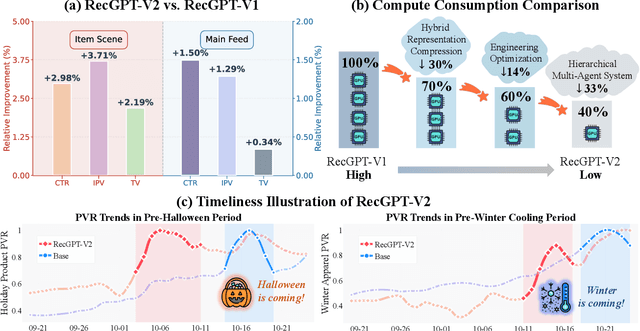
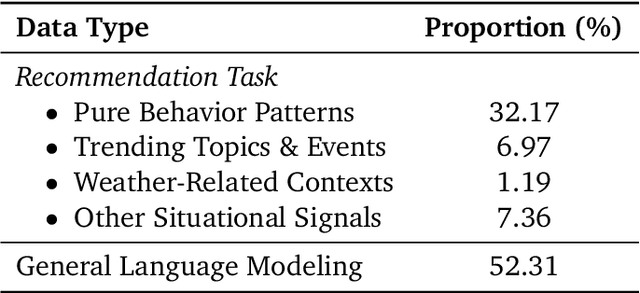
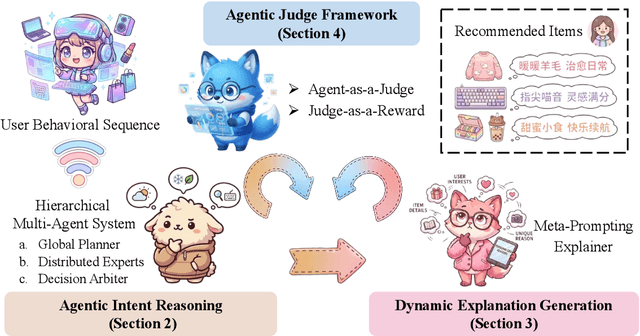

Large language models (LLMs) have demonstrated remarkable potential in transforming recommender systems from implicit behavioral pattern matching to explicit intent reasoning. While RecGPT-V1 successfully pioneered this paradigm by integrating LLM-based reasoning into user interest mining and item tag prediction, it suffers from four fundamental limitations: (1) computational inefficiency and cognitive redundancy across multiple reasoning routes; (2) insufficient explanation diversity in fixed-template generation; (3) limited generalization under supervised learning paradigms; and (4) simplistic outcome-focused evaluation that fails to match human standards. To address these challenges, we present RecGPT-V2 with four key innovations. First, a Hierarchical Multi-Agent System restructures intent reasoning through coordinated collaboration, eliminating cognitive duplication while enabling diverse intent coverage. Combined with Hybrid Representation Inference that compresses user-behavior contexts, our framework reduces GPU consumption by 60% and improves exclusive recall from 9.39% to 10.99%. Second, a Meta-Prompting framework dynamically generates contextually adaptive prompts, improving explanation diversity by +7.3%. Third, constrained reinforcement learning mitigates multi-reward conflicts, achieving +24.1% improvement in tag prediction and +13.0% in explanation acceptance. Fourth, an Agent-as-a-Judge framework decomposes assessment into multi-step reasoning, improving human preference alignment. Online A/B tests on Taobao demonstrate significant improvements: +2.98% CTR, +3.71% IPV, +2.19% TV, and +11.46% NER. RecGPT-V2 establishes both the technical feasibility and commercial viability of deploying LLM-powered intent reasoning at scale, bridging the gap between cognitive exploration and industrial utility.
RecGPT Technical Report
Jul 30, 2025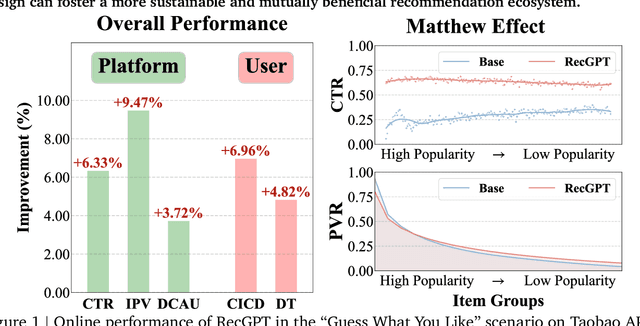
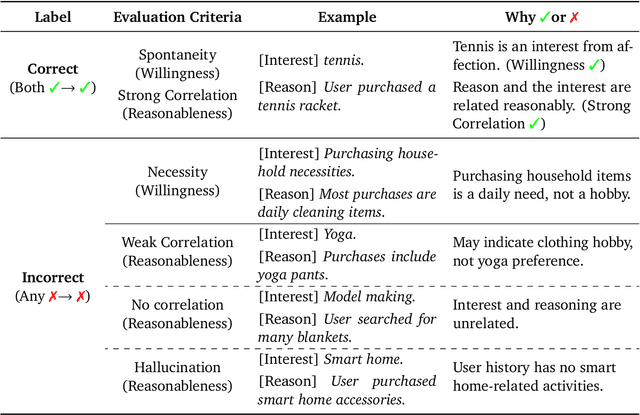
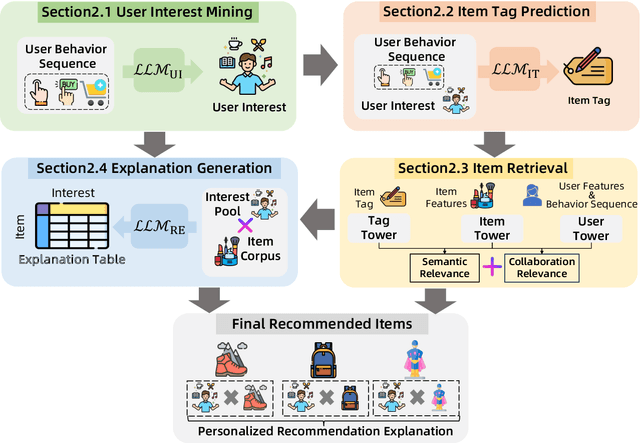

Recommender systems are among the most impactful applications of artificial intelligence, serving as critical infrastructure connecting users, merchants, and platforms. However, most current industrial systems remain heavily reliant on historical co-occurrence patterns and log-fitting objectives, i.e., optimizing for past user interactions without explicitly modeling user intent. This log-fitting approach often leads to overfitting to narrow historical preferences, failing to capture users' evolving and latent interests. As a result, it reinforces filter bubbles and long-tail phenomena, ultimately harming user experience and threatening the sustainability of the whole recommendation ecosystem. To address these challenges, we rethink the overall design paradigm of recommender systems and propose RecGPT, a next-generation framework that places user intent at the center of the recommendation pipeline. By integrating large language models (LLMs) into key stages of user interest mining, item retrieval, and explanation generation, RecGPT transforms log-fitting recommendation into an intent-centric process. To effectively align general-purpose LLMs to the above domain-specific recommendation tasks at scale, RecGPT incorporates a multi-stage training paradigm, which integrates reasoning-enhanced pre-alignment and self-training evolution, guided by a Human-LLM cooperative judge system. Currently, RecGPT has been fully deployed on the Taobao App. Online experiments demonstrate that RecGPT achieves consistent performance gains across stakeholders: users benefit from increased content diversity and satisfaction, merchants and the platform gain greater exposure and conversions. These comprehensive improvement results across all stakeholders validates that LLM-driven, intent-centric design can foster a more sustainable and mutually beneficial recommendation ecosystem.
Reinforcement Learning Optimization for Large-Scale Learning: An Efficient and User-Friendly Scaling Library
Jun 06, 2025We introduce ROLL, an efficient, scalable, and user-friendly library designed for Reinforcement Learning Optimization for Large-scale Learning. ROLL caters to three primary user groups: tech pioneers aiming for cost-effective, fault-tolerant large-scale training, developers requiring flexible control over training workflows, and researchers seeking agile experimentation. ROLL is built upon several key modules to serve these user groups effectively. First, a single-controller architecture combined with an abstraction of the parallel worker simplifies the development of the training pipeline. Second, the parallel strategy and data transfer modules enable efficient and scalable training. Third, the rollout scheduler offers fine-grained management of each sample's lifecycle during the rollout stage. Fourth, the environment worker and reward worker support rapid and flexible experimentation with agentic RL algorithms and reward designs. Finally, AutoDeviceMapping allows users to assign resources to different models flexibly across various stages.