 Add to Chrome
 Add to Firefox
 Add to Edge
RecGPT-V3 Technical Report
Jul 24, 2026
Large language models (LLMs) are transforming recommender systems from matching co-occurrence patterns in historical behavior toward reasoning about the intent that drives it. RecGPT-V1 pioneered this paradigm on Taobao by centering user understanding, and RecGPT-V2 scaled it via coordinated multi-agent reasoning; both are deployed in production with consistent gains in user experience and commercial outcomes. However, operating RecGPT at scale reveals three challenges: (1) stateless behavior modeling, where each request reprocesses full user history, wasting computation and discarding prior analysis; (2) a tag-to-item information bottleneck, where natural-language tags form a lossy channel between user understanding and item grounding; and (3) inefficient explicit reasoning, whose lengthy chain-of-thought incurs untenable latency and compute overhead. We present RecGPT-V3, a stateful, hybrid-modal recommender that reasons over natural language for open-world knowledge and Semantic IDs (SIDs) for concrete item grounding. A Memory Hub maintains structured, continually evolving user memory that distills long-horizon behavior into condensed units, cutting user-modeling computation by 55.8%. A Hybrid-modal Foundation Model allows the LLM jointly reason over text tags and SIDs, opening a high-bandwidth channel into the item space. Latent Intent Reasoning internalizes verbose rationales into compact learnable latent tokens that remain decodable into readable explanations, lowering output token cost by 200x. Deployed in Taobao's "Guess What You Like" feed, RecGPT-V3 achieves consistent gains in large-scale online A/B tests: IPV +1.28%, CTR +1.00%, TC +1.97%, GMV +3.97%, while cutting end-to-end serving resource consumption by 52.4%.

ShopX: A Foundation Model for Intent-to-Item Fulfillment in Agentic Shopping
Jun 30, 2026The wave of AI-native applications is moving shopping beyond page- and feed-based browsing toward intent-driven experiences orchestrated by LLM agents. A common design wraps an LLM around existing search and recommendation pipelines, forcing complex intents through low-bandwidth retrieval or ranking interfaces and leaving a gap between language understanding and item-space fulfillment. Generative recommendation gives LLMs a direct item-space interface through semantic IDs (SIDs), but existing models mainly generate candidates for retrieval rather than translate flexible intents into item-space outcomes. We propose ShopX to address this bottleneck by unifying intent understanding, execution planning, and flexible SID-native item-space operations into a single foundation model. We deploy ShopX in agentic shopping workflows through a model-native item-fulfillment framework with a serving harness that defines a model-facing action protocol and exposes support surfaces for context access, catalog grounding, and state management. Within this framework, ShopX plans and composes SID-based item-space operations such as SID beam-search retrieval, listwise ranking, or product bundling. This model-centric design reduces lossy hand-offs between agent orchestration and item-space execution. To build ShopX, we design semantically recoverable, LLM-operable SIDs and a training recipe that equips a general LLM for flexible multi-turn item-space fulfillment while retaining the knowledge and instruction-following abilities needed by a shopping agent. We evaluate the ShopX framework against tool-mediated agentic systems on single- and multi-turn fulfillment tasks derived from anonymized Taobao production logs, showing that model-native fulfillment improves overall framework behavior, especially on complex or ambiguous requests.
TreePrompt: Learning to Compose Tree Prompts for Explainable Visual Grounding
May 19, 2023


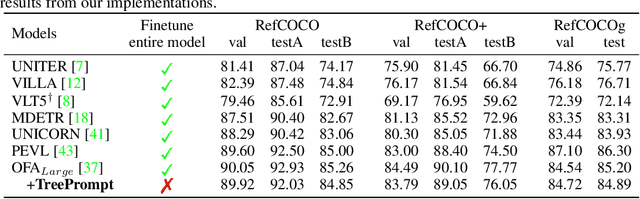
Prompt tuning has achieved great success in transferring the knowledge from large pretrained vision-language models into downstream tasks, and has dominated the performance on visual grounding (VG). However, almost all existing prompt tuning paradigms suffer from poor interpretability. In this paper, we argue that their poor interpretability is attributed to the holistic prompt generation and inference process. By "holistic", we mean that they usually directly learn a set of vectors as the prompt (i.e., prompt generation), and use the learned global prompt to augment the textual input for the VG model (i.e., prompt inference). To this end, we propose a new prompt construction paradigm with explicit explainable ability, named TreePrompt. Specifically, we first deconstruct a complex sentence into a tree, that is consistent with human reasoning. Then, following the syntax tree, we compose a structured prompt in a bottom-up manner. Thanks to this step-by-step prompt construction process, each intermediate prompt (i.e., tree node) permits us to understand the reasoning process. Extensive ablations on various backbones and benchmarks consistently demonstrate the effectiveness and interpretability of our TreePrompt.