 Add to Chrome
 Add to Firefox
 Add to Edge
STEAM: Self-Supervised Temporal Ensemble Advantage Modeling for Real-World Robot Learning
Jun 29, 2026
Real-world robot learning increasingly relies on heterogeneous data, but demonstrations and rollouts often mix useful progress with stalls, corrections, and suboptimal behavior. Effective policy learning therefore requires frame-level advantages that distinguish reliable local progress from failures and regressions. We propose Self-supervised Temporal Ensemble Advantage Modeling (STEAM), a label-free method that learns such advantages from expert demonstrations. STEAM trains an ensemble of temporal-offset predictors on frame pairs within expert trajectories, using the normalized temporal offset between two frames as a self-supervised signal. Each predictor maps a frame pair to a distribution over temporal offsets, which is converted into a scalar advantage. STEAM then takes the minimum advantage across the ensemble to score mixed-quality rollout data conservatively. Across real-world bimanual towel folding, chip checkout, cola restocking, and single-arm pick-and-place tasks, STEAM identifies stalls, failures, and recoveries. When combined with CFGRL, STEAM further improves policy success rate by 59%, 54.3%, 23% and 16.2% over baselines, respectively.

Human Universal Grasping
Jun 15, 2026Humans can grasp objects effortlessly, whereas multi-fingered robots are far from this level of generality. We argue that the most natural source of robot grasping data is from humans, who pick up thousands of objects every day. We present HUG, a flow-matching model that generates diverse human grasps for any user-specified object in a single RGB-D image captured from a stereo camera. Using smart glasses, we first collect 1M-HUGs, an egocentric dataset of human grasps spanning 1M frames (27.8 hrs) and 6,707 object instances across 41 buildings. Next, to model the distribution of natural human grasps, our novel flow-matching model fuses RGB and depth observations to output a grasp parameterized by wrist translation, wrist rotation, and MANO hand pose. Predicted grasps can be retargeted to various robot hands, enabling zero-shot grasping in everyday scenes. To standardize evaluation, we build a new simulated benchmark, HUG-Bench, of 90 unseen objects from five geometric categories and various sizes, with metric-scale 3D meshes. We evaluate HUG in the real world on the 30-object test set of HUG-Bench across multiple stereo cameras, robot embodiments, and household environments. HUG outperforms the state-of-the-art grasping baselines by +23% and +34% on our challenging object set. Code, data, benchmark, checkpoints, and an interactive demo are released on our website: https://grasping.io/
VolumeDP: Modeling Volumetric Representation for Manipulation Policy Learning
Mar 18, 2026Imitation learning is a prominent paradigm for robotic manipulation. However, existing visual imitation methods map 2D image observations directly to 3D action outputs, imposing a 2D-3D mismatch that hinders spatial reasoning and degrades robustness. We present VolumeDP, a policy architecture that restores spatial alignment by explicitly reasoning in 3D. VolumeDP first lifts image features into a Volumetric Representation via cross-attention. It then selects task-relevant voxels with a learnable module and converts them into a compact set of spatial tokens, markedly reducing computation while preserving action-critical geometry. Finally, a multi-token decoder conditions on the entire token set to predict actions, thereby avoiding lossy aggregation that collapses multiple spatial tokens into a single descriptor. VolumeDP achieves a state-of-the-art average success rate of 88.8% on the LIBERO simulation benchmark, outperforming the strongest baseline by a substantial 14.8% improvement. It also delivers large performance gains over prior methods on the ManiSkill and LIBERO-Plus benchmarks. Real-world experiments further demonstrate higher success rates and robust generalization to novel spatial layouts, camera viewpoints, and environment backgrounds. Code will be released.
WoVR: World Models as Reliable Simulators for Post-Training VLA Policies with RL
Feb 15, 2026Reinforcement learning (RL) promises to unlock capabilities beyond imitation learning for Vision-Language-Action (VLA) models, but its requirement for massive real-world interaction prevents direct deployment on physical robots. Recent work attempts to use learned world models as simulators for policy optimization, yet closed-loop imagined rollouts inevitably suffer from hallucination and long-horizon error accumulation. Such errors do not merely degrade visual fidelity; they corrupt the optimization signal, encouraging policies to exploit model inaccuracies rather than genuine task progress. We propose WoVR, a reliable world-model-based reinforcement learning framework for post-training VLA policies. Instead of assuming a faithful world model, WoVR explicitly regulates how RL interacts with imperfect imagined dynamics. It improves rollout stability through a controllable action-conditioned video world model, reshapes imagined interaction to reduce effective error depth via Keyframe-Initialized Rollouts, and maintains policy-simulator alignment through World Model-Policy co-evolution. Extensive experiments on LIBERO benchmarks and real-world robotic manipulation demonstrate that WoVR enables stable long-horizon imagined rollouts and effective policy optimization, improving average LIBERO success from 39.95% to 69.2% (+29.3 points) and real-robot success from 61.7% to 91.7% (+30.0 points). These results show that learned world models can serve as practical simulators for reinforcement learning when hallucination is explicitly controlled.
ViTaS: Visual Tactile Soft Fusion Contrastive Learning for Visuomotor Learning
Feb 12, 2026Tactile information plays a crucial role in human manipulation tasks and has recently garnered increasing attention in robotic manipulation. However, existing approaches mostly focus on the alignment of visual and tactile features and the integration mechanism tends to be direct concatenation. Consequently, they struggle to effectively cope with occluded scenarios due to neglecting the inherent complementary nature of both modalities and the alignment may not be exploited enough, limiting the potential of their real-world deployment. In this paper, we present ViTaS, a simple yet effective framework that incorporates both visual and tactile information to guide the behavior of an agent. We introduce Soft Fusion Contrastive Learning, an advanced version of conventional contrastive learning method and a CVAE module to utilize the alignment and complementarity within visuo-tactile representations. We demonstrate the effectiveness of our method in 12 simulated and 3 real-world environments, and our experiments show that ViTaS significantly outperforms existing baselines. Project page: https://skyrainwind.github.io/ViTaS/index.html.
RLinf-USER: A Unified and Extensible System for Real-World Online Policy Learning in Embodied AI
Feb 08, 2026Online policy learning directly in the physical world is a promising yet challenging direction for embodied intelligence. Unlike simulation, real-world systems cannot be arbitrarily accelerated, cheaply reset, or massively replicated, which makes scalable data collection, heterogeneous deployment, and long-horizon effective training difficult. These challenges suggest that real-world policy learning is not only an algorithmic issue but fundamentally a systems problem. We present USER, a Unified and extensible SystEm for Real-world online policy learning. USER treats physical robots as first-class hardware resources alongside GPUs through a unified hardware abstraction layer, enabling automatic discovery, management, and scheduling of heterogeneous robots. To address cloud-edge communication, USER introduces an adaptive communication plane with tunneling-based networking, distributed data channels for traffic localization, and streaming-multiprocessor-aware weight synchronization to regulate GPU-side overhead. On top of this infrastructure, USER organizes learning as a fully asynchronous framework with a persistent, cache-aware buffer, enabling efficient long-horizon experiments with robust crash recovery and reuse of historical data. In addition, USER provides extensible abstractions for rewards, algorithms, and policies, supporting online imitation or reinforcement learning of CNN/MLP, generative policies, and large vision-language-action (VLA) models within a unified pipeline. Results in both simulation and the real world show that USER enables multi-robot coordination, heterogeneous manipulators, edge-cloud collaboration with large models, and long-running asynchronous training, offering a unified and extensible systems foundation for real-world online policy learning.
FMimic: Foundation Models are Fine-grained Action Learners from Human Videos
Jul 28, 2025Visual imitation learning (VIL) provides an efficient and intuitive strategy for robotic systems to acquire novel skills. Recent advancements in foundation models, particularly Vision Language Models (VLMs), have demonstrated remarkable capabilities in visual and linguistic reasoning for VIL tasks. Despite this progress, existing approaches primarily utilize these models for learning high-level plans from human demonstrations, relying on pre-defined motion primitives for executing physical interactions, which remains a major bottleneck for robotic systems. In this work, we present FMimic, a novel paradigm that harnesses foundation models to directly learn generalizable skills at even fine-grained action levels, using only a limited number of human videos. Extensive experiments demonstrate that our FMimic delivers strong performance with a single human video, and significantly outperforms all other methods with five videos. Furthermore, our method exhibits significant improvements of over 39% and 29% in RLBench multi-task experiments and real-world manipulation tasks, respectively, and exceeds baselines by more than 34% in high-precision tasks and 47% in long-horizon tasks.
VLMimic: Vision Language Models are Visual Imitation Learner for Fine-grained Actions
Oct 29, 2024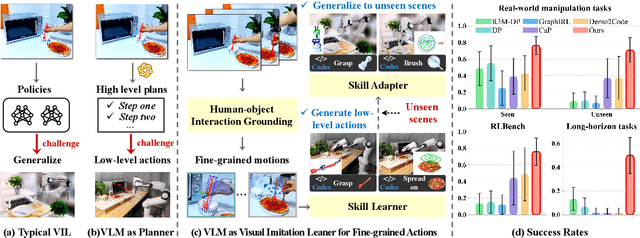
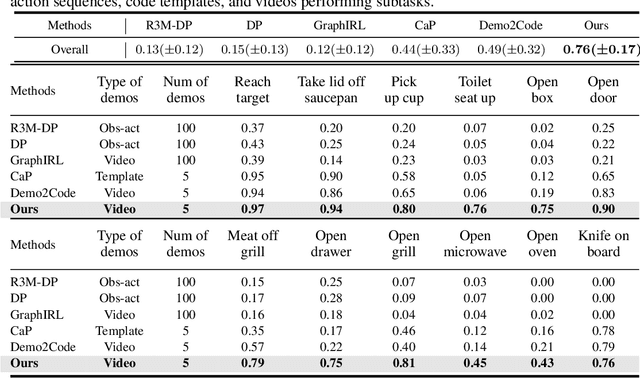
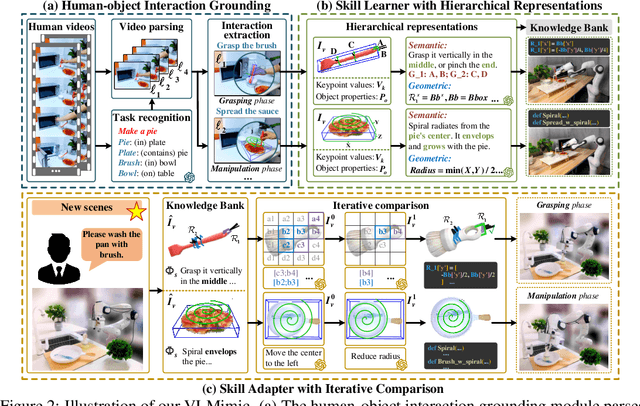
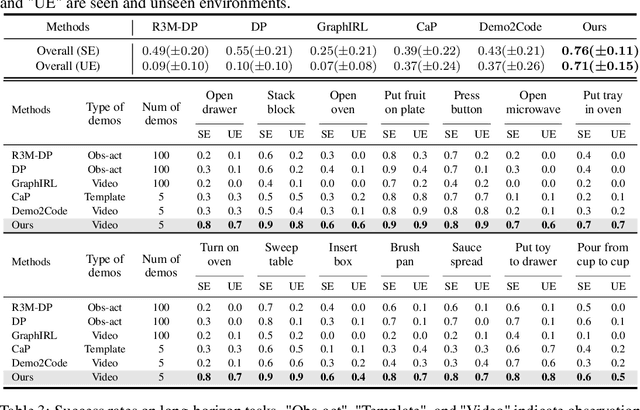
Visual imitation learning (VIL) provides an efficient and intuitive strategy for robotic systems to acquire novel skills. Recent advancements in Vision Language Models (VLMs) have demonstrated remarkable performance in vision and language reasoning capabilities for VIL tasks. Despite the progress, current VIL methods naively employ VLMs to learn high-level plans from human videos, relying on pre-defined motion primitives for executing physical interactions, which remains a major bottleneck. In this work, we present VLMimic, a novel paradigm that harnesses VLMs to directly learn even fine-grained action levels, only given a limited number of human videos. Specifically, VLMimic first grounds object-centric movements from human videos, and learns skills using hierarchical constraint representations, facilitating the derivation of skills with fine-grained action levels from limited human videos. These skills are refined and updated through an iterative comparison strategy, enabling efficient adaptation to unseen environments. Our extensive experiments exhibit that our VLMimic, using only 5 human videos, yields significant improvements of over 27% and 21% in RLBench and real-world manipulation tasks, and surpasses baselines by over 37% in long-horizon tasks.
Human Demonstrations are Generalizable Knowledge for Robots
Dec 05, 2023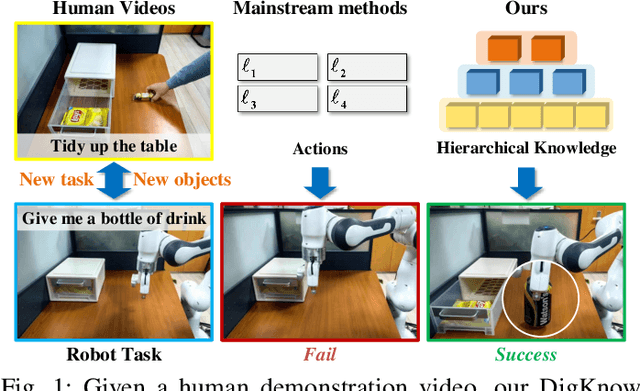
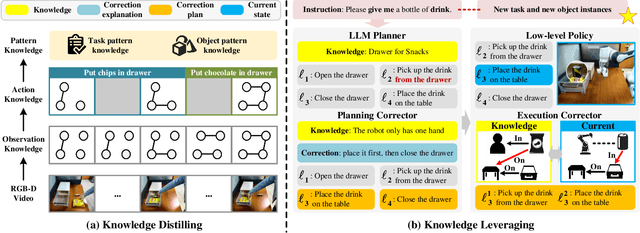
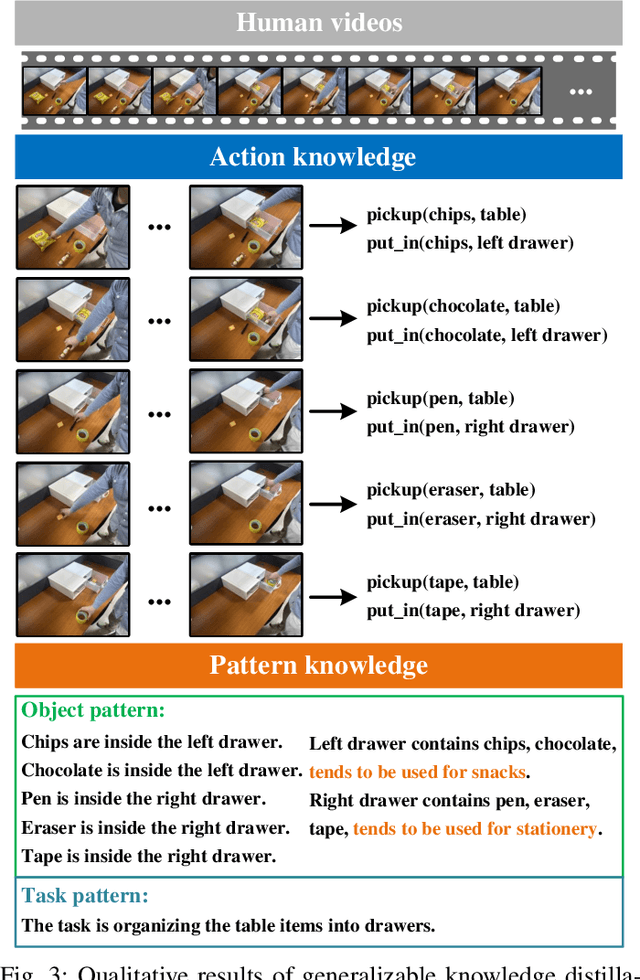
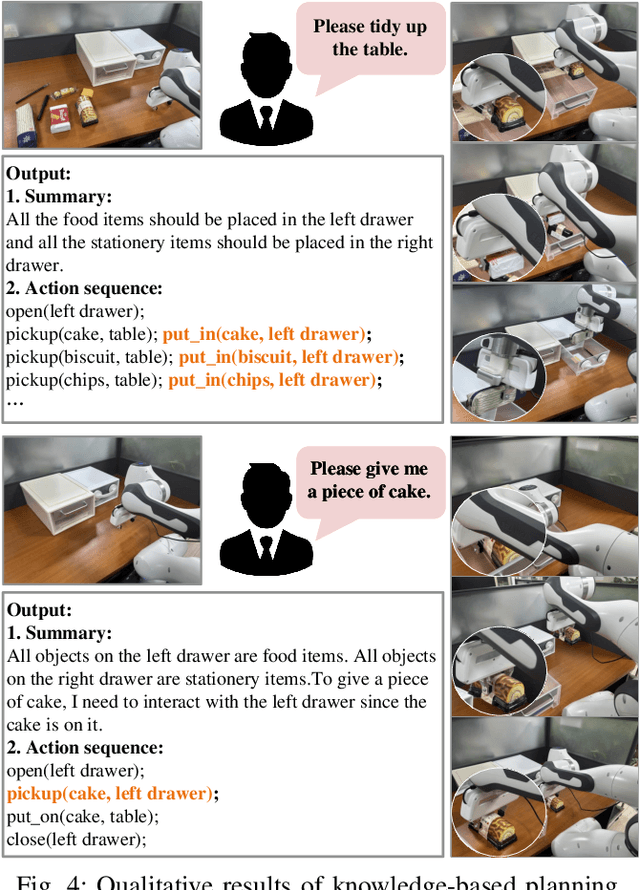
Learning from human demonstrations is an emerging trend for designing intelligent robotic systems. However, previous methods typically regard videos as instructions, simply dividing them into action sequences for robotic repetition, which poses obstacles to generalization to diverse tasks or object instances. In this paper, we propose a different perspective, considering human demonstration videos not as mere instructions, but as a source of knowledge for robots. Motivated by this perspective and the remarkable comprehension and generalization capabilities exhibited by large language models (LLMs), we propose DigKnow, a method that DIstills Generalizable KNOWledge with a hierarchical structure. Specifically, DigKnow begins by converting human demonstration video frames into observation knowledge. This knowledge is then subjected to analysis to extract human action knowledge and further distilled into pattern knowledge compassing task and object instances, resulting in the acquisition of generalizable knowledge with a hierarchical structure. In settings with different tasks or object instances, DigKnow retrieves relevant knowledge for the current task and object instances. Subsequently, the LLM-based planner conducts planning based on the retrieved knowledge, and the policy executes actions in line with the plan to achieve the designated task. Utilizing the retrieved knowledge, we validate and rectify planning and execution outcomes, resulting in a substantial enhancement of the success rate. Experimental results across a range of tasks and scenes demonstrate the effectiveness of this approach in facilitating real-world robots to accomplish tasks with the knowledge derived from human demonstrations.