 Add to Chrome
 Add to Firefox
 Add to Edge
STEAM: Self-Supervised Temporal Ensemble Advantage Modeling for Real-World Robot Learning
Jun 29, 2026
Real-world robot learning increasingly relies on heterogeneous data, but demonstrations and rollouts often mix useful progress with stalls, corrections, and suboptimal behavior. Effective policy learning therefore requires frame-level advantages that distinguish reliable local progress from failures and regressions. We propose Self-supervised Temporal Ensemble Advantage Modeling (STEAM), a label-free method that learns such advantages from expert demonstrations. STEAM trains an ensemble of temporal-offset predictors on frame pairs within expert trajectories, using the normalized temporal offset between two frames as a self-supervised signal. Each predictor maps a frame pair to a distribution over temporal offsets, which is converted into a scalar advantage. STEAM then takes the minimum advantage across the ensemble to score mixed-quality rollout data conservatively. Across real-world bimanual towel folding, chip checkout, cola restocking, and single-arm pick-and-place tasks, STEAM identifies stalls, failures, and recoveries. When combined with CFGRL, STEAM further improves policy success rate by 59%, 54.3%, 23% and 16.2% over baselines, respectively.

WoVR: World Models as Reliable Simulators for Post-Training VLA Policies with RL
Feb 15, 2026Reinforcement learning (RL) promises to unlock capabilities beyond imitation learning for Vision-Language-Action (VLA) models, but its requirement for massive real-world interaction prevents direct deployment on physical robots. Recent work attempts to use learned world models as simulators for policy optimization, yet closed-loop imagined rollouts inevitably suffer from hallucination and long-horizon error accumulation. Such errors do not merely degrade visual fidelity; they corrupt the optimization signal, encouraging policies to exploit model inaccuracies rather than genuine task progress. We propose WoVR, a reliable world-model-based reinforcement learning framework for post-training VLA policies. Instead of assuming a faithful world model, WoVR explicitly regulates how RL interacts with imperfect imagined dynamics. It improves rollout stability through a controllable action-conditioned video world model, reshapes imagined interaction to reduce effective error depth via Keyframe-Initialized Rollouts, and maintains policy-simulator alignment through World Model-Policy co-evolution. Extensive experiments on LIBERO benchmarks and real-world robotic manipulation demonstrate that WoVR enables stable long-horizon imagined rollouts and effective policy optimization, improving average LIBERO success from 39.95% to 69.2% (+29.3 points) and real-robot success from 61.7% to 91.7% (+30.0 points). These results show that learned world models can serve as practical simulators for reinforcement learning when hallucination is explicitly controlled.
RLinf-USER: A Unified and Extensible System for Real-World Online Policy Learning in Embodied AI
Feb 08, 2026Online policy learning directly in the physical world is a promising yet challenging direction for embodied intelligence. Unlike simulation, real-world systems cannot be arbitrarily accelerated, cheaply reset, or massively replicated, which makes scalable data collection, heterogeneous deployment, and long-horizon effective training difficult. These challenges suggest that real-world policy learning is not only an algorithmic issue but fundamentally a systems problem. We present USER, a Unified and extensible SystEm for Real-world online policy learning. USER treats physical robots as first-class hardware resources alongside GPUs through a unified hardware abstraction layer, enabling automatic discovery, management, and scheduling of heterogeneous robots. To address cloud-edge communication, USER introduces an adaptive communication plane with tunneling-based networking, distributed data channels for traffic localization, and streaming-multiprocessor-aware weight synchronization to regulate GPU-side overhead. On top of this infrastructure, USER organizes learning as a fully asynchronous framework with a persistent, cache-aware buffer, enabling efficient long-horizon experiments with robust crash recovery and reuse of historical data. In addition, USER provides extensible abstractions for rewards, algorithms, and policies, supporting online imitation or reinforcement learning of CNN/MLP, generative policies, and large vision-language-action (VLA) models within a unified pipeline. Results in both simulation and the real world show that USER enables multi-robot coordination, heterogeneous manipulators, edge-cloud collaboration with large models, and long-running asynchronous training, offering a unified and extensible systems foundation for real-world online policy learning.
Denoising-based Contractive Imitation Learning
Mar 20, 2025A fundamental challenge in imitation learning is the \emph{covariate shift} problem. Existing methods to mitigate covariate shift often require additional expert interactions, access to environment dynamics, or complex adversarial training, which may not be practical in real-world applications. In this paper, we propose a simple yet effective method (DeCIL) to mitigate covariate shift by incorporating a denoising mechanism that enhances the contraction properties of the state transition mapping. Our approach involves training two neural networks: a dynamics model ( f ) that predicts the next state from the current state, and a joint state-action denoising policy network ( d ) that refines this state prediction via denoising and outputs the corresponding action. We provide theoretical analysis showing that the denoising network acts as a local contraction mapping, reducing the error propagation of the state transition and improving stability. Our method is straightforward to implement and can be easily integrated with existing imitation learning frameworks without requiring additional expert data or complex modifications to the training procedure. Empirical results demonstrate that our approach effectively improves success rate of various imitation learning tasks under noise perturbation.
Efficient Recurrent Off-Policy RL Requires a Context-Encoder-Specific Learning Rate
May 24, 2024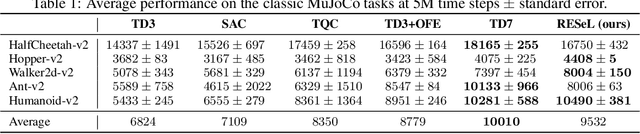
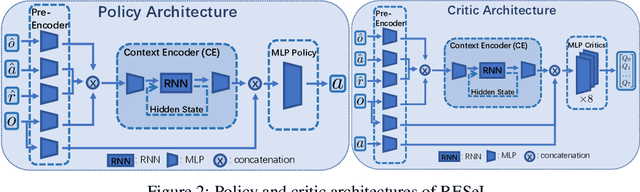
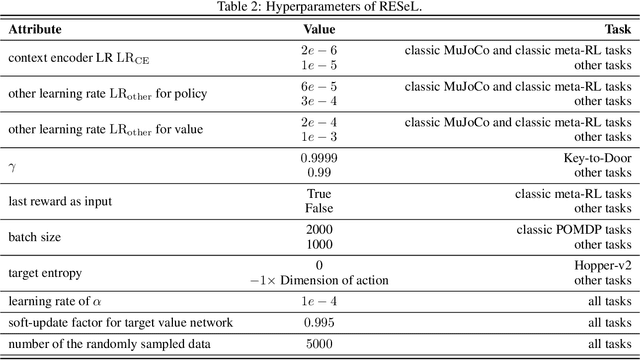

Real-world decision-making tasks are usually partially observable Markov decision processes (POMDPs), where the state is not fully observable. Recent progress has demonstrated that recurrent reinforcement learning (RL), which consists of a context encoder based on recurrent neural networks (RNNs) for unobservable state prediction and a multilayer perceptron (MLP) policy for decision making, can mitigate partial observability and serve as a robust baseline for POMDP tasks. However, previous recurrent RL methods face training stability issues due to the gradient instability of RNNs. In this paper, we propose Recurrent Off-policy RL with Context-Encoder-Specific Learning Rate (RESeL) to tackle this issue. Specifically, RESeL uses a lower learning rate for context encoder than other MLP layers to ensure the stability of the former while maintaining the training efficiency of the latter. We integrate this technique into existing off-policy RL methods, resulting in the RESeL algorithm. We evaluated RESeL in 18 POMDP tasks, including classic, meta-RL, and credit assignment scenarios, as well as five MDP locomotion tasks. The experiments demonstrate significant improvements in training stability with RESeL. Comparative results show that RESeL achieves notable performance improvements over previous recurrent RL baselines in POMDP tasks, and is competitive with or even surpasses state-of-the-art methods in MDP tasks. Further ablation studies highlight the necessity of applying a distinct learning rate for the context encoder.