 Add to Chrome
 Add to Firefox
 Add to Edge
How Much Future Helps? A Controlled Study of Future-Privileged Supervision for Causal Egocentric Gaze Estimation
Jul 01, 2026
Egocentric gaze estimation is commonly studied using models that process the full video with access to future frames, while real-world applications require strictly causal, online prediction. This discrepancy raises key questions: Does future context inherently provide valuable signals for gaze estimation? If so, how much future look-ahead optimally supervises a causal model during training? To investigate, we propose a controlled framework featuring a future-aware branch that accesses a tunable look-ahead horizon during training but is discarded at inference. This design isolates the impact of future context while keeping the inference architecture fixed and strictly causal. Across EGTEA Gaze+ and Ego4D, we find that future-privileged supervision consistently improves causal gaze prediction, confirming its utility. However, performance gains do not increase monotonically with longer look-ahead, but rather peak within a bounded temporal regime. Specifically, optimal performance corresponds to roughly 1.7--3.3 seconds of future context ($H{\in}[5, 10]$) on EGTEA Gaze+ and 2.7 seconds ($H{=}10$) on Ego4D. Our results demonstrate that lightweight causal models can effectively absorb future-aware signals, providing practical guidance for real-time egocentric gaze modeling.

Audio-Visual Intelligence in Large Foundation Models
May 05, 2026Audio-Visual Intelligence (AVI) has emerged as a central frontier in artificial intelligence, bridging auditory and visual modalities to enable machines that can perceive, generate, and interact in the multimodal real world. In the era of large foundation models, joint modeling of audio and vision has become increasingly crucial, i.e., not only for understanding but also for controllable generation and reasoning across dynamic, temporally grounded signals. Recent advances, such as Meta MovieGen and Google Veo-3, highlight the growing industrial and academic focus on unified audio-vision architectures that learn from massive multimodal data. However, despite rapid progress, the literature remains fragmented, spanning diverse tasks, inconsistent taxonomies, and heterogeneous evaluation practices that impede systematic comparison and knowledge integration. This survey provides the first comprehensive review of AVI through the lens of large foundation models. We establish a unified taxonomy covering the broad landscape of AVI tasks, ranging from understanding (e.g., speech recognition, sound localization) to generation (e.g., audio-driven video synthesis, video-to-audio) and interaction (e.g., dialogue, embodied, or agentic interfaces). We synthesize methodological foundations, including modality tokenization, cross-modal fusion, autoregressive and diffusion-based generation, large-scale pretraining, instruction alignment, and preference optimization. Furthermore, we curate representative datasets, benchmarks, and evaluation metrics, offering a structured comparison across task families and identifying open challenges in synchronization, spatial reasoning, controllability, and safety. By consolidating this rapidly expanding field into a coherent framework, this survey aims to serve as a foundational reference for future research on large-scale AVI.
OmniSonic: Towards Universal and Holistic Audio Generation from Video and Text
Apr 06, 2026In this paper, we propose Universal Holistic Audio Generation (UniHAGen), a task for synthesizing comprehensive auditory scenes that include both on-screen and off-screen sounds across diverse domains (e.g., ambient events, musical instruments, and human speech). Prior video-conditioned audio generation models typically focus on producing on-screen environmental sounds that correspond to visible sounding events, neglecting off-screen auditory events. While recent holistic joint text-video-to-audio generation models aim to produce auditory scenes with both on- and off-screen sound but they are limited to non-speech sounds, lacking the ability to generate or integrate human speech. To overcome these limitations, we introduce OmniSonic, a flow-matching-based diffusion framework jointly conditioned on video and text. It features a TriAttn-DiT architecture that performs three cross-attention operations to process on-screen environmental sound, off-screen environmental sound, and speech conditions simultaneously, with a Mixture-of-Experts (MoE) gating mechanism that adaptively balances their contributions during generation. Furthermore, we construct UniHAGen-Bench, a new benchmark with over one thousand samples covering three representative on/off-screen speech-environment scenarios. Extensive experiments show that OmniSonic consistently outperforms state-of-the-art approaches on both objective metrics and human evaluations, establishing a strong baseline for universal and holistic audio generation. Project page: https://weiguopian.github.io/OmniSonic_webpage/
Omni-MMSI: Toward Identity-attributed Social Interaction Understanding
Mar 31, 2026We introduce Omni-MMSI, a new task that requires comprehensive social interaction understanding from raw audio, vision, and speech input. The task involves perceiving identity-attributed social cues (e.g., who is speaking what) and reasoning about the social interaction (e.g., whom the speaker refers to). This task is essential for developing AI assistants that can perceive and respond to human interactions. Unlike prior studies that operate on oracle-preprocessed social cues, Omni-MMSI reflects realistic scenarios where AI assistants must perceive and reason from raw data. However, existing pipelines and multi-modal LLMs perform poorly on Omni-MMSI because they lack reliable identity attribution capabilities, which leads to inaccurate social interaction understanding. To address this challenge, we propose Omni-MMSI-R, a reference-guided pipeline that produces identity-attributed social cues with tools and conducts chain-of-thought social reasoning. To facilitate this pipeline, we construct participant-level reference pairs and curate reasoning annotations on top of the existing datasets. Experiments demonstrate that Omni-MMSI-R outperforms advanced LLMs and counterparts on Omni-MMSI. Project page: https://sampson-lee.github.io/omni-mmsi-project-page.
ARGaze: Autoregressive Transformers for Online Egocentric Gaze Estimation
Feb 04, 2026Online egocentric gaze estimation predicts where a camera wearer is looking from first-person video using only past and current frames, a task essential for augmented reality and assistive technologies. Unlike third-person gaze estimation, this setting lacks explicit head or eye signals, requiring models to infer current visual attention from sparse, indirect cues such as hand-object interactions and salient scene content. We observe that gaze exhibits strong temporal continuity during goal-directed activities: knowing where a person looked recently provides a powerful prior for predicting where they look next. Inspired by vision-conditioned autoregressive decoding in vision-language models, we propose ARGaze, which reformulates gaze estimation as sequential prediction: at each timestep, a transformer decoder predicts current gaze by conditioning on (i) current visual features and (ii) a fixed-length Gaze Context Window of recent gaze target estimates. This design enforces causality and enables bounded-resource streaming inference. We achieve state-of-the-art performance across multiple egocentric benchmarks under online evaluation, with extensive ablations validating that autoregressive modeling with bounded gaze history is critical for robust prediction. We will release our source code and pre-trained models.
Explainable AI-Generated Image Detection RewardBench
Nov 15, 2025Conventional, classification-based AI-generated image detection methods cannot explain why an image is considered real or AI-generated in a way a human expert would, which reduces the trustworthiness and persuasiveness of these detection tools for real-world applications. Leveraging Multimodal Large Language Models (MLLMs) has recently become a trending solution to this issue. Further, to evaluate the quality of generated explanations, a common approach is to adopt an "MLLM as a judge" methodology to evaluate explanations generated by other MLLMs. However, how well those MLLMs perform when judging explanations for AI-generated image detection generated by themselves or other MLLMs has not been well studied. We therefore propose \textbf{XAIGID-RewardBench}, the first benchmark designed to evaluate the ability of current MLLMs to judge the quality of explanations about whether an image is real or AI-generated. The benchmark consists of approximately 3,000 annotated triplets sourced from various image generation models and MLLMs as policy models (detectors) to assess the capabilities of current MLLMs as reward models (judges). Our results show that the current best reward model scored 88.76\% on this benchmark (while human inter-annotator agreement reaches 98.30\%), demonstrating that a visible gap remains between the reasoning abilities of today's MLLMs and human-level performance. In addition, we provide an analysis of common pitfalls that these models frequently encounter. Code and benchmark are available at https://github.com/RewardBench/XAIGID-RewardBench.
Toward Gaze Target Detection of Young Autistic Children
Nov 14, 2025The automatic detection of gaze targets in autistic children through artificial intelligence can be impactful, especially for those who lack access to a sufficient number of professionals to improve their quality of life. This paper introduces a new, real-world AI application for gaze target detection in autistic children, which predicts a child's point of gaze from an activity image. This task is foundational for building automated systems that can measure joint attention-a core challenge in Autism Spectrum Disorder (ASD). To facilitate the study of this challenging application, we collected the first-ever Autism Gaze Target (AGT) dataset. We further propose a novel Socially Aware Coarse-to-Fine (SACF) gaze detection framework that explicitly leverages the social context of a scene to overcome the class imbalance common in autism datasets-a consequence of autistic children's tendency to show reduced gaze to faces. It utilizes a two-pathway architecture with expert models specialized in social and non-social gaze, guided by a context-awareness gate module. The results of our comprehensive experiments demonstrate that our framework achieves new state-of-the-art performance for gaze target detection in this population, significantly outperforming existing methods, especially on the critical minority class of face-directed gaze.
Towards Online Multi-Modal Social Interaction Understanding
Mar 25, 2025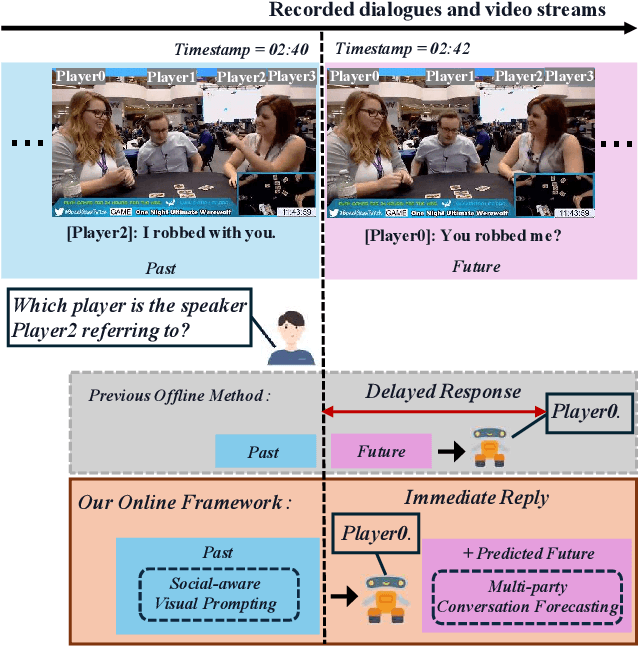
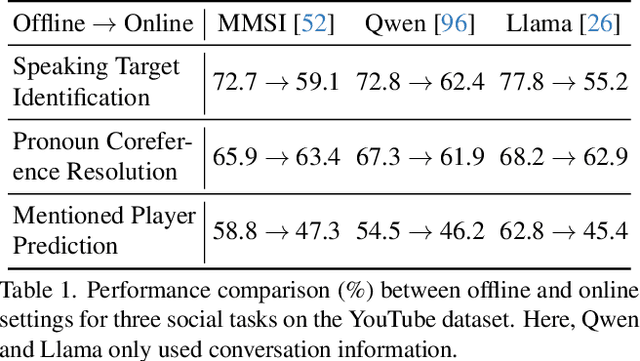
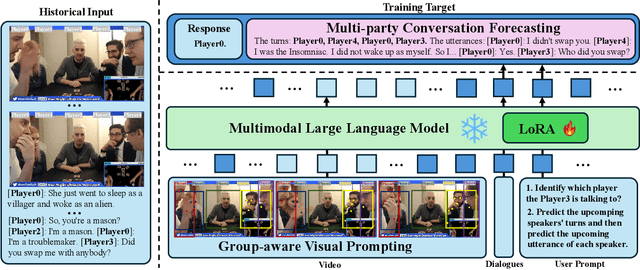
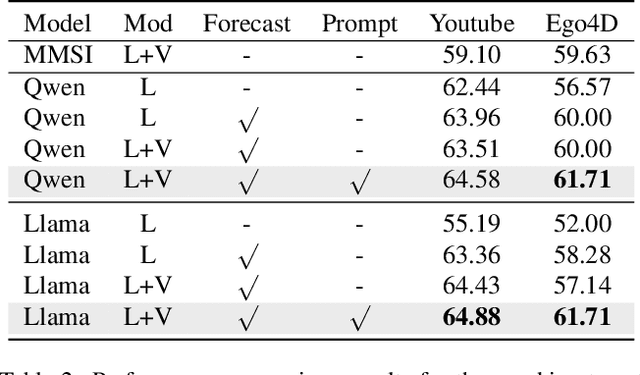
Multimodal social interaction understanding (MMSI) is critical in human-robot interaction systems. In real-world scenarios, AI agents are required to provide real-time feedback. However, existing models often depend on both past and future contexts, which hinders them from applying to real-world problems. To bridge this gap, we propose an online MMSI setting, where the model must resolve MMSI tasks using only historical information, such as recorded dialogues and video streams. To address the challenges of missing the useful future context, we develop a novel framework, named Online-MMSI-VLM, that leverages two complementary strategies: multi-party conversation forecasting and social-aware visual prompting with multi-modal large language models. First, to enrich linguistic context, the multi-party conversation forecasting simulates potential future utterances in a coarse-to-fine manner, anticipating upcoming speaker turns and then generating fine-grained conversational details. Second, to effectively incorporate visual social cues like gaze and gesture, social-aware visual prompting highlights the social dynamics in video with bounding boxes and body keypoints for each person and frame. Extensive experiments on three tasks and two datasets demonstrate that our method achieves state-of-the-art performance and significantly outperforms baseline models, indicating its effectiveness on Online-MMSI. The code and pre-trained models will be publicly released at: https://github.com/Sampson-Lee/OnlineMMSI.
Modality-Inconsistent Continual Learning of Multimodal Large Language Models
Dec 17, 2024
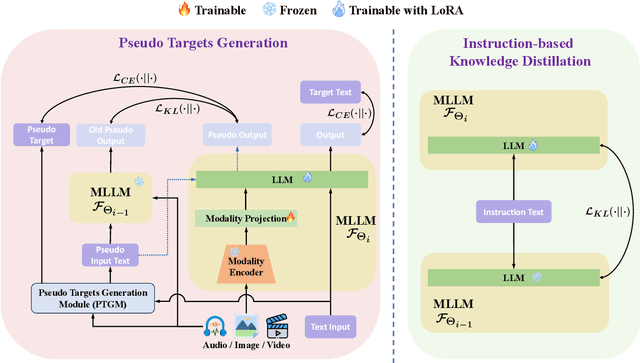


In this paper, we introduce Modality-Inconsistent Continual Learning (MICL), a new continual learning scenario for Multimodal Large Language Models (MLLMs) that involves tasks with inconsistent modalities (image, audio, or video) and varying task types (captioning or question-answering). Unlike existing vision-only or modality-incremental settings, MICL combines modality and task type shifts, both of which drive catastrophic forgetting. To address these challenges, we propose MoInCL, which employs a Pseudo Targets Generation Module to mitigate forgetting caused by task type shifts in previously seen modalities. It also incorporates Instruction-based Knowledge Distillation to preserve the model's ability to handle previously learned modalities when new ones are introduced. We benchmark MICL using a total of six tasks and conduct experiments to validate the effectiveness of our proposed MoInCL. The experimental results highlight the superiority of MoInCL, showing significant improvements over representative and state-of-the-art continual learning baselines.
Efficient Self-Improvement in Multimodal Large Language Models: A Model-Level Judge-Free Approach
Nov 26, 2024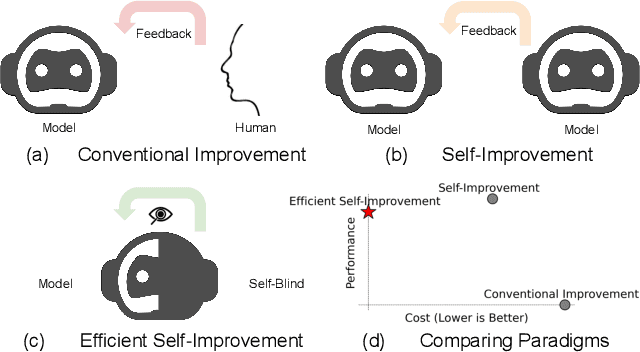
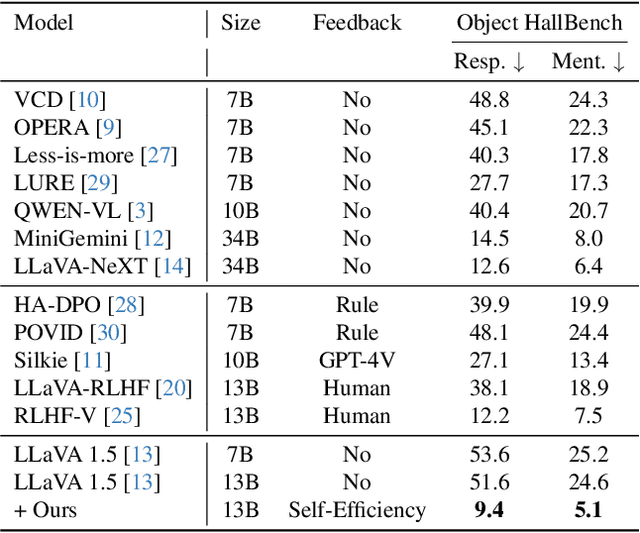

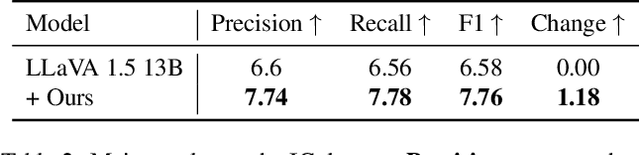
Self-improvement in multimodal large language models (MLLMs) is crucial for enhancing their reliability and robustness. However, current methods often rely heavily on MLLMs themselves as judges, leading to high computational costs and potential pitfalls like reward hacking and model collapse. This paper introduces a novel, model-level judge-free self-improvement framework. Our approach employs a controlled feedback mechanism while eliminating the need for MLLMs in the verification loop. We generate preference learning pairs using a controllable hallucination mechanism and optimize data quality by leveraging lightweight, contrastive language-image encoders to evaluate and reverse pairs when necessary. Evaluations across public benchmarks and our newly introduced IC dataset designed to challenge hallucination control demonstrate that our model outperforms conventional techniques. We achieve superior precision and recall with significantly lower computational demands. This method offers an efficient pathway to scalable self-improvement in MLLMs, balancing performance gains with reduced resource requirements.