 Add to Chrome
 Add to Firefox
 Add to Edge
ARES: Adaptive Reasoning-Effort Steering for PPA- and Cost-Aware RTL Optimization with LLM Agents
Jul 30, 2026
Large language model (LLM) agents optimize the power, performance, and area (PPA) of register-transfer-level (RTL) designs by iterating over edits, synthesis, and PPA analysis, paying a dollar cost for every LLM call. Prior agents report the quality reached without its normalized cost, attribute that quality to an engineered cross-design memory, and hold the reasoning effort of every call fixed. We propose Ares with three corresponding innovations. (1) We introduce a normalized dollar cost per LLM call reported alongside the figure of merit (FoM), enabling fair comparison across effort levels and optimizers. (2) Using this accounting, we find the construction of the long-term memory matters little. An engineered memory brings no dependable gain over a plain concatenation of the same experience. (3) We instead adapt the per-call reasoning effort by escalating to deeper reasoning only once progress at a lower effort stalls, via a patience counter fit on 21 training designs, allocating reasoning where it pays rather than uniformly across all iterations. On three test designs unseen during training, the effort policy lowers the FoM by 23-27% where the best fixed effort reaches 16-23%, at equal normalized cost. Ares closes up to 83% of the gap from an LLM-drafted multiply-accumulate unit to its highly hand-optimized counterpart, and reaches a 25% deeper FoM than state-of-the-art Dr. RTL at 12% of its tokens.

HiKV: Hierarchical Importance-Aware KV Cache with Hardware Acceleration for LLM Decoding
Jul 24, 2026With the rapid adoption of long-context large language models (LLMs), the continuously growing KV cache during decoding has become the critical memory bottleneck. To tackle this challenge, we propose HiKV, a novel algorithm-hardware co-design that exploits KV cache redundancy through hierarchical importance awareness. Algorithmically, HiKV compresses the KV cache at two granularities: Stage I evicts unimportant tokens within a fixed budget, and Stage II further loads only the significant elements of each retained token, reaching compression ratios unattainable at a single granularity. Architecturally, we develop a dedicated accelerator centered on a reconfigurable importance sorter that switches between the distinct sorting datapaths each stage requires, unifying the two-stage acceleration in one circuit with minimal overhead. Evaluated on representative LLMs, HiKV achieves up to 7.95x speedup and 90% energy reduction in the attention computation over the vanilla KV cache baseline within negligible 1% accuracy loss. Under iso-accuracy constraints, HiKV outperforms state-of-the-art importance-based methods by achieving an additional 1.82~4.87x reduction in external memory accesses. These benefits are enabled by specialized hardware components that add only 8% to the system area.
TreeGRNG: Binary Tree Gaussian Random Number Generator for Efficient Probabilistic AI Hardware
Jun 15, 2026Bayesian Neural Networks (BNNs) offer opportunities for greatly enhancing the trustworthiness of conventional neural networks by monitoring the uncertainties in decision-making. A significant drawback for BNN inference at the extreme edge, however, is the imperative need to incorporate Gaussian Random Number Generators (GRNG) within each neuron. State-of-the-art GRNG algorithms heavily depend on multiple arithmetic operations and the use of extensive look-up tables, posing significant implementation challenges for ultra-low power hardware implementations. To overcome this, this paper presents an innovative binary tree random number generator (TreeGRNG) allowing the use of ultra-low-cost constant comparators instead of arithmetic units. We further enhance the TreeGRNG proposal with a set of hardware-aware optimizations exploiting the Gaussian properties. The optimized TreeGRNG surpasses the State-of-the-Art (SoTA) in terms of distribution accuracy while achieving a 3.7$\times$ reduction in energy per sample and boosting the throughput per unit area by 5.8$\times$. Moreover, our TreeGRNG proposal possesses a distinct advantage over the current SoTA in terms of flexibility, as it easily enables designers to adjust the shape of the sampled probability distribution, extending beyond the capabilities of traditional GRNGs, opening the horizon towards future probabilistic AI designs. The TreeGRNG design is available open-source in the link
* 6 pages, 5 figures, Proceeded by the 2024 Design, Automation and Test in Europe Conference (DATE)
Agent Memory: Characterization and System Implications of Stateful Long-Horizon Workloads
Jun 04, 2026LLM agents are increasingly deployed on long-horizon tasks requiring sustained reasoning over extended interaction histories. Realizing this at scale requires agents to persistently store, retrieve, and update their own memory across sessions. A rich ecosystem of agent memory systems has emerged spanning flat retrieval, LLM-mediated extraction, consolidating fact stores, and agentic control flows. Yet, their system-level behavior remains uncharacterized. We present the first systems characterization of agent memory. First, we introduce a system-oriented taxonomy classifying agent memory systems along four axes. Second, we build a phase-aware profiling harness attributing cost to construction, retrieval, and generation. Third, we characterize ten representative systems across two benchmark suites, uncovering how design choices shift cost across the write and read paths. Finally, we derive 10 system recommendations covering construction scheduling, capability floors, amortization via query volume, freshness-latency tradeoffs, and fleet-scale management.
MONET: Modeling and Optimization of neural NEtwork Training from Edge to Data Centers
Mar 16, 2026While hardware-software co-design has significantly improved the efficiency of neural network inference, modeling the training phase remains a critical yet underexplored challenge. Training workloads impose distinct constraints, particularly regarding memory footprint and backpropagation complexity, which existing inference-focused tools fail to capture. This paper introduces MONET, a framework designed to model the training of neural networks on heterogeneous dataflow accelerators. MONET builds upon Stream, an experimentally verified framework that that models the inference of neural networks on heterogeneous dataflow accelerators with layer fusion. Using MONET, we explore the design space of ResNet-18 and a small GPT-2, demonstrating the framework's capability to model training workflows and find better hardware architectures. We then further examine problems that become more complex in neural network training due to the larger design space, such as determining the best layer-fusion configuration. Additionally, we use our framework to find interesting trade-offs in activation checkpointing, with the help of a genetic algorithm. Our findings highlight the importance of a holistic approach to hardware-software co-design for scalable and efficient deep learning deployment.
P3-LLM: An Integrated NPU-PIM Accelerator for LLM Inference Using Hybrid Numerical Formats
Nov 16, 2025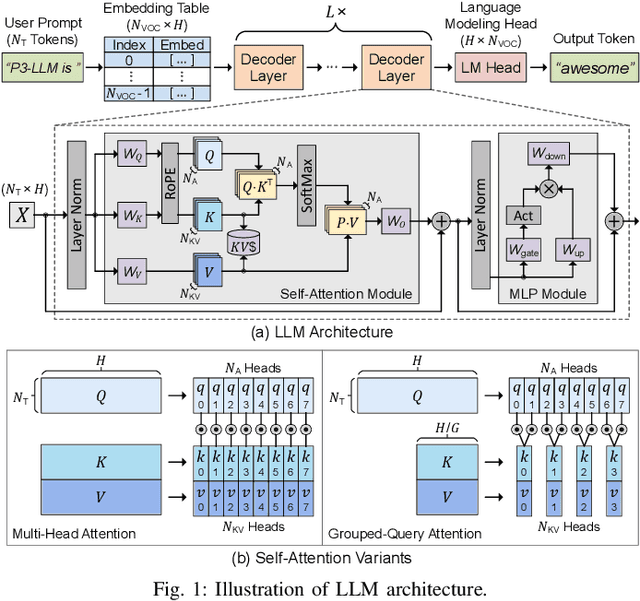
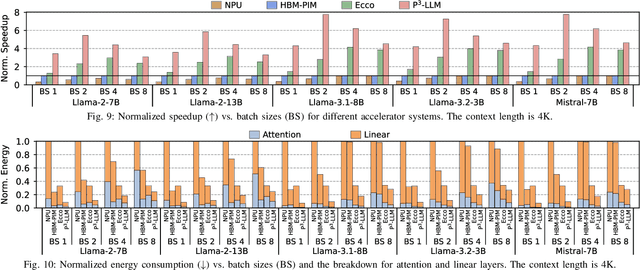
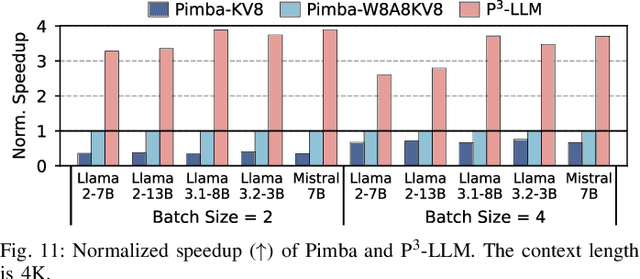
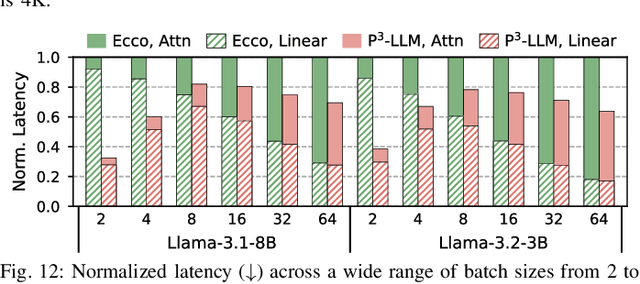
The substantial memory bandwidth and computational demands of large language models (LLMs) present critical challenges for efficient inference. To tackle this, the literature has explored heterogeneous systems that combine neural processing units (NPUs) with DRAM-based processing-in-memory (PIM) for LLM acceleration. However, existing high-precision (e.g., FP16) PIM compute units incur significant area and power overhead in DRAM technology, limiting the effective computation throughput. In this paper, we introduce P3-LLM, a novel NPU-PIM integrated accelerator for LLM inference using hybrid numerical formats. Our approach is threefold: First, we propose a flexible mixed-precision quantization scheme, which leverages hybrid numerical formats to quantize different LLM operands with high compression efficiency and minimal accuracy loss. Second, we architect an efficient PIM accelerator for P3-LLM, featuring enhanced compute units to support hybrid numerical formats. Our careful choice of numerical formats allows to co-design low-precision PIM compute units that significantly boost the computation throughput under iso-area constraints. Third, we optimize the low-precision dataflow of different LLM modules by applying operator fusion to minimize the overhead of runtime dequantization. Evaluation on a diverse set of representative LLMs and tasks demonstrates that P3-LLM achieves state-of-the-art accuracy in terms of both KV-cache quantization and weight-activation quantization. Combining the proposed quantization scheme with PIM architecture co-design, P3-LLM yields an average of $4.9\times$, $2.0\times$, and $3.4\times$ speedups over the state-of-the-art LLM accelerators HBM-PIM, Ecco, and Pimba, respectively. Our quantization code is available at https://github.com/yc2367/P3-LLM.git
Precision-Scalable Microscaling Datapaths with Optimized Reduction Tree for Efficient NPU Integration
Nov 09, 2025Emerging continual learning applications necessitate next-generation neural processing unit (NPU) platforms to support both training and inference operations. The promising Microscaling (MX) standard enables narrow bit-widths for inference and large dynamic ranges for training. However, existing MX multiply-accumulate (MAC) designs face a critical trade-off: integer accumulation requires expensive conversions from narrow floating-point products, while FP32 accumulation suffers from quantization losses and costly normalization. To address these limitations, we propose a hybrid precision-scalable reduction tree for MX MACs that combines the benefits of both approaches, enabling efficient mixed-precision accumulation with controlled accuracy relaxation. Moreover, we integrate an 8x8 array of these MACs into the state-of-the-art (SotA) NPU integration platform, SNAX, to provide efficient control and data transfer to our optimized precision-scalable MX datapath. We evaluate our design both on MAC and system level and compare it to the SotA. Our integrated system achieves an energy efficiency of 657, 1438-1675, and 4065 GOPS/W, respectively, for MXINT8, MXFP8/6, and MXFP4, with a throughput of 64, 256, and 512 GOPS.
An Open-Source HW-SW Co-Development Framework Enabling Efficient Multi-Accelerator Systems
Aug 20, 2025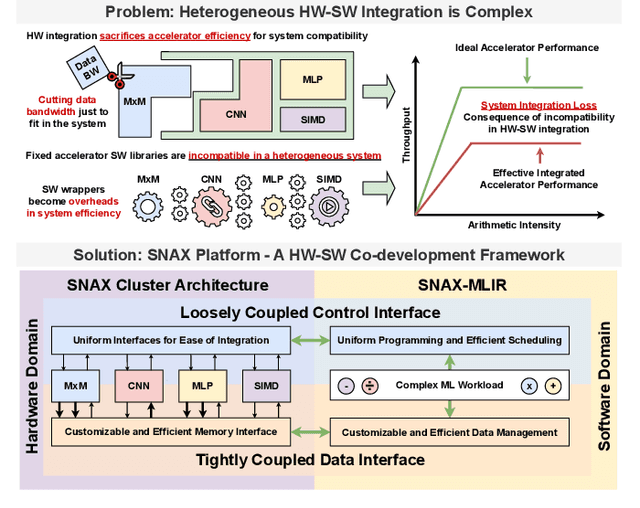
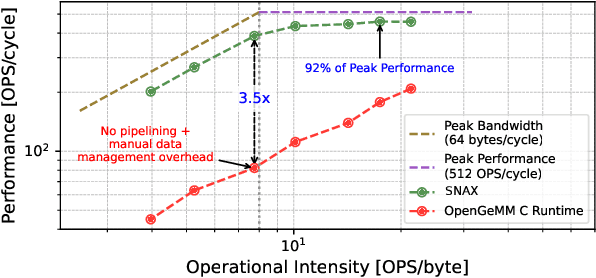
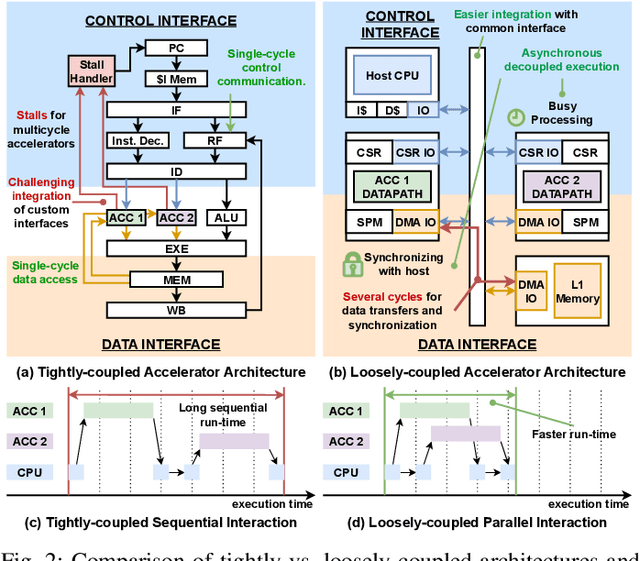
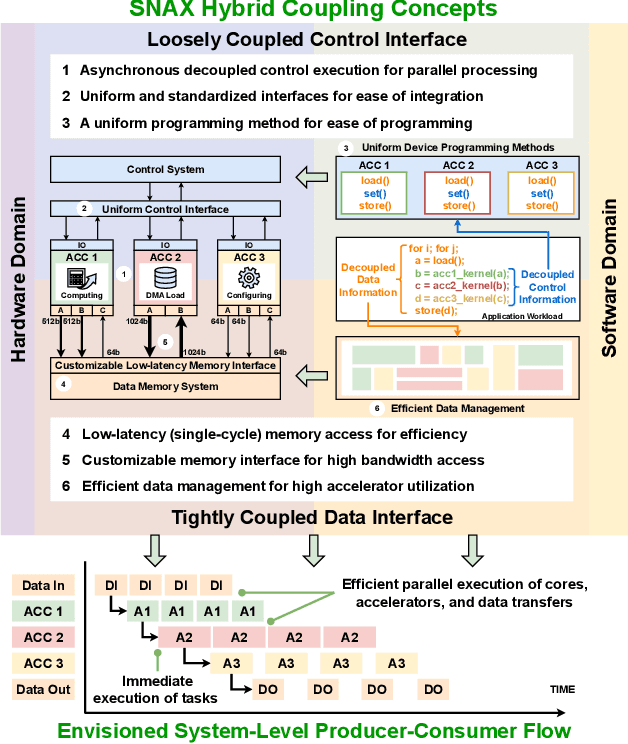
Heterogeneous accelerator-centric compute clusters are emerging as efficient solutions for diverse AI workloads. However, current integration strategies often compromise data movement efficiency and encounter compatibility issues in hardware and software. This prevents a unified approach that balances performance and ease of use. To this end, we present SNAX, an open-source integrated HW-SW framework enabling efficient multi-accelerator platforms through a novel hybrid-coupling scheme, consisting of loosely coupled asynchronous control and tightly coupled data access. SNAX brings reusable hardware modules designed to enhance compute accelerator utilization, and its customizable MLIR-based compiler to automate key system management tasks, jointly enabling rapid development and deployment of customized multi-accelerator compute clusters. Through extensive experimentation, we demonstrate SNAX's efficiency and flexibility in a low-power heterogeneous SoC. Accelerators can easily be integrated and programmed to achieve > 10x improvement in neural network performance compared to other accelerator systems while maintaining accelerator utilization of > 90% in full system operation.
Efficient Precision-Scalable Hardware for Microscaling (MX) Processing in Robotics Learning
May 28, 2025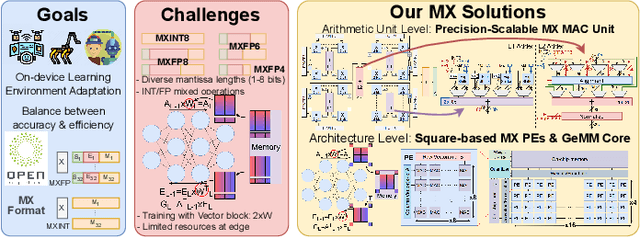
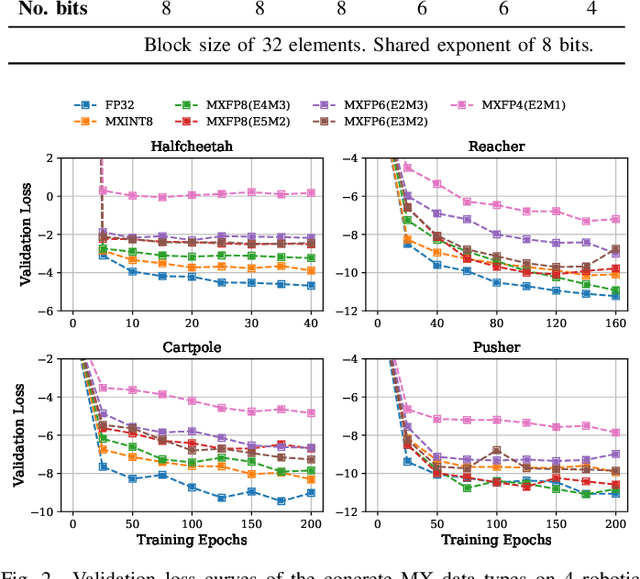
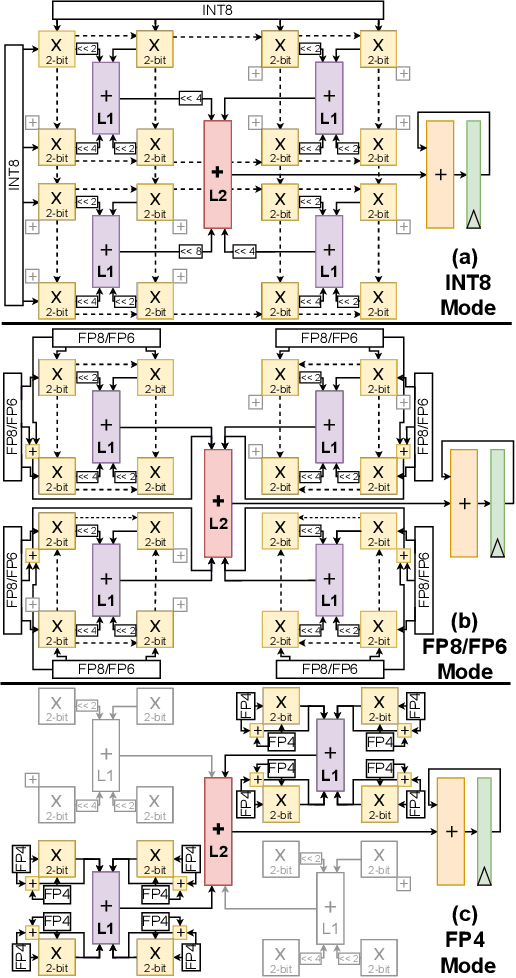
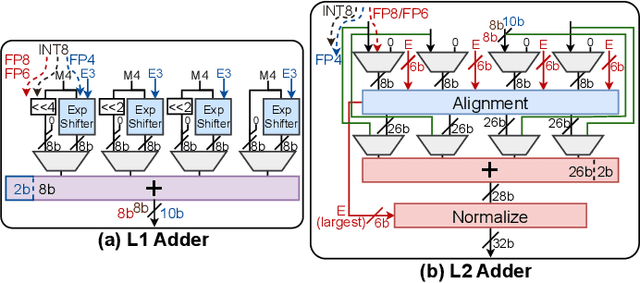
Autonomous robots require efficient on-device learning to adapt to new environments without cloud dependency. For this edge training, Microscaling (MX) data types offer a promising solution by combining integer and floating-point representations with shared exponents, reducing energy consumption while maintaining accuracy. However, the state-of-the-art continuous learning processor, namely Dacapo, faces limitations with its MXINT-only support and inefficient vector-based grouping during backpropagation. In this paper, we present, to the best of our knowledge, the first work that addresses these limitations with two key innovations: (1) a precision-scalable arithmetic unit that supports all six MX data types by exploiting sub-word parallelism and unified integer and floating-point processing; and (2) support for square shared exponent groups to enable efficient weight handling during backpropagation, removing storage redundancy and quantization overhead. We evaluate our design against Dacapo under iso-peak-throughput on four robotics workloads in TSMC 16nm FinFET technology at 500MHz, reaching a 25.6% area reduction, a 51% lower memory footprint, and 4x higher effective training throughput while achieving comparable energy-efficiency, enabling efficient robotics continual learning at the edge.
CNN-based Robust Sound Source Localization with SRP-PHAT for the Extreme Edge
Mar 03, 2025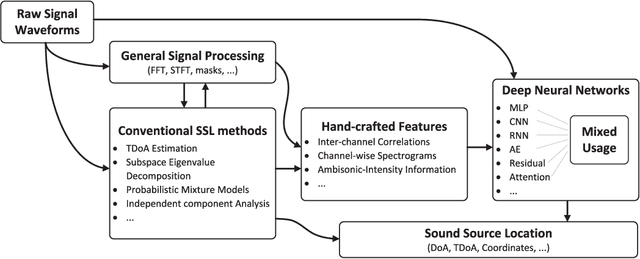
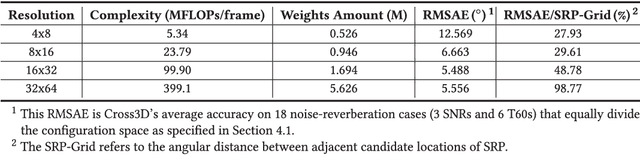
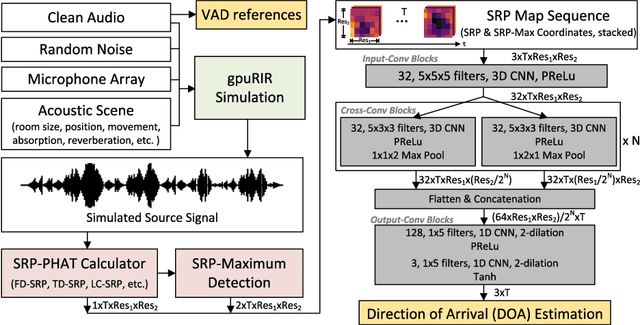
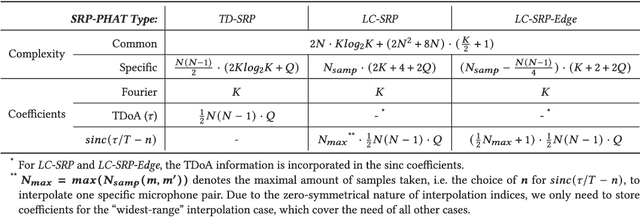
Robust sound source localization for environments with noise and reverberation are increasingly exploiting deep neural networks fed with various acoustic features. Yet, state-of-the-art research mainly focuses on optimizing algorithmic accuracy, resulting in huge models preventing edge-device deployment. The edge, however, urges for real-time low-footprint acoustic reasoning for applications such as hearing aids and robot interactions. Hence, we set off from a robust CNN-based model using SRP-PHAT features, Cross3D [16], to pursue an efficient yet compact model architecture for the extreme edge. For both the SRP feature representation and neural network, we propose respectively our scalable LC-SRP-Edge and Cross3D-Edge algorithms which are optimized towards lower hardware overhead. LC-SRP-Edge halves the complexity and on-chip memory overhead for the sinc interpolation compared to the original LC-SRP [19]. Over multiple SRP resolution cases, Cross3D-Edge saves 10.32~73.71% computational complexity and 59.77~94.66% neural network weights against the Cross3D baseline. In terms of the accuracy-efficiency tradeoff, the most balanced version (EM) requires only 127.1 MFLOPS computation, 3.71 MByte/s bandwidth, and 0.821 MByte on-chip memory in total, while still retaining competitiveness in state-of-the-art accuracy comparisons. It achieves 8.59 ms/frame end-to-end latency on a Rasberry Pi 4B, which is 7.26x faster than the corresponding baseline.