 Add to Chrome
 Add to Firefox
 Add to Edge
REIMU: Efficient Heterogeneous Hierarchical Reasoning for SSL-Based Speech Deepfake Detection
Aug 01, 2026
The increasing realism of speech generated by text-to-speech and voice conversion systems poses growing challenges to media integrity and voice authentication. Self-supervised learning (SSL) has substantially advanced speech deepfake detection, where downstream backbones conventionally process SSL representations through a single forward pass. This work investigates the practical effectiveness of recurrent hierarchical reasoning for this task. We term this controlled study REIMU and systematically compare conventional single-pass backbones, weight-shared recurrence, homogeneous HRM, and heterogeneous HRM across four Base-scale SSL frontends. We further examine heterogeneous high- and low-level modules that combine self-attention with linear attention. Experiments on the ASVspoof 2019 and 2021 evaluation sets show that recurrence and hierarchical decomposition do not inherently improve detection, whereas heterogeneous operator assignment provides a more competitive configuration. Notably, the heterogeneous design remains competitive while using 10.8\% fewer downstream parameters than the matched baseline, demonstrating its potential for parameter-efficient speech deepfake detection.

XLSR-MamBo: Scaling the Hybrid Mamba-Attention Backbone for Audio Deepfake Detection
Jan 06, 2026Advanced speech synthesis technologies have enabled highly realistic speech generation, posing security risks that motivate research into audio deepfake detection (ADD). While state space models (SSMs) offer linear complexity, pure causal SSMs architectures often struggle with the content-based retrieval required to capture global frequency-domain artifacts. To address this, we explore the scaling properties of hybrid architectures by proposing XLSR-MamBo, a modular framework integrating an XLSR front-end with synergistic Mamba-Attention backbones. We systematically evaluate four topological designs using advanced SSM variants, Mamba, Mamba2, Hydra, and Gated DeltaNet. Experimental results demonstrate that the MamBo-3-Hydra-N3 configuration achieves competitive performance compared to other state-of-the-art systems on the ASVspoof 2021 LA, DF, and In-the-Wild benchmarks. This performance benefits from Hydra's native bidirectional modeling, which captures holistic temporal dependencies more efficiently than the heuristic dual-branch strategies employed in prior works. Furthermore, evaluations on the DFADD dataset demonstrate robust generalization to unseen diffusion- and flow-matching-based synthesis methods. Crucially, our analysis reveals that scaling backbone depth effectively mitigates the performance variance and instability observed in shallower models. These results demonstrate the hybrid framework's ability to capture artifacts in spoofed speech signals, providing an effective method for ADD.
AI-Driven Prediction of Cancer Pain Episodes: A Hybrid Decision Support Approach
Dec 18, 2025Lung cancer patients frequently experience breakthrough pain episodes, with up to 91% requiring timely intervention. To enable proactive pain management, we propose a hybrid machine learning and large language model pipeline that predicts pain episodes within 48 and 72 hours of hospitalization using both structured and unstructured electronic health record data. A retrospective cohort of 266 inpatients was analyzed, with features including demographics, tumor stage, vital signs, and WHO-tiered analgesic use. The machine learning module captured temporal medication trends, while the large language model interpreted ambiguous dosing records and free-text clinical notes. Integrating these modalities improved sensitivity and interpretability. Our framework achieved an accuracy of 0.874 (48h) and 0.917 (72h), with an improvement in sensitivity of 8.6% and 10.4% due to the augmentation of large language model. This hybrid approach offers a clinically interpretable and scalable tool for early pain episode forecasting, with potential to enhance treatment precision and optimize resource allocation in oncology care.
AKConv: Convolutional Kernel with Arbitrary Sampled Shapes and Arbitrary Number of Parameters
Nov 26, 2023
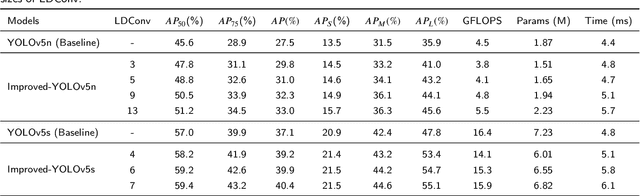
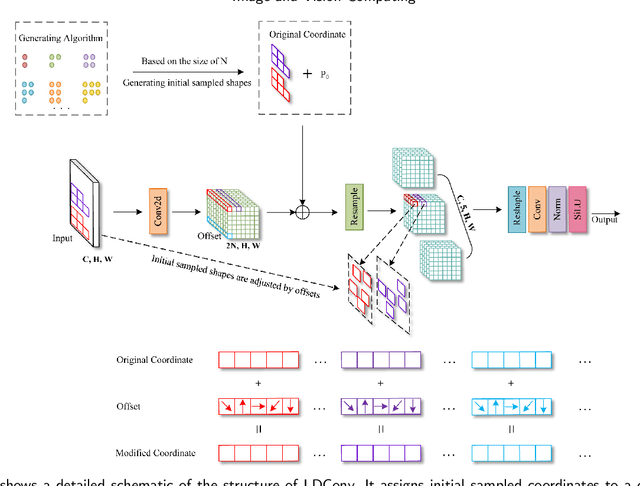
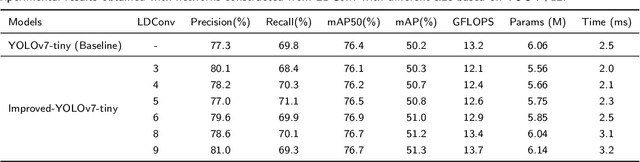
Neural networks based on convolutional operations have achieved remarkable results in the field of deep learning, but there are two inherent flaws in standard convolutional operations. On the one hand, the convolution operation be confined to a local window and cannot capture information from other locations, and its sampled shapes is fixed. On the other hand, the size of the convolutional kernel is fixed to k $\times$ k, which is a fixed square shape, and the number of parameters tends to grow squarely with size. It is obvious that the shape and size of targets are various in different datasets and at different locations. Convolutional kernels with fixed sample shapes and squares do not adapt well to changing targets. In response to the above questions, the Alterable Kernel Convolution (AKConv) is explored in this work, which gives the convolution kernel an arbitrary number of parameters and arbitrary sampled shapes to provide richer options for the trade-off between network overhead and performance. In AKConv, we define initial positions for convolutional kernels of arbitrary size by means of a new coordinate generation algorithm. To adapt to changes for targets, we introduce offsets to adjust the shape of the samples at each position. Moreover, we explore the effect of the neural network by using the AKConv with the same size and different initial sampled shapes. AKConv completes the process of efficient feature extraction by irregular convolutional operations and brings more exploration options for convolutional sampling shapes. Object detection experiments on representative datasets COCO2017, VOC 7+12 and VisDrone-DET2021 fully demonstrate the advantages of AKConv. AKConv can be used as a plug-and-play convolutional operation to replace convolutional operations to improve network performance. The code for the relevant tasks can be found at https://github.com/CV-ZhangXin/AKConv.
RFAConv: Innovating Spatial Attention and Standard Convolutional Operation
Apr 18, 2023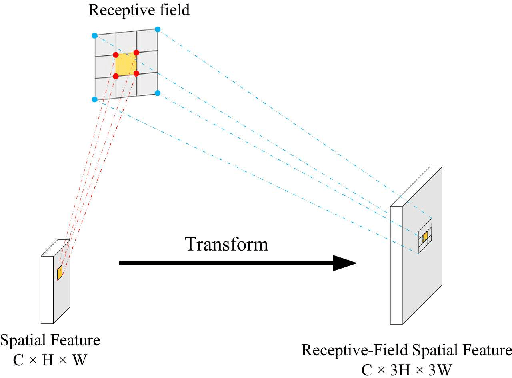
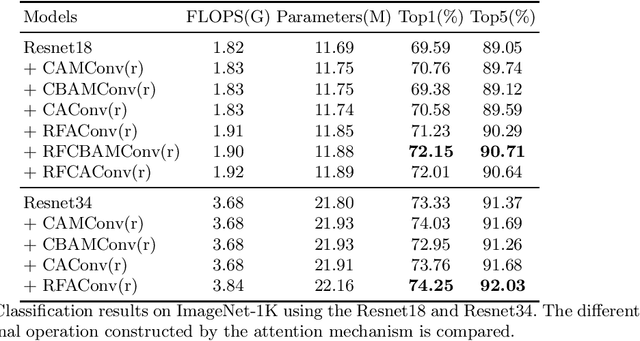
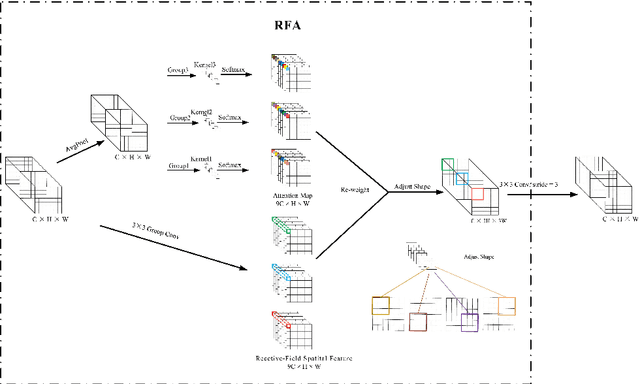
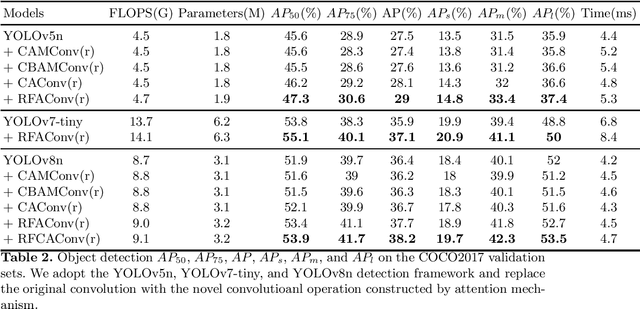
Spatial attention has been widely used to improve the performance of convolutional neural networks. However, it has certain limitations. In this paper, we propose a new perspective on the effectiveness of spatial attention, which is that the spatial attention mechanism essentially solves the problem of convolutional kernel parameter sharing. However, the information contained in the attention map generated by spatial attention is not sufficient for large-size convolutional kernels. Therefore, we propose a novel attention mechanism called Receptive-Field Attention (RFA). Existing spatial attention, such as Convolutional Block Attention Module (CBAM) and Coordinated Attention (CA) focus only on spatial features, which does not fully address the problem of convolutional kernel parameter sharing. In contrast, RFA not only focuses on the receptive-field spatial feature but also provides effective attention weights for large-size convolutional kernels. The Receptive-Field Attention convolutional operation (RFAConv), developed by RFA, represents a new approach to replace the standard convolution operation. It offers nearly negligible increment of computational cost and parameters, while significantly improving network performance. We conducted a series of experiments on ImageNet-1k, COCO, and VOC datasets to demonstrate the superiority of our approach. Of particular importance, we believe that it is time to shift focus from spatial features to receptive-field spatial features for current spatial attention mechanisms. In this way, we can further improve network performance and achieve even better results. The code and pre-trained models for the relevant tasks can be found at https://github.com/Liuchen1997/RFAConv.