 Add to Chrome
 Add to Firefox
 Add to Edge
SCoPE: Training-Free Audio-Visual Event Perception via Sparse Cross-Modal Prior Exchange
Aug 08, 2026
Audio-visual event perception (AVEP) determines which events occur in a video, when they occur, and whether they are audible, visible, or both. Training-free methods query new event vocabularies by matching frozen audio and visual features with text-encoded event names. However, related labels share evidence. An incorrect label can then score at least as high as a correct one. We call this a false co-activation (FCA). No scalar cutoff can reject the incorrect label while keeping every correct one. Class-specific thresholds may prevent that label from becoming a final prediction, but the FCA remains in the underlying score vector. We introduce SCoPE, a training-free framework in which all queried labels compete for shared evidence and each modality guides event selection in the other. We derive an exact condition for when this competition removes an FCA in a two-label fit. With identical frozen CLIP+CLAP backbones on LLP, SCoPE improves Type@seg by 7.45 points and Event@seg by 5.04 points compared with the reported AV$^2$A values. The same fixed configuration transfers unchanged to OV-AVEBench and VGGSound-AVEL100k.

Instruction-Tuned Language Models Cannot Sample from Distributions They Can Describe
Jul 28, 2026Silicon sampling uses language models as proxies for human survey respondents, treating each model call as an independent draw from the persona's response distribution. We show this draw does not exist: instruction-tuned models do not sample from distributions, they collapse to a single output. The same persona on the same question returns the same answer on more than half of items in a public-opinion benchmark. The collapse is sharp: the model's internal probabilities concentrate on a single option, and the failure is substantially amplified by instruction tuning: across three model families with materially different post-training pipelines, every instruction-tuned model fails on every task we test, while base models fail far less often. Strikingly, the same model that cannot sample from a distribution can describe it accurately in a single call. We call this gap the KNOWS/DOES split, and trace it to a degenerate sampling primitive visible in the logits and induced by alignment training. Exploiting this split, asking the model to describe the response distribution in one call more than halves the error against human survey data compared to persona aggregation. For applications that require per-persona outputs, we propose Prompt-Perturbed Argyle (PPA), which reduces the same error by 21% at no added cost.
Last But Not Least: Boundary Attention CalibratiON for Multimodal KV Cache Compression
Jun 16, 2026Multimodal Large Language Models (MLLMs) achieve strong vision-language reasoning, but long visual contexts enlarge the KV cache and increase decoding latency. Existing compression methods rely on observation window attention for stable token-importance estimation, yet this aggregation can dilute sparse visual evidence and discard answer-critical tokens under aggressive compression. Therefore, we identify last-query attention as a complementary source for recovering such evidence, but its answer-irrelevant signals can mislead retention. We propose BACON, a plug-and-play method that calibrates observation window attention with last-query evidence and suppresses isolated noise via intra-layer coherence and inter-layer persistence. Across diverse benchmarks, models, budgets, and compression methods, BACON improves multimodal KV compression by 7.5% on average under the most aggressive budget, with gains up to 30.9%. Our project page is available at https://ryu1ion.github.io/official_BACON/
LACO: Adaptive Latent Communication for Collaborative Driving
May 21, 2026Collaborative driving aims to improve safety and efficiency by enabling connected vehicles to coordinate under partial observability. Recent approaches have evolved from sharing visual features for perception to exchanging language-based reasoning through foundation models for behavioral coordination. Though communicating in language provides intuitive information, it introduces two challenges: high latency caused by autoregressive decoding and information loss caused by compressing rich internal representations into discrete tokens. To address these challenges, we analyze latent communication in collaborative driving under inherent limitations of multi-agent settings. Our analysis reveals agent identity confusion, where direct fusion of latent states entangles decision representations across vehicles. Motivated by this, we propose LACO, a training-free \textbf{LA}tent \textbf{CO}mmunication paradigm that seamlessly adapts pretrained driving models to collaborative settings. LACO introduces Iterative Latent Deliberation (ILD) for latent reasoning, Cross-Horizon Saliency Attribution (CHSA) for communication-efficient information selection, and Structured Semantic Knowledge Distillation (SSKD) to stabilize ego-centric decision making. Closed-loop experiments in CARLA show that LACO notably reduces communication and inference latency while maintaining strong collaborative driving performance.
Delta Forcing: Trust Region Steering for Interactive Autoregressive Video Generation
May 14, 2026Interactive real-time autoregressive video generation is essential for applications such as content creation and world modeling, where visual content must adapt to dynamically evolving event conditions. A fundamental challenge lies in balancing reactivity and stability: models must respond promptly to new events while maintaining temporal coherence over long horizons. Existing approaches distill bidirectional models into autoregressive generators and further adapt them via streaming long tuning, yet often exhibit persistent drift after condition changes. We identify the cause as conditional bias, where the teacher may provide condition-aligned but trajectory-agnostic guidance, biasing generation toward locally valid yet globally inconsistent modes. Inspired by Trust Region Policy Optimization, we propose Delta Forcing, a simple yet effective framework that constrains unreliable teacher supervision within an adaptive trust region. Specifically, Delta Forcing estimates transition consistency from the latent delta between teacher and generator trajectories, and uses it to balance teacher supervision with a monotonic continuity objective. This suppress unreliable teacher-induced shifts while preserving responsiveness to new events. Extensive experiments demonstrate that Delta Forcing significantly improves consistency while maintaining event reactivity.
DETACH : Decomposed Spatio-Temporal Alignment for Exocentric Video and Ambient Sensors with Staged Learning
Dec 23, 2025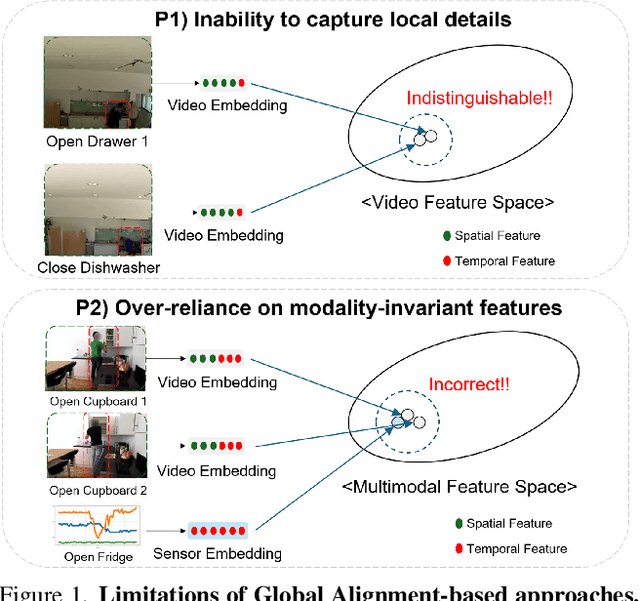

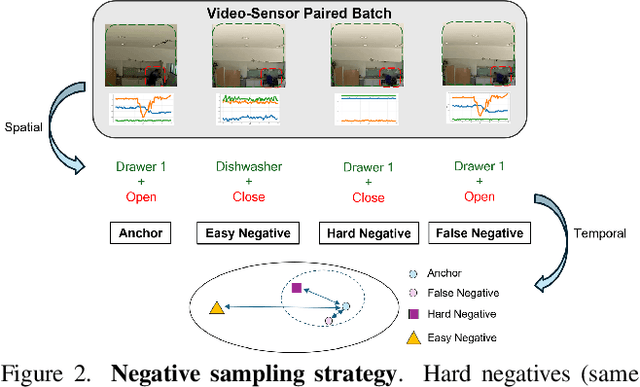
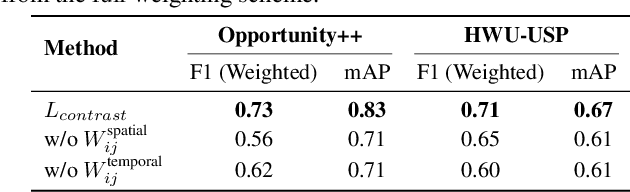
Aligning egocentric video with wearable sensors have shown promise for human action recognition, but face practical limitations in user discomfort, privacy concerns, and scalability. We explore exocentric video with ambient sensors as a non-intrusive, scalable alternative. While prior egocentric-wearable works predominantly adopt Global Alignment by encoding entire sequences into unified representations, this approach fails in exocentric-ambient settings due to two problems: (P1) inability to capture local details such as subtle motions, and (P2) over-reliance on modality-invariant temporal patterns, causing misalignment between actions sharing similar temporal patterns with different spatio-semantic contexts. To resolve these problems, we propose DETACH, a decomposed spatio-temporal framework. This explicit decomposition preserves local details, while our novel sensor-spatial features discovered via online clustering provide semantic grounding for context-aware alignment. To align the decomposed features, our two-stage approach establishes spatial correspondence through mutual supervision, then performs temporal alignment via a spatial-temporal weighted contrastive loss that adaptively handles easy negatives, hard negatives, and false negatives. Comprehensive experiments with downstream tasks on Opportunity++ and HWU-USP datasets demonstrate substantial improvements over adapted egocentric-wearable baselines.
Enhancing Regional Airbnb Trend Forecasting Using LLM-Based Embeddings of Accessibility and Human Mobility
Nov 18, 2025The expansion of short-term rental platforms, such as Airbnb, has significantly disrupted local housing markets, often leading to increased rental prices and housing affordability issues. Accurately forecasting regional Airbnb market trends can thus offer critical insights for policymakers and urban planners aiming to mitigate these impacts. This study proposes a novel time-series forecasting framework to predict three key Airbnb indicators -- Revenue, Reservation Days, and Number of Reservations -- at the regional level. Using a sliding-window approach, the model forecasts trends 1 to 3 months ahead. Unlike prior studies that focus on individual listings at fixed time points, our approach constructs regional representations by integrating listing features with external contextual factors such as urban accessibility and human mobility. We convert structured tabular data into prompt-based inputs for a Large Language Model (LLM), producing comprehensive regional embeddings. These embeddings are then fed into advanced time-series models (RNN, LSTM, Transformer) to better capture complex spatio-temporal dynamics. Experiments on Seoul's Airbnb dataset show that our method reduces both average RMSE and MAE by approximately 48% compared to conventional baselines, including traditional statistical and machine learning models. Our framework not only improves forecasting accuracy but also offers practical insights for detecting oversupplied regions and supporting data-driven urban policy decisions.
Background Fades, Foreground Leads: Curriculum-Guided Background Pruning for Efficient Foreground-Centric Collaborative Perception
Oct 22, 2025Collaborative perception enhances the reliability and spatial coverage of autonomous vehicles by sharing complementary information across vehicles, offering a promising solution to long-tail scenarios that challenge single-vehicle perception. However, the bandwidth constraints of vehicular networks make transmitting the entire feature map impractical. Recent methods, therefore, adopt a foreground-centric paradigm, transmitting only predicted foreground-region features while discarding the background, which encodes essential context. We propose FadeLead, a foreground-centric framework that overcomes this limitation by learning to encapsulate background context into compact foreground features during training. At the core of our design is a curricular learning strategy that leverages background cues early on but progressively prunes them away, forcing the model to internalize context into foreground representations without transmitting background itself. Extensive experiments on both simulated and real-world benchmarks show that FadeLead outperforms prior methods under different bandwidth settings, underscoring the effectiveness of context-enriched foreground sharing.
Feature Augmentation based Test-Time Adaptation
Oct 18, 2024Test-time adaptation (TTA) allows a model to be adapted to an unseen domain without accessing the source data. Due to the nature of practical environments, TTA has a limited amount of data for adaptation. Recent TTA methods further restrict this by filtering input data for reliability, making the effective data size even smaller and limiting adaptation potential. To address this issue, We propose Feature Augmentation based Test-time Adaptation (FATA), a simple method that fully utilizes the limited amount of input data through feature augmentation. FATA employs Normalization Perturbation to augment features and adapts the model using the FATA loss, which makes the outputs of the augmented and original features similar. FATA is model-agnostic and can be seamlessly integrated into existing models without altering the model architecture. We demonstrate the effectiveness of FATA on various models and scenarios on ImageNet-C and Office-Home, validating its superiority in diverse real-world conditions.
Multiple Areal Feature Aware Transportation Demand Prediction
Aug 23, 2024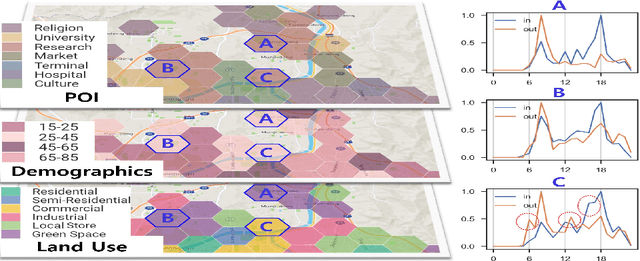
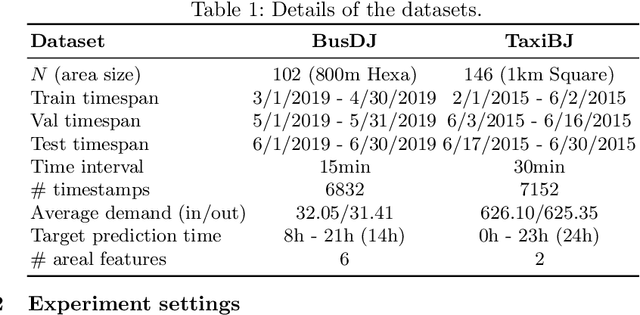
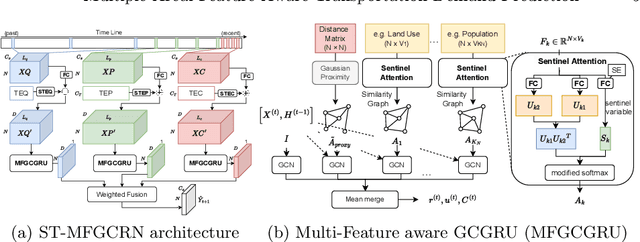
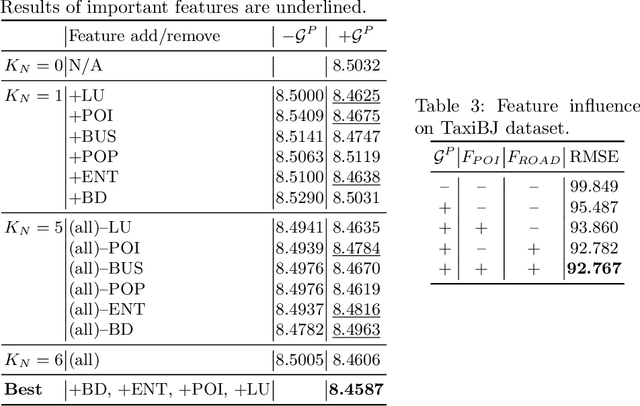
A reliable short-term transportation demand prediction supports the authorities in improving the capability of systems by optimizing schedules, adjusting fleet sizes, and generating new transit networks. A handful of research efforts incorporate one or a few areal features while learning spatio-temporal correlation, to capture similar demand patterns between similar areas. However, urban characteristics are polymorphic, and they need to be understood by multiple areal features such as land use, sociodemographics, and place-of-interest (POI) distribution. In this paper, we propose a novel spatio-temporal multi-feature-aware graph convolutional recurrent network (ST-MFGCRN) that fuses multiple areal features during spatio-temproal understanding. Inside ST-MFGCRN, we devise sentinel attention to calculate the areal similarity matrix by allowing each area to take partial attention if the feature is not useful. We evaluate the proposed model on two real-world transportation datasets, one with our constructed BusDJ dataset and one with benchmark TaxiBJ. Results show that our model outperforms the state-of-the-art baselines up to 7\% on BusDJ and 8\% on TaxiBJ dataset.