 Add to Chrome
 Add to Firefox
 Add to Edge
MMGRec: Multimodal Generative Recommendation with Transformer Model
Apr 25, 2024
Multimodal recommendation aims to recommend user-preferred candidates based on her/his historically interacted items and associated multimodal information. Previous studies commonly employ an embed-and-retrieve paradigm: learning user and item representations in the same embedding space, then retrieving similar candidate items for a user via embedding inner product. However, this paradigm suffers from inference cost, interaction modeling, and false-negative issues. Toward this end, we propose a new MMGRec model to introduce a generative paradigm into multimodal recommendation. Specifically, we first devise a hierarchical quantization method Graph RQ-VAE to assign Rec-ID for each item from its multimodal and CF information. Consisting of a tuple of semantically meaningful tokens, Rec-ID serves as the unique identifier of each item. Afterward, we train a Transformer-based recommender to generate the Rec-IDs of user-preferred items based on historical interaction sequences. The generative paradigm is qualified since this model systematically predicts the tuple of tokens identifying the recommended item in an autoregressive manner. Moreover, a relation-aware self-attention mechanism is devised for the Transformer to handle non-sequential interaction sequences, which explores the element pairwise relation to replace absolute positional encoding. Extensive experiments evaluate MMGRec's effectiveness compared with state-of-the-art methods.

Augmented CARDS: A machine learning approach to identifying triggers of climate change misinformation on Twitter
Apr 24, 2024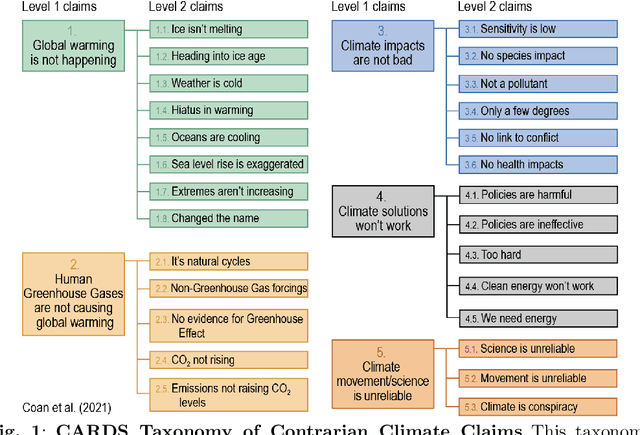
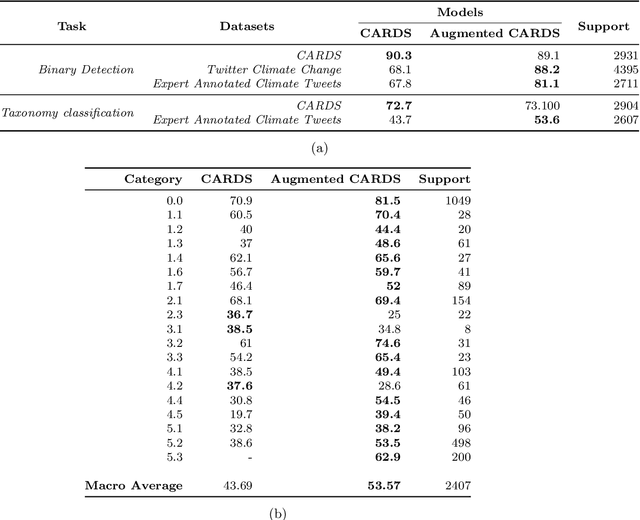
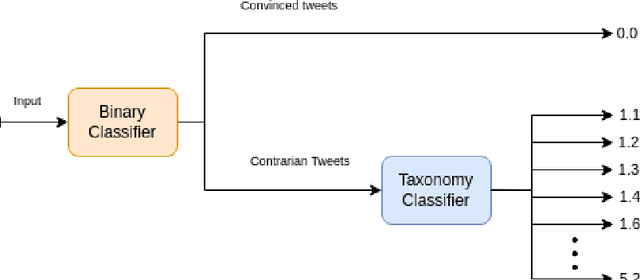
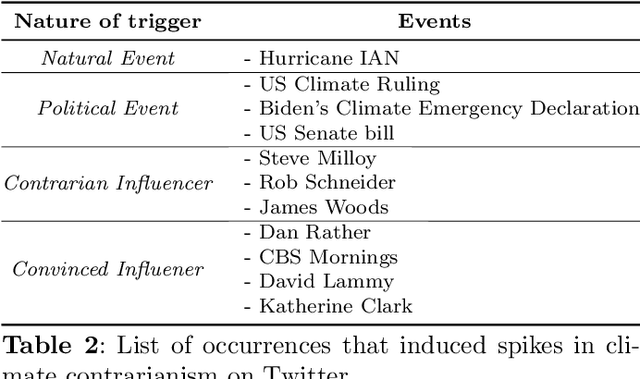
Misinformation about climate change poses a significant threat to societal well-being, prompting the urgent need for effective mitigation strategies. However, the rapid proliferation of online misinformation on social media platforms outpaces the ability of fact-checkers to debunk false claims. Automated detection of climate change misinformation offers a promising solution. In this study, we address this gap by developing a two-step hierarchical model, the Augmented CARDS model, specifically designed for detecting contrarian climate claims on Twitter. Furthermore, we apply the Augmented CARDS model to five million climate-themed tweets over a six-month period in 2022. We find that over half of contrarian climate claims on Twitter involve attacks on climate actors or conspiracy theories. Spikes in climate contrarianism coincide with one of four stimuli: political events, natural events, contrarian influencers, or convinced influencers. Implications for automated responses to climate misinformation are discussed.
Double Mixture: Towards Continual Event Detection from Speech
Apr 20, 2024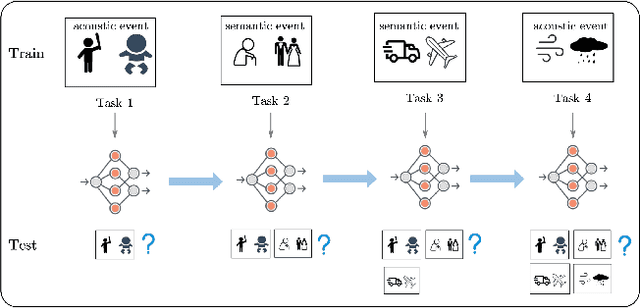
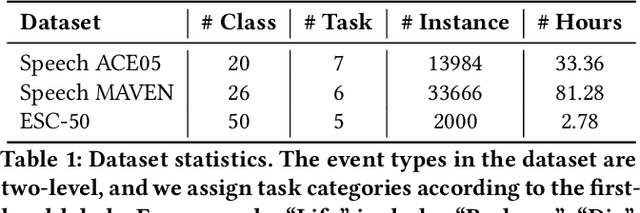
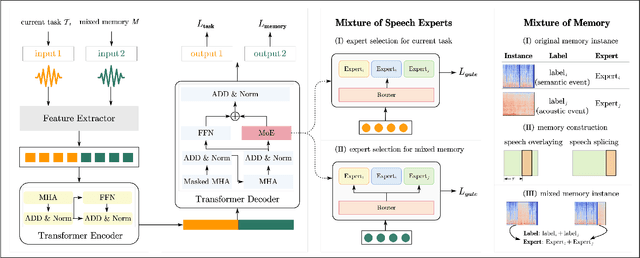
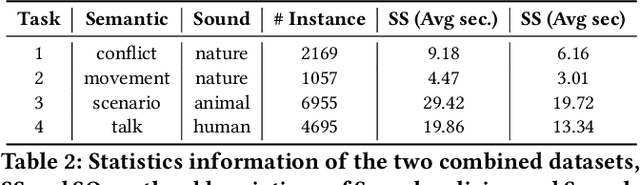
Speech event detection is crucial for multimedia retrieval, involving the tagging of both semantic and acoustic events. Traditional ASR systems often overlook the interplay between these events, focusing solely on content, even though the interpretation of dialogue can vary with environmental context. This paper tackles two primary challenges in speech event detection: the continual integration of new events without forgetting previous ones, and the disentanglement of semantic from acoustic events. We introduce a new task, continual event detection from speech, for which we also provide two benchmark datasets. To address the challenges of catastrophic forgetting and effective disentanglement, we propose a novel method, 'Double Mixture.' This method merges speech expertise with robust memory mechanisms to enhance adaptability and prevent forgetting. Our comprehensive experiments show that this task presents significant challenges that are not effectively addressed by current state-of-the-art methods in either computer vision or natural language processing. Our approach achieves the lowest rates of forgetting and the highest levels of generalization, proving robust across various continual learning sequences. Our code and data are available at https://anonymous.4open.science/status/Continual-SpeechED-6461.
HGT: Leveraging Heterogeneous Graph-enhanced Large Language Models for Few-shot Complex Table Understanding
Mar 28, 2024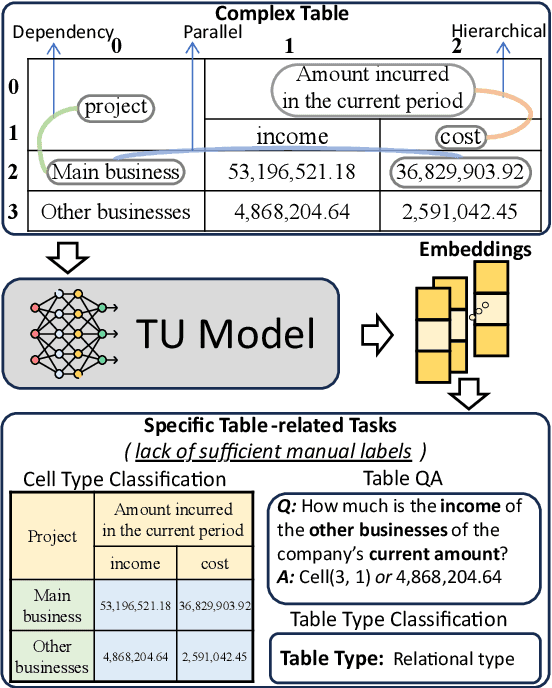
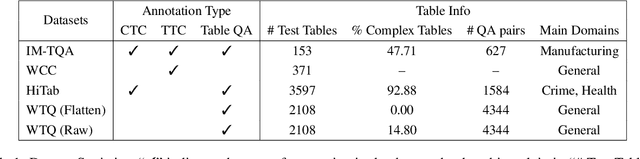
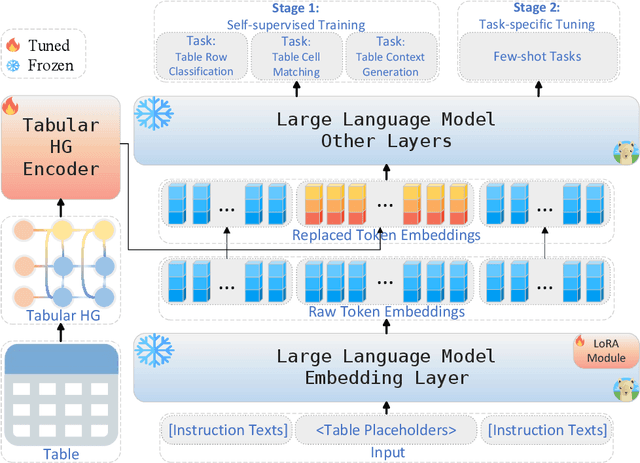

Table understanding (TU) has achieved promising advancements, but it faces the challenges of the scarcity of manually labeled tables and the presence of complex table structures.To address these challenges, we propose HGT, a framework with a heterogeneous graph (HG)-enhanced large language model (LLM) to tackle few-shot TU tasks.It leverages the LLM by aligning the table semantics with the LLM's parametric knowledge through soft prompts and instruction turning and deals with complex tables by a multi-task pre-training scheme involving three novel multi-granularity self-supervised HG pre-training objectives.We empirically demonstrate the effectiveness of HGT, showing that it outperforms the SOTA for few-shot complex TU on several benchmarks.
Modelling Political Coalition Negotiations Using LLM-based Agents
Feb 18, 2024

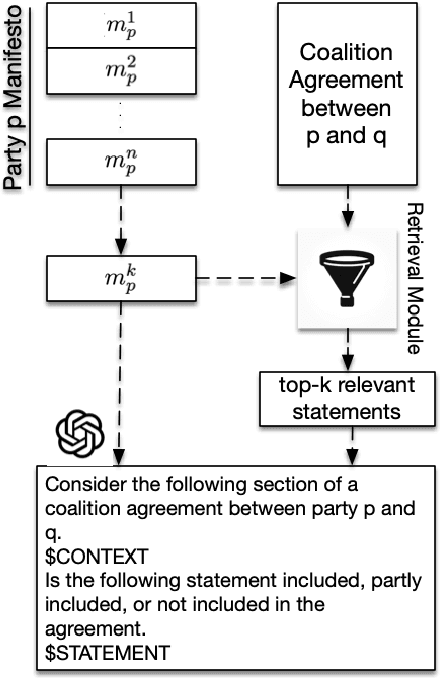
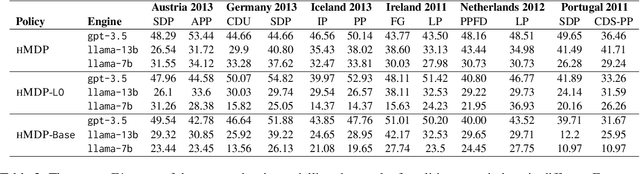
Coalition negotiations are a cornerstone of parliamentary democracies, characterised by complex interactions and strategic communications among political parties. Despite its significance, the modelling of these negotiations has remained unexplored with the domain of Natural Language Processing (NLP), mostly due to lack of proper data. In this paper, we introduce coalition negotiations as a novel NLP task, and model it as a negotiation between large language model-based agents. We introduce a multilingual dataset, POLCA, comprising manifestos of European political parties and coalition agreements over a number of elections in these countries. This dataset addresses the challenge of the current scope limitations in political negotiation modelling by providing a diverse, real-world basis for simulation. Additionally, we propose a hierarchical Markov decision process designed to simulate the process of coalition negotiation between political parties and predict the outcomes. We evaluate the performance of state-of-the-art large language models (LLMs) as agents in handling coalition negotiations, offering insights into their capabilities and paving the way for future advancements in political modelling.
Direct Evaluation of Chain-of-Thought in Multi-hop Reasoning with Knowledge Graphs
Feb 17, 2024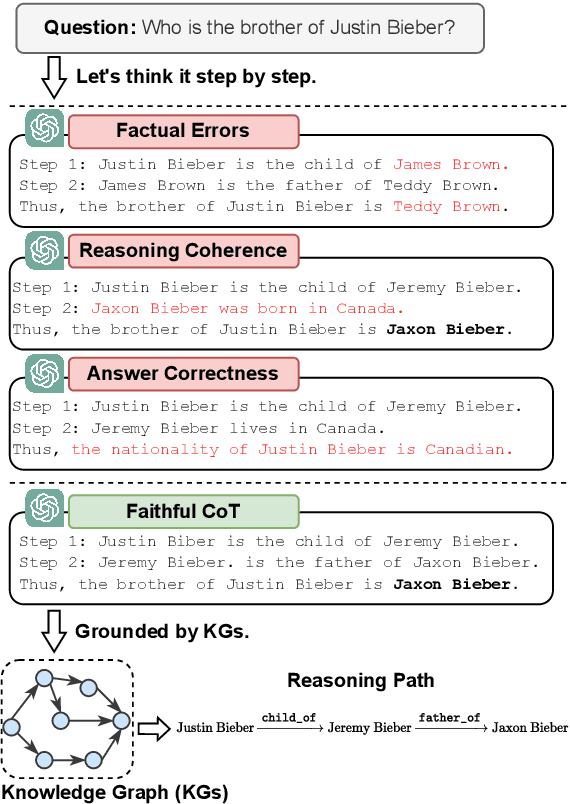
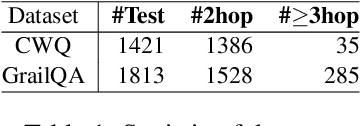
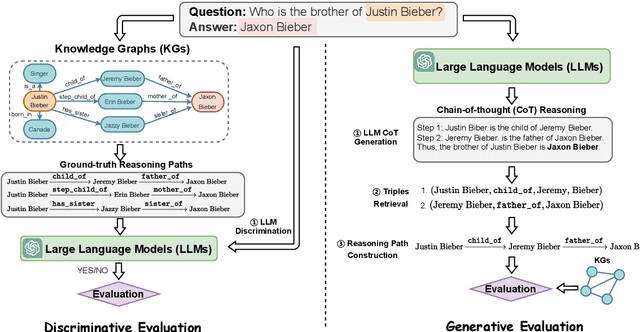
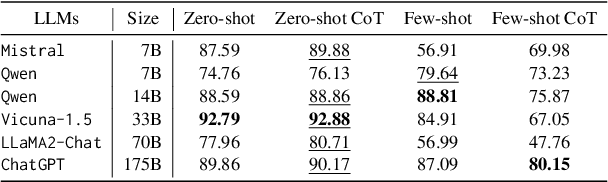
Large language models (LLMs) demonstrate strong reasoning abilities when prompted to generate chain-of-thought (CoT) explanations alongside answers. However, previous research on evaluating LLMs has solely focused on answer accuracy, neglecting the correctness of the generated CoT. In this paper, we delve deeper into the CoT reasoning capabilities of LLMs in multi-hop question answering by utilizing knowledge graphs (KGs). We propose a novel discriminative and generative CoT evaluation paradigm to assess LLMs' knowledge of reasoning and the accuracy of the generated CoT. Through experiments conducted on 5 different families of LLMs across 2 multi-hop question-answering datasets, we find that LLMs possess sufficient knowledge to perform reasoning. However, there exists a significant disparity between answer accuracy and faithfulness of the CoT reasoning generated by LLMs, indicating that they often arrive at correct answers through incorrect reasoning.
Continual Learning for Large Language Models: A Survey
Feb 07, 2024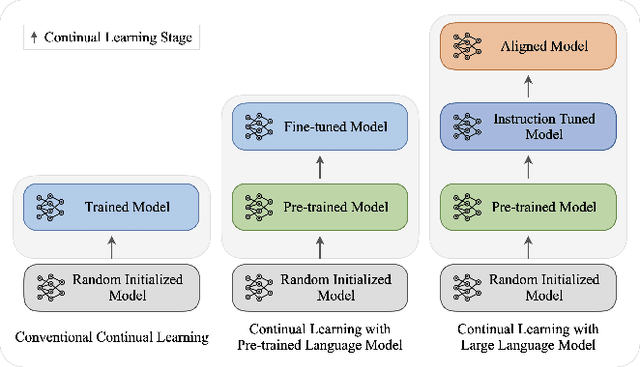
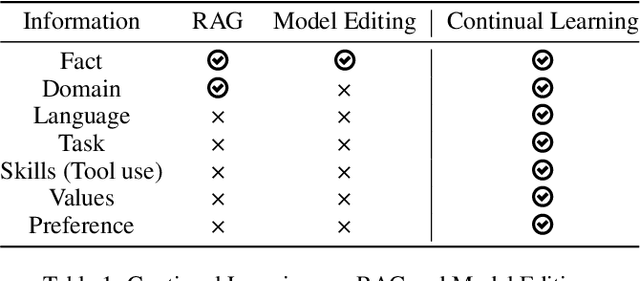
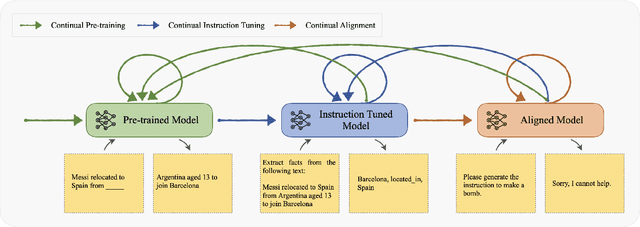

Large language models (LLMs) are not amenable to frequent re-training, due to high training costs arising from their massive scale. However, updates are necessary to endow LLMs with new skills and keep them up-to-date with rapidly evolving human knowledge. This paper surveys recent works on continual learning for LLMs. Due to the unique nature of LLMs, we catalog continue learning techniques in a novel multi-staged categorization scheme, involving continual pretraining, instruction tuning, and alignment. We contrast continual learning for LLMs with simpler adaptation methods used in smaller models, as well as with other enhancement strategies like retrieval-augmented generation and model editing. Moreover, informed by a discussion of benchmarks and evaluation, we identify several challenges and future work directions for this crucial task.
Towards Event Extraction from Speech with Contextual Clues
Jan 27, 2024While text-based event extraction has been an active research area and has seen successful application in many domains, extracting semantic events from speech directly is an under-explored problem. In this paper, we introduce the Speech Event Extraction (SpeechEE) task and construct three synthetic training sets and one human-spoken test set. Compared to event extraction from text, SpeechEE poses greater challenges mainly due to complex speech signals that are continuous and have no word boundaries. Additionally, unlike perceptible sound events, semantic events are more subtle and require a deeper understanding. To tackle these challenges, we introduce a sequence-to-structure generation paradigm that can produce events from speech signals in an end-to-end manner, together with a conditioned generation method that utilizes speech recognition transcripts as the contextual clue. We further propose to represent events with a flat format to make outputs more natural language-like. Our experimental results show that our method brings significant improvements on all datasets, achieving a maximum F1 gain of 10.7%. The code and datasets are released on https://github.com/jodie-kang/SpeechEE.
Towards Lifelong Scene Graph Generation with Knowledge-ware In-context Prompt Learning
Jan 26, 2024Scene graph generation (SGG) endeavors to predict visual relationships between pairs of objects within an image. Prevailing SGG methods traditionally assume a one-off learning process for SGG. This conventional paradigm may necessitate repetitive training on all previously observed samples whenever new relationships emerge, mitigating the risk of forgetting previously acquired knowledge. This work seeks to address this pitfall inherent in a suite of prior relationship predictions. Motivated by the achievements of in-context learning in pretrained language models, our approach imbues the model with the capability to predict relationships and continuously acquire novel knowledge without succumbing to catastrophic forgetting. To achieve this goal, we introduce a novel and pragmatic framework for scene graph generation, namely Lifelong Scene Graph Generation (LSGG), where tasks, such as predicates, unfold in a streaming fashion. In this framework, the model is constrained to exclusive training on the present task, devoid of access to previously encountered training data, except for a limited number of exemplars, but the model is tasked with inferring all predicates it has encountered thus far. Rigorous experiments demonstrate the superiority of our proposed method over state-of-the-art SGG models in the context of LSGG across a diverse array of metrics. Besides, extensive experiments on the two mainstream benchmark datasets, VG and Open-Image(v6), show the superiority of our proposed model to a number of competitive SGG models in terms of continuous learning and conventional settings. Moreover, comprehensive ablation experiments demonstrate the effectiveness of each component in our model.
Latte: Latent Diffusion Transformer for Video Generation
Jan 05, 2024
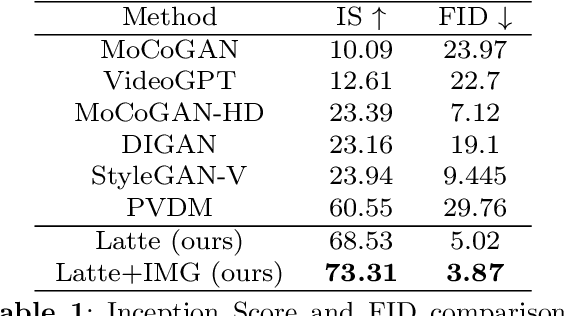

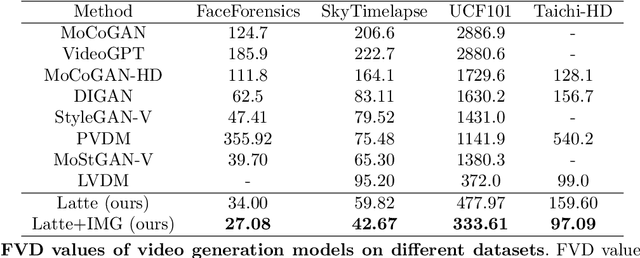
We propose a novel Latent Diffusion Transformer, namely Latte, for video generation. Latte first extracts spatio-temporal tokens from input videos and then adopts a series of Transformer blocks to model video distribution in the latent space. In order to model a substantial number of tokens extracted from videos, four efficient variants are introduced from the perspective of decomposing the spatial and temporal dimensions of input videos. To improve the quality of generated videos, we determine the best practices of Latte through rigorous experimental analysis, including video clip patch embedding, model variants, timestep-class information injection, temporal positional embedding, and learning strategies. Our comprehensive evaluation demonstrates that Latte achieves state-of-the-art performance across four standard video generation datasets, i.e., FaceForensics, SkyTimelapse, UCF101, and Taichi-HD. In addition, we extend Latte to text-to-video generation (T2V) task, where Latte achieves comparable results compared to recent T2V models. We strongly believe that Latte provides valuable insights for future research on incorporating Transformers into diffusion models for video generation.