 Add to Chrome
 Add to Firefox
 Add to Edge
How Robust Are Large Language Models for Clinical Numeracy? An Empirical Study on Numerical Reasoning Abilities in Clinical Contexts
Apr 13, 2026
Large Language Models (LLMs) are increasingly being explored for clinical question answering and decision support, yet safe deployment critically requires reliable handling of patient measurements in heterogeneous clinical notes. Existing evaluations of LLMs for clinical numerical reasoning provide limited operation-level coverage, restricted primarily to arithmetic computation, and rarely assess the robustness of numerical understanding across clinical note formats. We introduce ClinicNumRobBench, a benchmark of 1,624 context-question instances with ground-truth answers that evaluates four main types of clinical numeracy: value retrieval, arithmetic computation, relational comparison, and aggregation. To stress-test robustness, ClinicNumRobBench presents longitudinal MIMIC-IV vital-sign records in three semantically equivalent representations, including a real-world note-style variant derived from the Open Patients dataset, and instantiates queries using 42 question templates. Experiments on 14 LLMs show that value retrieval is generally strong, with most models exceeding 85% accuracy, while relational comparison and aggregation remain challenging, with some models scoring below 15%. Fine-tuning on medical data can reduce numeracy relative to base models by over 30%, and performance drops under note-style variation indicate LLM sensitivity to format. ClinicNumRobBench offers a rigorous testbed for clinically reliable numerical reasoning. Code and data URL are available on https://github.com/MinhVuong2000/ClinicNumRobBench.

Direct Evaluation of Chain-of-Thought in Multi-hop Reasoning with Knowledge Graphs
Feb 17, 2024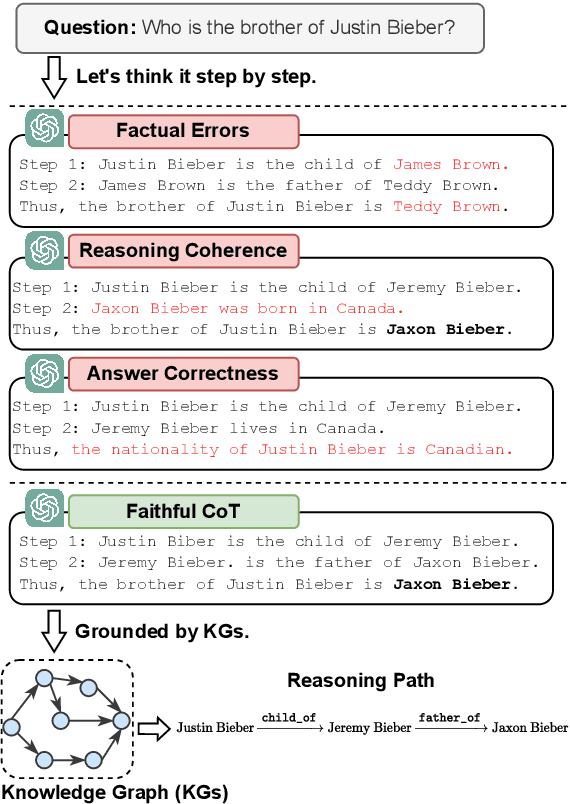
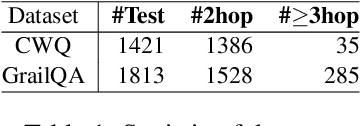
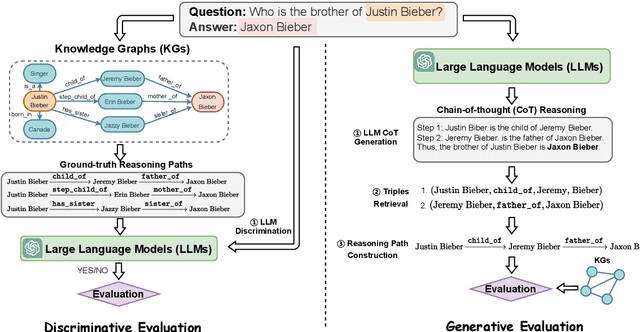
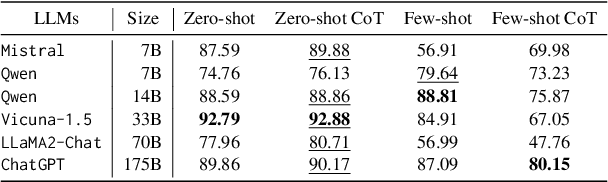
Large language models (LLMs) demonstrate strong reasoning abilities when prompted to generate chain-of-thought (CoT) explanations alongside answers. However, previous research on evaluating LLMs has solely focused on answer accuracy, neglecting the correctness of the generated CoT. In this paper, we delve deeper into the CoT reasoning capabilities of LLMs in multi-hop question answering by utilizing knowledge graphs (KGs). We propose a novel discriminative and generative CoT evaluation paradigm to assess LLMs' knowledge of reasoning and the accuracy of the generated CoT. Through experiments conducted on 5 different families of LLMs across 2 multi-hop question-answering datasets, we find that LLMs possess sufficient knowledge to perform reasoning. However, there exists a significant disparity between answer accuracy and faithfulness of the CoT reasoning generated by LLMs, indicating that they often arrive at correct answers through incorrect reasoning.