 Add to Chrome
 Add to Firefox
 Add to Edge
DHCP: Detecting Hallucinations by Cross-modal Attention Pattern in Large Vision-Language Models
Nov 27, 2024


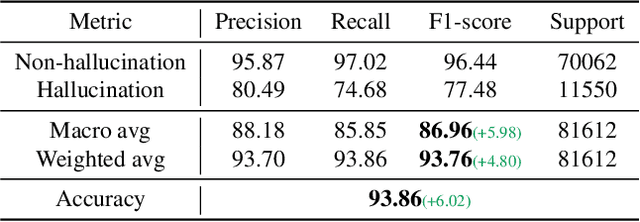
Large vision-language models (LVLMs) have demonstrated exceptional performance on complex multimodal tasks. However, they continue to suffer from significant hallucination issues, including object, attribute, and relational hallucinations. To accurately detect these hallucinations, we investigated the variations in cross-modal attention patterns between hallucination and non-hallucination states. Leveraging these distinctions, we developed a lightweight detector capable of identifying hallucinations. Our proposed method, Detecting Hallucinations by Cross-modal Attention Patterns (DHCP), is straightforward and does not require additional LVLM training or extra LVLM inference steps. Experimental results show that DHCP achieves remarkable performance in hallucination detection. By offering novel insights into the identification and analysis of hallucinations in LVLMs, DHCP contributes to advancing the reliability and trustworthiness of these models.

LiteVAR: Compressing Visual Autoregressive Modelling with Efficient Attention and Quantization
Nov 26, 2024Visual Autoregressive (VAR) has emerged as a promising approach in image generation, offering competitive potential and performance comparable to diffusion-based models. However, current AR-based visual generation models require substantial computational resources, limiting their applicability on resource-constrained devices. To address this issue, we conducted analysis and identified significant redundancy in three dimensions of the VAR model: (1) the attention map, (2) the attention outputs when using classifier free guidance, and (3) the data precision. Correspondingly, we proposed efficient attention mechanism and low-bit quantization method to enhance the efficiency of VAR models while maintaining performance. With negligible performance lost (less than 0.056 FID increase), we could achieve 85.2% reduction in attention computation, 50% reduction in overall memory and 1.5x latency reduction. To ensure deployment feasibility, we developed efficient training-free compression techniques and analyze the deployment feasibility and efficiency gain of each technique.
ΩSFormer: Dual-Modal Ω-like Super-Resolution Transformer Network for Cross-scale and High-accuracy Terraced Field Vectorization Extraction
Nov 26, 2024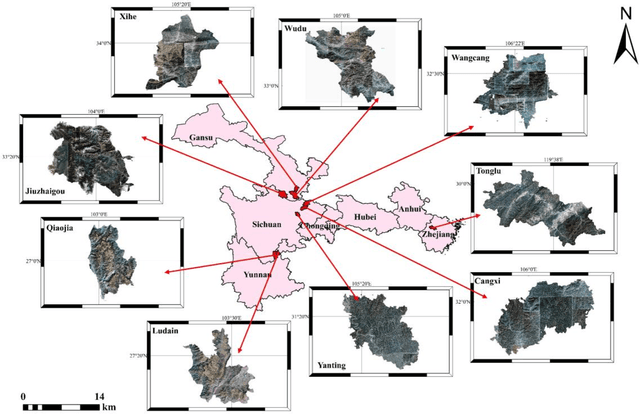


Terraced field is a significant engineering practice for soil and water conservation (SWC). Terraced field extraction from remotely sensed imagery is the foundation for monitoring and evaluating SWC. This study is the first to propose a novel dual-modal {\Omega}-like super-resolution Transformer network for intelligent TFVE, offering the following advantages: (1) reducing edge segmentation error from conventional multi-scale downsampling encoder, through fusing original high-resolution features with downsampling features at each step of encoder and leveraging a multi-head attention mechanism; (2) improving the accuracy of TFVE by proposing a {\Omega}-like network structure, which fully integrates rich high-level features from both spectral and terrain data to form cross-scale super-resolution features; (3) validating an optimal fusion scheme for cross-modal and cross-scale (i.e., inconsistent spatial resolution between remotely sensed imagery and DEM) super-resolution feature extraction; (4) mitigating uncertainty between segmentation edge pixels by a coarse-to-fine and spatial topological semantic relationship optimization (STSRO) segmentation strategy; (5) leveraging contour vibration neural network to continuously optimize parameters and iteratively vectorize terraced fields from semantic segmentation results. Moreover, a DMRVD for deep-learning-based TFVE was created for the first time, which covers nine study areas in four provinces of China, with a total coverage area of 22441 square kilometers. To assess the performance of {\Omega}SFormer, classic and SOTA networks were compared. The mIOU of {\Omega}SFormer has improved by 0.165, 0.297 and 0.128 respectively, when compared with best accuracy single-modal remotely sensed imagery, single-modal DEM and dual-modal result.
Glo-In-One-v2: Holistic Identification of Glomerular Cells, Tissues, and Lesions in Human and Mouse Histopathology
Nov 25, 2024Segmenting glomerular intraglomerular tissue and lesions traditionally depends on detailed morphological evaluations by expert nephropathologists, a labor-intensive process susceptible to interobserver variability. Our group previously developed the Glo-In-One toolkit for integrated detection and segmentation of glomeruli. In this study, we leverage the Glo-In-One toolkit to version 2 with fine-grained segmentation capabilities, curating 14 distinct labels for tissue regions, cells, and lesions across a dataset of 23,529 annotated glomeruli across human and mouse histopathology data. To our knowledge, this dataset is among the largest of its kind to date.In this study, we present a single dynamic head deep learning architecture designed to segment 14 classes within partially labeled images of human and mouse pathology data. Our model was trained using a training set derived from 368 annotated kidney whole-slide images (WSIs) to identify 5 key intraglomerular tissues covering Bowman's capsule, glomerular tuft, mesangium, mesangial cells, and podocytes. Additionally, the network segments 9 glomerular lesion classes including adhesion, capsular drop, global sclerosis, hyalinosis, mesangial lysis, microaneurysm, nodular sclerosis, mesangial expansion, and segmental sclerosis. The glomerulus segmentation model achieved a decent performance compared with baselines, and achieved a 76.5 % average Dice Similarity Coefficient (DSC). Additional, transfer learning from rodent to human for glomerular lesion segmentation model has enhanced the average segmentation accuracy across different types of lesions by more than 3 %, as measured by Dice scores. The Glo-In-One-v2 model and trained weight have been made publicly available at https: //github.com/hrlblab/Glo-In-One_v2.
Continual SFT Matches Multimodal RLHF with Negative Supervision
Nov 22, 2024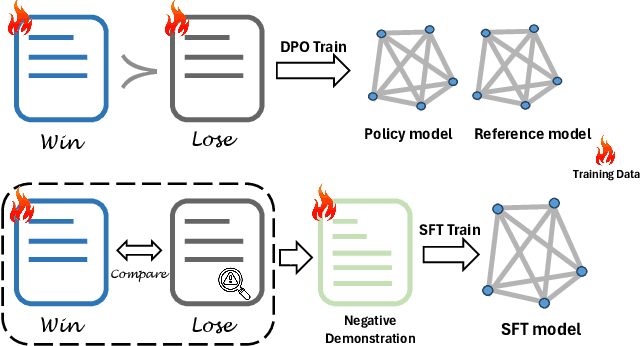

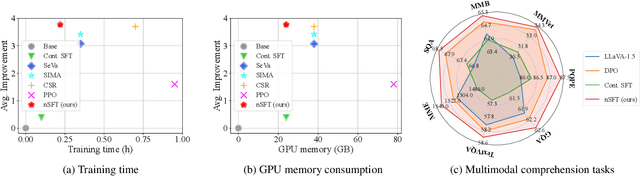

Multimodal RLHF usually happens after supervised finetuning (SFT) stage to continually improve vision-language models' (VLMs) comprehension. Conventional wisdom holds its superiority over continual SFT during this preference alignment stage. In this paper, we observe that the inherent value of multimodal RLHF lies in its negative supervision, the logit of the rejected responses. We thus propose a novel negative supervised finetuning (nSFT) approach that fully excavates these information resided. Our nSFT disentangles this negative supervision in RLHF paradigm, and continually aligns VLMs with a simple SFT loss. This is more memory efficient than multimodal RLHF where 2 (e.g., DPO) or 4 (e.g., PPO) large VLMs are strictly required. The effectiveness of nSFT is rigorously proved by comparing it with various multimodal RLHF approaches, across different dataset sources, base VLMs and evaluation metrics. Besides, fruitful of ablations are provided to support our hypothesis. We hope this paper will stimulate further research to properly align large vision language models.
Neural Internal Model Control: Learning a Robust Control Policy via Predictive Error Feedback
Nov 20, 2024


Accurate motion control in the face of disturbances within complex environments remains a major challenge in robotics. Classical model-based approaches often struggle with nonlinearities and unstructured disturbances, while RL-based methods can be fragile when encountering unseen scenarios. In this paper, we propose a novel framework, Neural Internal Model Control, which integrates model-based control with RL-based control to enhance robustness. Our framework streamlines the predictive model by applying Newton-Euler equations for rigid-body dynamics, eliminating the need to capture complex high-dimensional nonlinearities. This internal model combines model-free RL algorithms with predictive error feedback. Such a design enables a closed-loop control structure to enhance the robustness and generalizability of the control system. We demonstrate the effectiveness of our framework on both quadrotors and quadrupedal robots, achieving superior performance compared to state-of-the-art methods. Furthermore, real-world deployment on a quadrotor with rope-suspended payloads highlights the framework's robustness in sim-to-real transfer. Our code is released at https://github.com/thu-uav/NeuralIMC.
Towards Accurate and Efficient Sub-8-Bit Integer Training
Nov 17, 2024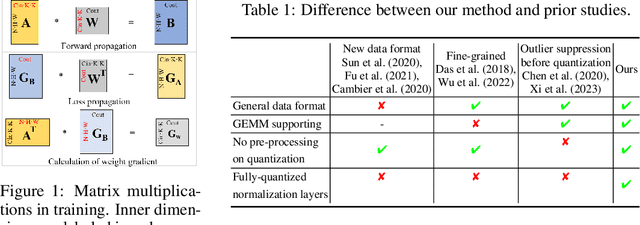
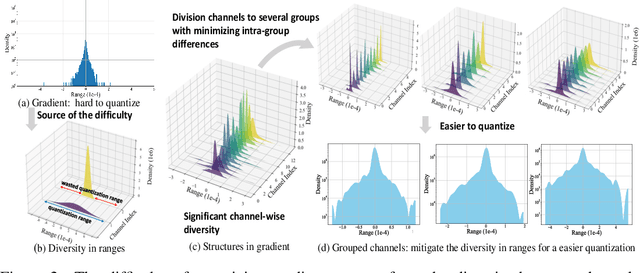
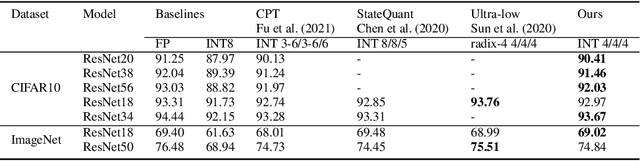
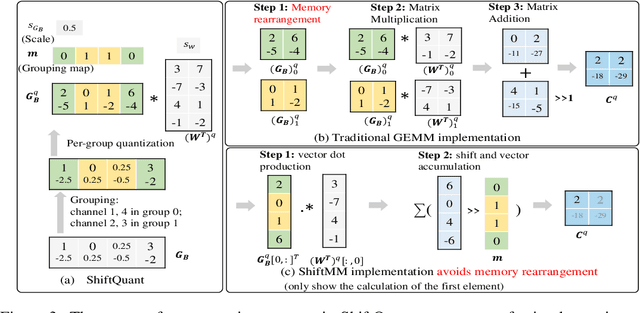
Neural network training is a memory- and compute-intensive task. Quantization, which enables low-bitwidth formats in training, can significantly mitigate the workload. To reduce quantization error, recent methods have developed new data formats and additional pre-processing operations on quantizers. However, it remains quite challenging to achieve high accuracy and efficiency simultaneously. In this paper, we explore sub-8-bit integer training from its essence of gradient descent optimization. Our integer training framework includes two components: ShiftQuant to realize accurate gradient estimation, and L1 normalization to smoothen the loss landscape. ShiftQuant attains performance that approaches the theoretical upper bound of group quantization. Furthermore, it liberates group quantization from inefficient memory rearrangement. The L1 normalization facilitates the implementation of fully quantized normalization layers with impressive convergence accuracy. Our method frees sub-8-bit integer training from pre-processing and supports general devices. This framework achieves negligible accuracy loss across various neural networks and tasks ($0.92\%$ on 4-bit ResNets, $0.61\%$ on 6-bit Transformers). The prototypical implementation of ShiftQuant achieves more than $1.85\times/15.3\%$ performance improvement on CPU/GPU compared to its FP16 counterparts, and $33.9\%$ resource consumption reduction on FPGA than the FP16 counterparts. The proposed fully-quantized L1 normalization layers achieve more than $35.54\%$ improvement in throughout on CPU compared to traditional L2 normalization layers. Moreover, theoretical analysis verifies the advancement of our method.
WelQrate: Defining the Gold Standard in Small Molecule Drug Discovery Benchmarking
Nov 14, 2024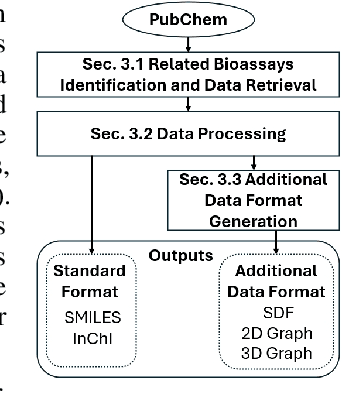
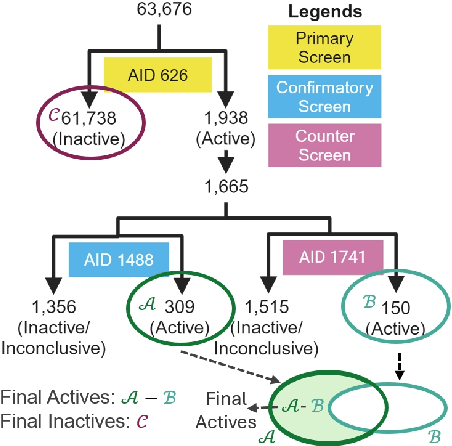
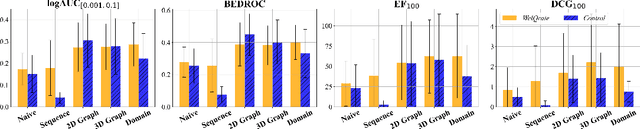
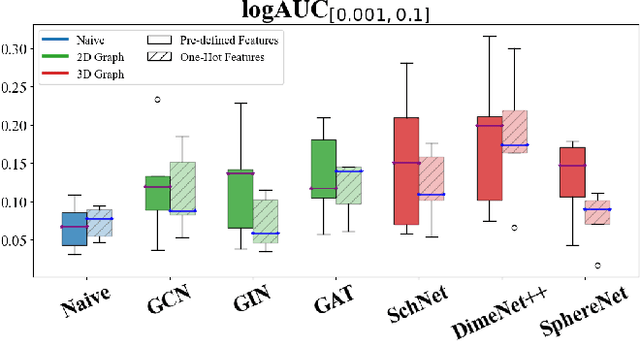
While deep learning has revolutionized computer-aided drug discovery, the AI community has predominantly focused on model innovation and placed less emphasis on establishing best benchmarking practices. We posit that without a sound model evaluation framework, the AI community's efforts cannot reach their full potential, thereby slowing the progress and transfer of innovation into real-world drug discovery. Thus, in this paper, we seek to establish a new gold standard for small molecule drug discovery benchmarking, WelQrate. Specifically, our contributions are threefold: WelQrate Dataset Collection - we introduce a meticulously curated collection of 9 datasets spanning 5 therapeutic target classes. Our hierarchical curation pipelines, designed by drug discovery experts, go beyond the primary high-throughput screen by leveraging additional confirmatory and counter screens along with rigorous domain-driven preprocessing, such as Pan-Assay Interference Compounds (PAINS) filtering, to ensure the high-quality data in the datasets; WelQrate Evaluation Framework - we propose a standardized model evaluation framework considering high-quality datasets, featurization, 3D conformation generation, evaluation metrics, and data splits, which provides a reliable benchmarking for drug discovery experts conducting real-world virtual screening; Benchmarking - we evaluate model performance through various research questions using the WelQrate dataset collection, exploring the effects of different models, dataset quality, featurization methods, and data splitting strategies on the results. In summary, we recommend adopting our proposed WelQrate as the gold standard in small molecule drug discovery benchmarking. The WelQrate dataset collection, along with the curation codes, and experimental scripts are all publicly available at WelQrate.org.
AuscultaBase: A Foundational Step Towards AI-Powered Body Sound Diagnostics
Nov 12, 2024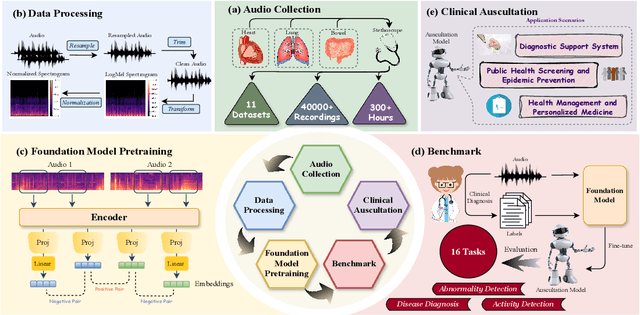
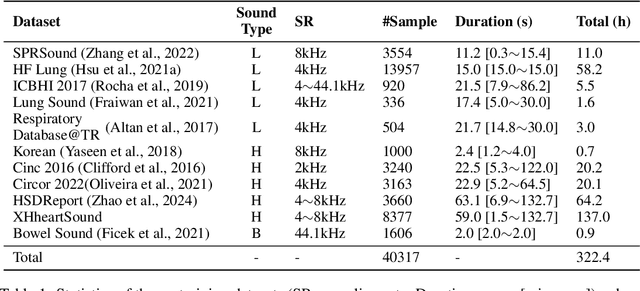
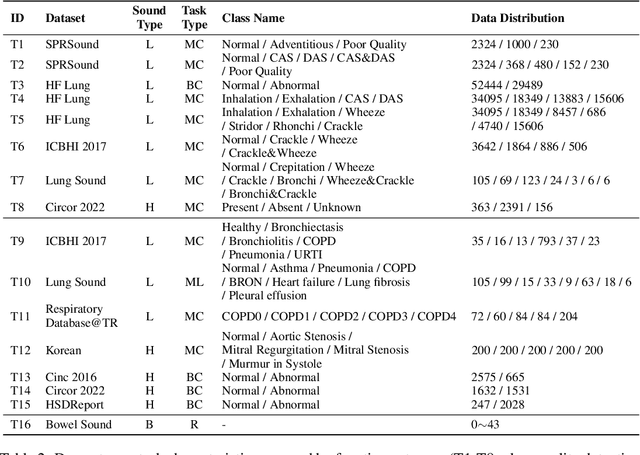
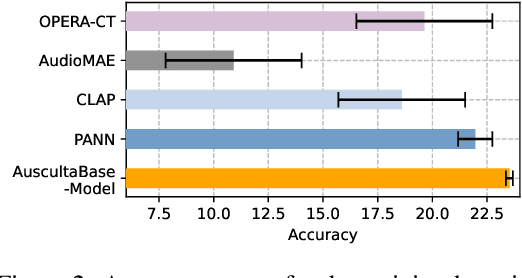
Auscultation of internal body sounds is essential for diagnosing a range of health conditions, yet its effectiveness is often limited by clinicians' expertise and the acoustic constraints of human hearing, restricting its use across various clinical scenarios. To address these challenges, we introduce AuscultaBase, a foundational framework aimed at advancing body sound diagnostics through innovative data integration and contrastive learning techniques. Our contributions include the following: First, we compile AuscultaBase-Corpus, a large-scale, multi-source body sound database encompassing 11 datasets with 40,317 audio recordings and totaling 322.4 hours of heart, lung, and bowel sounds. Second, we develop AuscultaBase-Model, a foundational diagnostic model for body sounds, utilizing contrastive learning on the compiled corpus. Third, we establish AuscultaBase-Bench, a comprehensive benchmark containing 16 sub-tasks, assessing the performance of various open-source acoustic pre-trained models. Evaluation results indicate that our model outperforms all other open-source models in 12 out of 16 tasks, demonstrating the efficacy of our approach in advancing diagnostic capabilities for body sound analysis.
Selecting Between BERT and GPT for Text Classification in Political Science Research
Nov 07, 2024

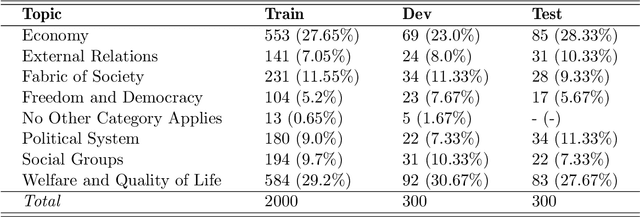
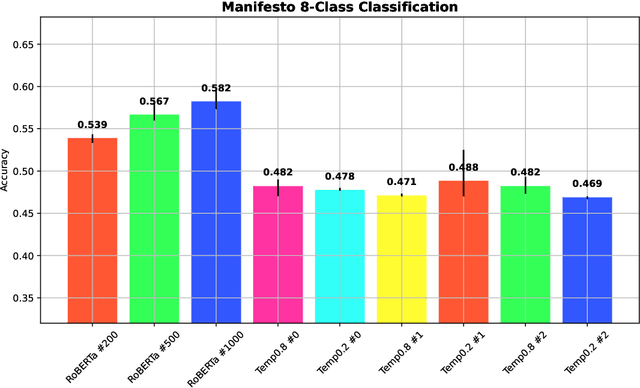
Political scientists often grapple with data scarcity in text classification. Recently, fine-tuned BERT models and their variants have gained traction as effective solutions to address this issue. In this study, we investigate the potential of GPT-based models combined with prompt engineering as a viable alternative. We conduct a series of experiments across various classification tasks, differing in the number of classes and complexity, to evaluate the effectiveness of BERT-based versus GPT-based models in low-data scenarios. Our findings indicate that while zero-shot and few-shot learning with GPT models provide reasonable performance and are well-suited for early-stage research exploration, they generally fall short - or, at best, match - the performance of BERT fine-tuning, particularly as the training set reaches a substantial size (e.g., 1,000 samples). We conclude by comparing these approaches in terms of performance, ease of use, and cost, providing practical guidance for researchers facing data limitations. Our results are particularly relevant for those engaged in quantitative text analysis in low-resource settings or with limited labeled data.