 Add to Chrome
 Add to Firefox
 Add to Edge
From Empathy to Personalized Empathy: Adapting Empathetic Strategies to Individual Users
May 30, 2026
As Large Language Models (LLMs) are increasingly deployed in long-term interactions with users, empathy has become an increasingly important capability. However, existing research overlooks the influence of users' personality traits on empathetic strategies during long-term interactions. To address this gap, we introduce the task of personalized empathy, which focuses on adapting empathetic strategies according to users' personalized characteristics derived from history. To study and enhance this capability, we construct PersonaEmp, a personalized empathy dataset built from long-term user-AI interactions, featuring rich user histories, persona information, and empathy-seeking queries. We further propose PereGRM, a reward modeling framework that combines the empathy evaluation structure with dynamic evaluation criteria generation for fine-grained reward modeling. Experimental results across different settings and multiple judge models show that PereGRM consistently achieves the strongest performance improvements, indicating its effectiveness for enhancing personalized empathetic capabilities.

Predicting Solar Flares Using CNN and LSTM on Two Solar Cycles of Active Region Data
Apr 07, 2022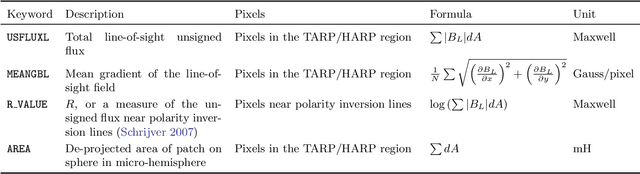
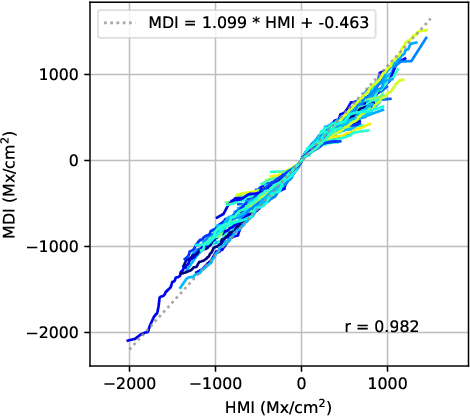
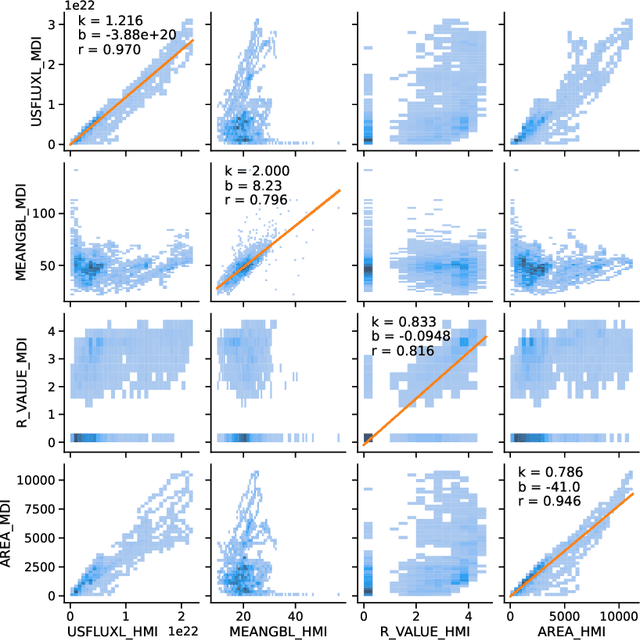
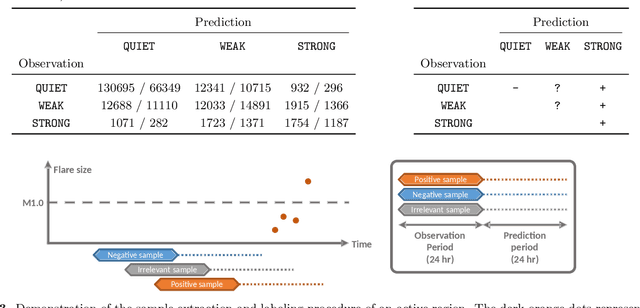
We consider the flare prediction problem that distinguishes flare-imminent active regions that produce an M- or X-class flare in the future 24 hours, from quiet active regions that do not produce any flare within $\pm 24$ hours. Using line-of-sight magnetograms and parameters of active regions in two data products covering Solar Cycle 23 and 24, we train and evaluate two deep learning algorithms -- CNN and LSTM -- and their stacking ensembles. The decisions of CNN are explained using visual attribution methods. We have the following three main findings. (1) LSTM trained on data from two solar cycles achieves significantly higher True Skill Scores (TSS) than that trained on data from a single solar cycle with a confidence level of at least 0.95. (2) On data from Solar Cycle 23, a stacking ensemble that combines predictions from LSTM and CNN using the TSS criterion achieves significantly higher TSS than the "select-best" strategy with a confidence level of at least 0.95. (3) A visual attribution method called Integrated Gradients is able to attribute the CNN's predictions of flares to the emerging magnetic flux in the active region. It also reveals a limitation of CNN as a flare prediction method using line-of-sight magnetograms: it treats the polarity artifact of line-of-sight magnetograms as positive evidence of flares.
Interpreting LSTM Prediction on Solar Flare Eruption with Time-series Clustering
Dec 27, 2019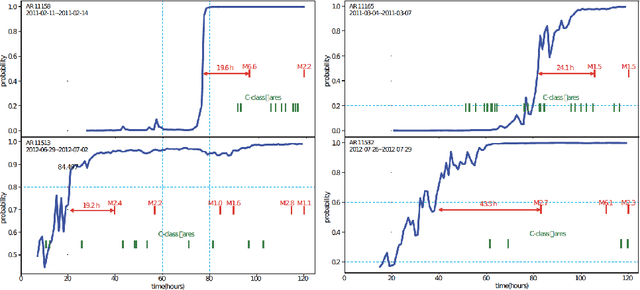

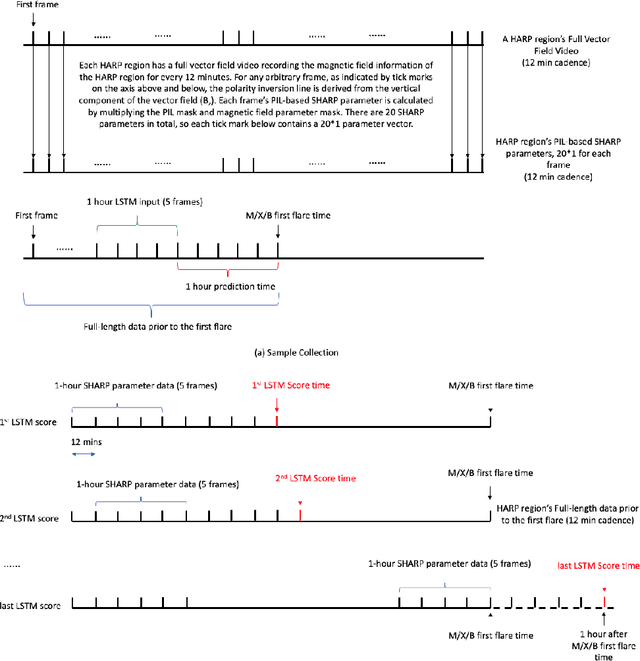
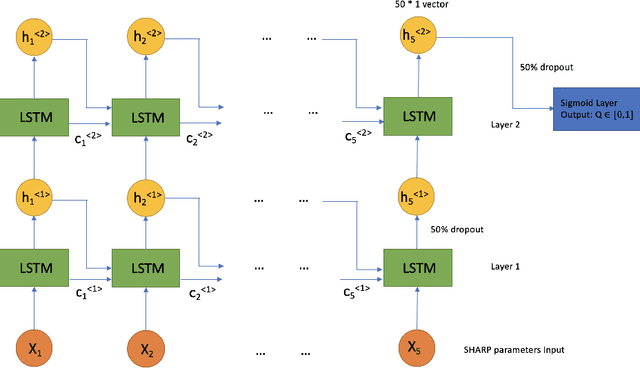
We conduct a post hoc analysis of solar flare predictions made by a Long Short Term Memory (LSTM) model employing data in the form of Space-weather HMI Active Region Patches (SHARP) parameters. These data are distinguished in that the parameters are calculated from data in proximity to the magnetic polarity inversion line where the flares originate. We train the the LSTM model for binary classification to provide a prediction score for the probability of M/X class flares to occur in next hour. We then develop a dimension-reduction technique to reduce the dimensions of SHARP parameter (LSTM inputs) and demonstrate the different patterns of SHARP parameters corresponding to the transition from low to high prediction score. Our work shows that a subset of SHARP parameters contain the key signals that strong solar flare eruptions are imminent. The dynamics of these parameters have a highly uniform trajectory for many events whose LSTM prediction scores for M/X class flares transition from very low to very high. The results suggest that there exist a few threshold values of a subset of SHARP parameters when surpassed could indicate a high probability of strong flare eruption. Our method has distilled the knowledge of solar flare eruption learnt by deep learning model and provides a more interpretable approximation where more physics related insights could be derived.